Let the values of λ$\lambda$ for which the shortest distance between the lines
(x - 1)/(2) = (y - 2)/(3) = (z - 3)/(4) (x - λ)/(3) = (y - 4)/(4) = (z - 5)/(5)$$\frac{x - 1}{2} = \frac{y - 2}{3} = \frac{z - 3}{4}\quad\text{and}\quad\frac{x - \lambda}{3} = \frac{y - 4}{4} = \frac{z - 5}{5}$$
is 1√(6)$\frac{1}{\sqrt{6}}$ be λ₁$\lambda_{1}$ and λ₂$\lambda_{2}$. Then the radius of the circle passing through the points (0, 0)$(0, 0)$, (λ₁, λ₂)$(\lambda_{1}, \lambda_{2})$ and (λ₂, λ₁)$(\lambda_{2}, \lambda_{1})$ is
A.5 √(2)3$\frac{5 \sqrt{2}}{3}$
B.4$4$
C.√(2)3$\frac{\sqrt{2}}{3}$
D.3$3$
Solution & Explanation
Related Formula
Shortest Distance = | AB · ( p × q)| p × q| |$$\text{Shortest Distance} = \left| \frac{\vec{AB} \cdot (\vec{p} \times \vec{q})}{|\vec{p} \times \vec{q}|} \right|$$
Core Logic
Identify points A(1, 2, 3)$A(1, 2, 3)$ and B(λ, 4, 5)$B(\lambda, 4, 5)$ on the lines with directions p = 2 i + 3 j + 4 k$\vec{p} = 2\hat{i} + 3\hat{j} + 4\hat{k}$ and q = 3 i + 4 j + 5 k$\vec{q} = 3\hat{i} + 4\hat{j} + 5\hat{k}$ respectively. Use the shortest distance formula to determine λ₁$\lambda_1$ and λ₂$\lambda_2$.
Step 1: Calculate Cross Product and Direction Vector
Shortest distance values create symmetric configurations. When finding a circle passing through (0,0)$(0,0)$, (x,y)$(x,y)$, and (y,x)$(y,x)$, the symmetry about y=x$y=x$ simplifies radius calculations immediately.
Chapter Mix
Class 12 Mathematics: Three Dimensional Geometry
Class 11 Mathematics: Circles
Keywords:#shortest distance between lines#JEE Main 2025 Evening Q51#Three Dimensional Geometry JEE Main#Radius of circle from lambda parameters
More Three Dimensional Geometry Previous-Year Questions — Page 8
Q56jee_main_2025_04_april_morningShortest Distance Between Two Lines
Let the shortest distance between the lines (x - 3)/(3) = (y - α)/(-1) = (z - 3)/(1)$\frac{x - 3}{3} = \frac{y - \alpha}{-1} = \frac{z - 3}{1}$ and (x + 3)/(-3) = (y + 7)/(2) = (z - β)/(4)$\frac{x + 3}{-3} = \frac{y + 7}{2} = \frac{z - \beta}{4}$ be 3√(30)$3\sqrt{30}$. Then the positive value of 5α + β$5\alpha + \beta$ is
A. 42
B. 46
C. 48
D. 40
Solution
Related Formula
Shortest distance between lines passing through a₁, a₂$\vec{a}_1, \vec{a}_2$ with directions p, q$\vec{p}, \vec{q}$:
d = |( a₂ - a₁) · ( p × q)|| p × q|$$d = \frac{|(\vec{a}_2 - \vec{a}_1) \cdot (\vec{p} \times \vec{q})|}{|\vec{p} \times \vec{q}|}$$
Core Logic
Identify parameters:
A = (3, α, 3)$A = (3, \alpha, 3)$ and B = (-3, -7, β) BA = 6 i + (α + 7) j + (3 - β) k$B = (-3, -7, \beta) \implies \overrightarrow{BA} = 6\hat{i} + (\alpha + 7)\hat{j} + (3 - \beta)\hat{k}$.
Directions: p = 3 i - j + k$\vec{p} = 3\hat{i} - \hat{j} + \hat{k}$ and \ \vec{q} = -3\hat{i} + 2\hat{j} + 4\hat{k}.
Notice that the determinant logic perfectly structures linear equations. Simplifying the dot product using standard scaling helps prevent sign errors.
Chapter Mix
Class 12 Mathematics: Three Dimensional Geometry
Q64jee_main_2025_07_april_eveningLines in 3D Space
If the equation of the line passing through the point (0, -(1)/(2), 0)$\left(0, -\frac{1}{2}, 0\right)$ and perpendicular to the lines r = λ ( i + a j + b k)$\vec {\mathrm {r}} = \lambda (\hat {\mathrm {i}} + \mathrm {a} \hat {\mathrm {j}} + \mathrm {b} \hat {\mathrm {k}})$ and r = ( i - j - 6 k) + μ (- b i + a j + 5 k)$\vec {\mathrm {r}} = \left(\hat {\mathrm {i}} - \hat {\mathrm {j}} - 6 \hat {\mathrm {k}}\right) + \mu \left(- b \hat {\mathrm {i}} + a \hat {\mathrm {j}} + 5 \hat {\mathrm {k}}\right)$ is x - 1-2 = y + 4d = z - c-4$\frac{\mathrm{x} - 1}{-2} = \frac{\mathrm{y} + 4}{\mathrm{d}} = \frac{\mathrm{z} - \mathrm{c}}{-4}$ then a +b + c + d$+\mathrm{b} + \mathrm{c} + \mathrm{d}$ is equal to:
A.10$10$
B.14$14$
C.13$13$
D.12$12$
Solution
Related Formula
The direction vector of a line perpendicular to two given lines with direction vectors v₁$\vec{v}_1$ and \vec{v}_2 is determined by their cross product:
v = v₁ × v₂$$\vec{v} = \vec{v}_1 \times \vec{v}_2$$
Core Logic
The given point (0, -(1)/(2), 0)$\left(0, -\frac{1}{2}, 0\right)$ lies on the required line:
From the first and third components of equation (i):
(5a - ab)/(-2) = (a + ab)/(-4) 2(5a - ab) = a + ab$$\frac{5a - ab}{-2} = \frac{a + ab}{-4} \implies 2(5a - ab) = a + ab$$10a - 2ab = a + ab 9a = 3ab b = 3$$10a - 2ab = a + ab \implies 9a = 3ab \implies b = 3$$
Now use the second component ratio with b = 3$b = 3$ and d = 7$d = 7$:
(-(3² + 5))/(7) = (a + a(3))/(-4) (-14)/(7) = (4a)/(-4) -2 = -a a = 2$$\frac{-(3^2 + 5)}{7} = \frac{a + a(3)}{-4} \implies \frac{-14}{7} = \frac{4a}{-4} \implies -2 = -a \implies a = 2$$
Step 3: Sum the Variables
Summing up a, b, c, d$a, b, c, d$:
a + b + c + d = 2 + 3 + 2 + 7 = 14$$a + b + c + d = 2 + 3 + 2 + 7 = 14$$
Pattern Recognition
Substituting known point values into symmetric equations immediately determines structural values like c$c$ and d$d$ before running cross product systems.
Chapter Mix
Class 12 Mathematics: Three Dimensional Geometry
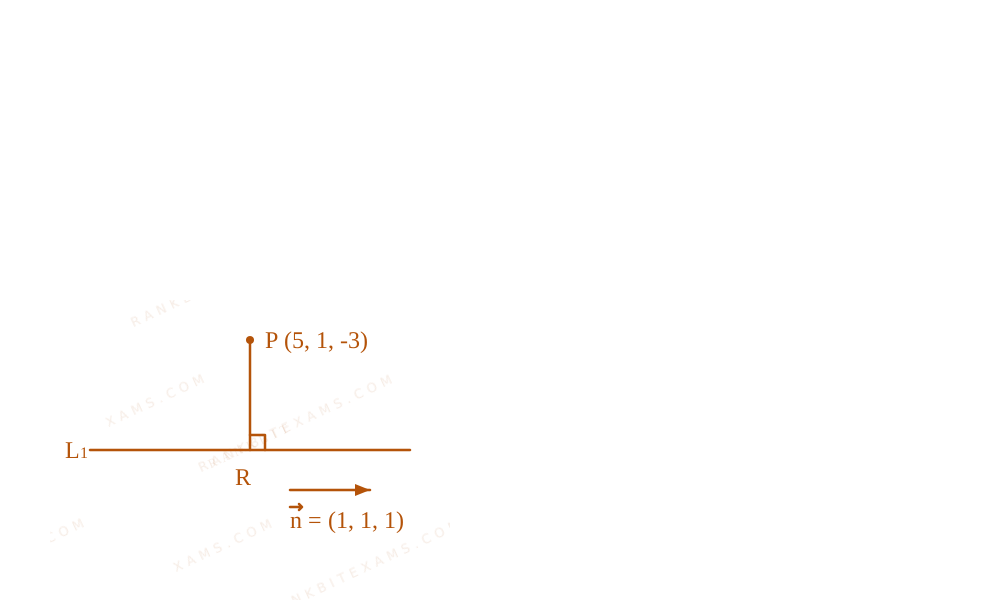
Q66jee_main_2025_07_april_eveningFoot of Perpendicular and Area
Consider the lines L₁: x - 1 = y - 2 = z$\mathrm{L}_1: \mathrm{x} - 1 = \mathrm{y} - 2 = \mathrm{z}$ and L₂: x - 2 = y = z - 1$\mathrm{L}_2: \mathrm{x} - 2 = \mathrm{y} = \mathrm{z} - 1$. Let the feet of the perpendiculars from the point P(5,1,-3)$\mathrm{P}(5,1,-3)$ on the lines L₁$\mathrm{L}_1$ and L₂$\mathrm{L}_2$ be Q$\mathrm{Q}$ and R$\mathrm{R}$ respectively. If the area of the triangle PQR is A$\mathrm{A}$, then 4A²$4\mathrm{A}^2$ is equal to:
A.139$139$
B.147$147$
C.151$151$
D.143$143$
Solution
Related Formula
The vector area of a triangle given two adjacent position vectors u$\vec{u}$ and v$\vec{v}$ is calculated as:
Area = (1)/(2) | u × v|$$\text{Area} = \frac{1}{2} |\vec{u} \times \vec{v}|$$
Core Logic
For line L₁$L_1$: (x-1)/(1) = (y-2)/(1) = (z-0)/(1)$\frac{x-1}{1} = \frac{y-2}{1} = \frac{z-0}{1}$. Let a general point be Q(λ+1, λ+2, λ)$Q(\lambda+1, \lambda+2, \lambda)$.
Foot of Perpendicular and Area diagram for Q66 - JEE Main 2025 Evening
Step 1: Compute Foot R
For line L₂$L_2$: (x-2)/(1) = (y)/(1) = (z-1)/(1)$\frac{x-2}{1} = \frac{y}{1} = \frac{z-1}{1}$. Let a general point be R(μ+2, μ, μ+1)$R(\mu+2, \mu, \mu+1)$.
Setting up dot products systematically with general parametric forms quickly locks in spatial feet indices without complex geometric drawings.
Chapter Mix
Class 12 Mathematics: Three Dimensional Geometry
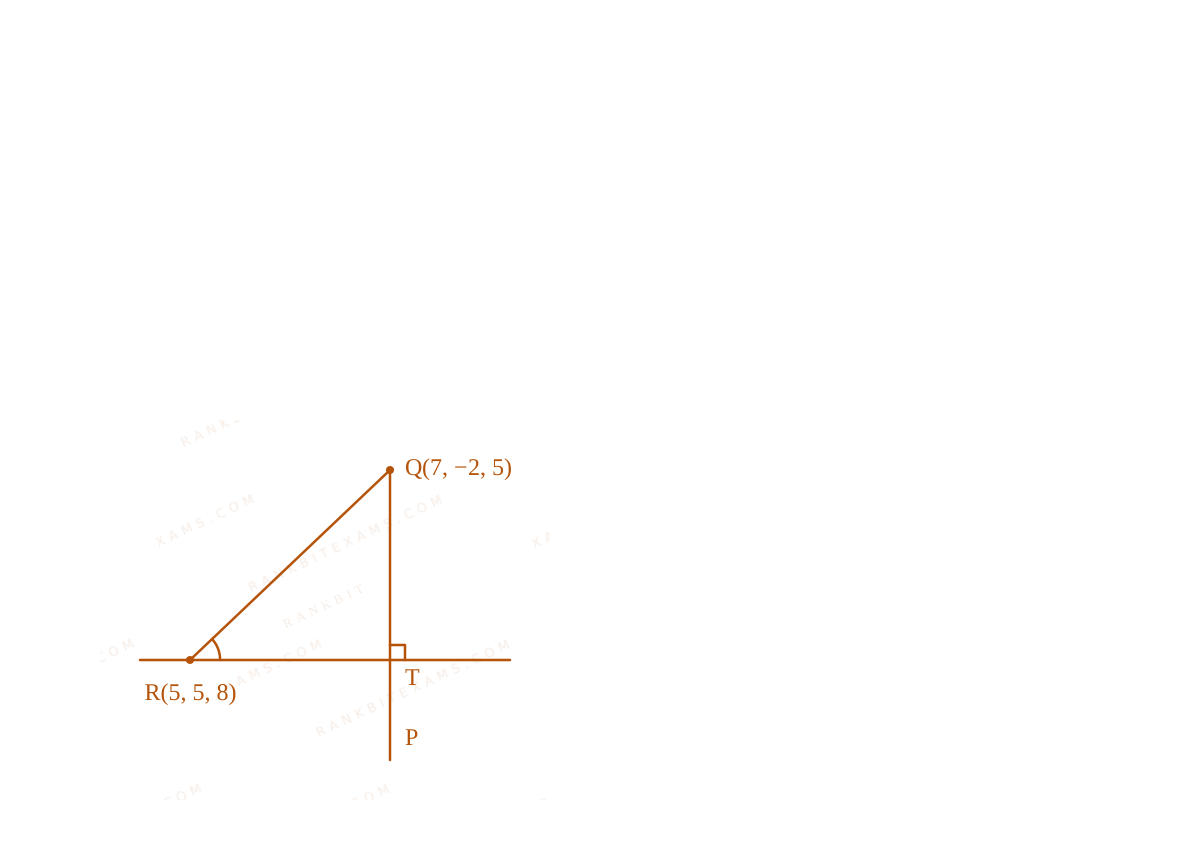
Q72jee_main_2025_24_jan_eveningImage of a Point and Area of Triangle
Let P be the image of the point Q(7,-2,5)$Q(7,-2,5)$ in the line L: (x-1)/(2)=(y+1)/(3)=(z)/(4)$\frac{x-1}{2}=\frac{y+1}{3}=\frac{z}{4}$ and R(5,p,q)$R(5,p,q)$ be a point on L. Then the square of the area of PQR$\triangle PQR$ is \_\_\_\_.
Numerical Answer.Answer: 957
Solution
Related Formula
Area of a $\triangle$ with perpendicular height h$h$ and base b$b$:
Area = (1)/(2) × b × h$$\text{Area} = \frac{1}{2} \times b \times h$$
Since P$P$ is the reflection image of Q$Q$ across line L$L$, the line acts as a perpendicular bisector. For any point R$R$ lying on the line, the height from R$R$ to the line is RT$RT$, and the base QP = 2QT$QP = 2QT$.
Core Logic
Determine parameters for point R$R$ lying directly on line L:
Because the image geometry creates an isosceles pairing from any point on the mirror line to the object and image point, the area reduces beautifully to 2 × Area( QTR) = QT × RT$2 \times \text{Area}(\triangle QTR) = QT \times RT$.
Chapter Mix
Class 12 Mathematics: Three Dimensional Geometry

Q58jee_main_2025_24_jan_morningArea of a Triangle in 3D Space
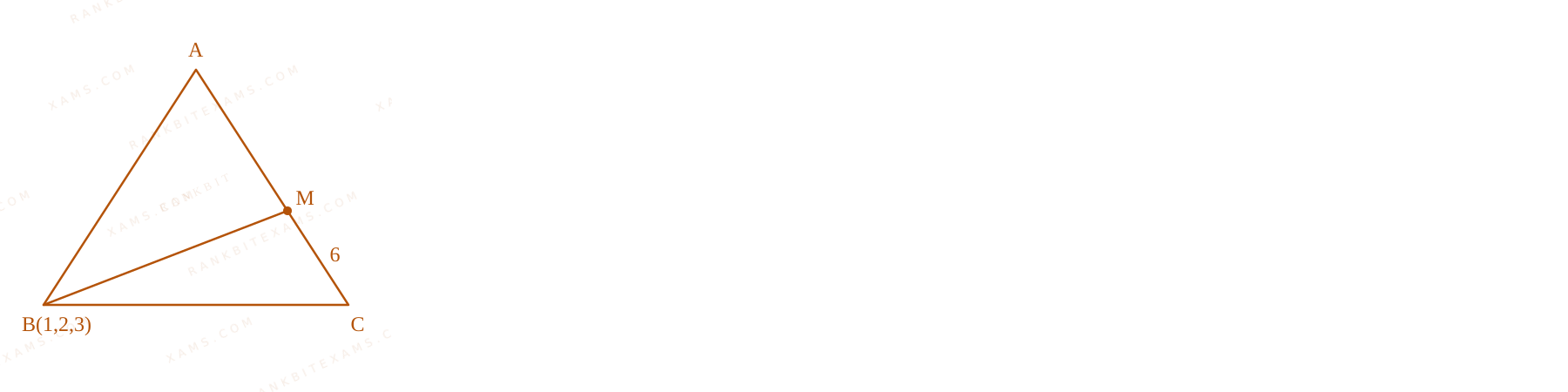
Let in a Δ ABC$\Delta ABC$ , the length of the side AC$AC$ be 6$6$, the vertex B$B$ be (1, 2, 3)$(1, 2, 3)$ and the vertices A, C$A, C$ lie on the line (x - 6)/(3) = (y - 7)/(2) = (z - 7)/(-2)$\frac{x - 6}{3} = \frac{y - 7}{2} = \frac{z - 7}{-2}$ . Then the area (in sq. units) of Δ ABC$\Delta ABC$ is :
A.42$42$
B.21$21$
C.56$56$
D.17$17$
Solution
Related Formula
The area of a triangle given base length b$b$ and altitude perpendicular height h$h$ is evaluated as:
Area = (1)/(2) · b · h$$\text{Area} = \frac{1}{2} \cdot b \cdot h$$
Core Logic
The base side AC$AC$ lies entirely along the line equation. Let M$M$ be the foot of the perpendicular dropped from vertex B(1,2,3)$B(1,2,3)$ to the line segment AC$AC$:
Area of a Triangle in 3D Space diagram for Q58 - JEE Main 2025 Morning
Any coordinate point on the line can be represented parametrically by setting the line fractions equal to λ$\lambda$:
Since BM$BM$ is perpendicular to the base line segment direction vector v = 3 i + 2 j - 2 k$\vec{v} = 3\hat{\mathbf{i}} + 2\hat{\mathbf{j}} - 2\hat{\mathbf{k}}$, their dot product must equal zero:
Instead of determining the absolute coordinates for individual triangle vertices A$A$ and C$C$, treating the problem via altitude minimization relative to the given parametric vector direction saves substantial calculation steps.
Chapter Mix
Class 12 Mathematics: Three Dimensional Geometry
More Three Dimensional Geometry Questions — jee_main_2025_08_april_evening
Practice past-year questions one chapter at a time. Pick an exam → subject → chapter and get every PYQ for that topic — pulled together from all past papers — with the chapter's key formulas alongside.