Related Formula
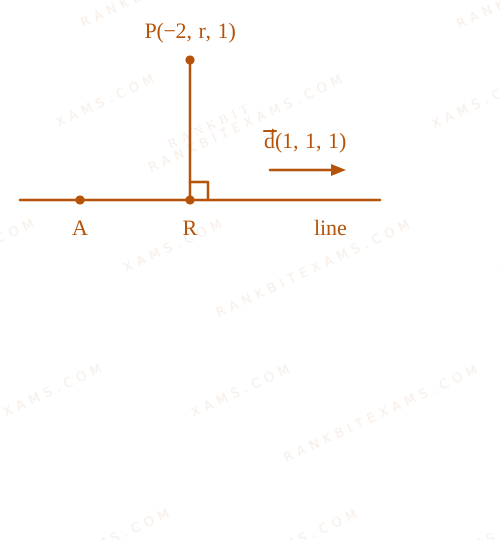
Shortest distance between two skew lines r = a₁ + λ b₁ and r = a₂ + μ b₂ is d = | ( a₂ - a₁) · ( b₁ × b₂)| b₁ × b₂| |$$\text{Shortest distance between two skew lines } \vec{r} = \vec{a_1} + \lambda\vec{b_1} \text{ and } \vec{r} = \vec{a_2} + \mu\vec{b_2} \text{ is } d = \left| \frac{(\vec{a_2} - \vec{a_1}) \cdot (\vec{b_1} \times \vec{b_2})}{|\vec{b_1} \times \vec{b_2}|} \right|$$
Core Logic
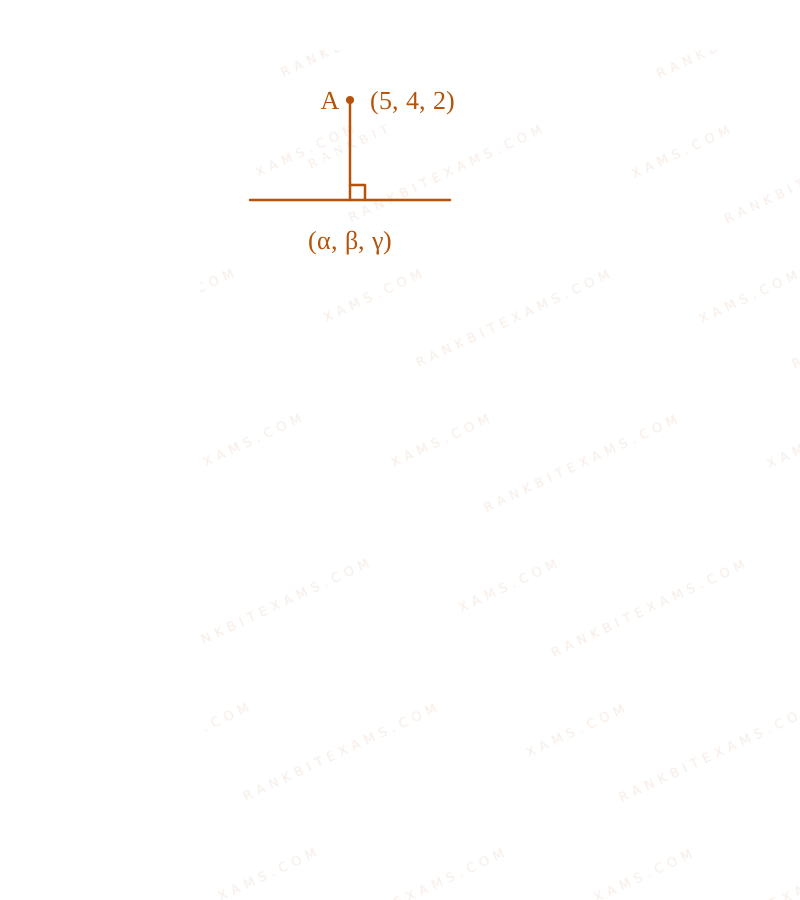
Let any point on the first line (x - 1)/(2) = (y + 1)/(-3) = (z)/(1) = λ$\frac{x - 1}{2} = \frac{y + 1}{-3} = \frac{z}{1} = \lambda$ be given by P(2λ + 1, -3λ - 1, λ)$P(2\lambda + 1, -3\lambda - 1, \lambda)$.
The distance of P$P$ from the point A(1, -1, 0)$A(1, -1, 0)$ is 4√(14)$4\sqrt{14}$.
(2λ + 1 - 1)² + (-3λ - 1 + 1)² + (λ - 0)² = (4√(14))²$$(2\lambda + 1 - 1)^2 + (-3\lambda - 1 + 1)^2 + (\lambda - 0)^2 = (4\sqrt{14})^2$$
4λ² + 9λ² + λ² = 16 × 14$$4\lambda^2 + 9\lambda^2 + \lambda^2 = 16 \times 14$$
14λ² = 224 λ² = 16 λ = ± 4$$14\lambda^2 = 224 \implies \lambda^2 = 16 \implies \lambda = \pm 4$$
Step 1: Finding Point P
For λ = 4$\lambda = 4$, point is P₁(9, -13, 4)$P_1(9, -13, 4)$. Distance from origin: √(81 + 169 + 16) = √(266)$\sqrt{81 + 169 + 16} = \sqrt{266}$
For λ = -4$\lambda = -4$, point is P₂(-7, 11, -4)$P_2(-7, 11, -4)$. Distance from origin: √(49 + 121 + 16) = √(186)$\sqrt{49 + 121 + 16} = \sqrt{186}$
Since P$P$ is nearer to the origin, we choose λ = -4$\lambda = -4$.
Therefore, P(α, β, γ) = (-7, 11, -4)$P(\alpha, \beta, \gamma) = (-7, 11, -4)$.
We need the shortest distance between Line 1: (x + 7)/(1) = (y - 11)/(2) = (z + 4)/(3)$\frac{x + 7}{1} = \frac{y - 11}{2} = \frac{z + 4}{3}$ and Line 2: (x + 5)/(2) = (y - 10)/(1) = (z - 3)/(1)$\frac{x + 5}{2} = \frac{y - 10}{1} = \frac{z - 3}{1}$.
Here, a₁ = -7 i + 11 j - 4 k$\vec{a_1} = -7\hat{i} + 11\hat{j} - 4\hat{k}$ and b₁ = i + 2 j + 3 k$\vec{b_1} = \hat{i} + 2\hat{j} + 3\hat{k}$.
a₂ = -5 i + 10 j + 3 k$\vec{a_2} = -5\hat{i} + 10\hat{j} + 3\hat{k}$ and b₂ = 2 i + j + k$\vec{b_2} = 2\hat{i} + \hat{j} + \hat{k}$.
( a₂ - a₁) = 2 i - j + 7 k$$(\vec{a_2} - \vec{a_1}) = 2\hat{i} - \hat{j} + 7\hat{k}$$
Shortest distance d$d$ is given by the determinant form:
d = | matrix 2 & -1 & 7 1 & 2 & 3 2 & 1 & 1 matrix || b₁ × b₂|$$d = \frac{\left| \begin{matrix} 2 & -1 & 7 \\ 1 & 2 & 3 \\ 2 & 1 & 1 \end{matrix} \right|}{|\vec{b_1} \times \vec{b_2}|}$$
Evaluate the determinant:
= 2(2 - 3) - (-1)(1 - 6) + 7(1 - 4) = 2(-1) + 1(-5) + 7(-3) = -2 - 5 - 21 = -28$$= 2(2 - 3) - (-1)(1 - 6) + 7(1 - 4) = 2(-1) + 1(-5) + 7(-3) = -2 - 5 - 21 = -28$$
Now find | b₁ × b₂| = | matrix i & j & k 1 & 2 & 3 2 & 1 & 1 matrix | = i(2-3) - j(1-6) + k(1-4) = - i + 5 j - 3 k$|\vec{b_1} \times \vec{b_2}| = \left| \begin{matrix} \hat{i} & \hat{j} & \hat{k} \\ 1 & 2 & 3 \\ 2 & 1 & 1 \end{matrix} \right| = \hat{i}(2-3) - \hat{j}(1-6) + \hat{k}(1-4) = -\hat{i} + 5\hat{j} - 3\hat{k}$
Magnitude is √((-1)² + 5² + (-3)²) = √(1 + 25 + 9) = √(35)$\sqrt{(-1)^2 + 5^2 + (-3)^2} = \sqrt{1 + 25 + 9} = \sqrt{35}$.
d = |-28|√(35) = 28√(35) = 4 × 7√(5 × 7) = 4√(7)√(5) = 4√((7)/(5))$$d = \frac{|-28|}{\sqrt{35}} = \frac{28}{\sqrt{35}} = \frac{4 \times 7}{\sqrt{5 \times 7}} = \frac{4\sqrt{7}}{\sqrt{5}} = 4\sqrt{\frac{7}{5}}$$
Pattern Recognition
To find points on a line at a given distance from a fixed point on the line itself, the algebraic distance parameter λ$\lambda$ translates to d² = λ²(a²+b²+c²)$d^2 = \lambda^2(a^2+b^2+c^2)$, meaning 14λ²$14\lambda^2$ equates instantly to the squared given distance. Bypasses the complex distance formula.
Chapter Mix
Class 12 Maths: Three Dimensional Geometry