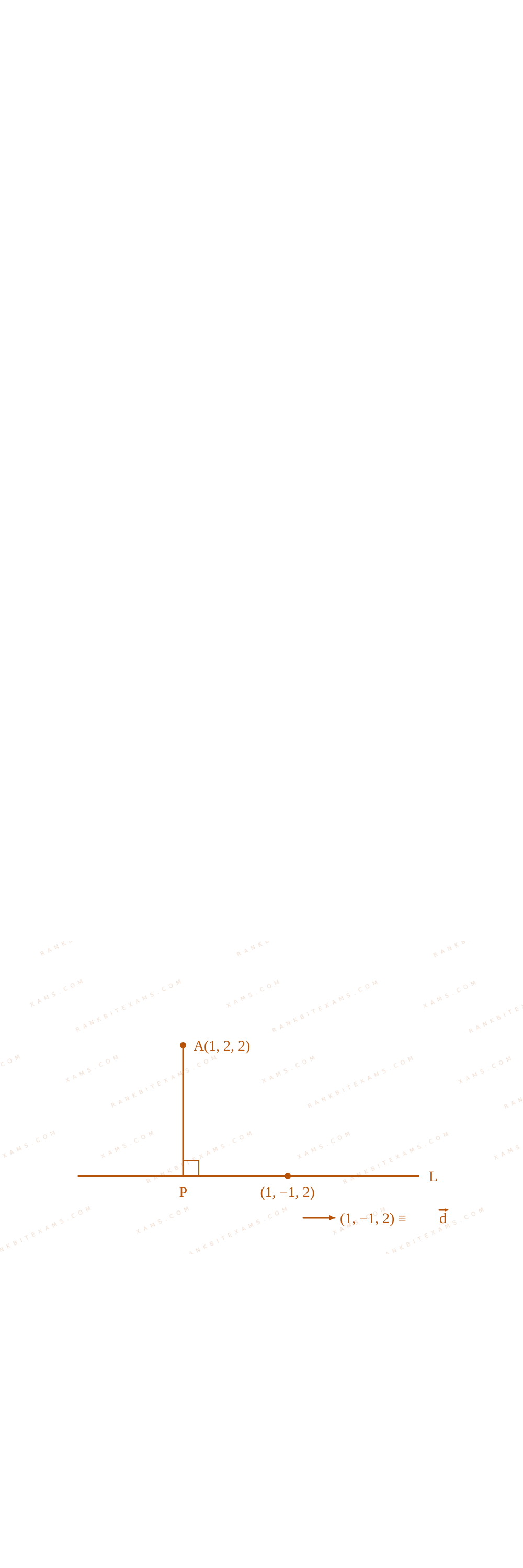
Let P$\mathbf{P}$ be the foot of the perpendicular from the point (1,2,2)$(1,2,2)$ on the line L: x - 11 = y + 1-1 = z - 22$\mathrm{L}:\frac{\mathrm{x} - 1}{1} = \frac{\mathrm{y} + 1}{-1} = \frac{\mathrm{z} - 2}{2}$. Let the line r = (- i + j -2 k) + λ ( i - j + k)$\vec{\mathrm{r}} = (-\hat{\mathrm{i}} +\hat{\mathrm{j}} -2\hat{\mathrm{k}}) + \lambda (\hat{\mathrm{i}} -\hat{\mathrm{j}} +\hat{\mathrm{k}})$, λ in R$\lambda \in \mathbb{R}$, intersect the line L$\mathrm{L}$ at Q. Then 2(PQ)²$2(\mathrm{PQ})^2$ is equal to:
A.27$27$
B.25$25$
C.29$29$
D.19$19$
Solution & Explanation
Related Formula
Dot product of vector projection matching orthogonal axes equals zero:
AP · d = 0$$\vec{AP} \cdot \vec{d} = 0$$
Core Logic
Let the target source coordinates tracking point match A(1, 2, 2)$A(1, 2, 2)$. General parameter points on line L$L$ are defined by parameter μ$\mu$:
Keywords:#foot of the perpendicular distance line#JEE Main 2025 Evening Q63#Three Dimensional Geometry JEE Main 2025#Shortest Distance and Intersection of Lines JEE Main 2025
More Three Dimensional Geometry Previous-Year Questions
Q14jee_main_2026_21_jan_morningFoot of Perpendicular and Projection
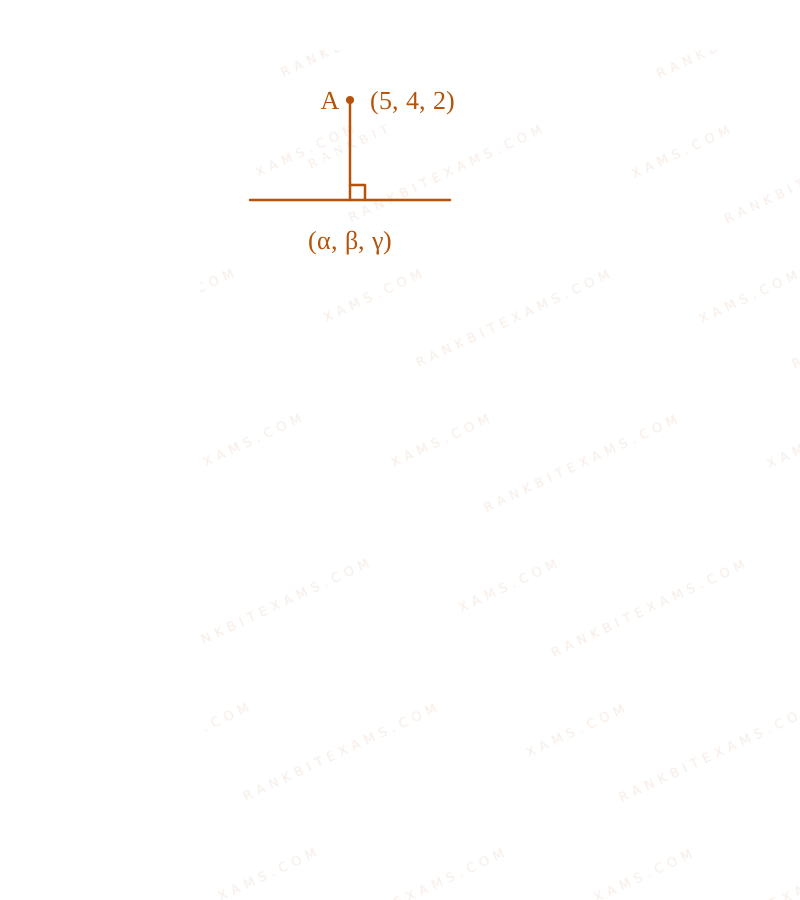
Let (α, β, γ)$(\alpha, \beta, \gamma)$ be the co-ordinates of the foot of the perpendicular drawn from the point (5, 4, 2) on the line r = (- i + 3 j + k) + λ(2 i + 3 j - k)$\vec{r} = (-\hat{i} + 3\hat{j} + \hat{k}) + \lambda(2\hat{i} + 3\hat{j} - \hat{k})$ .
Then the length of the projection of the vector α i+β j+γ k$\alpha\hat{i}+\beta\hat{j}+\gamma\hat{k}$ on the vector 6 i+2 j+3 k$6\hat{i}+2\hat{j}+3\hat{k}$ is :
A.(15)/(7)$\frac{15}{7}$
B. 4
C.(18)/(7)$\frac{18}{7}$
D. 3
Solution
### Related Formula
Length of projection of u on w = | u · w|| w|$$\text{Length of projection of } \vec{u} \text{ on } \vec{w} = \frac{|\vec{u} \cdot \vec{w}|}{|\vec{w}|}$$
### Core Logic
Given point A(5, 4, 2)$A(5, 4, 2)$ and line (L)$(L)$:
r = (- i + 3 j + k) + λ(2 i + 3 j - k)$$\vec{r} = (-\hat{i} + 3\hat{j} + \hat{k}) + \lambda(2\hat{i} + 3\hat{j} - \hat{k})$$
Any general point P$P$ on this line has coordinates:
(-1 + 2λ, 3 + 3λ, 1 - λ)$(-1 + 2\lambda, 3 + 3\lambda, 1 - \lambda)$
### Step 1: Finding the foot of the perpendicular
Vector AP = P - A = (-1 + 2λ - 5) i + (3 + 3λ - 4) j + (1 - λ - 2) k$\vec{AP} = P - A = (-1 + 2\lambda - 5)\hat{i} + (3 + 3\lambda - 4)\hat{j} + (1 - \lambda - 2)\hat{k}$AP = (2λ - 6) i + (3λ - 1) j + (-λ - 1) k$$\vec{AP} = (2\lambda - 6)\hat{i} + (3\lambda - 1)\hat{j} + (-\lambda - 1)\hat{k}$$
Since AP$AP$ is perpendicular to line (L)$(L)$, the dot product of AP$\vec{AP}$ with the direction vector of the line (2 i + 3 j - k)$(2\hat{i} + 3\hat{j} - \hat{k})$ must be zero:
AP · (2 i + 3 j - k) = 0$$\vec{AP} \cdot (2\hat{i} + 3\hat{j} - \hat{k}) = 0$$2(2λ - 6) + 3(3λ - 1) - 1(-λ - 1) = 0$$2(2\lambda - 6) + 3(3\lambda - 1) - 1(-\lambda - 1) = 0$$4λ - 12 + 9λ - 3 + λ + 1 = 0$$4\lambda - 12 + 9\lambda - 3 + \lambda + 1 = 0$$14λ - 14 = 0 ⇒ λ = 1$$14\lambda - 14 = 0 \Rightarrow \lambda = 1$$Foot of perpendicular 3D diagram for Q14 - JEE Main 2026 Morning
### Step 2: Coordinates of the foot
Substitute λ = 1$\lambda = 1$ into general point P$P$ to get (α, β, γ)$(\alpha, \beta, \gamma)$:
α = -1 + 2(1) = 1$\alpha = -1 + 2(1) = 1$β = 3 + 3(1) = 6$\beta = 3 + 3(1) = 6$γ = 1 - 1 = 0$\gamma = 1 - 1 = 0$
Foot of perpendicular is (1, 6, 0)$(1, 6, 0)$.
### Step 3: Calculate the projection
Let u = α i + β j + γ k = i + 6 j + 0 k$\vec{u} = \alpha\hat{i} + \beta\hat{j} + \gamma\hat{k} = \hat{i} + 6\hat{j} + 0\hat{k}$
Let w = 6 i + 2 j + 3 k$\vec{w} = 6\hat{i} + 2\hat{j} + 3\hat{k}$Projection = | u · w|| w| = |1(6) + 6(2) + 0(3)|√(6² + 2² + 3²)$$\text{Projection} = \frac{|\vec{u} \cdot \vec{w}|}{|\vec{w}|} = \frac{|1(6) + 6(2) + 0(3)|}{\sqrt{6^2 + 2^2 + 3^2}}$$= 6 + 12√(36 + 4 + 9) = 18√(49) = (18)/(7)$$= \frac{6 + 12}{\sqrt{36 + 4 + 9}} = \frac{18}{\sqrt{49}} = \frac{18}{7}$$
### Pattern Recognition
Foot of perpendicular problems algorithm: 1) Frame general vector P(λ)$P(\lambda)$. 2) Construct distance vector AP$\vec{AP}$. 3) Dot product with direction vector d = 0$\vec{d} = 0$. 4) Solve for λ$\lambda$.
### Evaluation Rubric / Model Answer
null
### Chapter Mix
Class 12 Maths: Three Dimensional Geometry
Class 12 Maths: Vector Algebra
Q7jee_main_2026_21_jan_eveningLines
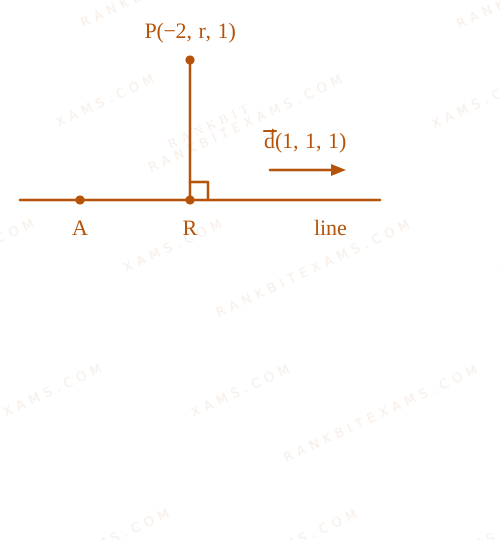
Let the line L$L$ pass through the point (-3, 5, 2)$(-3, 5, 2)$ and make equal angles with the positive coordinate axes. If the distance of L$L$ from the point (-2, r, 1)$(-2, r, 1)$ is √((14)/(3))$\sqrt{\frac{14}{3}}$, then the sum of all possible values of r$r$ is:
A.12$12$
B.16$16$
C.6$6$
D.10$10$
Solution
### Related Formula
Equation of a line: (x - x₁)/(a) = (y - y₁)/(b) = (z - z₁)/(c) = λ$$\text{Equation of a line: } \frac{x - x_1}{a} = \frac{y - y_1}{b} = \frac{z - z_1}{c} = \lambda$$Distance formula: d² = (x₂ - x₁)² + (y₂ - y₁)² + (z₂ - z₁)²$$\text{Distance formula: } d^2 = (x_2 - x_1)^2 + (y_2 - y_1)^2 + (z_2 - z_1)^2$$
### Core Logic
Distance from point to line in 3D diagram for Q7 - JEE Main 2026 Evening
Line L$L$ makes equal angles with the positive axes, so its direction ratios are (1, 1, 1)$(1, 1, 1)$.
Equation of line L$L$ is (x + 3)/(1) = (y - 5)/(1) = (z - 2)/(1) = λ$\frac{x + 3}{1} = \frac{y - 5}{1} = \frac{z - 2}{1} = \lambda$.
A general point R$R$ on the line is (λ - 3, λ + 5, λ + 2)$(\lambda - 3, \lambda + 5, \lambda + 2)$.
Use the perpendicularity condition PR · d = 0$\overrightarrow{PR} \cdot \vec{d} = 0$ to find λ$\lambda$, then substitute back into the distance formula.
### Step 1: Apply Perpendicularity Condition
Let point P = (-2, r, 1)$P = (-2, r, 1)$.
The vector PR = λ - 1, λ + 5 - r, λ + 1$\overrightarrow{PR} = \langle \lambda - 1, \lambda + 5 - r, \lambda + 1 \rangle$.
Since PR · 1, 1, 1 = 0$\overrightarrow{PR} \cdot \langle 1, 1, 1 \rangle = 0$:
(λ - 1)(1) + (λ + 5 - r)(1) + (λ + 1)(1) = 0$$(\lambda - 1)(1) + (\lambda + 5 - r)(1) + (\lambda + 1)(1) = 0$$3λ - r + 5 = 0 λ = (r - 5)/(3)$$3\lambda - r + 5 = 0 \implies \lambda = \frac{r - 5}{3}$$
### Step 2: Calculate Distance
Substitute λ$\lambda$ back into point R$R$:
R ≡ ( (r - 14)/(3), (r + 10)/(3), (r + 1)/(3) )$$R \equiv \left( \frac{r - 14}{3}, \frac{r + 10}{3}, \frac{r + 1}{3} \right)$$
We are given PR = √((14)/(3)) PR² = (14)/(3)$PR = \sqrt{\frac{14}{3}} \implies PR^2 = \frac{14}{3}$.
PR² = ( (r - 14)/(3) + 2 )² + ( (r + 10)/(3) - r )² + ( (r + 1)/(3) - 1 )² = (14)/(3)$PR^2 = \left( \frac{r - 14}{3} + 2 \right)^2 + \left( \frac{r + 10}{3} - r \right)^2 + \left( \frac{r + 1}{3} - 1 \right)^2 = \frac{14}{3}$((r - 8)²)/(9) + ((10 - 2r)²)/(9) + ((r - 2)²)/(9) = (14)/(3)$$\frac{(r - 8)^2}{9} + \frac{(10 - 2r)^2}{9} + \frac{(r - 2)^2}{9} = \frac{14}{3}$$(r² - 16r + 64) + (100 + 4r² - 40r) + (r² - 4r + 4) = 42$$(r^2 - 16r + 64) + (100 + 4r^2 - 40r) + (r^2 - 4r + 4) = 42$$6r² - 60r + 168 = 42 6r² - 60r + 126 = 0$$6r^2 - 60r + 168 = 42 \implies 6r^2 - 60r + 126 = 0$$
Dividing by 6:
r² - 10r + 21 = 0$$r^2 - 10r + 21 = 0$$
### Step 3: Solve for r
(r - 7)(r - 3) = 0 r = 3, 7$$(r - 7)(r - 3) = 0 \implies r = 3, 7$$
The sum of all possible values of r$r$ is 3 + 7 = 10$3 + 7 = 10$.
### Pattern Recognition
When a line makes equal angles with coordinate axes, its direction cosines are (1/√(3), 1/√(3), 1/√(3))$(1/\sqrt{3}, 1/\sqrt{3}, 1/\sqrt{3})$, making its simpler direction ratios (1, 1, 1)$(1, 1, 1)$. Use projection vector methods or direct dot product to find perpendicular foot.
### Evaluation Rubric / Model Answer
null
### Chapter Mix
Class 12 Maths: Three Dimensional Geometry
Q8jee_main_2026_21_jan_eveningShortest Distance
Let the line L₁$L_{1}$ be parallel to the vector -3 i + 2 j + 4 k$-3\hat{i} + 2\hat{j} + 4\hat{k}$ and pass through the point (2, 6, 7) and the line L₂$L_{2}$ be parallel to the vector 2 i + j + 3 k$2\hat{i} + \hat{j} + 3\hat{k}$ and pass through the point (4, 3, 5). If the line L₃$L_{3}$ is parallel to the vector -3 i + 5 j + 16 k$-3\hat{i} + 5\hat{j} + 16\hat{k}$ and intersects the linesL₁$L_{1}$ and L₂$L_{2}$ at the points C and D, respectively, then | CD|²$\left|\overrightarrow{CD}\right|^{2}$ is equal to:
A.171$171$
B.290$290$
C.312$312$
D.89$89$
Solution
### Related Formula
Equation of a line: r = a + λ b$$\text{Equation of a line: } \vec{r} = \vec{a} + \lambda\vec{b}$$| CD|² = (x₂ - x₁)² + (y₂ - y₁)² + (z₂ - z₁)²$$|\overrightarrow{CD}|^2 = (x_2 - x_1)^2 + (y_2 - y_1)^2 + (z_2 - z_1)^2$$
### Core Logic
Write general points on L₁$L_1$ and L₂$L_2$ representing points C$C$ and D$D$. The vector CD$\overrightarrow{CD}$ must be parallel to the given direction vector of L₃$L_3$. This yields proportional equations to solve for the line parameters.
### Step 1: Write Line Equations
Line L₁$L_{1}$: (x-2)/(-3) = (y-6)/(2) = (z-7)/(4) = λ₁$\frac{x-2}{-3} = \frac{y-6}{2} = \frac{z-7}{4} = \lambda_{1}$
Point C$C$ on L₁$L_{1}$: (-3λ₁+2, 2λ₁+6, 4λ₁+7)$(-3\lambda_{1}+2, 2\lambda_{1}+6, 4\lambda_{1}+7)$
Line L₂$L_{2}$: (x-4)/(2) = (y-3)/(1) = (z-5)/(3) = λ₂$\frac{x-4}{2} = \frac{y-3}{1} = \frac{z-5}{3} = \lambda_{2}$
Point D$D$ on L₂$L_{2}$: (2λ₂+4, λ₂+3, 3λ₂+5)$(2\lambda_{2}+4, \lambda_{2}+3, 3\lambda_{2}+5)$
### Step 2: Proportionality of Vector CD
The vector CD = 2λ₂+3λ₁+2, λ₂-2λ₁-3, 3λ₂-4λ₁-2$\overrightarrow{CD} = \langle 2\lambda_{2}+3\lambda_{1}+2, \lambda_{2}-2\lambda_{1}-3, 3\lambda_{2}-4\lambda_{1}-2 \rangle$.
Since L₃$L_3$ is parallel to -3 i + 5 j + 16 k$-3\hat{i} + 5\hat{j} + 16\hat{k}$, the components are proportional:
2λ₂+3λ₁+2-3 = λ₂-2λ₁-35 = 3λ₂-4λ₁-216$$\frac{2\lambda_{2}+3\lambda_{1}+2}{-3} = \frac{\lambda_{2}-2\lambda_{1}-3}{5} = \frac{3\lambda_{2}-4\lambda_{1}-2}{16}$$
### Step 3: Solve for lambda values
From the first two expressions:
5(2λ₂+3λ₁+2) = -3(λ₂-2λ₁-3)$$5(2\lambda_{2}+3\lambda_{1}+2) = -3(\lambda_{2}-2\lambda_{1}-3)$$10λ₂ + 15λ₁ + 10 = -3λ₂ + 6λ₁ + 9$$10\lambda_{2} + 15\lambda_{1} + 10 = -3\lambda_{2} + 6\lambda_{1} + 9$$13λ₂ + 9λ₁ = -1$$13\lambda_{2} + 9\lambda_{1} = -1$$
From the last two expressions:
16(λ₂-2λ₁-3) = 5(3λ₂-4λ₁-2)$$16(\lambda_{2}-2\lambda_{1}-3) = 5(3\lambda_{2}-4\lambda_{1}-2)$$16λ₂ - 32λ₁ - 48 = 15λ₂ - 20λ₁ - 10$$16\lambda_{2} - 32\lambda_{1} - 48 = 15\lambda_{2} - 20\lambda_{1} - 10$$λ₂ - 12λ₁ = 38$$\lambda_{2} - 12\lambda_{1} = 38$$
Substitute λ₂ = 12λ₁ + 38$\lambda_{2} = 12\lambda_{1} + 38$ into the first equation:
13(12λ₁ + 38) + 9λ₁ = -1$$13(12\lambda_{1} + 38) + 9\lambda_{1} = -1$$156λ₁ + 494 + 9λ₁ = -1$$156\lambda_{1} + 494 + 9\lambda_{1} = -1$$165λ₁ = -495 λ₁ = -3$$165\lambda_{1} = -495 \implies \lambda_{1} = -3$$λ₂ = 12(-3) + 38 = 2$$\lambda_{2} = 12(-3) + 38 = 2$$
Coordinates of C$C$: (11, 0, -5)$(11, 0, -5)$
Coordinates of D$D$: (8, 5, 11)$(8, 5, 11)$
### Step 4: Calculate Magnitude squared
| CD|² = (8 - 11)² + (5 - 0)² + (11 - (-5))²$$\left|\overrightarrow{CD}\right|^{2} = (8 - 11)^2 + (5 - 0)^2 + (11 - (-5))^2$$= (-3)² + 5² + 16²$$= (-3)^2 + 5^2 + 16^2$$= 9 + 25 + 256 = 290$$= 9 + 25 + 256 = 290$$
### Pattern Recognition
For intersecting lines via a transversal of known direction, represent intersection points generally using independent parameters λ$\lambda$ and μ$\mu$. The difference vector MUST be proportional to the given direction ratio.
### Evaluation Rubric / Model Answer
null
### Chapter Mix
Class 12 Maths: Three Dimensional Geometry
Class 12 Maths: Vector Algebra
Q6jee_main_2026_22_january_morningShortest Distance Between Two Lines
Let P(α, β, γ)$P(\alpha, \beta, \gamma)$ be the point on the line (x - 1)/(2) = (y + 1)/(-3) = z$\frac{x - 1}{2} = \frac{y + 1}{-3} = z$ at a distance 4√(14)$4\sqrt{14}$ from the point (1, -1, 0)$(1, -1, 0)$ and nearer to the origin. Then the shortest distance, between the lines (x - α)/(1) = (y - β)/(2) = (z - γ)/(3)$\frac{x - \alpha}{1} = \frac{y - \beta}{2} = \frac{z - \gamma}{3}$ and (x + 5)/(2) = (y - 10)/(1) = (z - 3)/(1)$\frac{x + 5}{2} = \frac{y - 10}{1} = \frac{z - 3}{1}$, is equal to
A.7√((5)/(4))$7\sqrt{\frac{5}{4}}$
B.4√((7)/(5))$4\sqrt{\frac{7}{5}}$
C.4√((5)/(7))$4\sqrt{\frac{5}{7}}$
D.2√((7)/(4))$2\sqrt{\frac{7}{4}}$
Solution
### Related Formula
Shortest distance between two skew lines r = a₁ + λ b₁ and r = a₂ + μ b₂ is d = | ( a₂ - a₁) · ( b₁ × b₂)| b₁ × b₂| |$$\text{Shortest distance between two skew lines } \vec{r} = \vec{a_1} + \lambda\vec{b_1} \text{ and } \vec{r} = \vec{a_2} + \mu\vec{b_2} \text{ is } d = \left| \frac{(\vec{a_2} - \vec{a_1}) \cdot (\vec{b_1} \times \vec{b_2})}{|\vec{b_1} \times \vec{b_2}|} \right|$$
### Core Logic
Let any point on the first line (x - 1)/(2) = (y + 1)/(-3) = (z)/(1) = λ$\frac{x - 1}{2} = \frac{y + 1}{-3} = \frac{z}{1} = \lambda$ be given by P(2λ + 1, -3λ - 1, λ)$P(2\lambda + 1, -3\lambda - 1, \lambda)$.
The distance of P$P$ from the point A(1, -1, 0)$A(1, -1, 0)$ is 4√(14)$4\sqrt{14}$.
(2λ + 1 - 1)² + (-3λ - 1 + 1)² + (λ - 0)² = (4√(14))²$$(2\lambda + 1 - 1)^2 + (-3\lambda - 1 + 1)^2 + (\lambda - 0)^2 = (4\sqrt{14})^2$$4λ² + 9λ² + λ² = 16 × 14$$4\lambda^2 + 9\lambda^2 + \lambda^2 = 16 \times 14$$14λ² = 224 λ² = 16 λ = ± 4$$14\lambda^2 = 224 \implies \lambda^2 = 16 \implies \lambda = \pm 4$$
### Step 1: Finding Point P
For λ = 4$\lambda = 4$, point is P₁(9, -13, 4)$P_1(9, -13, 4)$. Distance from origin: √(81 + 169 + 16) = √(266)$\sqrt{81 + 169 + 16} = \sqrt{266}$
For λ = -4$\lambda = -4$, point is P₂(-7, 11, -4)$P_2(-7, 11, -4)$. Distance from origin: √(49 + 121 + 16) = √(186)$\sqrt{49 + 121 + 16} = \sqrt{186}$
Since P$P$ is nearer to the origin, we choose λ = -4$\lambda = -4$.
Therefore, P(α, β, γ) = (-7, 11, -4)$P(\alpha, \beta, \gamma) = (-7, 11, -4)$.
### Step 2: Shortest Distance Calculation
We need the shortest distance between Line 1: (x + 7)/(1) = (y - 11)/(2) = (z + 4)/(3)$\frac{x + 7}{1} = \frac{y - 11}{2} = \frac{z + 4}{3}$ and Line 2: (x + 5)/(2) = (y - 10)/(1) = (z - 3)/(1)$\frac{x + 5}{2} = \frac{y - 10}{1} = \frac{z - 3}{1}$.
Here, a₁ = -7 i + 11 j - 4 k$\vec{a_1} = -7\hat{i} + 11\hat{j} - 4\hat{k}$ and b₁ = i + 2 j + 3 k$\vec{b_1} = \hat{i} + 2\hat{j} + 3\hat{k}$.
a₂ = -5 i + 10 j + 3 k$\vec{a_2} = -5\hat{i} + 10\hat{j} + 3\hat{k}$ and b₂ = 2 i + j + k$\vec{b_2} = 2\hat{i} + \hat{j} + \hat{k}$.
( a₂ - a₁) = 2 i - j + 7 k$$(\vec{a_2} - \vec{a_1}) = 2\hat{i} - \hat{j} + 7\hat{k}$$Shortest distanced$d$ is given by the determinant form:
d = | matrix 2 & -1 & 7 1 & 2 & 3 2 & 1 & 1 matrix || b₁ × b₂|$$d = \frac{\left| \begin{matrix} 2 & -1 & 7 \\ 1 & 2 & 3 \\ 2 & 1 & 1 \end{matrix} \right|}{|\vec{b_1} \times \vec{b_2}|}$$
Evaluate the determinant:
= 2(2 - 3) - (-1)(1 - 6) + 7(1 - 4) = 2(-1) + 1(-5) + 7(-3) = -2 - 5 - 21 = -28$$= 2(2 - 3) - (-1)(1 - 6) + 7(1 - 4) = 2(-1) + 1(-5) + 7(-3) = -2 - 5 - 21 = -28$$
Now find | b₁ × b₂| = | matrix i & j & k 1 & 2 & 3 2 & 1 & 1 matrix | = i(2-3) - j(1-6) + k(1-4) = - i + 5 j - 3 k$|\vec{b_1} \times \vec{b_2}| = \left| \begin{matrix} \hat{i} & \hat{j} & \hat{k} \\ 1 & 2 & 3 \\ 2 & 1 & 1 \end{matrix} \right| = \hat{i}(2-3) - \hat{j}(1-6) + \hat{k}(1-4) = -\hat{i} + 5\hat{j} - 3\hat{k}$
Magnitude is √((-1)² + 5² + (-3)²) = √(1 + 25 + 9) = √(35)$\sqrt{(-1)^2 + 5^2 + (-3)^2} = \sqrt{1 + 25 + 9} = \sqrt{35}$.
d = |-28|√(35) = 28√(35) = 4 × 7√(5 × 7) = 4√(7)√(5) = 4√((7)/(5))$$d = \frac{|-28|}{\sqrt{35}} = \frac{28}{\sqrt{35}} = \frac{4 \times 7}{\sqrt{5 \times 7}} = \frac{4\sqrt{7}}{\sqrt{5}} = 4\sqrt{\frac{7}{5}}$$
### Pattern Recognition
To find points on a line at a given distance from a fixed point on the line itself, the algebraic distance parameter λ$\lambda$ translates to d² = λ²(a²+b²+c²)$d^2 = \lambda^2(a^2+b^2+c^2)$, meaning 14λ²$14\lambda^2$ equates instantly to the squared given distance. Bypasses the complex distance formula.
### Evaluation Rubric / Model Answer
null
### Chapter Mix
Class 12 Maths: Three Dimensional Geometry
Q11jee_main_2026_22_january_morningImage of a Point in a Line
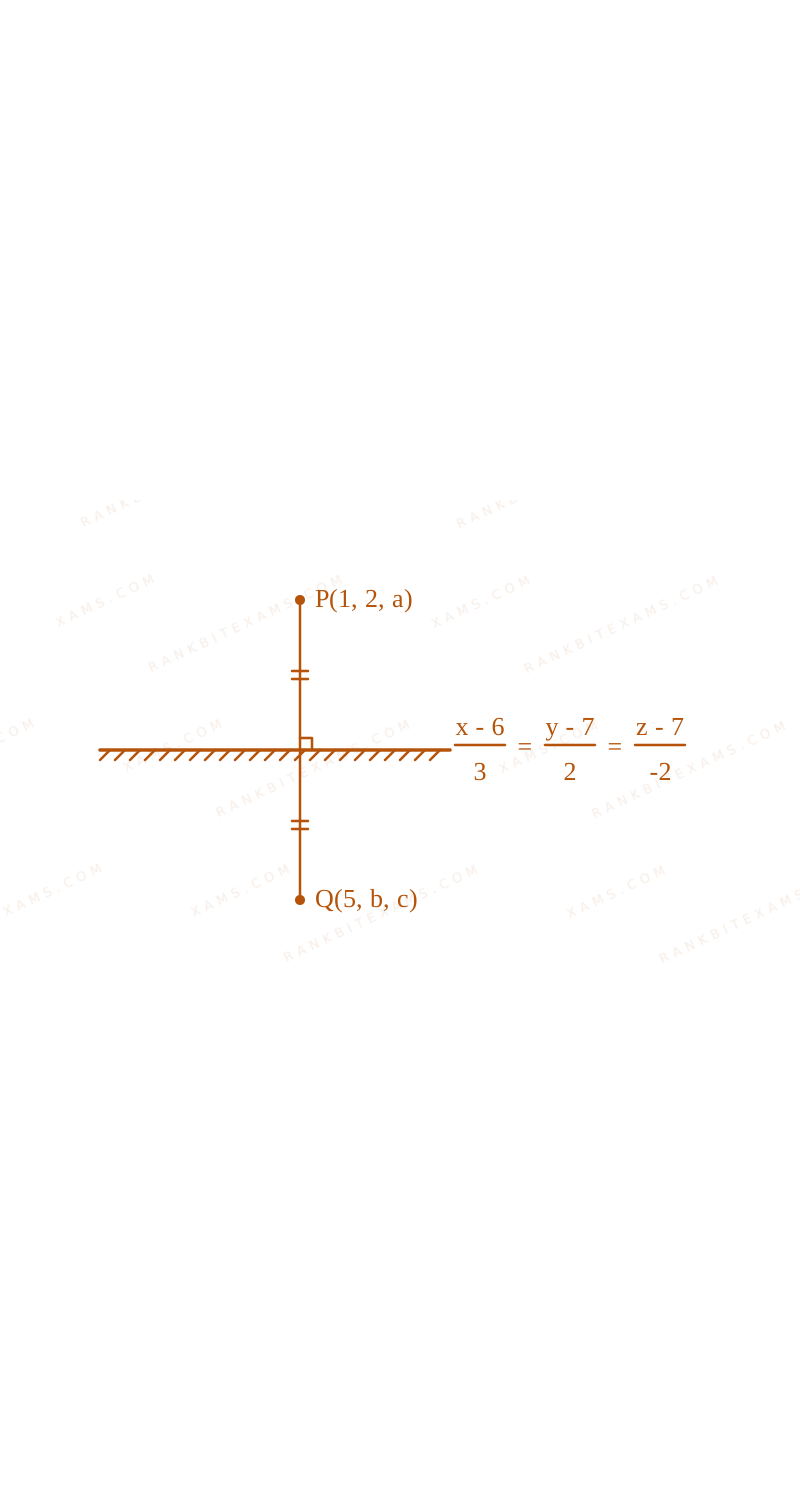
If the image of the point P (1, 2, a) in the line (x - 6)/(3) = (y - 7)/(2) = (7 - z)/(2)$\frac{x - 6}{3} = \frac{y - 7}{2} = \frac{7 - z}{2}$ is Q(5, b, c), then a² + b² + c²$a^2 + b^2 + c^2$ is equal to
A.293$293$
B.264$264$
C.298$298$
D.283$283$
Solution
### Related Formula
Midpoint M = ((x₁ + x₂)/(2), (y₁ + y₂)/(2), (z₁ + z₂)/(2)) lies on the given line.$$\text{Midpoint } M = \left(\frac{x_1 + x_2}{2}, \frac{y_1 + y_2}{2}, \frac{z_1 + z_2}{2}\right) \text{ lies on the given line.}$$Direction ratio of PQ is perpendicular to line's direction vector b, so PQ · b = 0.$$\text{Direction ratio of } PQ \text{ is perpendicular to line's direction vector } \vec{b}, \text{ so } \overrightarrow{PQ} \cdot \vec{b} = 0.$$
### Core Logic
Given line L$L$: (x - 6)/(3) = (y - 7)/(2) = (z - 7)/(-2)$\frac{x - 6}{3} = \frac{y - 7}{2} = \frac{z - 7}{-2}$. Notice the standard form requires (z-7)/(-2)$(z-7)/(-2)$.
Point P = (1, 2, a)$P = (1, 2, a)$ and its image is Q = (5, b, c)$Q = (5, b, c)$.
The midpoint M$M$ of PQ$PQ$ must lie exactly on the line L$L$.
M = ((1 + 5)/(2), (2 + b)/(2), (a + c)/(2)) = (3, (b + 2)/(2), (c + a)/(2))$$M = \left(\frac{1 + 5}{2}, \frac{2 + b}{2}, \frac{a + c}{2}\right) = \left(3, \frac{b + 2}{2}, \frac{c + a}{2}\right)$$
### Step 1: Using the Midpoint on the Line
Substitute M$M$ into the line equation:
(3 - 6)/(3) = ((b + 2)/(2) - 7)/(2) = ((c + a)/(2) - 7)/(-2)$$\frac{3 - 6}{3} = \frac{\frac{b + 2}{2} - 7}{2} = \frac{\frac{c + a}{2} - 7}{-2}$$-1 = (b - 12)/(4) = (c + a - 14)/(-4)$$-1 = \frac{b - 12}{4} = \frac{c + a - 14}{-4}$$
From -1 = (b - 12)/(4)$-1 = \frac{b - 12}{4}$, we get -4 = b - 12 b = 8$-4 = b - 12 \implies b = 8$.
From -1 = (c + a - 14)/(-4)$-1 = \frac{c + a - 14}{-4}$, we get 4 = c + a - 14 c + a = 18$4 = c + a - 14 \implies c + a = 18$.
### Step 2: Using the Orthogonality Condition
The vector PQ$\overrightarrow{PQ}$ must be perpendicular to the line's direction vector v = 3 i + 2 j - 2 k$\vec{v} = 3\hat{i} + 2\hat{j} - 2\hat{k}$.
PQ = (5 - 1) i + (b - 2) j + (c - a) k = 4 i + 6 j + (c - a) k$$\overrightarrow{PQ} = (5 - 1)\hat{i} + (b - 2)\hat{j} + (c - a)\hat{k} = 4\hat{i} + 6\hat{j} + (c - a)\hat{k}$$ (since b = 8$b = 8$)
Now set the dot product to zero:
4(3) + 6(2) + (c - a)(-2) = 0$$4(3) + 6(2) + (c - a)(-2) = 0$$12 + 12 - 2(c - a) = 0 24 = 2(c - a) c - a = 12$$12 + 12 - 2(c - a) = 0 \implies 24 = 2(c - a) \implies c - a = 12$$
### Step 3: Solving for variables
We have a system of linear equations:
1) c + a = 18$c + a = 18$
2) c - a = 12$c - a = 12$
Adding both: 2c = 30 c = 15$2c = 30 \implies c = 15$.
Substituting c$c$: 15 + a = 18 a = 3$15 + a = 18 \implies a = 3$.
Therefore, a = 3, b = 8, c = 15$a = 3, b = 8, c = 15$.
Calculate a² + b² + c²$a^2 + b^2 + c^2$:
a² + b² + c² = 3² + 8² + 15² = 9 + 64 + 225 = 298$$a^2 + b^2 + c^2 = 3^2 + 8^2 + 15^2 = 9 + 64 + 225 = 298$$Image of a Point in a Line diagram for Q11 - JEE Main 2026 Morning
### Pattern Recognition
Any 'image of a point' problem revolves around two strict constraints: 1) The line bisects the segment joining the point and its image (Midpoint lies on the line), and 2) The segment is orthogonal to the line (Dot product = 0). Directly imposing these generates decoupled simple linear equations.
### Evaluation Rubric / Model Answer
null
### Chapter Mix
Class 12 Maths: Three Dimensional Geometry
More Three Dimensional Geometry Questions — jee_main_2025_29_jan_evening
Practice past-year questions one chapter at a time. Pick an exam → subject → chapter and get every PYQ for that topic — pulled together from all past papers — with the chapter's key formulas alongside.