JEE Main · Mathematics ↓ Falling

Three Dimensional Geometry appeared 62 times across 3 years — 7.2% of Mathematics. This question is from Shortest Distance Between Two Lines.

Year 2026 2025 2024 Total
Questions 15 29 18 62

Let the values of p, for which the shortest distance between the lines (x + 1)/(3) = (y)/(4) = (z)/(5) and r = (p i + 2 j + hatk) + λ (2hati + 3hatj + 4hatk) is 1sqrt6, be a, b, (a < b). Then the length of the latus rectum of the ellipse (x²)/(a²) + (y²)/(b²) = 1 is:

Solution & Explanation

Related Formula

The shortest distance between two lines r = a₁ + λ b₁ and r = a₂ + μ b₂ is given by:

d = |( a₂ - a₁) · ( b₁ × b₂)|| b₁ × b₂|
Core Logic

From the given line equations: Line 1 passes through a₁ = - i + 0 j + 0 k along vector b₁ = 3 i + 4 j + 5 k. Line 2 passes through a₂ = p i + 2 j + k along vector b₂ = 2 i + 3 j + 4 k.

Vector difference:

a₂ - a₁ = (p + 1) i + 2 j + k

Computing the cross product b₁ × b₂:

b₁ × b₂ = vmatrix i & j & k 3 & 4 & 5 2 & 3 & 4 vmatrix = i(16-15) - j(12-10) + k(9-8) = i - 2 j + k

Magnitude | b₁ × b₂| = √(1² + (-2)² + 1²) = √(6).

Step 1: Applying the Shortest Distance Value

Substitute these into the distance equation:

d = |((p + 1) i + 2 j + k) · ( i - 2 j + k)|√(6) = 1√(6) |(p + 1)(1) + 2(-2) + 1(1)| = 1 |p + 1 - 4 + 1| = 1 |p - 2| = 1

This yields two values for p:

  • p - 2 = 1 p = 3
  • p - 2 = -1 p = 1
  • Given that a, b are the parameters with a < b, we assign a = 1 and b = 3.

Step 2: Computing Latus Rectum of the Ellipse

The ellipse equation is:

(x²)/(1²) + (y²)/(3²) = 1

Since b > a, the formula for the length of the latus rectum is:

Latus Rectum = (2a²)/(b) = (2(1)²)/(3) = (2)/(3)
Pattern Recognition

Be careful with coordinate geometry variables; when an ellipse satisfies b > a, the major axis is along the y-axis, making the latus rectum equal to (2a²)/(b) instead of (2b²)/(a).

Chapter Mix

Class 12 Mathematics: Three Dimensional Geometry Class 11 Mathematics: Conic Sections

Reference Study Guides

More Three Dimensional Geometry Previous-Year Questions

Q14 jee_main_2026_21_jan_morning Foot of Perpendicular and Projection
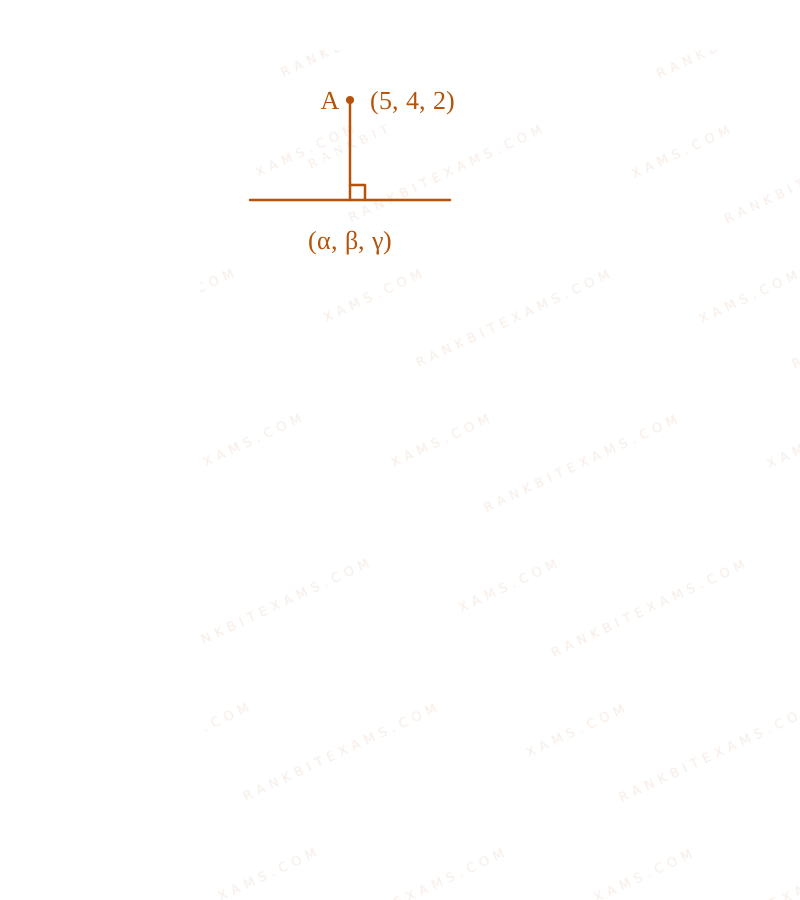
Let (α, β, γ) be the co-ordinates of the foot of the perpendicular drawn from the point (5, 4, 2) on the line r = (- i + 3 j + k) + λ(2 i + 3 j - k) . Then the length of the projection of the vector α i+β j+γ k on the vector 6 i+2 j+3 k is :
  • A. (15)/(7)
  • B. 4
  • C. (18)/(7)
  • D. 3

Solution

Related Formula
Length of projection of u on w = | u · w|| w|
Core Logic

Given point A(5, 4, 2) and line (L):

r = (- i + 3 j + k) + λ(2 i + 3 j - k)

Any general point P on this line has coordinates: (-1 + 2λ, 3 + 3λ, 1 - λ)

Step 1: Finding the foot of the perpendicular

Vector AP = P - A = (-1 + 2λ - 5) i + (3 + 3λ - 4) j + (1 - λ - 2) k

AP = (2λ - 6) i + (3λ - 1) j + (-λ - 1) k

Since AP is perpendicular to line (L), the dot product of AP with the direction vector of the line (2 i + 3 j - k) must be zero:

AP · (2 i + 3 j - k) = 0 2(2λ - 6) + 3(3λ - 1) - 1(-λ - 1) = 0 4λ - 12 + 9λ - 3 + λ + 1 = 0 14λ - 14 = 0 ⇒ λ = 1

Foot of perpendicular 3D diagram for Q14 - JEE Main 2026 Morning

Step 2: Coordinates of the foot

Substitute λ = 1 into general point P to get (α, β, γ): α = -1 + 2(1) = 1 β = 3 + 3(1) = 6 γ = 1 - 1 = 0 Foot of perpendicular is (1, 6, 0).

Step 3: Calculate the projection

Let u = α i + β j + γ k = i + 6 j + 0 k Let w = 6 i + 2 j + 3 k

Projection = | u · w|| w| = |1(6) + 6(2) + 0(3)|√(6² + 2² + 3²) = 6 + 12√(36 + 4 + 9) = 18√(49) = (18)/(7)
Pattern Recognition

Foot of perpendicular problems algorithm: 1) Frame general vector P(λ). 2) Construct distance vector AP. 3) Dot product with direction vector d = 0. 4) Solve for λ.

Chapter Mix

Class 12 Maths: Three Dimensional Geometry Class 12 Maths: Vector Algebra

Q7 jee_main_2026_21_jan_evening Lines
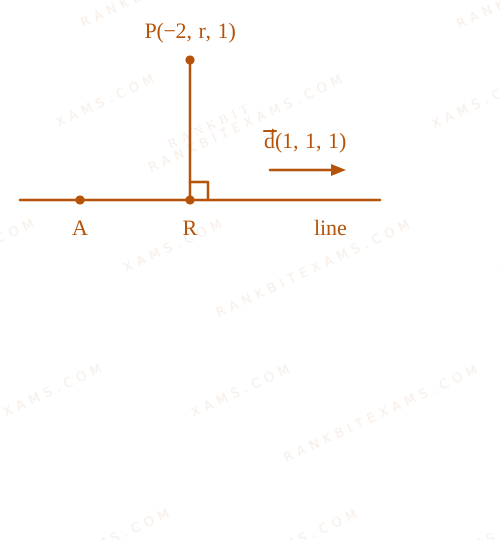
Let the line L pass through the point (-3, 5, 2) and make equal angles with the positive coordinate axes. If the distance of L from the point (-2, r, 1) is √((14)/(3)), then the sum of all possible values of r is:
  • A. 12
  • B. 16
  • C. 6
  • D. 10

Solution

Related Formula
Equation of a line: (x - x₁)/(a) = (y - y₁)/(b) = (z - z₁)/(c) = λ Distance formula: d² = (x₂ - x₁)² + (y₂ - y₁)² + (z₂ - z₁)²
Core Logic

Distance from point to line in 3D diagram for Q7 - JEE Main 2026 Evening
Line L makes equal angles with the positive axes, so its direction ratios are (1, 1, 1). Equation of line L is (x + 3)/(1) = (y - 5)/(1) = (z - 2)/(1) = λ. A general point R on the line is (λ - 3, λ + 5, λ + 2). Use the perpendicularity condition PR · d = 0 to find λ, then substitute back into the distance formula.

Step 1: Apply Perpendicularity Condition

Let point P = (-2, r, 1). The vector PR = λ - 1, λ + 5 - r, λ + 1. Since PR · 1, 1, 1 = 0:

(λ - 1)(1) + (λ + 5 - r)(1) + (λ + 1)(1) = 0 3λ - r + 5 = 0 λ = (r - 5)/(3)
Step 2: Calculate Distance

Substitute λ back into point R:

R ≡ ( (r - 14)/(3), (r + 10)/(3), (r + 1)/(3) )

We are given PR = √((14)/(3)) PR² = (14)/(3). PR² = ( (r - 14)/(3) + 2 )² + ( (r + 10)/(3) - r )² + ( (r + 1)/(3) - 1 )² = (14)/(3)

((r - 8)²)/(9) + ((10 - 2r)²)/(9) + ((r - 2)²)/(9) = (14)/(3) (r² - 16r + 64) + (100 + 4r² - 40r) + (r² - 4r + 4) = 42 6r² - 60r + 168 = 42 6r² - 60r + 126 = 0

Dividing by 6:

r² - 10r + 21 = 0
Step 3: Solve for r
(r - 7)(r - 3) = 0 r = 3, 7

The sum of all possible values of r is 3 + 7 = 10.

Pattern Recognition

When a line makes equal angles with coordinate axes, its direction cosines are (1/√(3), 1/√(3), 1/√(3)), making its simpler direction ratios (1, 1, 1). Use projection vector methods or direct dot product to find perpendicular foot.

Chapter Mix

Class 12 Maths: Three Dimensional Geometry

Q8 jee_main_2026_21_jan_evening Shortest Distance
Let the line L₁ be parallel to the vector -3 i + 2 j + 4 k and pass through the point (2, 6, 7) and the line L₂ be parallel to the vector 2 i + j + 3 k and pass through the point (4, 3, 5). If the line L₃ is parallel to the vector -3 i + 5 j + 16 k and intersects the lines L₁ and L₂ at the points C and D, respectively, then | CD|² is equal to:
  • A. 171
  • B. 290
  • C. 312
  • D. 89

Solution

Related Formula
Equation of a line: r = a + λ b | CD|² = (x₂ - x₁)² + (y₂ - y₁)² + (z₂ - z₁)²
Core Logic

Write general points on L₁ and L₂ representing points C and D. The vector CD must be parallel to the given direction vector of L₃. This yields proportional equations to solve for the line parameters.

Step 1: Write Line Equations

Line L₁: (x-2)/(-3) = (y-6)/(2) = (z-7)/(4) = λ₁ Point C on L₁: (-3λ₁+2, 2λ₁+6, 4λ₁+7) Line L₂: (x-4)/(2) = (y-3)/(1) = (z-5)/(3) = λ₂ Point D on L₂: (2λ₂+4, λ₂+3, 3λ₂+5)

Step 2: Proportionality of Vector CD

The vector CD = 2λ₂+3λ₁+2, λ₂-2λ₁-3, 3λ₂-4λ₁-2. Since L₃ is parallel to -3 i + 5 j + 16 k, the components are proportional:

2λ₂+3λ₁+2-3 = λ₂-2λ₁-35 = 3λ₂-4λ₁-216
Step 3: Solve for lambda values

From the first two expressions:

5(2λ₂+3λ₁+2) = -3(λ₂-2λ₁-3) 10λ₂ + 15λ₁ + 10 = -3λ₂ + 6λ₁ + 9 13λ₂ + 9λ₁ = -1

From the last two expressions:

16(λ₂-2λ₁-3) = 5(3λ₂-4λ₁-2) 16λ₂ - 32λ₁ - 48 = 15λ₂ - 20λ₁ - 10 λ₂ - 12λ₁ = 38

Substitute λ₂ = 12λ₁ + 38 into the first equation:

13(12λ₁ + 38) + 9λ₁ = -1 156λ₁ + 494 + 9λ₁ = -1 165λ₁ = -495 λ₁ = -3 λ₂ = 12(-3) + 38 = 2

Coordinates of C: (11, 0, -5) Coordinates of D: (8, 5, 11)

Step 4: Calculate Magnitude squared
| CD|² = (8 - 11)² + (5 - 0)² + (11 - (-5))² = (-3)² + 5² + 16² = 9 + 25 + 256 = 290
Pattern Recognition

For intersecting lines via a transversal of known direction, represent intersection points generally using independent parameters λ and μ. The difference vector MUST be proportional to the given direction ratio.

Chapter Mix

Class 12 Maths: Three Dimensional Geometry Class 12 Maths: Vector Algebra

Q6 jee_main_2026_22_january_morning Shortest Distance Between Two Lines
Let P(α, β, γ) be the point on the line (x - 1)/(2) = (y + 1)/(-3) = z at a distance 4√(14) from the point (1, -1, 0) and nearer to the origin. Then the shortest distance, between the lines (x - α)/(1) = (y - β)/(2) = (z - γ)/(3) and (x + 5)/(2) = (y - 10)/(1) = (z - 3)/(1), is equal to
  • A. 7√((5)/(4))
  • B. 4√((7)/(5))
  • C. 4√((5)/(7))
  • D. 2√((7)/(4))

Solution

Related Formula
Shortest distance between two skew lines r = a₁ + λ b₁ and r = a₂ + μ b₂ is d = | ( a₂ - a₁) · ( b₁ × b₂)| b₁ × b₂| |
Core Logic

Let any point on the first line (x - 1)/(2) = (y + 1)/(-3) = (z)/(1) = λ be given by P(2λ + 1, -3λ - 1, λ).

The distance of P from the point A(1, -1, 0) is 4√(14).

(2λ + 1 - 1)² + (-3λ - 1 + 1)² + (λ - 0)² = (4√(14))² 4λ² + 9λ² + λ² = 16 × 14 14λ² = 224 λ² = 16 λ = ± 4
Step 1: Finding Point P

For λ = 4, point is P₁(9, -13, 4). Distance from origin: √(81 + 169 + 16) = √(266) For λ = -4, point is P₂(-7, 11, -4). Distance from origin: √(49 + 121 + 16) = √(186)

Since P is nearer to the origin, we choose λ = -4. Therefore, P(α, β, γ) = (-7, 11, -4).

Step 2: Shortest Distance Calculation

We need the shortest distance between Line 1: (x + 7)/(1) = (y - 11)/(2) = (z + 4)/(3) and Line 2: (x + 5)/(2) = (y - 10)/(1) = (z - 3)/(1).

Here, a₁ = -7 i + 11 j - 4 k and b₁ = i + 2 j + 3 k. a₂ = -5 i + 10 j + 3 k and b₂ = 2 i + j + k.

( a₂ - a₁) = 2 i - j + 7 k

Shortest distance d is given by the determinant form:

d = | matrix 2 & -1 & 7 1 & 2 & 3 2 & 1 & 1 matrix || b₁ × b₂|

Evaluate the determinant:

= 2(2 - 3) - (-1)(1 - 6) + 7(1 - 4) = 2(-1) + 1(-5) + 7(-3) = -2 - 5 - 21 = -28

Now find | b₁ × b₂| = | matrix i & j & k 1 & 2 & 3 2 & 1 & 1 matrix | = i(2-3) - j(1-6) + k(1-4) = - i + 5 j - 3 k

Magnitude is √((-1)² + 5² + (-3)²) = √(1 + 25 + 9) = √(35).

d = |-28|√(35) = 28√(35) = 4 × 7√(5 × 7) = 4√(7)√(5) = 4√((7)/(5))
Pattern Recognition

To find points on a line at a given distance from a fixed point on the line itself, the algebraic distance parameter λ translates to d² = λ²(a²+b²+c²), meaning 14λ² equates instantly to the squared given distance. Bypasses the complex distance formula.

Chapter Mix

Class 12 Maths: Three Dimensional Geometry
Q11 jee_main_2026_22_january_morning Image of a Point in a Line
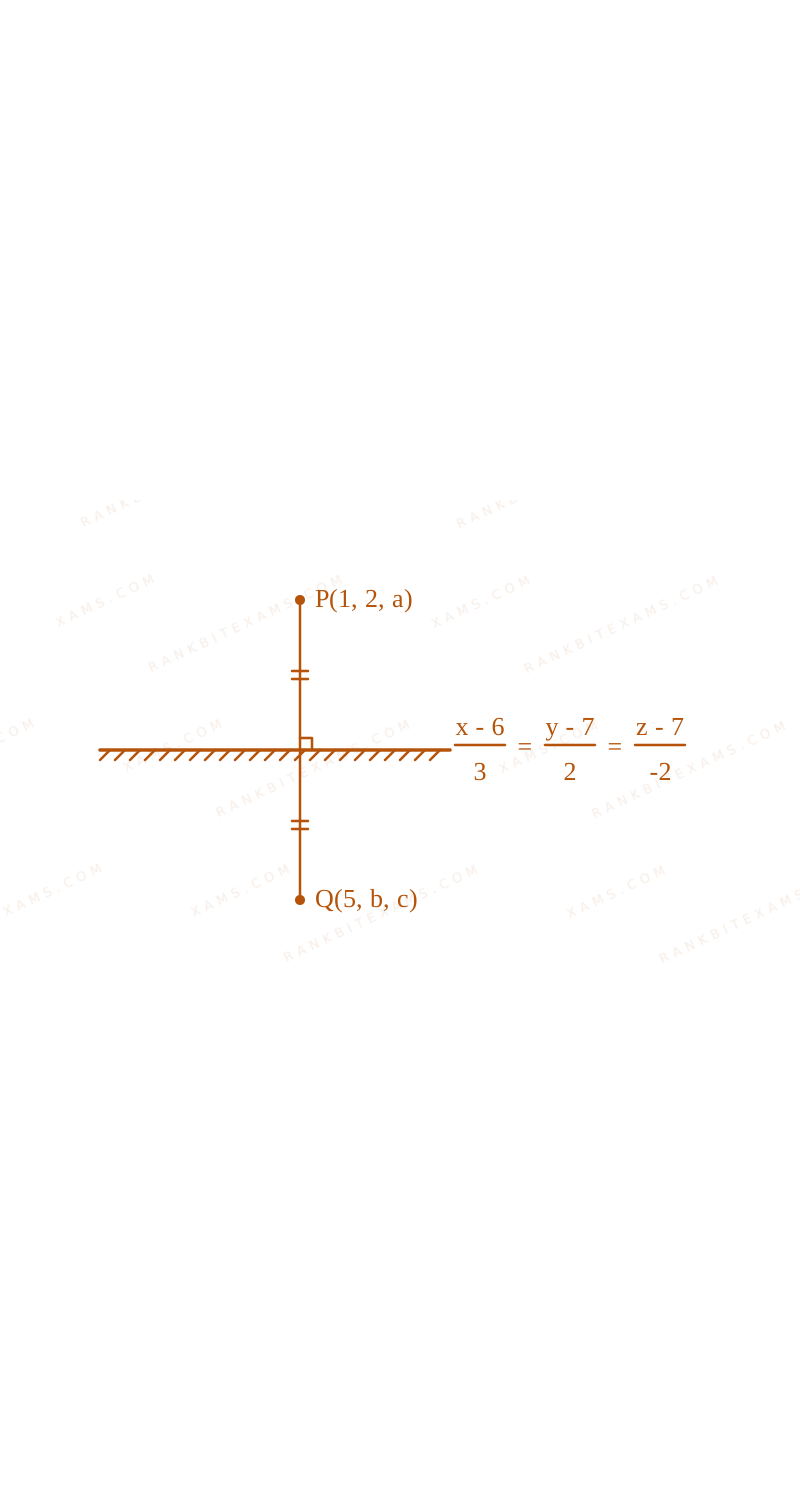
If the image of the point P (1, 2, a) in the line (x - 6)/(3) = (y - 7)/(2) = (7 - z)/(2) is Q(5, b, c), then a² + b² + c² is equal to
  • A. 293
  • B. 264
  • C. 298
  • D. 283

Solution

Related Formula
Midpoint M = ((x₁ + x₂)/(2), (y₁ + y₂)/(2), (z₁ + z₂)/(2)) lies on the given line. Direction ratio of PQ is perpendicular to line's direction vector b, so PQ · b = 0.
Core Logic

Given line L: (x - 6)/(3) = (y - 7)/(2) = (z - 7)/(-2). Notice the standard form requires (z-7)/(-2).

Point P = (1, 2, a) and its image is Q = (5, b, c). The midpoint M of PQ must lie exactly on the line L.

M = ((1 + 5)/(2), (2 + b)/(2), (a + c)/(2)) = (3, (b + 2)/(2), (c + a)/(2))
Step 1: Using the Midpoint on the Line

Substitute M into the line equation:

(3 - 6)/(3) = ((b + 2)/(2) - 7)/(2) = ((c + a)/(2) - 7)/(-2) -1 = (b - 12)/(4) = (c + a - 14)/(-4)

From -1 = (b - 12)/(4), we get -4 = b - 12 b = 8.

From -1 = (c + a - 14)/(-4), we get 4 = c + a - 14 c + a = 18.

Step 2: Using the Orthogonality Condition

The vector PQ must be perpendicular to the line's direction vector v = 3 i + 2 j - 2 k.

PQ = (5 - 1) i + (b - 2) j + (c - a) k = 4 i + 6 j + (c - a) k (since b = 8)

Now set the dot product to zero:

4(3) + 6(2) + (c - a)(-2) = 0 12 + 12 - 2(c - a) = 0 24 = 2(c - a) c - a = 12
Step 3: Solving for variables

We have a system of linear equations:

  • c + a = 18
  • c - a = 12
  • Adding both: 2c = 30 c = 15. Substituting c: 15 + a = 18 a = 3.

    Therefore, a = 3, b = 8, c = 15.

    Calculate a² + b² + c²:

a² + b² + c² = 3² + 8² + 15² = 9 + 64 + 225 = 298

Image of a Point in a Line diagram for Q11 - JEE Main 2026 Morning

Pattern Recognition

Any 'image of a point' problem revolves around two strict constraints: 1) The line bisects the segment joining the point and its image (Midpoint lies on the line), and 2) The segment is orthogonal to the line (Dot product = 0). Directly imposing these generates decoupled simple linear equations.

Chapter Mix

Class 12 Maths: Three Dimensional Geometry
More Three Dimensional Geometry Questions — jee_main_2025_04_april_evening

Practice all Three Dimensional Geometry previous-year questions →

Rankbit System
JEE Physics: Waves (+15.5%) | Electrostatics: Concentric Shells (-29.7%) | Modern Physics: Photoelectric Clones (+34.2%) | Mathematics: Definite Integrals (+18.1%) | Chemistry: Coordination Splitting (-11.4%) | JEE Physics: Waves (+15.5%) | Electrostatics: Concentric Shells (-29.7%) | Modern Physics: Photoelectric Clones (+34.2%) | Mathematics: Definite Integrals (+18.1%) | Chemistry: Coordination Splitting (-11.4%)