Keywords:#Shortest Distance#JEE Main 2026 Evening Q11#Three Dimensional Geometry JEE Main 2026#Shortest Distance Between Two Lines JEE Main 2026
More Three Dimensional Geometry Previous-Year Questions
Q14jee_main_2026_21_jan_morningFoot of Perpendicular and Projection
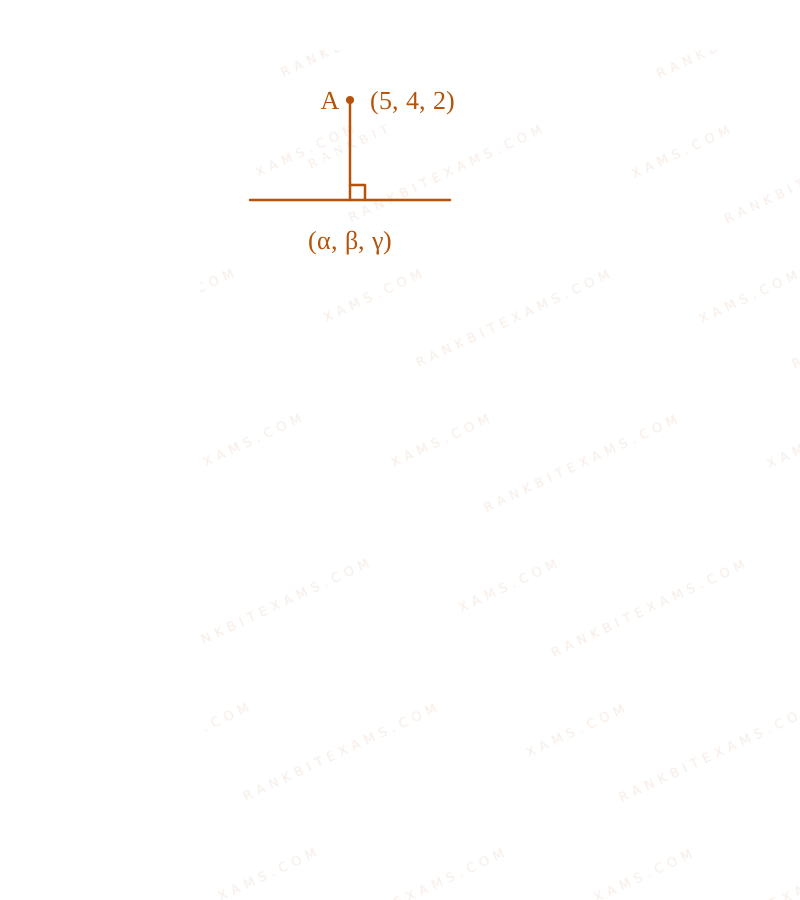
Let (alpha, beta, gamma)$(\alpha, \beta, \gamma)$ be the co-ordinates of the foot of the perpendicular drawn from the point (5, 4, 2) on the line vecr = (-hati + 3hatj + hatk) + lambda(2hati + 3hatj - hatk)$\vec{r} = (-\hat{i} + 3\hat{j} + \hat{k}) + \lambda(2\hat{i} + 3\hat{j} - \hat{k})$ .
Then the length of the projection of the vector alphahati+betahatj+gammahatk$\alpha\hat{i}+\beta\hat{j}+\gamma\hat{k}$ on the vector 6hati+2hatj+3hatk$6\hat{i}+2\hat{j}+3\hat{k}$ is :
A.frac157$\frac{15}{7}$
B. 4
C.frac187$\frac{18}{7}$
D. 3
Solution
### Related Formula
textLength of projection of vecu text on vecw = frac|vecu cdot vecw||vecw|$$\text{Length of projection of } \vec{u} \text{ on } \vec{w} = \frac{|\vec{u} \cdot \vec{w}|}{|\vec{w}|}$$
### Core Logic
Given point A(5, 4, 2)$A(5, 4, 2)$ and line (L)$(L)$:
vecr = (-hati + 3hatj + hatk) + lambda(2hati + 3hatj - hatk)$$\vec{r} = (-\hat{i} + 3\hat{j} + \hat{k}) + \lambda(2\hat{i} + 3\hat{j} - \hat{k})$$
Any general point P$P$ on this line has coordinates:
(-1 + 2lambda, 3 + 3lambda, 1 - lambda)$(-1 + 2\lambda, 3 + 3\lambda, 1 - \lambda)$
### Step 1: Finding the foot of the perpendicular
Vector vecAP = P - A = (-1 + 2lambda - 5)hati + (3 + 3lambda - 4)hatj + (1 - lambda - 2)hatk$\vec{AP} = P - A = (-1 + 2\lambda - 5)\hat{i} + (3 + 3\lambda - 4)\hat{j} + (1 - \lambda - 2)\hat{k}$vecAP = (2lambda - 6)hati + (3lambda - 1)hatj + (-lambda - 1)hatk$$\vec{AP} = (2\lambda - 6)\hat{i} + (3\lambda - 1)\hat{j} + (-\lambda - 1)\hat{k}$$
Since AP$AP$ is perpendicular to line (L)$(L)$, the dot product of vecAP$\vec{AP}$ with the direction vector of the line (2hati + 3hatj - hatk)$(2\hat{i} + 3\hat{j} - \hat{k})$ must be zero:
vecAP cdot (2hati + 3hatj - hatk) = 0$$\vec{AP} \cdot (2\hat{i} + 3\hat{j} - \hat{k}) = 0$$2(2lambda - 6) + 3(3lambda - 1) - 1(-lambda - 1) = 0$$2(2\lambda - 6) + 3(3\lambda - 1) - 1(-\lambda - 1) = 0$$4lambda - 12 + 9lambda - 3 + lambda + 1 = 0$$4\lambda - 12 + 9\lambda - 3 + \lambda + 1 = 0$$14lambda - 14 = 0 Rightarrow lambda = 1$$14\lambda - 14 = 0 \Rightarrow \lambda = 1$$Foot of perpendicular 3D diagram for Q14 - JEE Main 2026 Morning
### Step 2: Coordinates of the foot
Substitute lambda = 1$\lambda = 1$ into general point P$P$ to get (alpha, beta, gamma)$(\alpha, \beta, \gamma)$:
alpha = -1 + 2(1) = 1$\alpha = -1 + 2(1) = 1$beta = 3 + 3(1) = 6$\beta = 3 + 3(1) = 6$gamma = 1 - 1 = 0$\gamma = 1 - 1 = 0$
Foot of perpendicular is (1, 6, 0)$(1, 6, 0)$.
### Step 3: Calculate the projection
Let vecu = alphahati + betahatj + gammahatk = hati + 6hatj + 0hatk$\vec{u} = \alpha\hat{i} + \beta\hat{j} + \gamma\hat{k} = \hat{i} + 6\hat{j} + 0\hat{k}$
Let vecw = 6hati + 2hatj + 3hatk$\vec{w} = 6\hat{i} + 2\hat{j} + 3\hat{k}$textProjection = frac|vecu cdot vecw||vecw| = frac|1(6) + 6(2) + 0(3)|sqrt6^2 + 2^2 + 3^2$$\text{Projection} = \frac{|\vec{u} \cdot \vec{w}|}{|\vec{w}|} = \frac{|1(6) + 6(2) + 0(3)|}{\sqrt{6^2 + 2^2 + 3^2}}$$= frac6 + 12sqrt36 + 4 + 9 = frac18sqrt49 = frac187$$= \frac{6 + 12}{\sqrt{36 + 4 + 9}} = \frac{18}{\sqrt{49}} = \frac{18}{7}$$
### Pattern Recognition
Foot of perpendicular problems algorithm: 1) Frame general vector P(lambda)$P(\lambda)$. 2) Construct distance vector vecAP$\vec{AP}$. 3) Dot product with direction vector vecd = 0$\vec{d} = 0$. 4) Solve for lambda$\lambda$.
### Evaluation Rubric / Model Answer
null
### Chapter Mix
Class 12 Maths: Three Dimensional Geometry
Class 12 Maths: Vector Algebra
Q7jee_main_2026_21_jan_eveningLines
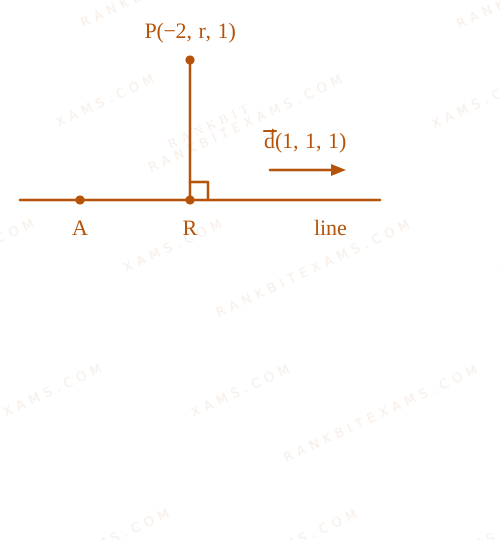
Let the line L$L$ pass through the point (-3, 5, 2)$(-3, 5, 2)$ and make equal angles with the positive coordinate axes. If the distance of L$L$ from the point (-2, r, 1)$(-2, r, 1)$ is sqrtfrac143$\sqrt{\frac{14}{3}}$, then the sum of all possible values of r$r$ is:
A.12$12$
B.16$16$
C.6$6$
D.10$10$
Solution
### Related Formula
textEquation of a line: fracx - x_1a = fracy - y_1b = fracz - z_1c = lambda$$\text{Equation of a line: } \frac{x - x_1}{a} = \frac{y - y_1}{b} = \frac{z - z_1}{c} = \lambda$$textDistance formula: d^2 = (x_2 - x_1)^2 + (y_2 - y_1)^2 + (z_2 - z_1)^2$$\text{Distance formula: } d^2 = (x_2 - x_1)^2 + (y_2 - y_1)^2 + (z_2 - z_1)^2$$
### Core Logic
Distance from point to line in 3D diagram for Q7 - JEE Main 2026 Evening
Line L$L$ makes equal angles with the positive axes, so its direction ratios are (1, 1, 1)$(1, 1, 1)$.
Equation of line L$L$ is fracx + 31 = fracy - 51 = fracz - 21 = lambda$\frac{x + 3}{1} = \frac{y - 5}{1} = \frac{z - 2}{1} = \lambda$.
A general point R$R$ on the line is (lambda - 3, lambda + 5, lambda + 2)$(\lambda - 3, \lambda + 5, \lambda + 2)$.
Use the perpendicularity condition overrightarrowPR cdot vecd = 0$\overrightarrow{PR} \cdot \vec{d} = 0$ to find lambda$\lambda$, then substitute back into the distance formula.
### Step 1: Apply Perpendicularity Condition
Let point P = (-2, r, 1)$P = (-2, r, 1)$.
The vector overrightarrowPR = langle lambda - 1, lambda + 5 - r, lambda + 1 rangle$\overrightarrow{PR} = \langle \lambda - 1, \lambda + 5 - r, \lambda + 1 \rangle$.
Since overrightarrowPR cdot langle 1, 1, 1 rangle = 0$\overrightarrow{PR} \cdot \langle 1, 1, 1 \rangle = 0$:
(lambda - 1)(1) + (lambda + 5 - r)(1) + (lambda + 1)(1) = 0$$(\lambda - 1)(1) + (\lambda + 5 - r)(1) + (\lambda + 1)(1) = 0$$3lambda - r + 5 = 0 implies lambda = fracr - 53$$3\lambda - r + 5 = 0 \implies \lambda = \frac{r - 5}{3}$$
### Step 2: Calculate Distance
Substitute lambda$\lambda$ back into point R$R$:
R equiv left( fracr - 143, fracr + 103, fracr + 13 right)$$R \equiv \left( \frac{r - 14}{3}, \frac{r + 10}{3}, \frac{r + 1}{3} \right)$$
We are given PR = sqrtfrac143 implies PR^2 = frac143$PR = \sqrt{\frac{14}{3}} \implies PR^2 = \frac{14}{3}$.
PR^2 = left( fracr - 143 + 2 right)^2 + left( fracr + 103 - r right)^2 + left( fracr + 13 - 1 right)^2 = frac143$PR^2 = \left( \frac{r - 14}{3} + 2 \right)^2 + \left( \frac{r + 10}{3} - r \right)^2 + \left( \frac{r + 1}{3} - 1 \right)^2 = \frac{14}{3}$frac(r - 8)^29 + frac(10 - 2r)^29 + frac(r - 2)^29 = frac143$$\frac{(r - 8)^2}{9} + \frac{(10 - 2r)^2}{9} + \frac{(r - 2)^2}{9} = \frac{14}{3}$$(r^2 - 16r + 64) + (100 + 4r^2 - 40r) + (r^2 - 4r + 4) = 42$$(r^2 - 16r + 64) + (100 + 4r^2 - 40r) + (r^2 - 4r + 4) = 42$$6r^2 - 60r + 168 = 42 implies 6r^2 - 60r + 126 = 0$$6r^2 - 60r + 168 = 42 \implies 6r^2 - 60r + 126 = 0$$
Dividing by 6:
r^2 - 10r + 21 = 0$$r^2 - 10r + 21 = 0$$
### Step 3: Solve for r
(r - 7)(r - 3) = 0 implies r = 3, 7$$(r - 7)(r - 3) = 0 \implies r = 3, 7$$
The sum of all possible values of r$r$ is 3 + 7 = 10$3 + 7 = 10$.
### Pattern Recognition
When a line makes equal angles with coordinate axes, its direction cosines are (1/sqrt3, 1/sqrt3, 1/sqrt3)$(1/\sqrt{3}, 1/\sqrt{3}, 1/\sqrt{3})$, making its simpler direction ratios (1, 1, 1)$(1, 1, 1)$. Use projection vector methods or direct dot product to find perpendicular foot.
### Evaluation Rubric / Model Answer
null
### Chapter Mix
Class 12 Maths: Three Dimensional Geometry
Q8jee_main_2026_21_jan_eveningShortest Distance
Let the line L_1$L_{1}$ be parallel to the vector -3hati + 2hatj + 4hatk$-3\hat{i} + 2\hat{j} + 4\hat{k}$ and pass through the point (2, 6, 7) and the line L_2$L_{2}$ be parallel to the vector 2hati + hatj + 3hatk$2\hat{i} + \hat{j} + 3\hat{k}$ and pass through the point (4, 3, 5). If the line L_3$L_{3}$ is parallel to the vector -3hati + 5hatj + 16hatk$-3\hat{i} + 5\hat{j} + 16\hat{k}$ and intersects the linesL_1$L_{1}$ and L_2$L_{2}$ at the points C and D, respectively, then left|overrightarrowCDright|^2$\left|\overrightarrow{CD}\right|^{2}$ is equal to:
A.171$171$
B.290$290$
C.312$312$
D.89$89$
Solution
### Related Formula
textEquation of a line: vecr = veca + lambdavecb$$\text{Equation of a line: } \vec{r} = \vec{a} + \lambda\vec{b}$$|overrightarrowCD|^2 = (x_2 - x_1)^2 + (y_2 - y_1)^2 + (z_2 - z_1)^2$$|\overrightarrow{CD}|^2 = (x_2 - x_1)^2 + (y_2 - y_1)^2 + (z_2 - z_1)^2$$
### Core Logic
Write general points on L_1$L_1$ and L_2$L_2$ representing points C$C$ and D$D$. The vector overrightarrowCD$\overrightarrow{CD}$ must be parallel to the given direction vector of L_3$L_3$. This yields proportional equations to solve for the line parameters.
### Step 1: Write Line Equations
Line L_1$L_{1}$: fracx-2-3 = fracy-62 = fracz-74 = lambda_1$\frac{x-2}{-3} = \frac{y-6}{2} = \frac{z-7}{4} = \lambda_{1}$
Point C$C$ on L_1$L_{1}$: (-3lambda_1+2, 2lambda_1+6, 4lambda_1+7)$(-3\lambda_{1}+2, 2\lambda_{1}+6, 4\lambda_{1}+7)$
Line L_2$L_{2}$: fracx-42 = fracy-31 = fracz-53 = lambda_2$\frac{x-4}{2} = \frac{y-3}{1} = \frac{z-5}{3} = \lambda_{2}$
Point D$D$ on L_2$L_{2}$: (2lambda_2+4, lambda_2+3, 3lambda_2+5)$(2\lambda_{2}+4, \lambda_{2}+3, 3\lambda_{2}+5)$
### Step 2: Proportionality of Vector CD
The vector overrightarrowCD = langle 2lambda_2+3lambda_1+2, lambda_2-2lambda_1-3, 3lambda_2-4lambda_1-2 rangle$\overrightarrow{CD} = \langle 2\lambda_{2}+3\lambda_{1}+2, \lambda_{2}-2\lambda_{1}-3, 3\lambda_{2}-4\lambda_{1}-2 \rangle$.
Since L_3$L_3$ is parallel to -3hati + 5hatj + 16hatk$-3\hat{i} + 5\hat{j} + 16\hat{k}$, the components are proportional:
frac2lambda_2+3lambda_1+2-3 = fraclambda_2-2lambda_1-35 = frac3lambda_2-4lambda_1-216$$\frac{2\lambda_{2}+3\lambda_{1}+2}{-3} = \frac{\lambda_{2}-2\lambda_{1}-3}{5} = \frac{3\lambda_{2}-4\lambda_{1}-2}{16}$$
### Step 3: Solve for lambda values
From the first two expressions:
5(2lambda_2+3lambda_1+2) = -3(lambda_2-2lambda_1-3)$$5(2\lambda_{2}+3\lambda_{1}+2) = -3(\lambda_{2}-2\lambda_{1}-3)$$10lambda_2 + 15lambda_1 + 10 = -3lambda_2 + 6lambda_1 + 9$$10\lambda_{2} + 15\lambda_{1} + 10 = -3\lambda_{2} + 6\lambda_{1} + 9$$13lambda_2 + 9lambda_1 = -1$$13\lambda_{2} + 9\lambda_{1} = -1$$
From the last two expressions:
16(lambda_2-2lambda_1-3) = 5(3lambda_2-4lambda_1-2)$$16(\lambda_{2}-2\lambda_{1}-3) = 5(3\lambda_{2}-4\lambda_{1}-2)$$16lambda_2 - 32lambda_1 - 48 = 15lambda_2 - 20lambda_1 - 10$$16\lambda_{2} - 32\lambda_{1} - 48 = 15\lambda_{2} - 20\lambda_{1} - 10$$lambda_2 - 12lambda_1 = 38$$\lambda_{2} - 12\lambda_{1} = 38$$
Substitute lambda_2 = 12lambda_1 + 38$\lambda_{2} = 12\lambda_{1} + 38$ into the first equation:
13(12lambda_1 + 38) + 9lambda_1 = -1$$13(12\lambda_{1} + 38) + 9\lambda_{1} = -1$$156lambda_1 + 494 + 9lambda_1 = -1$$156\lambda_{1} + 494 + 9\lambda_{1} = -1$$165lambda_1 = -495 implies lambda_1 = -3$$165\lambda_{1} = -495 \implies \lambda_{1} = -3$$lambda_2 = 12(-3) + 38 = 2$$\lambda_{2} = 12(-3) + 38 = 2$$
Coordinates of C$C$: (11, 0, -5)$(11, 0, -5)$
Coordinates of D$D$: (8, 5, 11)$(8, 5, 11)$
### Step 4: Calculate Magnitude squared
left|overrightarrowCDright|^2 = (8 - 11)^2 + (5 - 0)^2 + (11 - (-5))^2$$\left|\overrightarrow{CD}\right|^{2} = (8 - 11)^2 + (5 - 0)^2 + (11 - (-5))^2$$= (-3)^2 + 5^2 + 16^2$$= (-3)^2 + 5^2 + 16^2$$= 9 + 25 + 256 = 290$$= 9 + 25 + 256 = 290$$
### Pattern Recognition
For intersecting lines via a transversal of known direction, represent intersection points generally using independent parameters lambda$\lambda$ and mu$\mu$. The difference vector MUST be proportional to the given direction ratio.
### Evaluation Rubric / Model Answer
null
### Chapter Mix
Class 12 Maths: Three Dimensional Geometry
Class 12 Maths: Vector Algebra
Q6jee_main_2026_22_january_morningShortest Distance Between Two Lines
Let P(alpha, beta, gamma)$P(\alpha, \beta, \gamma)$ be the point on the line fracx - 12 = fracy + 1-3 = z$\frac{x - 1}{2} = \frac{y + 1}{-3} = z$ at a distance 4sqrt14$4\sqrt{14}$ from the point (1, -1, 0)$(1, -1, 0)$ and nearer to the origin. Then the shortest distance, between the lines fracx - alpha1 = fracy - beta2 = fracz - gamma3$\frac{x - \alpha}{1} = \frac{y - \beta}{2} = \frac{z - \gamma}{3}$ and fracx + 52 = fracy - 101 = fracz - 31$\frac{x + 5}{2} = \frac{y - 10}{1} = \frac{z - 3}{1}$, is equal to
A.7sqrtfrac54$7\sqrt{\frac{5}{4}}$
B.4sqrtfrac75$4\sqrt{\frac{7}{5}}$
C.4sqrtfrac57$4\sqrt{\frac{5}{7}}$
D.2sqrtfrac74$2\sqrt{\frac{7}{4}}$
Solution
### Related Formula
textShortest distance between two skew lines vecr = veca_1 + lambdavecb_1 text and vecr = veca_2 + muvecb_2 text is d = left| frac(veca_2 - veca_1) cdot (vecb_1 times vecb_2)|vecb_1 times vecb_2| right|$$\text{Shortest distance between two skew lines } \vec{r} = \vec{a_1} + \lambda\vec{b_1} \text{ and } \vec{r} = \vec{a_2} + \mu\vec{b_2} \text{ is } d = \left| \frac{(\vec{a_2} - \vec{a_1}) \cdot (\vec{b_1} \times \vec{b_2})}{|\vec{b_1} \times \vec{b_2}|} \right|$$
### Core Logic
Let any point on the first line fracx - 12 = fracy + 1-3 = fracz1 = lambda$\frac{x - 1}{2} = \frac{y + 1}{-3} = \frac{z}{1} = \lambda$ be given by P(2lambda + 1, -3lambda - 1, lambda)$P(2\lambda + 1, -3\lambda - 1, \lambda)$.
The distance of P$P$ from the point A(1, -1, 0)$A(1, -1, 0)$ is 4sqrt14$4\sqrt{14}$.
(2lambda + 1 - 1)^2 + (-3lambda - 1 + 1)^2 + (lambda - 0)^2 = (4sqrt14)^2$$(2\lambda + 1 - 1)^2 + (-3\lambda - 1 + 1)^2 + (\lambda - 0)^2 = (4\sqrt{14})^2$$4lambda^2 + 9lambda^2 + lambda^2 = 16 times 14$$4\lambda^2 + 9\lambda^2 + \lambda^2 = 16 \times 14$$14lambda^2 = 224 implies lambda^2 = 16 implies lambda = pm 4$$14\lambda^2 = 224 \implies \lambda^2 = 16 \implies \lambda = \pm 4$$
### Step 1: Finding Point P
For lambda = 4$\lambda = 4$, point is P_1(9, -13, 4)$P_1(9, -13, 4)$. Distance from origin: sqrt81 + 169 + 16 = sqrt266$\sqrt{81 + 169 + 16} = \sqrt{266}$
For lambda = -4$\lambda = -4$, point is P_2(-7, 11, -4)$P_2(-7, 11, -4)$. Distance from origin: sqrt49 + 121 + 16 = sqrt186$\sqrt{49 + 121 + 16} = \sqrt{186}$
Since P$P$ is nearer to the origin, we choose lambda = -4$\lambda = -4$.
Therefore, P(alpha, beta, gamma) = (-7, 11, -4)$P(\alpha, \beta, \gamma) = (-7, 11, -4)$.
### Step 2: Shortest Distance Calculation
We need the shortest distance between Line 1: fracx + 71 = fracy - 112 = fracz + 43$\frac{x + 7}{1} = \frac{y - 11}{2} = \frac{z + 4}{3}$ and Line 2: fracx + 52 = fracy - 101 = fracz - 31$\frac{x + 5}{2} = \frac{y - 10}{1} = \frac{z - 3}{1}$.
Here, veca_1 = -7hati + 11hatj - 4hatk$\vec{a_1} = -7\hat{i} + 11\hat{j} - 4\hat{k}$ and vecb_1 = hati + 2hatj + 3hatk$\vec{b_1} = \hat{i} + 2\hat{j} + 3\hat{k}$.
veca_2 = -5hati + 10hatj + 3hatk$\vec{a_2} = -5\hat{i} + 10\hat{j} + 3\hat{k}$ and vecb_2 = 2hati + hatj + hatk$\vec{b_2} = 2\hat{i} + \hat{j} + \hat{k}$.
(veca_2 - veca_1) = 2hati - hatj + 7hatk$$(\vec{a_2} - \vec{a_1}) = 2\hat{i} - \hat{j} + 7\hat{k}$$Shortest distanced$d$ is given by the determinant form:
d = fracleft| beginmatrix 2 & -1 & 7 \\ 1 & 2 & 3 \\ 2 & 1 & 1 endmatrix right||vecb_1 times vecb_2|$$d = \frac{\left| \begin{matrix} 2 & -1 & 7 \\ 1 & 2 & 3 \\ 2 & 1 & 1 \end{matrix} \right|}{|\vec{b_1} \times \vec{b_2}|}$$
Evaluate the determinant:
= 2(2 - 3) - (-1)(1 - 6) + 7(1 - 4) = 2(-1) + 1(-5) + 7(-3) = -2 - 5 - 21 = -28$$= 2(2 - 3) - (-1)(1 - 6) + 7(1 - 4) = 2(-1) + 1(-5) + 7(-3) = -2 - 5 - 21 = -28$$
Now find |vecb_1 times vecb_2| = left| beginmatrix hati & hatj & hatk \\ 1 & 2 & 3 \\ 2 & 1 & 1 endmatrix right| = hati(2-3) - hatj(1-6) + hatk(1-4) = -hati + 5hatj - 3hatk$|\vec{b_1} \times \vec{b_2}| = \left| \begin{matrix} \hat{i} & \hat{j} & \hat{k} \\ 1 & 2 & 3 \\ 2 & 1 & 1 \end{matrix} \right| = \hat{i}(2-3) - \hat{j}(1-6) + \hat{k}(1-4) = -\hat{i} + 5\hat{j} - 3\hat{k}$
Magnitude is sqrt(-1)^2 + 5^2 + (-3)^2 = sqrt1 + 25 + 9 = sqrt35$\sqrt{(-1)^2 + 5^2 + (-3)^2} = \sqrt{1 + 25 + 9} = \sqrt{35}$.
d = frac|-28|sqrt35 = frac28sqrt35 = frac4 times 7sqrt5 times 7 = frac4sqrt7sqrt5 = 4sqrtfrac75$$d = \frac{|-28|}{\sqrt{35}} = \frac{28}{\sqrt{35}} = \frac{4 \times 7}{\sqrt{5 \times 7}} = \frac{4\sqrt{7}}{\sqrt{5}} = 4\sqrt{\frac{7}{5}}$$
### Pattern Recognition
To find points on a line at a given distance from a fixed point on the line itself, the algebraic distance parameter lambda$\lambda$ translates to d^2 = lambda^2(a^2+b^2+c^2)$d^2 = \lambda^2(a^2+b^2+c^2)$, meaning 14lambda^2$14\lambda^2$ equates instantly to the squared given distance. Bypasses the complex distance formula.
### Evaluation Rubric / Model Answer
null
### Chapter Mix
Class 12 Maths: Three Dimensional Geometry
Q11jee_main_2026_22_january_morningImage of a Point in a Line
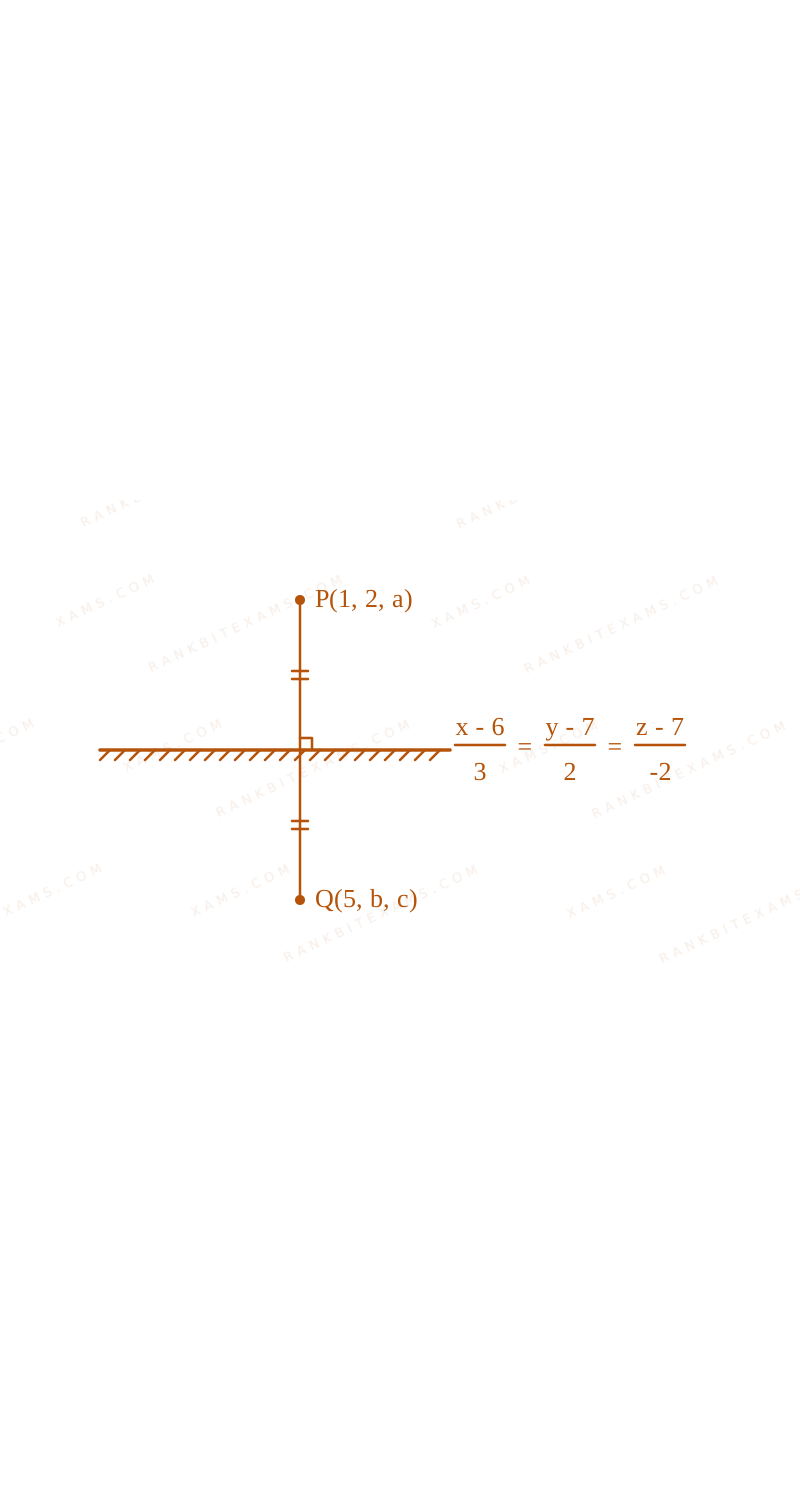
If the image of the point P (1, 2, a) in the line fracx - 63 = fracy - 72 = frac7 - z2$\frac{x - 6}{3} = \frac{y - 7}{2} = \frac{7 - z}{2}$ is Q(5, b, c), then a^2 + b^2 + c^2$a^2 + b^2 + c^2$ is equal to
A.293$293$
B.264$264$
C.298$298$
D.283$283$
Solution
### Related Formula
textMidpoint M = left(fracx_1 + x_22, fracy_1 + y_22, fracz_1 + z_22right) text lies on the given line.$$\text{Midpoint } M = \left(\frac{x_1 + x_2}{2}, \frac{y_1 + y_2}{2}, \frac{z_1 + z_2}{2}\right) \text{ lies on the given line.}$$textDirection ratio of PQ text is perpendicular to line's direction vector vecb, text so overrightarrowPQ cdot vecb = 0.$$\text{Direction ratio of } PQ \text{ is perpendicular to line's direction vector } \vec{b}, \text{ so } \overrightarrow{PQ} \cdot \vec{b} = 0.$$
### Core Logic
Given line L$L$: fracx - 63 = fracy - 72 = fracz - 7-2$\frac{x - 6}{3} = \frac{y - 7}{2} = \frac{z - 7}{-2}$. Notice the standard form requires (z-7)/(-2)$(z-7)/(-2)$.
Point P = (1, 2, a)$P = (1, 2, a)$ and its image is Q = (5, b, c)$Q = (5, b, c)$.
The midpoint M$M$ of PQ$PQ$ must lie exactly on the line L$L$.
M = left(frac1 + 52, frac2 + b2, fraca + c2right) = left(3, fracb + 22, fracc + a2right)$$M = \left(\frac{1 + 5}{2}, \frac{2 + b}{2}, \frac{a + c}{2}\right) = \left(3, \frac{b + 2}{2}, \frac{c + a}{2}\right)$$
### Step 1: Using the Midpoint on the Line
Substitute M$M$ into the line equation:
frac3 - 63 = fracfracb + 22 - 72 = fracfracc + a2 - 7-2$$\frac{3 - 6}{3} = \frac{\frac{b + 2}{2} - 7}{2} = \frac{\frac{c + a}{2} - 7}{-2}$$-1 = fracb - 124 = fracc + a - 14-4$$-1 = \frac{b - 12}{4} = \frac{c + a - 14}{-4}$$
From -1 = fracb - 124$-1 = \frac{b - 12}{4}$, we get -4 = b - 12 implies b = 8$-4 = b - 12 \implies b = 8$.
From -1 = fracc + a - 14-4$-1 = \frac{c + a - 14}{-4}$, we get 4 = c + a - 14 implies c + a = 18$4 = c + a - 14 \implies c + a = 18$.
### Step 2: Using the Orthogonality Condition
The vector overrightarrowPQ$\overrightarrow{PQ}$ must be perpendicular to the line's direction vector vecv = 3hati + 2hatj - 2hatk$\vec{v} = 3\hat{i} + 2\hat{j} - 2\hat{k}$.
overrightarrowPQ = (5 - 1)hati + (b - 2)hatj + (c - a)hatk = 4hati + 6hatj + (c - a)hatk$$\overrightarrow{PQ} = (5 - 1)\hat{i} + (b - 2)\hat{j} + (c - a)\hat{k} = 4\hat{i} + 6\hat{j} + (c - a)\hat{k}$$ (since b = 8$b = 8$)
Now set the dot product to zero:
4(3) + 6(2) + (c - a)(-2) = 0$$4(3) + 6(2) + (c - a)(-2) = 0$$12 + 12 - 2(c - a) = 0 implies 24 = 2(c - a) implies c - a = 12$$12 + 12 - 2(c - a) = 0 \implies 24 = 2(c - a) \implies c - a = 12$$
### Step 3: Solving for variables
We have a system of linear equations:
1) c + a = 18$c + a = 18$
2) c - a = 12$c - a = 12$
Adding both: 2c = 30 implies c = 15$2c = 30 \implies c = 15$.
Substituting c$c$: 15 + a = 18 implies a = 3$15 + a = 18 \implies a = 3$.
Therefore, a = 3, b = 8, c = 15$a = 3, b = 8, c = 15$.
Calculate a^2 + b^2 + c^2$a^2 + b^2 + c^2$:
a^2 + b^2 + c^2 = 3^2 + 8^2 + 15^2 = 9 + 64 + 225 = 298$$a^2 + b^2 + c^2 = 3^2 + 8^2 + 15^2 = 9 + 64 + 225 = 298$$Image of a Point in a Line diagram for Q11 - JEE Main 2026 Morning
### Pattern Recognition
Any 'image of a point' problem revolves around two strict constraints: 1) The line bisects the segment joining the point and its image (Midpoint lies on the line), and 2) The segment is orthogonal to the line (Dot product = 0). Directly imposing these generates decoupled simple linear equations.
### Evaluation Rubric / Model Answer
null
### Chapter Mix
Class 12 Maths: Three Dimensional Geometry
More Three Dimensional Geometry Questions — jee_main_2026_24_january_evening
We Map Every Repeating Question in Competitive Exams.
Say goodbye to generic mock test fatigue. RankBit uses smart analysis to group past exam questions into their foundational Repeating Question Types. Find chapter weightage, track repeating questions, and score higher with targeted practice.
Select Your Target Exam
Choose an exam track below to find formulas per chapter and patterns.
Syncing Exam Intelligence
Mapping formulas and patterns across all tracks…
PATH A — FULL LENGTH PRACTICE
Full Mock Test Hub
Simulate real NTA exam conditions with fully tracked mocks. Time yourself against past papers.
Practice past-year questions one chapter at a time. Pick an exam → subject → chapter and get every PYQ for that topic — pulled together from all past papers — with the chapter's key formulas alongside.