JEE Main · Mathematics ↓ Falling

Three Dimensional Geometry appeared 62 times across 3 years — 7.2% of Mathematics. This question is from Shortest Distance Between Lines.

Year 2026 2025 2024 Total
Questions 15 29 18 62

Let the values of λ for which the shortest distance between the lines (x - 1)/(2) = (y - 2)/(3) = (z - 3)/(4) (x - λ)/(3) = (y - 4)/(4) = (z - 5)/(5) is 1√(6) be λ₁ and λ₂. Then the radius of the circle passing through the points (0, 0), (λ₁, λ₂) and (λ₂, λ₁) is

Solution & Explanation

Related Formula
Shortest Distance = | AB · ( p × q)| p × q| |
Core Logic

Identify points A(1, 2, 3) and B(λ, 4, 5) on the lines with directions p = 2 i + 3 j + 4 k and q = 3 i + 4 j + 5 k respectively. Use the shortest distance formula to determine λ₁ and λ₂.

Step 1: Calculate Cross Product and Direction Vector
p × q = vmatrix i & j & k 2 & 3 & 4 3 & 4 & 5 vmatrix = - i + 2 j - k | p × q| = √((-1)² + 2² + (-1)²) = √(6) AB = (λ - 1) i + 2 j + 2 k
Step 2: Solve for Lambda
1√(6) = | ((λ - 1) i + 2 j + 2 k) · (- i + 2 j - k)√(6) | |-λ + 1 + 4 - 2| = 1 |λ - 3| = 1 λ = 4 or 2
Step 3: Radius of the Passing Circle

The circle passes through (0,0), (4,2) and (2,4). Using the circumradius formula R = (abc)/(4Δ):

a = √(20), b = √(20), c = √(8) Δ = (1)/(2) vmatrix 1 & 1 & 1 0 & 4 & 2 0 & 2 & 4 vmatrix = 6 R = √(20) × √(20) × √(8)4 × 6 = 40√(2)24 = 5√(2)3
Pattern Recognition

Shortest distance values create symmetric configurations. When finding a circle passing through (0,0), (x,y), and (y,x), the symmetry about y=x simplifies radius calculations immediately.

Chapter Mix

Class 12 Mathematics: Three Dimensional Geometry Class 11 Mathematics: Circles

Reference Study Guides

More Three Dimensional Geometry Previous-Year Questions — Page 7

Q jee_main_2025_03_april_morning Intersection of Lines
Let a line passing through the point (4,1,0) intersect the line L₁:(x-1)/(2)=(y-2)/(3)=(z-3)/(4) at the point A(α, β, γ) and the line L₂:x-6=y=-z+4 at the point B(a, b, c). Then the value of the determinant vmatrix 1 & 0 & 1 α & β & γ a & b & c vmatrix is equal to:
  • A. 8
  • B. 16
  • C. 12
  • D. 4

Solution

Related Formula

For three points P, A, and B to be collinear, their direction vectors must be proportional:

PA ∥ PB (xA - xP)/(xB - xP) = (yA - yP)/(yB - yP) = (zA - zP)/(zB - zP)
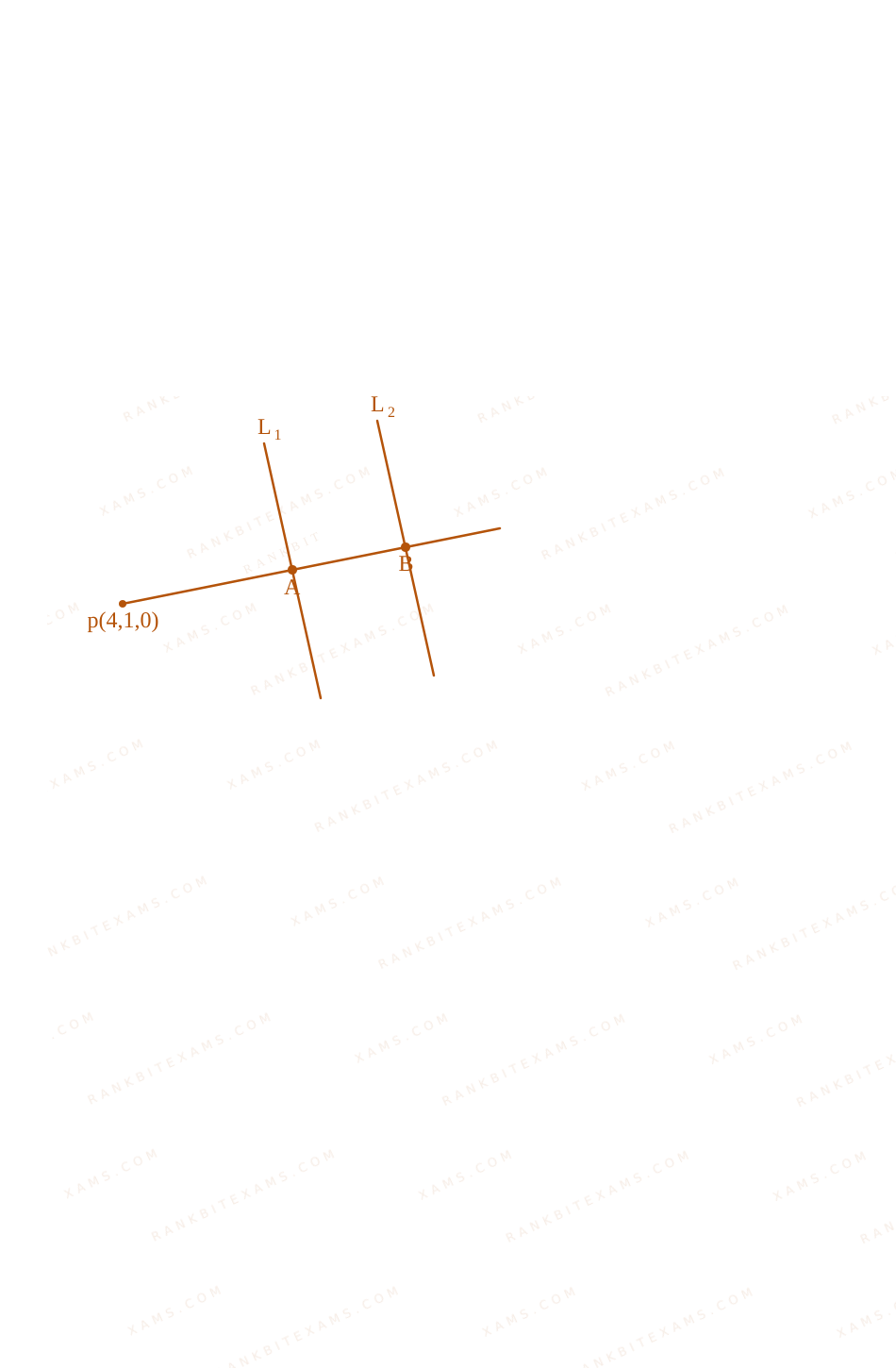
Intersection of Lines diagram for Q52 - JEE Main 2025 Morning

Core Logic

Express general coordinates for A on L₁ and B on L₂:

L₁: (x-1)/(2) = (y-2)/(3) = (z-3)/(4) = p A(2p+1, 3p+2, 4p+3) L₂: (x-6)/(1) = (y)/(1) = (z-4)/(-1) = q B(q+6, q, 4-q)

Direction ratios (D.R.) from P(4, 1, 0):

D.R. of PA = (2p-3, 3p+1, 4p+3) D.R. of PB = (q+2, q-1, 4-q)

Since P, A, B lie on the same line:

(2p-3)/(q+2) = (3p+1)/(q-1) = (4p+3)/(4-q)
Step 1: Solving the System of Equations

Equating the first two ratios:

2pq - 2p - 3q + 3 = 3pq + 6p + q + 2 pq + 8p + 4q - 1 = 0 --- (1)

Equating the second and third ratios:

12p - 3pq + 4 - q = 4pq + 3q - 4p - 3 7pq - 16p + 4q - 7 = 0 --- (2)

Subtracting (1) from (2) yields:

6pq - 24p - 6 = 0 pq = 4p + 1

Substituting pq = 4p + 1 into (1) gives:

12p + 4q = 0 q = -3p

Solving simultaneously yields:

p = -1, q = 3

Substituting the parameters back yields the points:

A(-1, -1, -1), B(9, 3, 1)
Step 2: Evaluating the Determinant

Substitute coordinates of A and B into the determinant:

vmatrix 1 & 0 & 1 -1 & -1 & -1 9 & 3 & 1 vmatrix

Applying the column operation C₃ arrow C₃ - C₁:

vmatrix 1 & 0 & 0 -1 & -1 & 0 9 & 3 & -8 vmatrix = 1((-1)(-8) - 0) = 8
Pattern Recognition

Shortcut: For collinearity across two skew lines with a known external point, express coordinates parametrically and equate direction ratios. Solving the linear relation between parameters rapidly leads to coordinates of A and B.

Evaluation Rubric / Model Answer

8

Chapter Mix

Class 12 Mathematics: Three Dimensional Geometry Class 12 Mathematics: Determinants

Q70 jee_main_2025_03_april_morning Shortest Distance between Skew Lines
Line L₁ passes through the point (1, 2, 3) and is parallel to z-axis[cite: 685]. Line L₂ passes through the point (lambda, 5, 6) and is parallel to y-axis[cite: 686]. Let for λ = λ₁, λ₂, λ₂ < λ₁ the shortest distance between the two lines be 3[cite: 698]. Then the square of the distance of the point (lambda₁, λ₂, 7) from the line L₁ is[cite: 698, 700]:
  • A. 40
  • B. 32
  • C. 25
  • D. 37

Solution

Related Formula

Shortest distance between perpendicular axes vectors:

S.D. = |( a₂ - a₁) · ( b₁ × b₂)|| b₁ × b₂|
Core Logic

Represent equations of straight lines symmetrically using vector directions [cite: 1418]: L₁: (x-1)/(0) = (y-2)/(0) = (z-3)/(1) [cite: 1418] L₂: (x-λ)/(0) = (y-5)/(1) = (z-6)/(0) [cite: 1418]

Evaluating the standard shortest distance configuration formula[cite: 1419, 1420]: S.D. = |λ - 1| = 3 λ - 1 = ± 3 [cite: 1420] λ = 4 or λ = -2 [cite: 1420]

Given the condition λ₂ < λ₁ [cite: 698]: λ₁ = 4, λ₂ = -2 [cite: 1421, 1422]

Step 1: Distance calculation from line

We need to find the square of distance from point P(4, -2, 7) to line L₁ [cite: 1424]. Any general matching point coordinates tracking along path L₁ look like Q(1, 2, t+3) [cite: 1424].

Form a perpendicular projection vector condition [cite: 1425]: PQ = (-3, 4, t-4) [cite: 1425] Since PQ · k = 0 t-4 = 0 t=4 [cite: 1425, 1426].

Thus, the foot of perpendicular is Q(1, 2, 7) [cite: 1427].

Evaluate the squared distance component magnitude [cite: 1427]: PQ² = (4-1)² + (-2-2)² + (7-7)² = 3² + (-4)² + 0 = 9 + 16 = 25 [cite: 1427, 1428]

Pattern Recognition

For lines parallel directly to independent Cartesian coordinate grid lines, the shortest paths are simply direct plane projections.

Chapter Mix

Class 12 Mathematics: Three Dimensional Geometry

Q56 jee_main_2025_04_april_evening Shortest Distance Between Two Lines
Let the values of p, for which the shortest distance between the lines (x + 1)/(3) = (y)/(4) = (z)/(5) and r = (p i + 2 j + hatk) + λ (2hati + 3hatj + 4hatk) is 1sqrt6, be a, b, (a < b). Then the length of the latus rectum of the ellipse (x²)/(a²) + (y²)/(b²) = 1 is:
  • A. 9
  • B. (3)/(2)
  • C. (2)/(3)
  • D. 18

Solution

Related Formula

The shortest distance between two lines r = a₁ + λ b₁ and r = a₂ + μ b₂ is given by:

d = |( a₂ - a₁) · ( b₁ × b₂)|| b₁ × b₂|
Core Logic

From the given line equations: Line 1 passes through a₁ = - i + 0 j + 0 k along vector b₁ = 3 i + 4 j + 5 k. Line 2 passes through a₂ = p i + 2 j + k along vector b₂ = 2 i + 3 j + 4 k.

Vector difference:

a₂ - a₁ = (p + 1) i + 2 j + k

Computing the cross product b₁ × b₂:

b₁ × b₂ = vmatrix i & j & k 3 & 4 & 5 2 & 3 & 4 vmatrix = i(16-15) - j(12-10) + k(9-8) = i - 2 j + k

Magnitude | b₁ × b₂| = √(1² + (-2)² + 1²) = √(6).

Step 1: Applying the Shortest Distance Value

Substitute these into the distance equation:

d = |((p + 1) i + 2 j + k) · ( i - 2 j + k)|√(6) = 1√(6) |(p + 1)(1) + 2(-2) + 1(1)| = 1 |p + 1 - 4 + 1| = 1 |p - 2| = 1

This yields two values for p:

  • p - 2 = 1 p = 3
  • p - 2 = -1 p = 1
  • Given that a, b are the parameters with a < b, we assign a = 1 and b = 3.

Step 2: Computing Latus Rectum of the Ellipse

The ellipse equation is:

(x²)/(1²) + (y²)/(3²) = 1

Since b > a, the formula for the length of the latus rectum is:

Latus Rectum = (2a²)/(b) = (2(1)²)/(3) = (2)/(3)
Pattern Recognition

Be careful with coordinate geometry variables; when an ellipse satisfies b > a, the major axis is along the y-axis, making the latus rectum equal to (2a²)/(b) instead of (2b²)/(a).

Chapter Mix

Class 12 Mathematics: Three Dimensional Geometry Class 11 Mathematics: Conic Sections

Q69 jee_main_2025_04_april_evening Angle Between Two Lines
Let A be the point of intersection of the lines L _ 1: (x - 7)/(1) = (y - 5)/(0) = (z - 3)/(- 1) and L₂: x - 13 = y + 34 = z + 75. Let B and C be the point on the lines L₁ and L₂ respectively such that AB = AC = √(15). Then the square of the area of the triangle ABC is :
  • A. 54
  • B. 63
  • C. 57
  • D. 60

Solution

Core Logic

First, find the point of intersection A by solving the lines. Any point on L₁ can be written as (λ + 7, 5, -λ + 3). Substituting this point into the equation for L₂:

((λ + 7) - 1)/(3) = (5 + 3)/(4) (λ + 6)/(3) = 2 λ = 0

Thus, the intersection point is A = (7, 5, 3).

Step 1: Calculating the Angle between lines

The directional vectors of lines L₁ and L₂ are u = i - k and v = 3hati + 4hatj + 5hatk respectively.

θ = | u · v|| u|| v| = |1(3) + 0(4) - 1(5)|√(1²+(-1)²) √(3²+4²+5²) = |3 - 5|√(2)√(50) = (2)/(10) = (1)/(5)

Now, find θ:

θ = √(1 - ²θ) = √(1 - (1)/(25)) = √(24)5

Three dimensional geometry diagram for Q69 - JEE Main 2025 Evening

Step 2: Finding Area of the Triangle

The area of ABC given two sides and their included angle is:

Area = (1)/(2) · AB · AC · θ

Given AB = AC = √(15):

Area = (1)/(2) · √(15) · √(15) · √(24)5 = 15√(24)10 = 3√(24)2

Squaring the area:

Area² = ( 3√(24)2)² = (9 × 24)/(4) = 9 × 6 = 54
Pattern Recognition

Since B and C lie on lines intersecting at A, you don't need to determine their exact coordinates to find the area of the triangle. The standard side-angle-side area formula works perfectly using just the directional angle.

Chapter Mix

Class 12 Mathematics: Three Dimensional Geometry Class 11 Mathematics: Properties of Triangles

Q jee_main_2025_04_april_morning Line and Point Relations
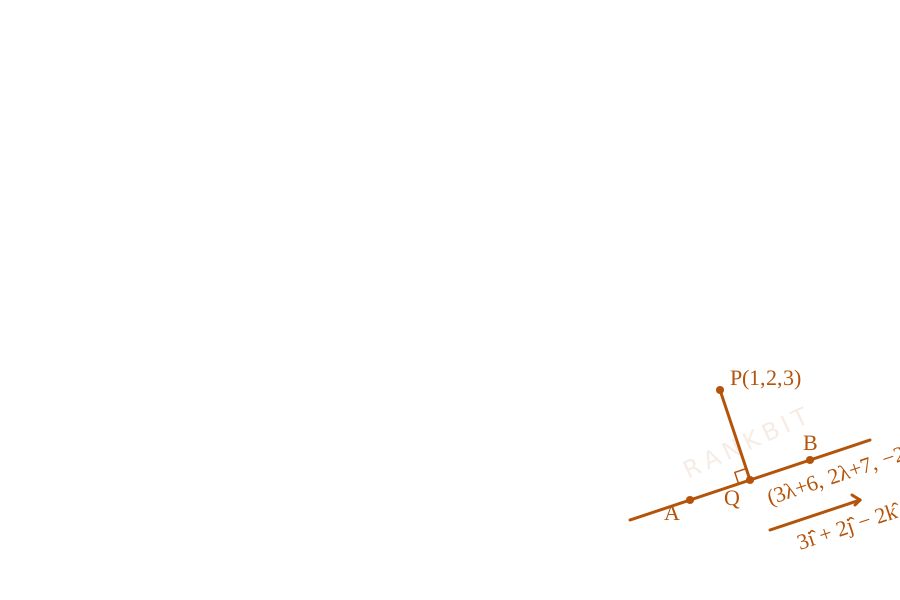
Let A and B be two distinct points on the line L: (x - 6)/(3) = (y - 7)/(2) = (z - 7)/(-2). Both A and B are at a distance 2√(17) from the foot of perpendicular drawn from the point (1,2,3) on the line L. If O is the origin, then OA· OB is equal to:
  • A. 49
  • B. 47
  • C. 21
  • D. 62

Solution

Related Formula

Dot product of two vectors:

OA · OB = xA xB + yA yB + zA zB

Condition for perpendicularity of two vectors:

u · v = 0
Core Logic

The symmetric equation of line L is:

(x - 6)/(3) = (y - 7)/(2) = (z - 7)/(-2) = λ

Any general point Q on line L can be expressed as:

Q(3λ + 6, 2λ + 7, -2λ + 7)

The vector from P(1, 2, 3) to Q is:

PQ = (3λ + 5) i + (2λ + 5) j + (-2λ + 4) k

Since Q is the foot of the perpendicular dropped from P onto L, the vector PQ is orthogonal to the line's direction vector b = 3 i + 2 j - 2 k:

PQ · b = 0 3(3λ + 5) + 2(2λ + 5) - 2(-2λ + 4) = 0 9λ + 15 + 4λ + 10 + 4λ - 8 = 0 17λ = -17 λ = -1

Substituting λ = -1 gives the foot of perpendicular: Q(3, 5, 9)

Step 1: Locate Points A and B

Points A and B lie on line L at a distance d = 2√(17) on either side of Q.

Let the coordinates of points on L relative to Q be (3μ + 3, 2μ + 5, -2μ + 9). The distance squared from Q is:

(3μ)² + (2μ)² + (-2μ)² = (2√(17))² 17μ² = 68 μ² = 4 μ = ± 2
  • For μ = 2:
A = (3(2) + 3, 2(2) + 5, -2(2) + 9) = (9, 9, 5)
  • For μ = -2:
B = (3(-2) + 3, 2(-2) + 5, -2(-2) + 9) = (-3, 1, 13)

Line and Point Relations diagram for Q59 - JEE Main 2025 Morning

Step 2: Vector Dot Product Evaluation

Position vectors of A and B from origin O(0, 0, 0):

OA = 9 i + 9 j + 5 k OB = -3 i + j + 13 k

Compute their scalar dot product:

OA · OB = (9)(-3) + (9)(1) + (5)(13) = -27 + 9 + 65 = 47
Pattern Recognition

Points lying symmetrically at equal distances along a 3D line from a known central point can be found directly using parametric displacement along the unit direction vector (r = rQ ± d b).

Evaluation Rubric / Model Answer

Option B: 47

Chapter Mix

Class 12 Mathematics: Three Dimensional Geometry

More Three Dimensional Geometry Questions — jee_main_2025_08_april_evening

Practice all Three Dimensional Geometry previous-year questions →

Rankbit System
JEE Physics: Waves (+15.5%) | Electrostatics: Concentric Shells (-29.7%) | Modern Physics: Photoelectric Clones (+34.2%) | Mathematics: Definite Integrals (+18.1%) | Chemistry: Coordination Splitting (-11.4%) | JEE Physics: Waves (+15.5%) | Electrostatics: Concentric Shells (-29.7%) | Modern Physics: Photoelectric Clones (+34.2%) | Mathematics: Definite Integrals (+18.1%) | Chemistry: Coordination Splitting (-11.4%)