Solution
Related Formula
The line passing through a and \parallel to direction vector v = l i + m j + n k is written in symmetric form as:
(x - xₐ)/(l) = (y - yₐ)/(m) = (z - zₐ)/(n)Core Logic
Formulate the equation of the line passing through (-1, 2, 1) with direction vector components (2, 3, 4):
L₁: (x + 1)/(2) = (y - 2)/(3) = (z - 1)/(4) = λ (1)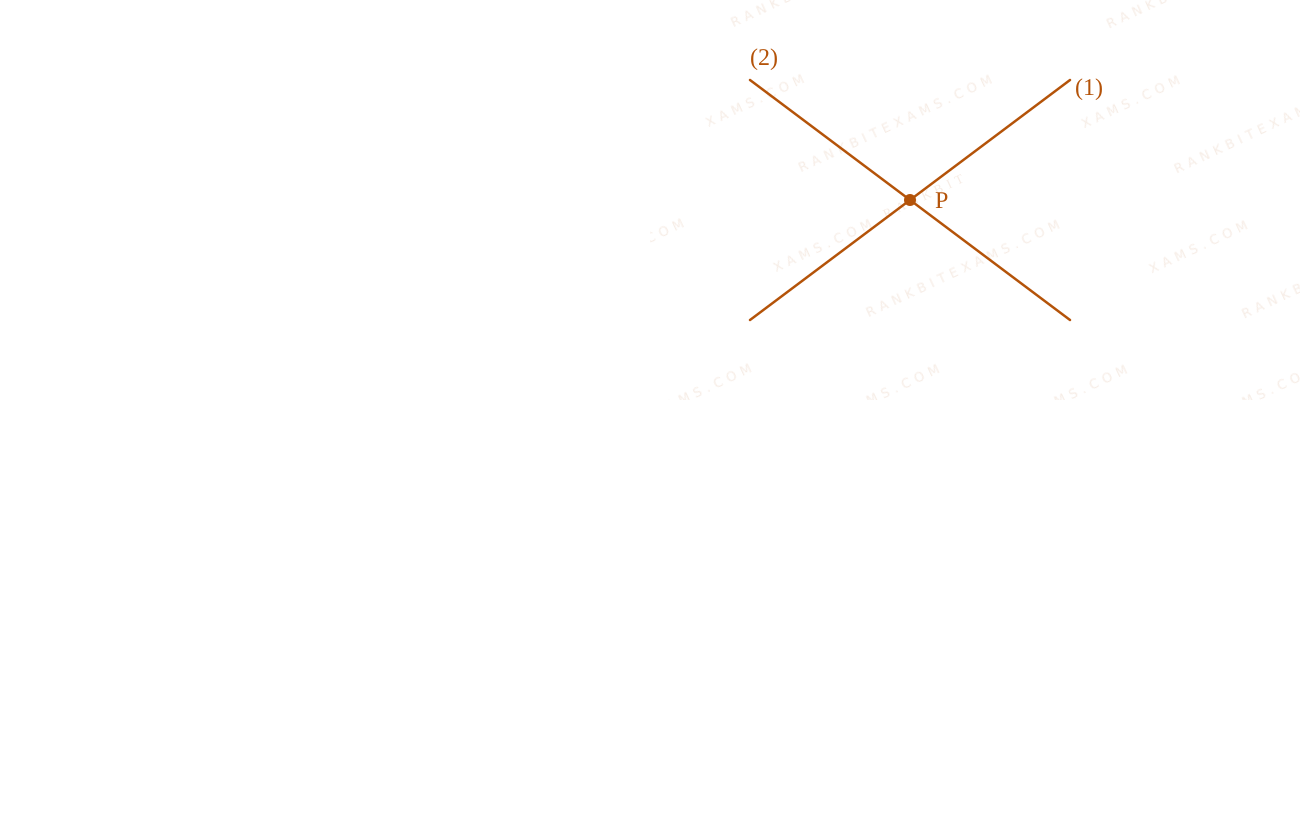
Any generic point on this line can be written as:
P = (2λ - 1, 3λ + 2, 4λ + 1)The second given line equation is:
L₂: (x + 2)/(3) = (y - 3)/(2) = (z - 4)/(1) = μ (2)Any generic point on line L₂ is:
P' = (3μ - 2, 2μ + 3, μ + 4)Step 1: Compute the Point of Intersection
At the point of intersection P, equate the coordinates from both lines:
2λ - 1 = 3μ - 2 2λ - 3μ = -1 (3) 3λ + 2 = 2μ + 3 3λ - 2μ = 1 (4) 4λ + 1 = μ + 4 4λ - μ = 3 (5)Solving equations (3) and (4) simultaneously gives:
λ = 1, μ = 1Verify these values using equation (5):
4(1) - 1 = 3 (Satisfied)Thus, substituting λ = 1 gives the coordinates of point P:
P = (2(1) - 1, 3(1) + 2, 4(1) + 1) = (1, 5, 5)Step 2: Calculate Euclidean Distance PQ
Find the distance between P(1, 5, 5) and Q(4, -5, 1) using the 3D distance formula:
PQ = √((4 - 1)² + (-5 - 5)² + (1 - 5)²) PQ = √(3² + (-10)² + (-4)²) = √(9 + 100 + 16) PQ = √(125) = 5√(5)Pattern Recognition
When finding the intersection point of two 3D lines, always use the third coordinate equation to verify the parameter values obtained from the first two equations to ensure consistency.
Chapter Mix
Class 12 Mathematics: Three Dimensional Geometry

