Rankbit System
JEE Physics: Waves (+15.5%) | Electrostatics: Concentric Shells (-29.7%) | Modern Physics: Photoelectric Clones (+34.2%) | Mathematics: Definite Integrals (+18.1%) | Chemistry: Coordination Splitting (-11.4%) | JEE Physics: Waves (+15.5%) | Electrostatics: Concentric Shells (-29.7%) | Modern Physics: Photoelectric Clones (+34.2%) | Mathematics: Definite Integrals (+18.1%) | Chemistry: Coordination Splitting (-11.4%)

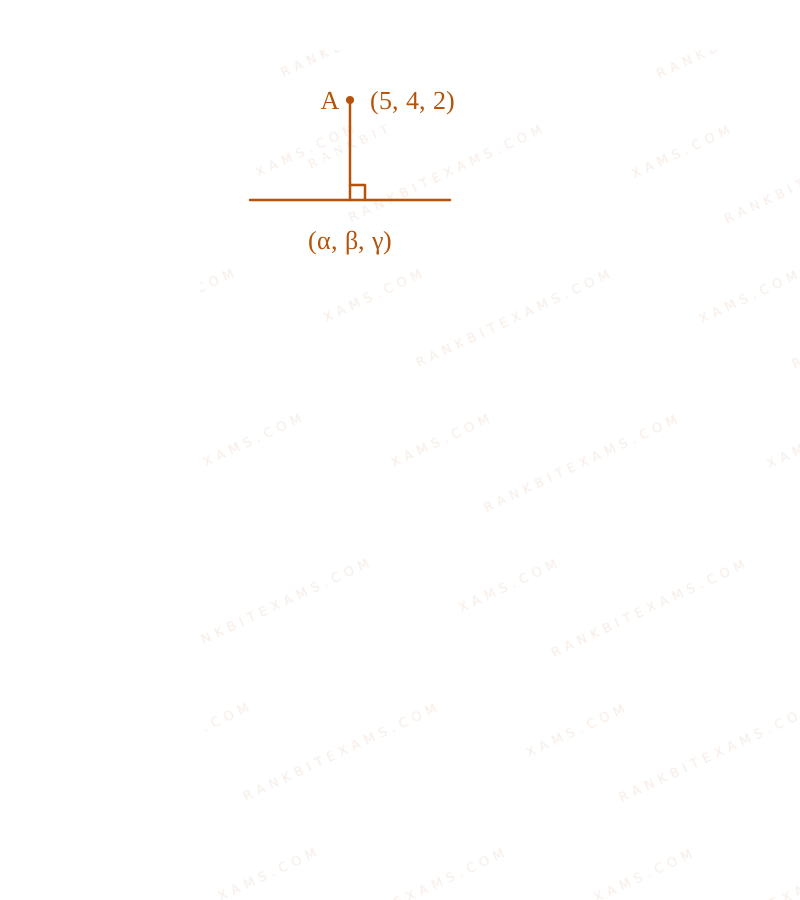
Let L_1: fracx - 11 = fracy - 2-1 = fracz - 12 and mathrmL_2:fracmathrmx + 1-1 = fracmathrmy - 22 = fracmathrmz1 be two lines. Let mathrmL_3 be a line passing through the point (alpha, beta, gamma) and be perpendicular to both mathrmL_1 and mathrmL_2 . If mathrmL_3 intersects mathrmL_1 , then |5alpha - 11beta - 8gamma| equals:

Solution & Explanation

### Related Formula textDirection ratios of a line perpendicular to both vectors: vecv = vecd_1 times vecd_2 ### Core Logic Compute direction ratios for L_3 using cross product of direction vectors of L_1 and L_2: vecv = left| beginarrayccc hati & hatj & hatk \\ 1 & -1 & 2 \\ -1 & 2 & 1 endarray right| = -5hati - 3hatj + hatk ### Step 1: Establish intersection constraints Let A be a general point on L_3 and B be a general point on L_1: A = (alpha - 5lambda, beta - 3lambda, gamma + lambda) B = (k+1, -k+2, 2k+1) Since L_3 intersects L_1, at the point of intersection A equiv B: alpha - 5lambda = k + 1 implies alpha = 5lambda + k + 1 beta - 3lambda = -k + 2 implies beta = 3lambda - k + 2 gamma + lambda = 2k + 1 implies gamma = -lambda + 2k + 1 ### Step 2: Solve final algebraic target equation Substitute expressions into the target mod expression: 5alpha - 11beta - 8gamma = 5(5lambda + k + 1) - 11(3lambda - k + 2) - 8(-lambda + 2k + 1) = lambda(25 - 33 + 8) + k(5 + 11 - 16) + (5 - 22 - 8) = 0lambda + 0k - 25 = -25 Taking absolute value yields |-25| = 25. ### Pattern Recognition The cancellation of internal variables (lambda and k) shows that the absolute expression describes a invariant geometric plane coordinate constraint, allowing simple baseline parameter values (like k=0, lambda=0) to evaluate the question instantly. ### Evaluation Rubric / Model Answer null ### Chapter Mix Class 12 Mathematics: Three Dimensional Geometry

Reference Study Guides

More Three Dimensional Geometry Previous-Year Questions

Q51 2025 Image of a Point in a Line
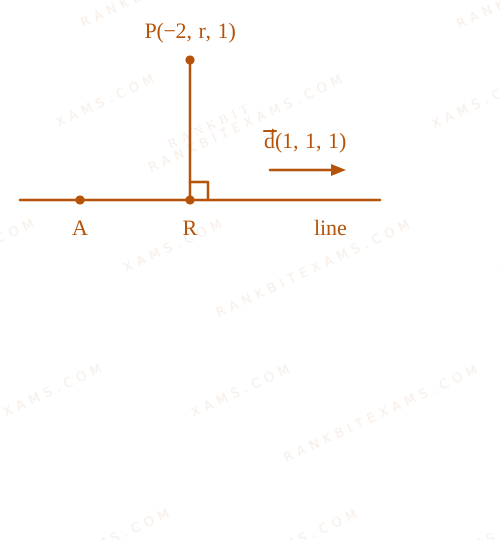
If the image of the point mathrmP(1, 0, 3) in the line joining the points mathrmA(4, 7, 1) and mathrmB(3, 5, 3) is mathrmQ(alpha, beta, gamma), then alpha + beta + gamma is equal to
  • A. frac473
  • B. frac463
  • C. 18
  • D. 13

Solution

### Related Formula textEquation of a line through (x_1, y_1, z_1) text with direction ratios (a, b, c): quad fracx-x_1a = fracy-y_1b = fracz-z_1c textCondition for Perpendicular Lines: quad a_1 a_2 + b_1 b_2 + c_1 c_2 = 0 ### Core Logic Let R be the foot of the perpendicular drawn from point P(1,0,3) to the line joining A(4,7,1) and B(3,5,3). Since Q(alpha,beta,gamma) is the reflection (image) of P across the line, point R serves as the midpoint of the line segment PQ. ### Step 1: Find the Equation of the Line AB The direction ratios of the line AB are: vecd = (3 - 4, 5 - 7, 3 - 1) = (-1, -2, 2) equiv (1, 2, -2) Using point B(3,5,3), the symmetric equation of the line AB is: fracx - 31 = fracy - 52 = fracz - 3-2 = lambda Any general point R on this line can be written in terms of parameter lambda: R equiv (lambda + 3, 2lambda + 5, -2lambda + 3) ### Step 2: Find the Foot of the Perpendicular R The direction ratios of the line segment PR are: vecmathrmPR = (lambda + 3 - 1, \, 2lambda + 5 - 0, \, -2lambda + 3 - 3) = (lambda + 2, \, 2lambda + 5, \, -2lambda) Since PR is perpendicular to the line AB, the dot product of their direction vectors must equal zero: 1(lambda + 2) + 2(2lambda + 5) - 2(-2lambda) = 0 lambda + 2 + 4lambda + 10 + 4lambda = 0 lambda = -frac43 ### Step 3: Coordinates of Foot of Perpendicular Substitute lambda = -frac43 into the general coordinates of R: R equiv left(-frac43 + 3, \, 2left(-frac43right) + 5, \, -2left(-frac43right) + 3right) R equiv left(frac53, \, frac73, \, frac173right) ### Step 4: Solve for the Image Coordinates and Sum Since R is the midpoint of PQ, where P = (1, 0, 3) and Q = (alpha, beta, gamma): - fracalpha + 12 = frac53 implies alpha = frac103 - 1 = frac73 - fracbeta + 02 = frac73 implies beta = frac143 - fracgamma + 32 = frac173 implies gamma = frac343 - 3 = frac253 Now, let us calculate the sum: alpha + beta + gamma = frac73 + frac143 + frac253 = frac463 ### Pattern Recognition Standard Midpoint reflection: The image coordinates are given directly by x_textimage = 2 x_textfoot - x_textpoint, y_textimage = 2 y_textfoot - y_textpoint, and z_textimage = 2 z_textfoot - z_textpoint. Finding the parameter lambda by using the perpendicular vector dot-product rule is the fastest and most robust method. ### Evaluation Rubric / Model Answer null ### Chapter Mix Class 12 Mathematics: Three Dimensional Geometry
Q56 2025 Shortest Distance between Skew Lines
The line mathrmL_1 is parallel to the vector vecmathrma = -3hatmathrmi + 2hatmathrmj + 4hatmathrmk and passes through the point (7, 6, 2) and the line mathrmL_2 is parallel to the vector vecmathrmb = 2hatmathrmi + hatmathrmj + 3hatmathrmk and passes through the point (5, 3, 4). The shortest distance between the lines mathrmL_1 and mathrmL_2 is:
  • A. frac23sqrt38
  • B. frac21sqrt57
  • C. frac23sqrt57
  • D. frac21sqrt38

Solution

### Related Formula textShortest Distance d = fracleft| (vecr_2 - vecr_1) cdot (veca times vecb) right||veca times vecb| ### Core Logic Shortest distance between two skew lines is the projection of the vector joining any two points of the lines onto their common normal. ### Step 1: Find the vector joining the two points Let the points be P_1(7, 6, 2) on L_1 and P_2(5, 3, 4) on L_2: vecr_2 - vecr_1 = (5 - 7)hatmathrmi + (3 - 6)hatmathrmj + (4 - 2)hatmathrmk = -2hatmathrmi - 3hatmathrmj + 2hatmathrmk ### Step 2: Find the common normal vector The direction is given by the cross product of the direction vectors: veca times vecb = beginvmatrix hatmathrmi & hatmathrmj & hatmathrmk \\ -3 & 2 & 4 \\ 2 & 1 & 3 endvmatrix veca times vecb = hatmathrmi(6 - 4) - hatmathrmj(-9 - 8) + hatmathrmk(-3 - 4) = 2hatmathrmi + 17hatmathrmj - 7hatmathrmk ### Step 3: Calculate the distance Calculate the dot product of the vectors: (vecr_2 - vecr_1) cdot (veca times vecb) = (-2)(2) + (-3)(17) + (2)(-7) = -4 - 51 - 14 = -69 Calculate the magnitude of the cross product: |veca times vecb| = sqrt2^2 + 17^2 + (-7)^2 = sqrt4 + 289 + 49 = sqrt342 = 3sqrt38 Now, compute the shortest distance: d = frac|-69|3sqrt38 = frac23sqrt38 ### Pattern Recognition Matrix determinant check: In skew lines problems, the numerator can also be computed as the determinant of the 3x3 matrix composed of (vecr_2-vecr_1), veca, and vecb. ### Evaluation Rubric / Model Answer null ### Chapter Mix Class 12 Mathematics: Three Dimensional Geometry
Q74 2025 Area of Triangles
Let mathrmA(4, -2), mathrmB(1, 1) and mathrmC(9, -3) be the vertices of a triangle ABC. Then the maximum area of the parallelogram AFDE, formed with vertices D, E and F on the sides BC, CA and AB of the triangle ABC respectively, is ____________.
Numerical Answer. Answer: 3 to 3

Solution

### Related Formula textArea of triangle ABC = frac12 left| x_1(y_2 - y_3) + x_2(y_3 - y_1) + x_3(y_1 - y_2) right| textMaximum area of an inscribed parallelogram = frac12 times textArea of triangle ### Core Logic First, we compute the total area of the triangle ABC from the given coordinate points. We then apply the geometric maximum area property for inscribed parallelograms. ### Step 1: Calculate the area of triangle ABC The coordinate points are A(4, -2), B(1, 1), and C(9, -3): textArea(Delta textABC) = frac12 beginvmatrix 4 & -2 & 1 \\ 1 & 1 & 1 \\ 9 & -3 & 1 endvmatrix textArea(Delta textABC) = frac12 left| 4(1 - (-3)) - (-2)(1 - 9) + 1(-3 - 9) right| textArea(Delta textABC) = frac12 left| 4(4) + 2(-8) + 1(-12) right| textArea(Delta textABC) = frac12 left| 16 - 16 - 12 right| = 6 text square units ### Step 2: Apply the maximum area theorem The maximum area of a parallelogram inscribed in a triangle of area Delta is always exactly half the area of the triangle: textMaximum Area = frac12 times textArea(Delta textABC) = frac12 times 6 = 3 text square units ### Pattern Recognition Inscribed shapes maximization: The maximum area of any inscribed parallelogram AFDE on the sides of a triangle ABC occurs when the vertices D, E, F are exactly the midpoints of the respective sides of the triangle. ### Evaluation Rubric / Model Answer null ### Chapter Mix Class 11 Mathematics: Straight Lines
Q 2025 Area of Triangle in 3D Space
Let the vertices Q and R of the triangle PQR lie on the line fracx+35=fracy-12=fracz+43, QR=5 and the coordinates of the point P be (0, 2, 3). If the area of the triangle PQR is fracmn then:
  • A. m-5sqrt21n=0
  • B. 2m-5sqrt21n=0
  • C. 5m-2sqrt21n=0
  • D. 5m-21sqrt2n=0

Solution

### Related Formula Area of a triangle given base length b and perpendicular height h: textArea = frac12 cdot b cdot h ### Core Logic Since Q and R lie on the line, the length QR=5 forms the base of the triangle. The perpendicular distance from point P to the line represents the height h.
Area of Triangle in 3D Space diagram for Q67 - JEE Main 2025 Morning
### Step 1: Define Perpendicular Foot coordinates Let M be the foot of the perpendicular from P(0,2,3) to the line. Parametric form of any point on the line: M(5lambda - 3, 2lambda + 1, 3lambda - 4) Direction ratios of line segment PM: textDRs = (5lambda - 3 - 0, 2lambda + 1 - 2, 3lambda - 4 - 3) = (5lambda - 3, 2lambda - 1, 3lambda - 7) ### Step 2: Solve for Parameter using Perpendicularity Since PM is perpendicular to the given line (DRs: 5, 2, 3): 5(5lambda - 3) + 2(2lambda - 1) + 3(3lambda - 7) = 0 25lambda - 15 + 4lambda - 2 + 9lambda - 21 = 0 implies 38lambda = 38 implies lambda = 1 ### Step 3: Compute Perpendicular Distance For lambda = 1, the coordinates of M are (2, 3, -1). Calculate length PM: PM = sqrt(2-0)^2 + (3-2)^2 + (-1-3)^2 = sqrt4 + 1 + 16 = sqrt21 ### Step 4: Formulate the Area Equation textArea = frac12 cdot QR cdot PM = frac12 cdot 5 cdot sqrt21 = fracmn frac5sqrt212 = fracmn implies 2m = 5sqrt21n implies 2m - 5sqrt21n = 0 ### Pattern Recognition Finding the foot of a perpendicular via parametric variables is a guaranteed shortcut for 3D area problems instead of cross-product calculations, keeping computation times minimal. ### Evaluation Rubric / Model Answer null ### Chapter Mix Class 12 Mathematics: Three Dimensional Geometry
Q 2025 Properties of Tetrahedron
Let ABCD be a tetrahedron such that the edges AB, AC and AD are mutually perpendicular. Let the areas of the triangles ABC, ACD and ADB be 5, 6 and 7 square units respectively. Then the area (in square units) of the Delta BCD is equal to:
  • A. sqrt340
  • B. 12
  • C. sqrt110
  • D. 7sqrt3

Solution

### Related Formula De Gua's Theorem (3D extension of Pythagorean theorem) for right corner tetrahedron states: [textArea(Delta BCD)]^2 = [textArea(Delta ABC)]^2 + [textArea(Delta ACD)]^2 + [textArea(Delta ADB)]^2 ### Core Logic Since the three edges meeting at vertex A are mutually perpendicular, we can align them directly with orthogonal coordinate axes to compute the slanted face area. ### Step 1: Apply Square Area Summation Let the target area be Delta. Delta^2 = 5^2 + 6^2 + 7^2 Delta^2 = 25 + 36 + 49 = 110 Delta = sqrt110 ### Pattern Recognition This is exactly analogous to finding the length of a vector given three perpendicular component lengths. Squaring, adding, and taking the square root yields the value immediately. ### Evaluation Rubric / Model Answer null ### Chapter Mix Class 12 Mathematics: Three Dimensional Geometry Class 12 Mathematics: Vector Algebra

More Three Dimensional Geometry Questions — jee_main_2025_29_jan_morning

Practice all Three Dimensional Geometry previous-year questions →

YOUR FIRST PREP STEP STARTS HERE

We Map Every Repeating Question in Competitive Exams.

Say goodbye to generic mock test fatigue. RankBit uses smart analysis to group past exam questions into their foundational Repeating Question Types. Find chapter weightage, track repeating questions, and score higher with targeted practice.

Select Your Target Exam

Choose an exam track below to find formulas per chapter and patterns.

Syncing Exam Intelligence

Mapping formulas and patterns across all tracks…

PATH A — FULL LENGTH PRACTICE

Full Mock Test Hub

Simulate real NTA exam conditions with fully tracked mocks. Time yourself against past papers.

Under Development
PATH B — TARGETED PRACTICE

Topic-wise Practice Hub

Practice past-year questions one chapter at a time. Pick an exam → subject → chapter and get every PYQ for that topic — pulled together from all past papers — with the chapter's key formulas alongside.

Loading Questions... Browse Topics
Latest from the Blog
View all →

Loading articles...