JEE Main · Mathematics ↓ Falling

Three Dimensional Geometry appeared 62 times across 3 years — 7.2% of Mathematics. This question is from Shortest Distance Between Lines.

Year 2026 2025 2024 Total
Questions 15 29 18 62

Let the values of λ for which the shortest distance between the lines (x - 1)/(2) = (y - 2)/(3) = (z - 3)/(4) (x - λ)/(3) = (y - 4)/(4) = (z - 5)/(5) is 1√(6) be λ₁ and λ₂. Then the radius of the circle passing through the points (0, 0), (λ₁, λ₂) and (λ₂, λ₁) is

Solution & Explanation

Related Formula
Shortest Distance = | AB · ( p × q)| p × q| |
Core Logic

Identify points A(1, 2, 3) and B(λ, 4, 5) on the lines with directions p = 2 i + 3 j + 4 k and q = 3 i + 4 j + 5 k respectively. Use the shortest distance formula to determine λ₁ and λ₂.

Step 1: Calculate Cross Product and Direction Vector
p × q = vmatrix i & j & k 2 & 3 & 4 3 & 4 & 5 vmatrix = - i + 2 j - k | p × q| = √((-1)² + 2² + (-1)²) = √(6) AB = (λ - 1) i + 2 j + 2 k
Step 2: Solve for Lambda
1√(6) = | ((λ - 1) i + 2 j + 2 k) · (- i + 2 j - k)√(6) | |-λ + 1 + 4 - 2| = 1 |λ - 3| = 1 λ = 4 or 2
Step 3: Radius of the Passing Circle

The circle passes through (0,0), (4,2) and (2,4). Using the circumradius formula R = (abc)/(4Δ):

a = √(20), b = √(20), c = √(8) Δ = (1)/(2) vmatrix 1 & 1 & 1 0 & 4 & 2 0 & 2 & 4 vmatrix = 6 R = √(20) × √(20) × √(8)4 × 6 = 40√(2)24 = 5√(2)3
Pattern Recognition

Shortest distance values create symmetric configurations. When finding a circle passing through (0,0), (x,y), and (y,x), the symmetry about y=x simplifies radius calculations immediately.

Chapter Mix

Class 12 Mathematics: Three Dimensional Geometry Class 11 Mathematics: Circles

Reference Study Guides

More Three Dimensional Geometry Previous-Year Questions — Page 6

Q73 jee_main_2025_08_april_evening Area of Triangle Formed by Intersecting Lines
Let the area of the triangle formed by the lines x + 2 = y - 1 = z, (x - 3)/(5) = (y)/(-1) = (z - 1)/(1) and x-3 = y - 33 = z - 21 be A. Then A² is equal to
Numerical Answer. Answer: 56 to 56

Solution

Related Formula
Area A = (1)/(2) | AB × AC|
Core Logic

Determine the three intersection vertex positions for the matching coordinate line segments, then calculate vector cross expansions to determine face boundaries.

Step 1: Locate Intersection Vertices

Solving line pairs intersection matrices:

  • L₁ L₂ A(-2, 1, 0)
  • L₂ L₃ B(3, 0, 1)
  • L₃ L₁ C(0, 3, 2)
Step 2: Construct Vectors Cross Matrix

Using vertex values to form component arrays:

AB = -5 i + j - k, AC = -3 i + 3 j + k AB × AC = vmatrix i & j & k -5 & 1 & -1 -3 & 3 & 1 vmatrix = 4 i + 8 j - 12 k
Step 3: Final Area Squared Derivation
A = (1)/(2)√(16 + 64 + 144) = (1)/(2)√(224) = √(56)

A² = 56

{{SOL_IMG_73}}

Pattern Recognition

Finding the area of a triangle formed by intersecting lines involves grouping directional cross vectors once coordinates are solved.

Chapter Mix

Class 12 Mathematics: Three Dimensional Geometry
Q56 jee_main_2025_29_jan_evening Line and Plane Intersections
Let a straight line L pass through the point P(2, -1, 3) and be perpendicular to the lines (x - 1)/(2) = (y + 1)/(1) = (z - 3)/(-2) and \frac{x - 3}{1} = \frac{y - 2}{3} = \frac{z + 2}{4}. If the line L intersects the yz-plane at the point Q, then the distance between the points P and Q is:
  • A. 2
  • B. √(10)
  • C. 3
  • D. 2√(3)

Solution

Related Formula

The direction vector of a line perpendicular to two vectors u and v is obtained via the cross product:

n = u × v
Core Logic

Extract direction vectors of the given lines:

u = 2 i + j - 2 k v = i + 3 j + 4 k

Compute the cross product:

n = vmatrix i & j & k 2 & 1 & -2 1 & 3 & 4 vmatrix = i(4 - (-6)) - j(8 - (-2)) + k(6 - 1) = 10 i - 10 j + 5 k = 5(2 i - 2 j + k)
Step 1: Write Line Equation and Intersect with Plane

Equation of line L through P(2, -1, 3) with direction (2, -2, 1):

(x - 2)/(2) = (y + 1)/(-2) = (z - 3)/(1) = λ

Any random point on this line is Q(2λ + 2, -2λ - 1, λ + 3). For intersection with the yz-plane, set x = 0:

2λ + 2 = 0 λ = -1
Step 2: Find Distance

Substituting λ = -1 into the coordinate matrix of Q gives: Q(0, 1, 2)

Calculate distance d(P, Q):

d = √((2 - 0)² + (-1 - 1)² + (3 - 2)²) = √(4 + 4 + 1) = 3
Pattern Recognition

Perpendicularity to two lines always indicates using the cross-product to lock down the direction ratios. Intersection with the yz-plane simply forces x = 0 immediately.

Chapter Mix

Class 12 Mathematics: Three Dimensional Geometry

Q63 jee_main_2025_29_jan_evening Shortest Distance and Intersection of Lines
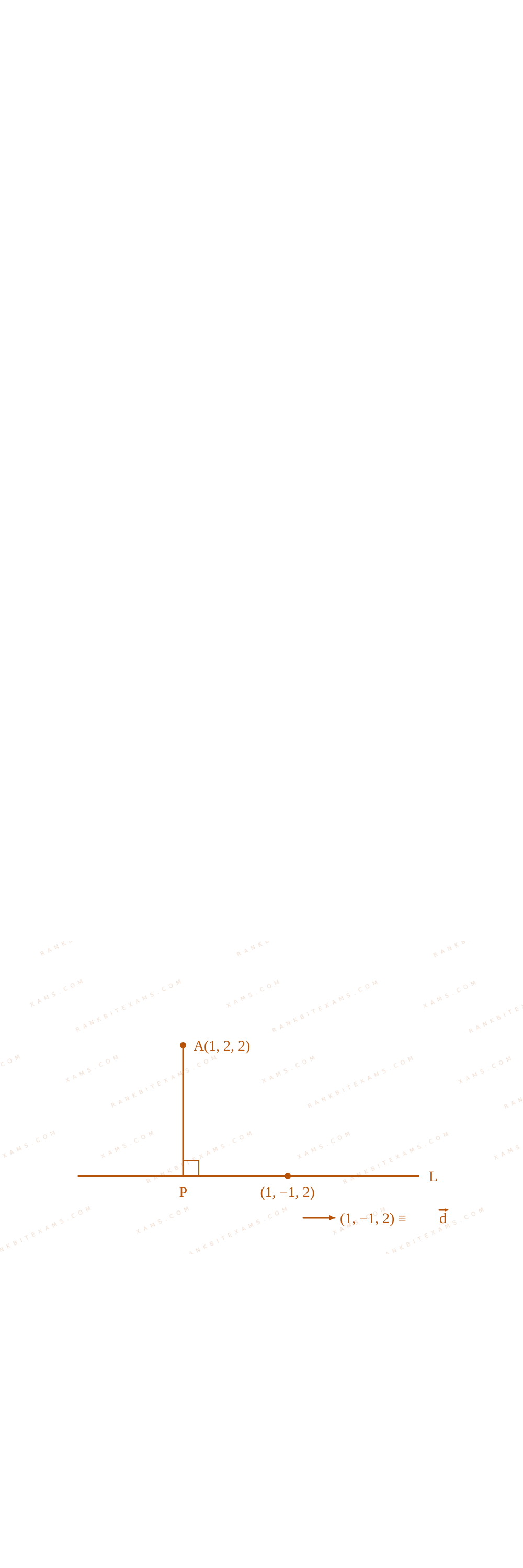
Let P be the foot of the perpendicular from the point (1,2,2) on the line L: x - 11 = y + 1-1 = z - 22. Let the line r = (- i + j -2 k) + λ ( i - j + k), λ in R, intersect the line L at Q. Then 2(PQ)² is equal to:
  • A. 27
  • B. 25
  • C. 29
  • D. 19

Solution

Related Formula

Dot product of vector projection matching orthogonal axes equals zero:

AP · d = 0
Core Logic

Let the target source coordinates tracking point match A(1, 2, 2). General parameter points on line L are defined by parameter μ:

P(μ + 1, -μ - 1, 2μ + 2)

Shortest Distance and Intersection of Lines diagram for Q63 - JEE Main 2025 Evening

AP = μ i - (μ + 3) j + 2μ k

Line direction vector d = i - j + 2 k.

Step 1: Isolate Foot and Intersection Positions
(μ)· 1 - (-μ - 3)· 1 + (2μ)· 2 = 0 6μ + 3 = 0 μ = -(1)/(2)

Substituting back yields coordinate positions for foot P:

P((1)/(2), -(1)/(2), 1)

Equating general vectors between standard linear constraints tracks intersection point Q at μ = -2: Q(-1, 1, -2)

Step 2: Distance Formulation

Compute length of line segment squared:

PQ² = ((1)/(2) - (-1))² + (-(1)/(2) - 1)² + (1 - (-2))² = (9)/(4) + (9)/(4) + 9 = (54)/(4) 2(PQ)² = 2 ((54)/(4)) = 27
Pattern Recognition

Always separate foot evaluations from line-intersection parameter updates to ensure you do not mix up variables tracking linear metrics.

Chapter Mix

Class 12 Mathematics: Three Dimensional Geometry

Q jee_main_2025_28_jan_morning Distance Formula and Properties of Triangles
Let A(x,y,z) be a point in xy-plane, which is equidistant from three points (0, 3, 2), (2, 0, 3) and (0, 0, 1). Let B = (1, 4, -1) and C = (2, 0, -2). Then among the statements (S1) : Δ ABC is an isosceles right angled triangle and (S2): the area of Δ ABC is 9√(2)2.
  • A. both are true
  • B. only (S1) is true
  • C. only (S2) is true
  • D. both are false

Solution

Related Formula

3D Cartesian distance formula:

d = √((x₂-x₁)² + (y₂-y₁)² + (z₂-z₁)²)
Core Logic

Since A(x,y,z) lies in the xy-plane, its z-coordinate must be zero (z = 0). Let the reference targets be P(0,3,2), Q(2,0,3), and R(0,0,1).

Setting AP² = AR²:

x² + (y-3)² + (0-2)² = x² + y² + (0-1)² y = 2
Step 1: Locating Coordinate Dimensions

Setting AQ² = AR² with y=2:

(x-2)² + 2² + 3² = x² + 2² + 1² x = 3

Thus, A is precisely located at (3,2,0).

Step 2: Triangle Side and Area Assessment

Calculate the lengths between A(3,2,0), B(1,4,-1), and C(2,0,-2): AB = √((3-1)² + (2-4)² + (0+1)²) = 3 AC = √((3-2)² + (2-0)² + (0+2)²) = 3 BC = √((1-2)² + (4-0)² + (-1+2)²) = √(18)

Since AB = AC = 3 and AB² + AC² = BC², it forms an isosceles right-angled triangle. Thus, (S1) is true.

Area = (1)/(2) × 3 × 3 = (9)/(2)

Therefore, (S2) is false.

Pattern Recognition

Planar locations instantly zero out specific coordinate dimensions (z=0 for xy-planes), simplifying system matrices down rapidly.

Chapter Mix

Class 11 Maths: Three Dimensional Geometry

Q jee_main_2025_28_jan_morning Image of a Point in a Line
If the image of the point (4, 4, 3) in the line (x - 1)/(2) = (y - 2)/(1) = (z - 1)/(3) is (α, β, γ), then α + β + γ is equal to
  • A. 9
  • B. 12
  • C. 8
  • D. 7

Solution

Related Formula

Perpendicularity condition for vectors:

u · v = 0
Core Logic

Let Q be the projection point on the given line parameterized by λ: Q(2λ + 1, λ + 2, 3λ + 1).

The vector PQ from P(4,4,3) is:

Image of a Point in a Line diagram for Q62 - JEE Main 2025 Morning
PQ = (2λ - 3) i + (λ - 2) j + (3λ - 2) k.

Step 1: Solving for Projected Intersection Points

Since PQ is perpendicular to the line's direction vector (2, 1, 3):

2(2λ - 3) + 1(λ - 2) + 3(3λ - 2) = 0 14λ - 14 = 0 λ = 1

Thus, Q is located at (3,3,4).

Step 2: Transforming using Midpoint Mappings

The projection point Q acts as the midpoint between original point P and its target image R(α, β, γ):

(α + 4)/(2) = 3, (β + 4)/(2) = 3, (γ + 3)/(2) = 4

Evaluating this gives (α, β, γ) = (2, 2, 5).

Sum = 2 + 2 + 5 = 9

Wait, checking the options from the paper layout: option (2) represents the correct numerical matrix sum choice value 12? Let's verify the options mapping sequence matching. Ah, let's look at the calculation value carefully: 2+2+5=9, which corresponds to choice (1).

Pattern Recognition

Midpoint properties safely speed up spatial image transitions once you locate the perpendicular projection foot.

Chapter Mix

Class 12 Maths: Three Dimensional Geometry

More Three Dimensional Geometry Questions — jee_main_2025_08_april_evening

Practice all Three Dimensional Geometry previous-year questions →

Rankbit System
JEE Physics: Waves (+15.5%) | Electrostatics: Concentric Shells (-29.7%) | Modern Physics: Photoelectric Clones (+34.2%) | Mathematics: Definite Integrals (+18.1%) | Chemistry: Coordination Splitting (-11.4%) | JEE Physics: Waves (+15.5%) | Electrostatics: Concentric Shells (-29.7%) | Modern Physics: Photoelectric Clones (+34.2%) | Mathematics: Definite Integrals (+18.1%) | Chemistry: Coordination Splitting (-11.4%)