Solution
Related Formula
Equation of a line passing through P(x₀, y₀, z₀) along direction vector v = a i+b j+c k:
(x-x₀)/(a) = (y-y₀)/(b) = (z-z₀)/(c) = λCore Logic
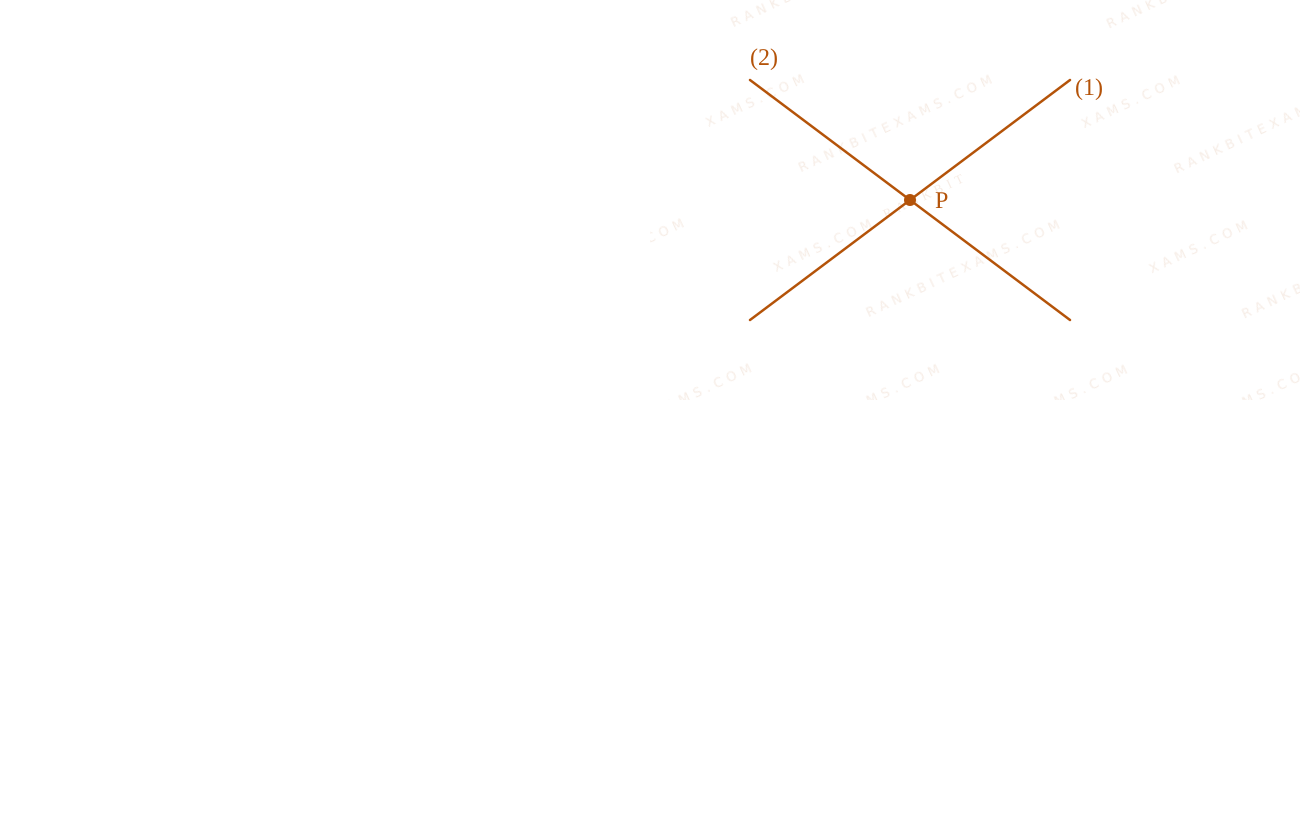
Let the given point be P((15)/(7), (32)/(7), 7). We need to find the distance measured along the line passing through P parallel to the vector v = i+4 j+7 k.
Equation of this line PQ is:
(x - (15)/(7))/(1) = (y - (32)/(7))/(4) = (z - 7)/(7) = λAny general point Q on this line can be written as:
Q(λ + (15)/(7), 4λ + (32)/(7), 7λ + 7)Step 1: Find Intersection Point Q with Given Line
Point Q must lie on the given target line L: (x+1)/(3) = (y+3)/(5) = (z+5)/(7).
Substitute coordinates of Q into the first and third fractions:
((λ + (15)/(7)) + 1)/(3) = ((7λ + 7) + 5)/(7) (λ + (22)/(7))/(3) = (7λ + 12)/(7) (7λ + 22)/(21) = (7λ + 12)/(7)Multiplying by 21:
7λ + 22 = 3(7λ + 12) 7λ + 22 = 21λ + 36 14λ = -14 λ = -1Step 2: Calculate Coordinates of Q and Distance squared
Substituting λ = -1 into coordinates of Q:
Q(-1 + (15)/(7), -4 + (32)/(7), -7 + 7) = Q((8)/(7), (4)/(7), 0)Now, compute the distance squared (PQ)²:
(PQ)² = ((15)/(7) - (8)/(7))² + ((32)/(7) - (4)/(7))² + (7 - 0)² (PQ)² = ((7)/(7))² + ((28)/(7))² + 7² = 1² + 4² + 49 = 1 + 16 + 49 = 66Pattern Recognition
Instead of finding coordinates of Q, we could also use the vector form directly: PQ = λ( i + 4 j + 7 k). Distance squared is PQ² = λ²(1² + 4² + 7²) = (-1)²(1 + 16 + 49) = 66. This saves a lot of fractional coordinate subtraction arithmetic!
Chapter Mix
Class 12 Mathematics: Three Dimensional Geometry

