JEE Main · Mathematics ↓ Falling

Three Dimensional Geometry appeared 62 times across 3 years — 7.2% of Mathematics. This question is from Intersection of Lines in 3D Space.

Year 2026 2025 2024 Total
Questions 15 29 18 62

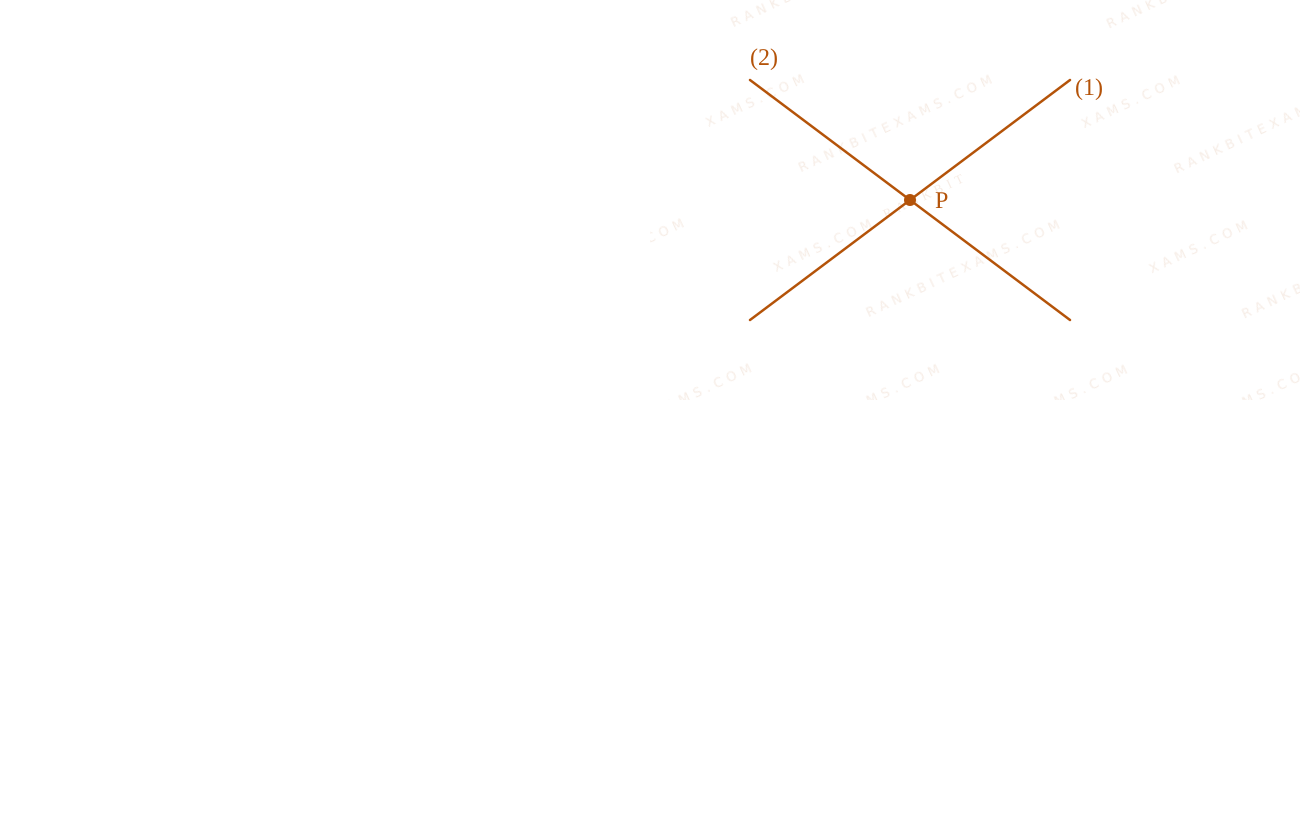
Let the line passing through the points (-1, 2, 1) and \parallel to the line (x - 1)/(2) = (y + 1)/(3) = (z)/(4) intersect the line (x + 2)/(3) = (y - 3)/(2) = (z - 4)/(1) at the point P. Then the distance of P from the point Q(4, -5, 1) is :

Solution & Explanation

Related Formula

The line passing through a and \parallel to direction vector v = l i + m j + n k is written in symmetric form as:

(x - xₐ)/(l) = (y - yₐ)/(m) = (z - zₐ)/(n)
Core Logic

Formulate the equation of the line passing through (-1, 2, 1) with direction vector components (2, 3, 4):

L₁: (x + 1)/(2) = (y - 2)/(3) = (z - 1)/(4) = λ (1)

Intersection of Lines in 3D Space

Any generic point on this line can be written as:

P = (2λ - 1, 3λ + 2, 4λ + 1)

The second given line equation is:

L₂: (x + 2)/(3) = (y - 3)/(2) = (z - 4)/(1) = μ (2)

Any generic point on line L₂ is:

P' = (3μ - 2, 2μ + 3, μ + 4)
Step 1: Compute the Point of Intersection

At the point of intersection P, equate the coordinates from both lines:

2λ - 1 = 3μ - 2 2λ - 3μ = -1 (3) 3λ + 2 = 2μ + 3 3λ - 2μ = 1 (4) 4λ + 1 = μ + 4 4λ - μ = 3 (5)

Solving equations (3) and (4) simultaneously gives:

λ = 1, μ = 1

Verify these values using equation (5):

4(1) - 1 = 3 (Satisfied)

Thus, substituting λ = 1 gives the coordinates of point P:

P = (2(1) - 1, 3(1) + 2, 4(1) + 1) = (1, 5, 5)
Step 2: Calculate Euclidean Distance PQ

Find the distance between P(1, 5, 5) and Q(4, -5, 1) using the 3D distance formula:

PQ = √((4 - 1)² + (-5 - 5)² + (1 - 5)²) PQ = √(3² + (-10)² + (-4)²) = √(9 + 100 + 16) PQ = √(125) = 5√(5)
Pattern Recognition

When finding the intersection point of two 3D lines, always use the third coordinate equation to verify the parameter values obtained from the first two equations to ensure consistency.

Chapter Mix

Class 12 Mathematics: Three Dimensional Geometry

Reference Study Guides

More Three Dimensional Geometry Previous-Year Questions — Page 8

Q56 jee_main_2025_04_april_morning Shortest Distance Between Two Lines
Let the shortest distance between the lines (x - 3)/(3) = (y - α)/(-1) = (z - 3)/(1) and (x + 3)/(-3) = (y + 7)/(2) = (z - β)/(4) be 3√(30). Then the positive value of 5α + β is
  • A. 42
  • B. 46
  • C. 48
  • D. 40

Solution

Related Formula

Shortest distance between lines passing through a₁, a₂ with directions p, q:

d = |( a₂ - a₁) · ( p × q)|| p × q|
Core Logic

Identify parameters: A = (3, α, 3) and B = (-3, -7, β) BA = 6 i + (α + 7) j + (3 - β) k. Directions: p = 3 i - j + k and \ \vec{q} = -3\hat{i} + 2\hat{j} + 4\hat{k}.

Compute cross product

Compute cross product $\vec{p} \times \vec{q}:

p × q = vmatrix i & j & k 3 & -1 & 1 -3 & 2 & 4 vmatrix = -6hati - 15hatj + 3hatk

Magnitude

Magnitude $|\vec{p} \times \vec{q}| = \sqrt{(-6)^2 + (-15)^2 + 3^2} = \sqrt{36 + 225 + 9} = \sqrt{270} = 3\sqrt{30}.

Step 1: Apply Distance Equation

Set shortest distance equation equal to

Step 1: Apply Distance Equation

Set shortest distance equation equal to $3\sqrt{30}:

| BA · ( p × q)|3√(30) = 3√(30) | BA · ( p × q)| = 270-6(6) - 15(α + 7) + 3(3 - β) = ± 270-36 - 15α - 105 + 9 - 3β = ± 270 -132 - 15α - 3β = ± 270

Choosing the negative branch for positive value extraction:

-15α - 3β = -138 15α + 3β = 138 5α + β = 46$
Pattern Recognition

Notice that the determinant logic perfectly structures linear equations. Simplifying the dot product using standard scaling helps prevent sign errors.

Chapter Mix

Class 12 Mathematics: Three Dimensional Geometry
Q64 jee_main_2025_07_april_evening Lines in 3D Space
If the equation of the line passing through the point (0, -(1)/(2), 0) and perpendicular to the lines r = λ ( i + a j + b k) and r = ( i - j - 6 k) + μ (- b i + a j + 5 k) is x - 1-2 = y + 4d = z - c-4 then a +b + c + d is equal to:
  • A. 10
  • B. 14
  • C. 13
  • D. 12

Solution

Related Formula

The direction vector of a line perpendicular to two given lines with direction vectors v₁ and \vec{v}_2 is determined by their cross product:

v = v₁ × v₂
Core Logic

The given point (0, -(1)/(2), 0) lies on the required line:

(x - 1)/(-2) = (y + 4)/(d) = (z - c)/(-4)

Substituting the point coordinates into the equation:

(0 - 1)/(-2) = (-(1)/(2) + 4)/(d) = (0 - c)/(-4) (1)/(2) = (7)/(2d) = (c)/(4) d = 7, c = 2
Step 1: Cross Product Direction Ratios

The direction vectors of the lines are v₁ = (1, a, b) and v₂ = (-b, a, 5).

v = vmatrix i & j & k 1 & a & b -b & a & 5 vmatrix = i(5a - ab) - j(5 + b²) + k(a + ab)

Thus, the direction ratios of the line are proportional to:

(5a - ab)/(-2) = (-(b² + 5))/(7) = (a + ab)/(-4) (i)
Step 2: Solve for a and b

From the first and third components of equation (i):

(5a - ab)/(-2) = (a + ab)/(-4) 2(5a - ab) = a + ab 10a - 2ab = a + ab 9a = 3ab b = 3

Now use the second component ratio with b = 3 and d = 7:

(-(3² + 5))/(7) = (a + a(3))/(-4) (-14)/(7) = (4a)/(-4) -2 = -a a = 2
Step 3: Sum the Variables

Summing up a, b, c, d:

a + b + c + d = 2 + 3 + 2 + 7 = 14
Pattern Recognition

Substituting known point values into symmetric equations immediately determines structural values like c and d before running cross product systems.

Chapter Mix

Class 12 Mathematics: Three Dimensional Geometry
Q66 jee_main_2025_07_april_evening Foot of Perpendicular and Area
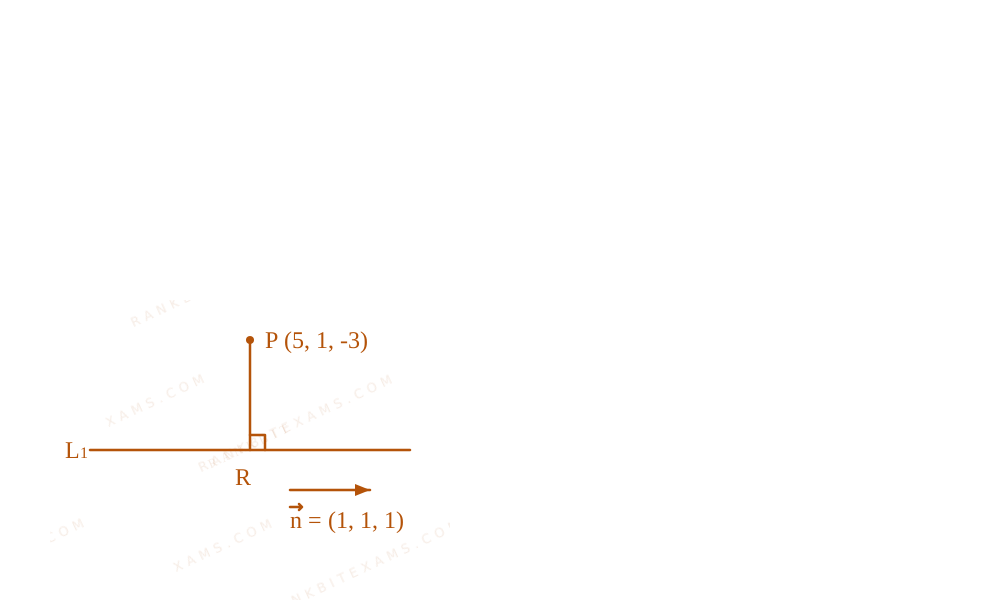
Consider the lines L₁: x - 1 = y - 2 = z and L₂: x - 2 = y = z - 1. Let the feet of the perpendiculars from the point P(5,1,-3) on the lines L₁ and L₂ be Q and R respectively. If the area of the triangle PQR is A, then 4A² is equal to:
  • A. 139
  • B. 147
  • C. 151
  • D. 143

Solution

Related Formula

The vector area of a triangle given two adjacent position vectors u and v is calculated as:

Area = (1)/(2) | u × v|
Core Logic

For line L₁: (x-1)/(1) = (y-2)/(1) = (z-0)/(1). Let a general point be Q(λ+1, λ+2, λ).

PQ = (λ-4, λ+1, λ+3)

Since PQ · m₁ = 0 (direction vector of L₁ is (1,1,1)):

(λ-4)(1) + (λ+1)(1) + (λ+3)(1) = 0 3λ = 0 λ = 0

Thus, Q(1, 2, 0) and PQ = (-4, 1, 3).

Foot of Perpendicular and Area diagram for Q66 - JEE Main 2025 Evening

Step 1: Compute Foot R

For line L₂: (x-2)/(1) = (y)/(1) = (z-1)/(1). Let a general point be R(μ+2, μ, μ+1).

PR = (μ-3, μ-1, μ+4)

Since PR · m₂ = 0 (direction vector of L₂ is (1,1,1)):

(μ-3)(1) + (μ-1)(1) + (μ+4)(1) = 0 3μ = 0 μ = 0

Thus, R(2, 0, 1) and PR = (-3, 1, 4).

Step 2: Area Vector Calculation

The area A of Δ PQR is given by:

A = (1)/(2) | PQ × PR| PQ × PR = vmatrix i & j & k -4 & 1 & 3 -3 & 1 & 4 vmatrix = i(4-3) - j(-16+9) + k(-4+3) = i + 7 j - k Magnitude squared: | PQ × PR|² = 1² + 7² + (-1)² = 1 + 49 + 1 = 51

Let's re-verify the matrix arithmetic layout:

PQ = (-4, 1, 3), PR = (-3, 1, 4) = 7 i + 7 j + 7 k |7( i + j + k)|² = 49 · 3 = 147
Step 3: Evaluate 4A^2

Since A = (1)/(2) √(147):

4A² = 4 · ((1)/(4) · 147) = 147
Pattern Recognition

Setting up dot products systematically with general parametric forms quickly locks in spatial feet indices without complex geometric drawings.

Chapter Mix

Class 12 Mathematics: Three Dimensional Geometry
Q72 jee_main_2025_24_jan_evening Image of a Point and Area of Triangle
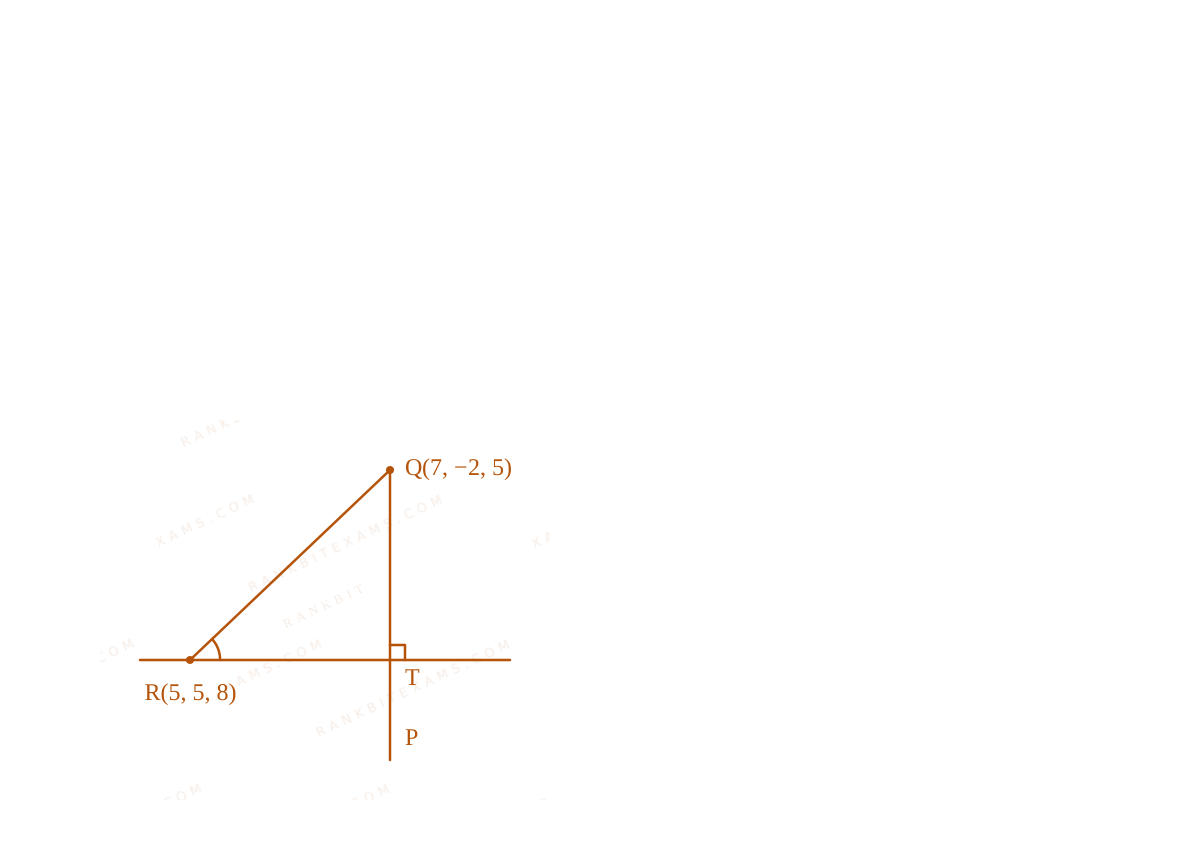
Let P be the image of the point Q(7,-2,5) in the line L: (x-1)/(2)=(y+1)/(3)=(z)/(4) and R(5,p,q) be a point on L. Then the square of the area of PQR is \_\_\_\_.
Numerical Answer. Answer: 957

Solution

Related Formula
  • Area of a with perpendicular height h and base b:
Area = (1)/(2) × b × h
  • Since P is the reflection image of Q across line L, the line acts as a perpendicular bisector. For any point R lying on the line, the height from R to the line is RT, and the base QP = 2QT.
Core Logic

Determine parameters for point R lying directly on line L:

(5-1)/(2) = (p+1)/(3) = (q)/(4) ⇒ 2 = (p+1)/(3) = (q)/(4) p+1 = 6 ⇒ p = 5, q = 8 ⇒ R = (5, 5, 8)

3D line reflection \triangle diagram for Q72 - JEE Main 2025 Evening

Step 1: Locate Foot of Perpendicular (T)

Let the foot of the perpendicular from Q(7, -2, 5) on line L be T(2λ+1, 3λ-1, 4λ) .

The directional direction of L is b = 2 i + 3 j + 4 k . Vector QT = (2λ - 6) i + (3λ + 1) j + (4λ - 5) k .

Apply orthogonality condition QT · b = 0 :

2(2λ - 6) + 3(3λ + 1) + 4(4λ - 5) = 0 4λ - 12 + 9λ + 3 + 16λ - 20 = 0 ⇒ 29λ - 29 = 0 ⇒ λ = 1

Thus, T = (3, 2, 4).

Step 2: Measure Geometric Distances

Compute length QT using distance metrics :

QT = √((3-7)² + (2 - (-2))² + (4-5)²) = √(16 + 16 + 1) = √(33)

Since P is the symmetrical image, base QP = 2QT = 2√(33).

Compute length RT representing height from vertex R(5, 5, 8) to base line at T(3, 2, 4) :

RT = √((5-3)² + (5-2)² + (8-4)²) = √(4 + 9 + 16) = √(29)
Step 3: Calculate Squared Area

Compute the area squared value:

Area = (1)/(2) × QP × RT = (1)/(2) × (2√(33)) × √(29) = √(957) (Area)² = 957
Pattern Recognition

Because the image geometry creates an isosceles pairing from any point on the mirror line to the object and image point, the area reduces beautifully to 2 × Area( QTR) = QT × RT.

Chapter Mix

Class 12 Mathematics: Three Dimensional Geometry

Q58 jee_main_2025_24_jan_morning Area of a Triangle in 3D Space
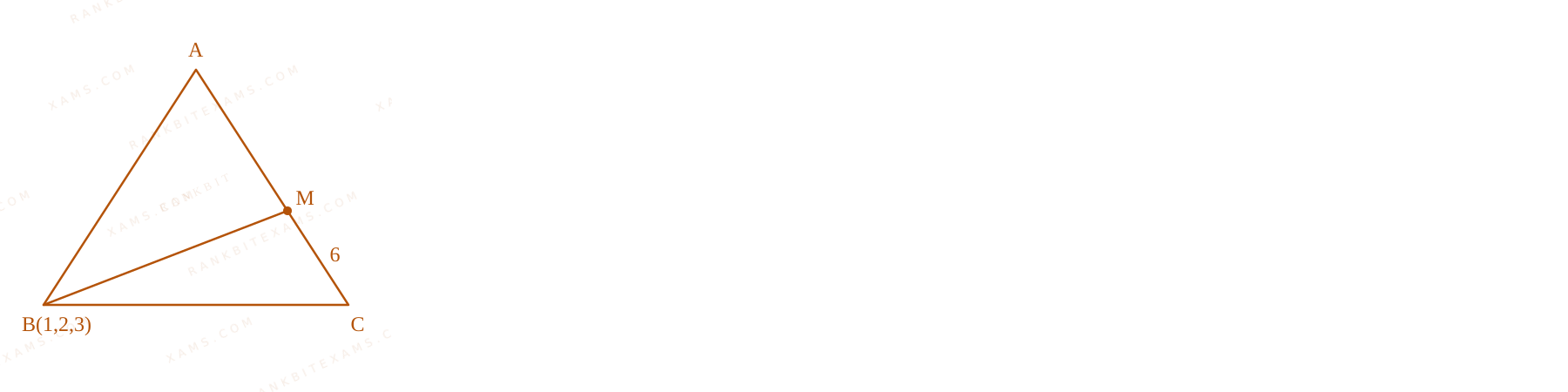
Let in a Δ ABC , the length of the side AC be 6, the vertex B be (1, 2, 3) and the vertices A, C lie on the line (x - 6)/(3) = (y - 7)/(2) = (z - 7)/(-2) . Then the area (in sq. units) of Δ ABC is :
  • A. 42
  • B. 21
  • C. 56
  • D. 17

Solution

Related Formula

The area of a triangle given base length b and altitude perpendicular height h is evaluated as:

Area = (1)/(2) · b · h
Core Logic

The base side AC lies entirely along the line equation. Let M be the foot of the perpendicular dropped from vertex B(1,2,3) to the line segment AC:

Area of a Triangle in 3D Space diagram for Q58 - JEE Main 2025 Morning

Any coordinate point on the line can be represented parametrically by setting the line fractions equal to λ:

M = (3λ + 6, 2λ + 7, -2λ + 7)
Step 1: Compute Foot of Perpendicular

Construct the vector direction representing line segment BM:

BM = (3λ + 6 - 1) i + (2λ + 7 - 2) j + (-2λ + 7 - 3) k BM = (3λ + 5) i + (2λ + 5) j + (-2λ + 4) k

Since BM is perpendicular to the base line segment direction vector v = 3 i + 2 j - 2 k, their dot product must equal zero:

BM · v = 3(3λ + 5) + 2(2λ + 5) - 2(-2λ + 4) = 0 9λ + 15 + 4λ + 10 + 4λ - 8 = 0 17λ + 17 = 0 λ = -1
Step 2: Find Perpendicular Length and Calculate Area

Substitute λ = -1 back into the vector equation to find the altitude magnitude:

BM = (3(-1) + 5) i + (2(-1) + 5) j + (-2(-1) + 4) k = 2 i + 3 j + 6 k h = | BM| = √(2² + 3² + 6²) = √(4 + 9 + 36) = √(49) = 7

Now, plug the base length AC = 6 and altitude h = 7 into the standard area formula:

Area = (1)/(2) · 6 · 7 = 21 sq. units
Pattern Recognition

Instead of determining the absolute coordinates for individual triangle vertices A and C, treating the problem via altitude minimization relative to the given parametric vector direction saves substantial calculation steps.

Chapter Mix

Class 12 Mathematics: Three Dimensional Geometry

More Three Dimensional Geometry Questions — jee_main_2025_24_jan_morning

Practice all Three Dimensional Geometry previous-year questions →

Rankbit System
JEE Physics: Waves (+15.5%) | Electrostatics: Concentric Shells (-29.7%) | Modern Physics: Photoelectric Clones (+34.2%) | Mathematics: Definite Integrals (+18.1%) | Chemistry: Coordination Splitting (-11.4%) | JEE Physics: Waves (+15.5%) | Electrostatics: Concentric Shells (-29.7%) | Modern Physics: Photoelectric Clones (+34.2%) | Mathematics: Definite Integrals (+18.1%) | Chemistry: Coordination Splitting (-11.4%)