JEE Main · Mathematics ↓ Falling

Three Dimensional Geometry appeared 62 times across 3 years — 7.2% of Mathematics. This question is from Shortest Distance Between Two Lines.

Year 2026 2025 2024 Total
Questions 15 29 18 62

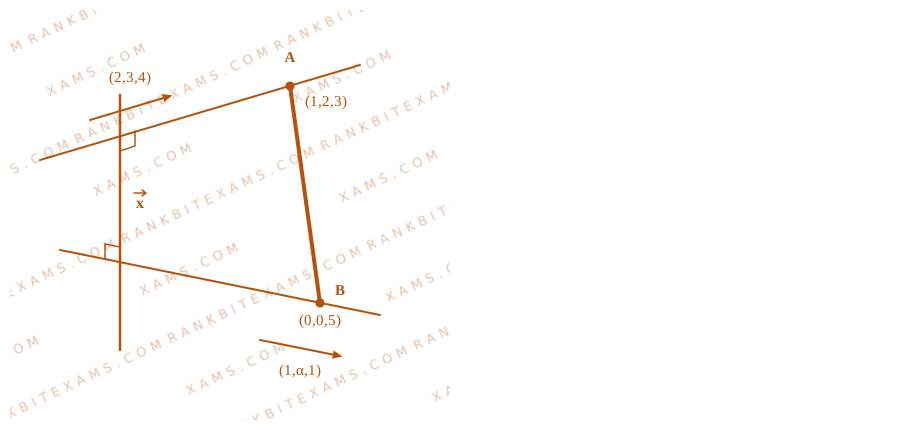
If the shortest distance between the lines (x - 1)/(2) = (y - 2)/(3) = (z - 3)/(4) and (x)/(1) = (y)/(α) = (z - 5)/(1) is 5√(6) , then the sum of all possible values of α is

Solution & Explanation

Related Formula

Shortest distance between two skewed lines with vector equations r = a₁ + λ b₁ and \vec{r} = \vec{a}_2 + \mu \vec{b}_2 is:

S.D. = | ( a₂ - a₁) · ( b₁ × b₂)| b₁ × b₂| |
Core Logic

From the given lines: Line 1 passes through A(1, 2, 3) with direction vector b₁ = 2 i + 3 j + 4 k. Line 2 passes through B(0, 0, 5) with direction vector b₂ = i + α j + k.

The vector connecting the two fixed points is:

BA = (1-0) i + (2-0) j + (3-5) k = i + 2 j - 2 k
Step 1: Compute Cross Product of Direction Vectors
n = b₁ × b₂ = | matrix i & j & k 2 & 3 & 4 1 & α & 1 matrix | = i(3 - 4α) - j(2 - 4) + k(2α - 3) n = (3 - 4α) i + 2 j + (2α - 3) k
Step 2: Apply Shortest Distance Formula

Shortest Distance Between Two Lines diagram for Q52 - JEE Main 2025 Morning

S.D. = | ( i + 2 j - 2 k) · n| n| | = 5√(6)

Taking dot product in numerator:

( i + 2 j - 2 k) · n = 1(3-4α) + 2(2) - 2(2α-3) = 3 - 4α + 4 - 4α + 6 = 13 - 8α

Squaring both sides:

((13 - 8α)²)/((3 - 4α)² + 4 + (2α - 3)²) = (25)/(6) 6(64α² - 208α + 169) = 25(16α² - 24α + 9 + 4 + 4α² - 12α + 9) 6(64α² - 208α + 169) = 25(20α² - 36α + 22) 384α² - 1248α + 1014 = 500α² - 900α + 550 116α² + 348α - 464 = 0 α² + 3α - 4 = 0
Step 3: Calculate the Sum of Roots

The sum of all possible values of α is given by the relation:

α₁ + α₂ = -(3)/(1) = -3
Pattern Recognition

Whenever asked for the sum of all possible parameter values resulting from a vector condition, look to directly read the linear term coefficient via Vieta's relations rather than explicitly factoring or computing the roots individually.

Chapter Mix

Class 12 Mathematics: Three Dimensional Geometry Class 12 Mathematics: Vector Algebra

Reference Study Guides

More Three Dimensional Geometry Previous-Year Questions — Page 9

Q68 jee_main_2025_24_jan_morning Intersection of Lines in 3D Space
Let the line passing through the points (-1, 2, 1) and \parallel to the line (x - 1)/(2) = (y + 1)/(3) = (z)/(4) intersect the line (x + 2)/(3) = (y - 3)/(2) = (z - 4)/(1) at the point P. Then the distance of P from the point Q(4, -5, 1) is :
  • A. 5
  • B. 10
  • C. 5√(6)
  • D. 5√(5)

Solution

Related Formula

The line passing through a and \parallel to direction vector v = l i + m j + n k is written in symmetric form as:

(x - xₐ)/(l) = (y - yₐ)/(m) = (z - zₐ)/(n)
Core Logic

Formulate the equation of the line passing through (-1, 2, 1) with direction vector components (2, 3, 4):

L₁: (x + 1)/(2) = (y - 2)/(3) = (z - 1)/(4) = λ (1)
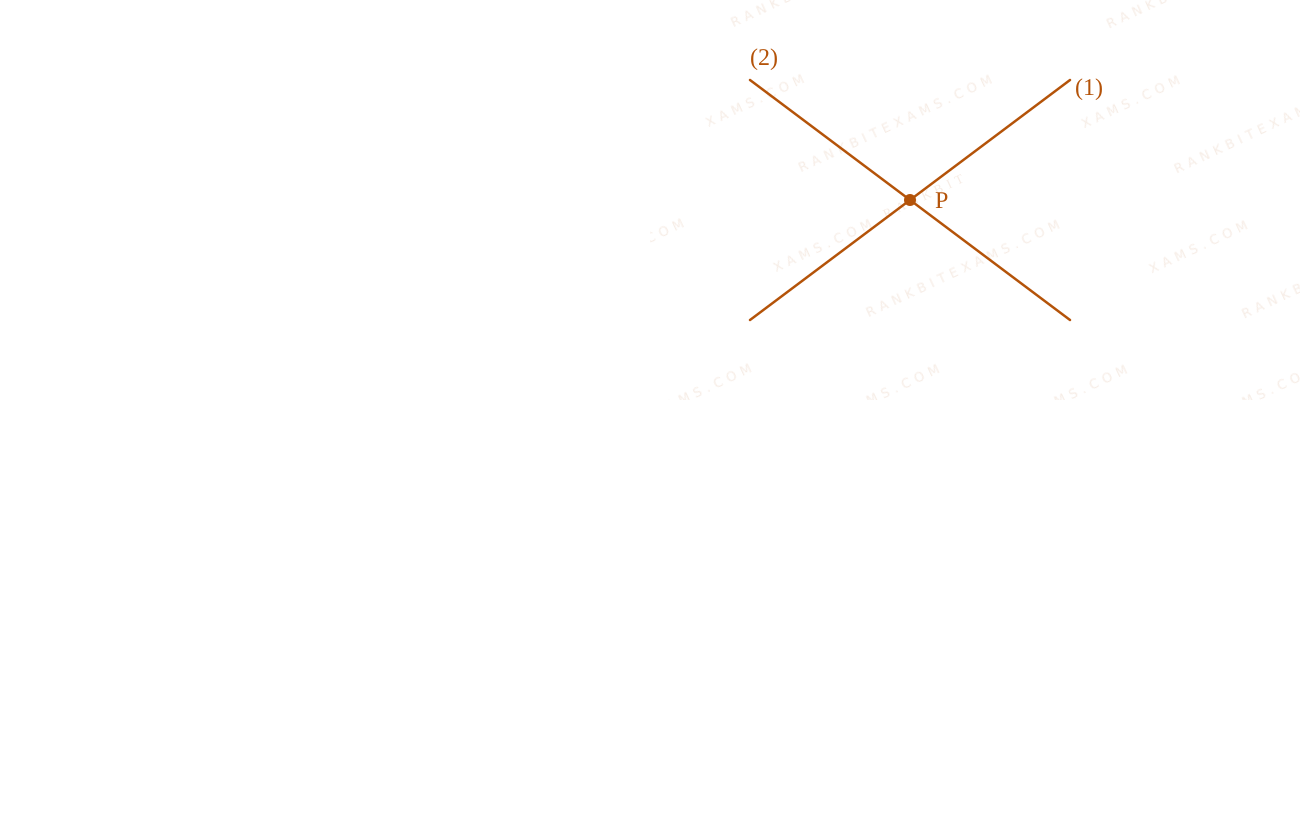
Intersection of Lines in 3D Space

Any generic point on this line can be written as:

P = (2λ - 1, 3λ + 2, 4λ + 1)

The second given line equation is:

L₂: (x + 2)/(3) = (y - 3)/(2) = (z - 4)/(1) = μ (2)

Any generic point on line L₂ is:

P' = (3μ - 2, 2μ + 3, μ + 4)
Step 1: Compute the Point of Intersection

At the point of intersection P, equate the coordinates from both lines:

2λ - 1 = 3μ - 2 2λ - 3μ = -1 (3) 3λ + 2 = 2μ + 3 3λ - 2μ = 1 (4) 4λ + 1 = μ + 4 4λ - μ = 3 (5)

Solving equations (3) and (4) simultaneously gives:

λ = 1, μ = 1

Verify these values using equation (5):

4(1) - 1 = 3 (Satisfied)

Thus, substituting λ = 1 gives the coordinates of point P:

P = (2(1) - 1, 3(1) + 2, 4(1) + 1) = (1, 5, 5)
Step 2: Calculate Euclidean Distance PQ

Find the distance between P(1, 5, 5) and Q(4, -5, 1) using the 3D distance formula:

PQ = √((4 - 1)² + (-5 - 5)² + (1 - 5)²) PQ = √(3² + (-10)² + (-4)²) = √(9 + 100 + 16) PQ = √(125) = 5√(5)
Pattern Recognition

When finding the intersection point of two 3D lines, always use the third coordinate equation to verify the parameter values obtained from the first two equations to ensure consistency.

Chapter Mix

Class 12 Mathematics: Three Dimensional Geometry

Q jee_main_2025_28_jan_evening Distance from a Point to a Line
The square of the distance of the point ((15)/(7),(32)/(7),7) from the line (x+1)/(3)=(y+3)/(5)=(z+5)/(7) in the direction of the vector i+4 j+7 k is:
  • A. 54
  • B. 41
  • C. 66
  • D. 44

Solution

Related Formula

Equation of a line passing through P(x₀, y₀, z₀) along direction vector v = a i+b j+c k:

(x-x₀)/(a) = (y-y₀)/(b) = (z-z₀)/(c) = λ
Core Logic

Let the given point be P((15)/(7), (32)/(7), 7). We need to find the distance measured along the line passing through P parallel to the vector v = i+4 j+7 k.

Equation of this line PQ is:

(x - (15)/(7))/(1) = (y - (32)/(7))/(4) = (z - 7)/(7) = λ

Any general point Q on this line can be written as:

Q(λ + (15)/(7), 4λ + (32)/(7), 7λ + 7)
Step 1: Find Intersection Point Q with Given Line

Point Q must lie on the given target line L: (x+1)/(3) = (y+3)/(5) = (z+5)/(7).

Substitute coordinates of Q into the first and third fractions:

((λ + (15)/(7)) + 1)/(3) = ((7λ + 7) + 5)/(7) (λ + (22)/(7))/(3) = (7λ + 12)/(7) (7λ + 22)/(21) = (7λ + 12)/(7)

Multiplying by 21:

7λ + 22 = 3(7λ + 12) 7λ + 22 = 21λ + 36 14λ = -14 λ = -1
Step 2: Calculate Coordinates of Q and Distance squared

Substituting λ = -1 into coordinates of Q:

Q(-1 + (15)/(7), -4 + (32)/(7), -7 + 7) = Q((8)/(7), (4)/(7), 0)

Now, compute the distance squared (PQ)²:

(PQ)² = ((15)/(7) - (8)/(7))² + ((32)/(7) - (4)/(7))² + (7 - 0)² (PQ)² = ((7)/(7))² + ((28)/(7))² + 7² = 1² + 4² + 49 = 1 + 16 + 49 = 66
Pattern Recognition

Instead of finding coordinates of Q, we could also use the vector form directly: PQ = λ( i + 4 j + 7 k). Distance squared is PQ² = λ²(1² + 4² + 7²) = (-1)²(1 + 16 + 49) = 66. This saves a lot of fractional coordinate subtraction arithmetic!

Chapter Mix

Class 12 Mathematics: Three Dimensional Geometry

Q64 jee_main_2025_29_jan_morning Intersection of Lines
Let a = i + 2 j + k and b = 2 i + 7 j + 3 k . Let L₁: r = (- i +2 j + k) + λ a,λ in R and L₂: r = ( j + k) + μ b,μ in R be two lines. If the line L₃ passes through the point of intersection of L₁ and L₂ , and is \parallel to a + b, then L₃ passes through the point:
  • A. (8, 26, 12)
  • B. (2, 8, 5)
  • C. (-1, -1, 1)
  • D. (5, 17, 4)

Solution

Related Formula
Equation of line passing through r₀ ∥ to v: r = r₀ + α v
Core Logic

Express general points on L₁ and L₂ vector components:

L₁: r = (λ - 1) i + 2(λ + 1) j + (λ + 1) k L₂: r = 2μ i + (1 + 7μ) j + (1 + 3μ) k
Step 1: Equate components to find point of intersection
λ - 1 = 2μ (1) 2λ + 2 = 1 + 7μ (2) λ + 1 = 1 + 3μ λ = 3μ (3)

Substituting (3) into (1):

3μ - 1 = 2μ μ = 1 λ = 3

Point of intersection r₀ = 2(1) i + (1+7) j + (1+3) k = 2 i + 8 j + 4 k.

Step 2: Formulate line L3

Direction vector v = a + b = 3 i + 9 j + 4 k.

L₃: r = (2 i + 8 j + 4 k) + α(3 i + 9 j + 4 k) L₃(α) = (2 + 3α) i + (8 + 9α) j + (4 + 4α) k
Step 3: Match options

For α = 2:

r = (2+6) i + (8+18) j + (4+8) k = 8 i + 26 j + 12 k

This matches coordinates (8, 26, 12).

Pattern Recognition

Instead of checking all lines simultaneously, match options via quick ratio checks: (x - 2)/(3) = (y - 8)/(9) = (z - 4)/(4). This eliminates false choices instantly.

Chapter Mix

Class 12 Mathematics: Three Dimensional Geometry Class 12 Mathematics: Vector Algebra

Q67 jee_main_2025_29_jan_morning Perpendicular Lines
Let L₁: (x - 1)/(1) = (y - 2)/(-1) = (z - 1)/(2) and L₂: x + 1-1 = y - 22 = z1 be two lines. Let L₃ be a line passing through the point (α, β, γ) and be perpendicular to both L₁ and L₂ . If L₃ intersects L₁ , then |5α - 11β - 8γ| equals:
  • A. 18
  • B. 16
  • C. 25
  • D. 20

Solution

Related Formula
Direction ratios of a line perpendicular to both vectors: v = d₁ × d₂
Core Logic

Compute direction ratios for L₃ using cross product of direction vectors of L₁ and L₂:

v = | arrayccc i & j & k 1 & -1 & 2 -1 & 2 & 1 array | = -5 i - 3 j + k
Step 1: Establish intersection constraints

Let A be a general point on L₃ and B be a general point on L₁:

A = (α - 5λ, β - 3λ, γ + λ) B = (k+1, -k+2, 2k+1)

Since L₃ intersects L₁, at the point of intersection A ≡ B:

α - 5λ = k + 1 α = 5λ + k + 1 β - 3λ = -k + 2 β = 3λ - k + 2 γ + λ = 2k + 1 γ = -λ + 2k + 1
Step 2: Solve final algebraic target equation

Substitute expressions into the target mod expression:

5α - 11β - 8γ = 5(5λ + k + 1) - 11(3λ - k + 2) - 8(-λ + 2k + 1) = λ(25 - 33 + 8) + k(5 + 11 - 16) + (5 - 22 - 8) = 0λ + 0k - 25 = -25

Taking absolute value yields |-25| = 25.

Pattern Recognition

The cancellation of internal variables (λ and k) shows that the absolute expression describes a invariant geometric plane coordinate constraint, allowing simple baseline parameter values (like k=0, λ=0) to evaluate the question instantly.

Chapter Mix

Class 12 Mathematics: Three Dimensional Geometry

Q20 jee_main_2024_01_february_morning Shortest Distance Between Skew Lines
If the shortest distance between the lines (x-λ)/(-2)=(y-2)/(1)=(z-1)/(1) and x-√(3)1=(y-1)/(-2)=(z-2)/(1) is 1, then the sum of all possible values of λ is:
  • A. 0
  • B. 2√(3)
  • C. 3√(3)
  • D. -2√(3)

Solution

Related Formula

The shortest distance between two skew lines r = a₁ + s b₁ and r = a₂ + t b₂ is given by:

d = |( a₂ - a₁) · ( b₁ × b₂)|| b₁ × b₂|
Core Logic

Identify the vectors from the equations of the lines:

  • Line 1 passes through a₁ = λ i + 2 j + k with direction b₁ = -2 i + j + k.
  • Line 2 passes through a₂ = √(3) i + j + 2 k with direction b₂ = i - 2 j + k.
  • Calculate the coordinate difference vector:

a₂ - a₁ = (√(3) - λ) i - j + k
Step 1: Compute the Cross Product of the Direction Vectors

Find the cross product matrix:

b₁ × b₂ = vmatrix i & j & k -2 & 1 & 1 1 & -2 & 1 vmatrix b₁ × b₂ = i(1 - (-2)) - j(-2 - 1) + k(4 - 1) = 3 i + 3 j + 3 k

Compute its magnitude:

| b₁ × b₂| = √(3² + 3² + 3²) = √(27) = 3√(3)

Shortest distance between skew lines vector representation for Q20 - JEE Main 2024 01 February Morning
The figure details the spatial arrangement of the two skew lines along with their common perpendicular normal vector representing the shortest path.

Step 2: Solve the Absolute Distance Equation for lambda

Substitute these values into the shortest distance formula:

1 = |((√(3) - λ) i - j + k) · (3 i + 3 j + 3 k)|3√(3) 1 = |3(√(3) - λ) - 3 + 3|3√(3) = 3|√(3) - λ|3√(3) = |√(3) - λ|√(3)

This gives:

|√(3) - λ| = √(3)

Unfolding the absolute value gives two cases:

  • Case A: √(3) - λ = √(3) λ = 0
  • Case B: √(3) - λ = -√(3) λ = 2√(3)
Step 3: Calculate the Final Sum

The sum of all possible values of λ is:

Sum = 0 + 2√(3) = 2√(3)
Pattern Recognition

Sees: Shortest distance setup between vector paths containing free variables. Shortcut: In equations like |c - λ| = d, the sum of the roots is simply equal to 2c, because the roots are symmetrically balanced around the center point c. Thus, Sum = 2 × √(3) = 2√(3) holds instantly without calculating individual values.

Chapter Mix

Class 12 Mathematics: Three Dimensional Geometry Class 12 Mathematics: Vector Algebra

More Three Dimensional Geometry Questions — jee_main_2025_07_april_morning

Practice all Three Dimensional Geometry previous-year questions →

Rankbit System
JEE Physics: Waves (+15.5%) | Electrostatics: Concentric Shells (-29.7%) | Modern Physics: Photoelectric Clones (+34.2%) | Mathematics: Definite Integrals (+18.1%) | Chemistry: Coordination Splitting (-11.4%) | JEE Physics: Waves (+15.5%) | Electrostatics: Concentric Shells (-29.7%) | Modern Physics: Photoelectric Clones (+34.2%) | Mathematics: Definite Integrals (+18.1%) | Chemistry: Coordination Splitting (-11.4%)