JEE Main · Mathematics ↓ Falling

Three Dimensional Geometry appeared 62 times across 3 years — 7.2% of Mathematics. This question is from Shortest Distance Between Two Lines.

Year 2026 2025 2024 Total
Questions 15 29 18 62

If the shortest distance between the lines (x - 1)/(2) = (y - 2)/(3) = (z - 3)/(4) and (x)/(1) = (y)/(α) = (z - 5)/(1) is 5√(6) , then the sum of all possible values of α is

Solution & Explanation

Related Formula

Shortest distance between two skewed lines with vector equations r = a₁ + λ b₁ and \vec{r} = \vec{a}_2 + \mu \vec{b}_2 is:

S.D. = | ( a₂ - a₁) · ( b₁ × b₂)| b₁ × b₂| |
Core Logic

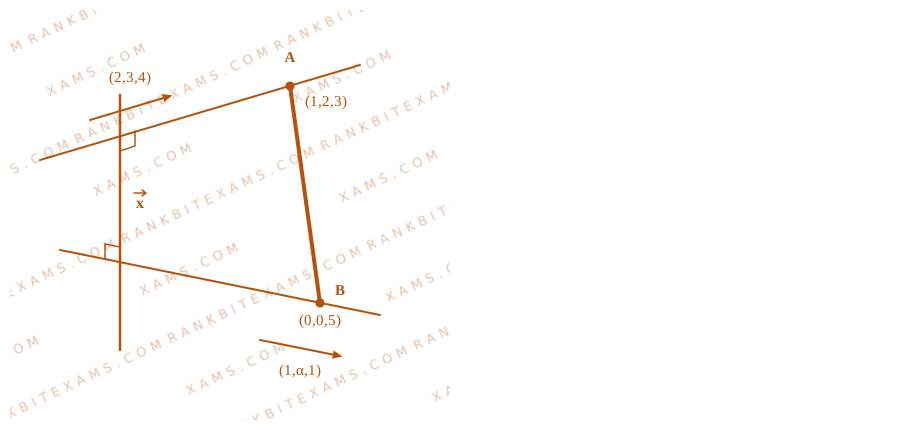
From the given lines: Line 1 passes through A(1, 2, 3) with direction vector b₁ = 2 i + 3 j + 4 k. Line 2 passes through B(0, 0, 5) with direction vector b₂ = i + α j + k.

The vector connecting the two fixed points is:

BA = (1-0) i + (2-0) j + (3-5) k = i + 2 j - 2 k
Step 1: Compute Cross Product of Direction Vectors
n = b₁ × b₂ = | matrix i & j & k 2 & 3 & 4 1 & α & 1 matrix | = i(3 - 4α) - j(2 - 4) + k(2α - 3) n = (3 - 4α) i + 2 j + (2α - 3) k
Step 2: Apply Shortest Distance Formula

Shortest Distance Between Two Lines diagram for Q52 - JEE Main 2025 Morning

S.D. = | ( i + 2 j - 2 k) · n| n| | = 5√(6)

Taking dot product in numerator:

( i + 2 j - 2 k) · n = 1(3-4α) + 2(2) - 2(2α-3) = 3 - 4α + 4 - 4α + 6 = 13 - 8α

Squaring both sides:

((13 - 8α)²)/((3 - 4α)² + 4 + (2α - 3)²) = (25)/(6) 6(64α² - 208α + 169) = 25(16α² - 24α + 9 + 4 + 4α² - 12α + 9) 6(64α² - 208α + 169) = 25(20α² - 36α + 22) 384α² - 1248α + 1014 = 500α² - 900α + 550 116α² + 348α - 464 = 0 α² + 3α - 4 = 0
Step 3: Calculate the Sum of Roots

The sum of all possible values of α is given by the relation:

α₁ + α₂ = -(3)/(1) = -3
Pattern Recognition

Whenever asked for the sum of all possible parameter values resulting from a vector condition, look to directly read the linear term coefficient via Vieta's relations rather than explicitly factoring or computing the roots individually.

Chapter Mix

Class 12 Mathematics: Three Dimensional Geometry Class 12 Mathematics: Vector Algebra

Reference Study Guides

More Three Dimensional Geometry Previous-Year Questions — Page 10

Q29 jee_main_2024_01_february_morning Shortest Distance Between Skew Lines
Let the line of the shortest distance between the lines L₁: r=( i+2 j+3 k)+λ( i- j+ k) and L₂: r=(4 i+5 j+6 k)+μ( i+ j- k) intersect L₁ and L₂ at P and Q respectively. If (\alpha, \beta, \gamma) is the midpoint of the line segment PQ, then 2(α+β+γ) is equal to
Numerical Answer. Answer: 21 to 21

Solution

Related Formula

The vector connecting the shortest distance points P and Q on two skew lines must be simultaneously perpendicular to the direction vectors b₁ and b₂ of both lines:

PQ ∥ ( b₁ × b₂)
Core Logic

Let's define general points on both lines:

  • Point P on L₁: (1+λ, 2-λ, 3+λ)
  • Point Q on L₂: (4+μ, 5+μ, 6-μ)
  • The direction ratios of vector PQ are:

PQ = (3+μ-λ) i + (3+μ+λ) j + (3-μ-λ) k
Step 1: Compute Perpendicular Direction Vector

Calculate the cross product of the directions of lines L₁ and L₂:

b₁ × b₂ = vmatrix i & j & k 1 & -1 & 1 1 & 1 & -1 vmatrix = 0 i + 2 j + 2 k

Since PQ is parallel to (0, 2, 2), we compare the coordinate ratios:

3+μ-λ = 0 λ - μ = 3 (1) (3+μ+λ)/(2) = (3-μ-λ)/(2) 2μ + 2λ = 0 λ + μ = 0 (2)

Shortest distance foot coordinates calculation for Q29 - JEE Main 2024 01 February Morning
The graphic maps out the geometry of lines L1 and L2 intersected by their common perpendicular segment at points A and B.

Step 2: Solve for Parameters and Midpoint

Solving linear equations (1) and (2) simultaneously:

λ = (3)/(2), μ = -(3)/(2)

Substitute these values back to find the specific coordinates of points P and Q: - P = ((5)/(2), (1)/(2), (9)/(2)) - Q = ((5)/(2), (7)/(2), (15)/(2))

The midpoint coordinates (α, β, γ) are:

(α, β, γ) = ( (5/2 + 5/2)/(2), (1/2 + 7/2)/(2), (9/2 + 15/2)/(2) ) = ((5)/(2), 2, 6)
Step 3: Final Computation

Calculate the required terms:

2(α+β+γ) = 2((5)/(2) + 2 + 6) = 5 + 4 + 12 = 21
Pattern Recognition

Sees: Explicit endpoints of the shortest distance line vector segment. Shortcut: Since the cross product component along i is 0, the x-coordinates of both line points are identical, providing a massive shortcut to check algebraic equations immediately.

Chapter Mix

Class 12 Mathematics: Three Dimensional Geometry
Q3 jee_main_2024_29_january_evening Angle Between Two Lines
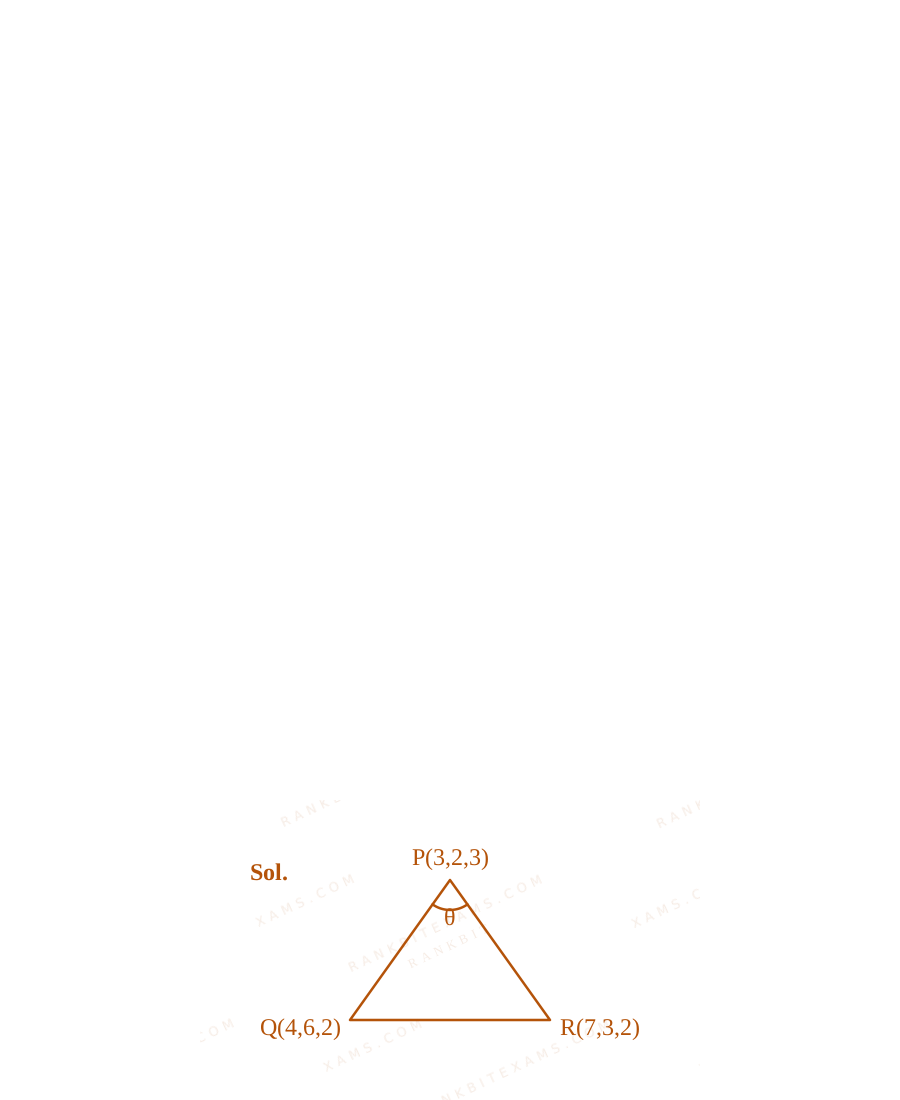
Let P(3,2,3), Q(4,6,2) and R(7,3,2) be the vertices of Δ PQR. Then, the angle ∠ QPR is
  • A. (π)/(6)
  • B. ⁻¹((7)/(18))
  • C. ⁻¹((1)/(18))
  • D. (π)/(3)

Solution

Related Formula
θ = a · b| a|| b|
Core Logic

Let us compute the direction ratios of the vectors PQ and PR originating from vertex P:

Direction ratios of PQ = (4 - 3, 6 - 2, 2 - 3) = (1, 4, -1) Direction ratios of PR = (7 - 3, 3 - 2, 2 - 3) = (4, 1, -1)

Step 1: Evaluating the Angle

Using the dot product formula for the angle θ = ∠ QPR:

θ = 1(4) + 4(1) + (-1)(-1)√(1² + 4² + (-1)²) · √(4² + 1² + (-1)²) θ = 4 + 4 + 1√(18) · √(18) = (9)/(18) = (1)/(2)

Angle Between Two Lines diagram for Q3 - JEE Main 2024 Evening

Since θ = (1)/(2), we have:

θ = (π)/(3)
Pattern Recognition

When asked for an angle like ∠ QPR, always ensure both vectors diverge from the common vertex P (i.e., use PQ and PR) to avoid sign errors.

Chapter Mix

Class 12 Mathematics: Three Dimensional Geometry

Q26 jee_main_2024_29_january_evening Shortest Distance Between Two Lines
Let O be the origin, and M and N be the points on the lines (x - 5)/(4) = (y - 4)/(1) = (z - 5)/(3) and (x + 8)/(12) = (y + 2)/(5) = (z + 11)/(9) respectively such that MN is the shortest distance between the given lines. Then OM· ON is equal to
Numerical Answer. Answer: 9 to 9

Solution

Related Formula

The line segment of shortest distance MN is perpendicular to both directing vectors b₁ and b₂.

Core Logic

Let general point coordinates be expressions of parameters λ and μ:

M = (4λ + 5, λ + 4, 3λ + 5) N = (12μ - 8, 5μ - 2, 9μ - 11)

Vector direction ratios of MN:

MN = (4λ - 12μ + 13, λ - 5μ + 6, 3λ - 9μ + 16)

The cross product vector perpendicular to both lines is b₁ × b₂ = (-6, 0, 8).

Step 1: Finding Parameters via Perpendicular Conditions

Equating directional proportional factors:

(4λ - 12μ + 13)/(-6) = (λ - 5μ + 6)/(0) = (3λ - 9μ + 16)/(8)

From the zero denominator constraint:

λ - 5μ + 6 = 0 (iii)

From the first and third components:

8(4λ - 12μ + 13) = -6(3λ - 9μ + 16) 32λ - 96μ + 104 = -18λ + 54μ - 96 50λ - 150μ + 200 = 0 λ - 3μ + 4 = 0 (iv)

Solving equations (iii) and (iv) yields λ = -1 and μ = 1.

Step 2: Vector Coordinate Evaluation

Substituting parameter roots into point layout vectors:

M = (4(-1)+5, -1+4, 3(-1)+5) = (1, 3, 2) N = (12(1)-8, 5(1)-2, 9(1)-11) = (4, 3, -2)

Evaluating target scalar products:

OM · ON = 1(4) + 3(3) + 2(-2) = 4 + 9 - 4 = 9
Pattern Recognition

Shortest distance points constrain line segments to align with the direct cross product vector. Setting proportional components yields quick parameters.

Chapter Mix

Class 12 Mathematics: Three Dimensional Geometry

Q3 jee_main_2024_27_jan_morning Distance of a Point from a Line
The distance of the point (7, -2, 11) from the line (x-6)/(1)=(y-4)/(0)=(z-8)/(3) along the line (x-5)/(2)=(y-1)/(-3)=(z-5)/(6), is:
  • A. 12
  • B. 14
  • C. 18
  • D. 21

Solution

Related Formula
(x-x₁)/(a) = (y-y₁)/(b) = (z-z₁)/(c) = λ
Core Logic

Let point A = (7, -2, 11). We want the distance from A to the line L₁: (x-6)/(1)=(y-4)/(0)=(z-8)/(3) measured along a line parallel to L₂: (x-5)/(2)=(y-1)/(-3)=(z-5)/(6).

The line passing through A parallel to L₂ will have the equation:

(x-7)/(2) = (y+2)/(-3) = (z-11)/(6) = λ

Any general point B on this new line can be represented as:

B ≡ (2λ + 7, -3λ - 2, 6λ + 11)
Step 1: Finding Intersection Point B

Since B lies on the given line L₁, its coordinates must satisfy the equation of L₁:

((2λ + 7) - 6)/(1) = ((-3λ - 2) - 4)/(0) = ((6λ + 11) - 8)/(3)

Focus on the middle term (since denominator is 0, numerator must equal 0 for intersection):

-3λ - 6 = 0 ⇒ λ = -2
Step 2: Coordinates of B and Distance Calculation

Substitute λ = -2 back into the coordinates of point B:

B = (2(-2)+7, -3(-2)-2, 6(-2)+11) = (3, 4, -1)

Now, calculate the distance AB using the 3D distance formula:

AB = √((7-3)² + (-2-4)² + (11 - (-1))²) AB = √(4² + (-6)² + (12)²) AB = √(16 + 36 + 144) AB = √(196) = 14
Pattern Recognition

Distance of a point from a line along another direction means finding the intersection of the given line and a new line passing through the point parallel to the direction vector. The zero in the direction ratio is a massive shortcut—just equate the corresponding numerator to zero.

Chapter Mix

Class 12 Maths: Three Dimensional Geometry

Q8 jee_main_2024_27_jan_morning Shortest Distance Between Two Lines
If the shortest distance between the lines (x-4)/(1)=(y+1)/(2)=(z)/(-3) and (x-λ)/(2)=(y+1)/(4)=(z-2)/(-5) is 6√(5), then the sum of all possible values of λ is:
  • A. 5
  • B. 8
  • C. 7
  • D. 10

Solution

Related Formula
d = |( a₂ - a₁) · ( b₁ × b₂)|| b₁ × b₂|
Core Logic

Identify the positional vectors and direction ratios for both lines: Line 1: a₁ = (4, -1, 0), direction b₁ = (1, 2, -3) Line 2: a₂ = (λ, -1, 2), direction b₂ = (2, 4, -5)

Vector connecting lines: ( a₂ - a₁) = (λ - 4, 0, 2)

Step 1: Cross Product and Magnitude

Find the normal vector n = b₁ × b₂:

b₁ × b₂ = vmatrix i & j & k 1 & 2 & -3 2 & 4 & -5 vmatrix = i(-10 - (-12)) - j(-5 - (-6)) + k(4 - 4) = 2 i - 1 j + 0 k = (2, -1, 0)

Magnitude of the normal vector:

| b₁ × b₂| = √(2² + (-1)² + 0²) = √(5)
Step 2: Application of Shortest Distance Formula

Dot product of normal vector and positional difference vector:

( a₂ - a₁) · ( b₁ × b₂) = (λ - 4)(2) + (0)(-1) + (2)(0) = 2(λ - 4)

Using the shortest distance formula given as 6√(5):

|2(λ - 4)|√(5) = 6√(5) |2(λ - 4)| = 6 |λ - 4| = 3
Step 3: Finding Unknown values

Solve the absolute value relation:

λ - 4 = 3 ⇒ λ = 7 λ - 4 = -3 ⇒ λ = 1

Sum of possible values = 7 + 1 = 8.

Pattern Recognition

Standard Shortest Distance methodology between skew lines. Cross product of direction vectors forms the perpendicular frame normal, and dot-producting the difference of positional anchor points yields the direct orthogonal projection.

Chapter Mix

Class 12 Maths: Three Dimensional Geometry Class 12 Maths: Vector Algebra

More Three Dimensional Geometry Questions — jee_main_2025_07_april_morning

Practice all Three Dimensional Geometry previous-year questions →

Rankbit System
JEE Physics: Waves (+15.5%) | Electrostatics: Concentric Shells (-29.7%) | Modern Physics: Photoelectric Clones (+34.2%) | Mathematics: Definite Integrals (+18.1%) | Chemistry: Coordination Splitting (-11.4%) | JEE Physics: Waves (+15.5%) | Electrostatics: Concentric Shells (-29.7%) | Modern Physics: Photoelectric Clones (+34.2%) | Mathematics: Definite Integrals (+18.1%) | Chemistry: Coordination Splitting (-11.4%)