A line with direction ratios 2, 1, 2 meets the lines x=y+2=z$x=y+2=z$ and x+2=2y=2z$x+2=2y=2z$ respectively at the point P and Q. if the length of the perpendicular from the point (1, 2, 12)$(1, 2, 12)$ to the line PQ is l$l$, then l²$l^2$ is
Numerical Answer Type:
Enter a numerical valueAnswer: 65 to 65+4 marks
Solution & Explanation
Related Formula
Dot Product for Orthogonality: A · B = 0 a₁b₁ + a₂b₂ + a₃b₃ = 0$$\text{Dot Product for Orthogonality: } \vec{A} \cdot \vec{B} = 0 \implies a_1b_1 + a_2b_2 + a_3b_3 = 0$$Distance between 3D points: d = √((x₂-x₁)²+(y₂-y₁)²+(z₂-z₁)²)$$\text{Distance between 3D points: } d = \sqrt{(x_2-x_1)^2+(y_2-y_1)^2+(z_2-z_1)^2}$$
Core Logic
Let the first line be L₁: x = y+2 = z = t$L_1: x = y+2 = z = t$.
Any point P$P$ on L₁$L_1$ has coordinates (t, t-2, t)$(t, t-2, t)$.
Let the second line be L₂: (x+2)/(2) = y = z = s$L_2: \frac{x+2}{2} = y = z = s$.
Any point Q$Q$ on L₂$L_2$ has coordinates (2s-2, s, s)$(2s-2, s, s)$.
The line segment PQ$PQ$ has direction ratios given by the difference of coordinates:
(s-t+2)/(1) = (s-t)/(2)$$\frac{s-t+2}{1} = \frac{s-t}{2}$$2s - 2t + 4 = s - t ⇒ s - t = -4 ⇒ t = s + 4$$2s - 2t + 4 = s - t \Rightarrow s - t = -4 \Rightarrow t = s + 4$$
Let F$F$ be the foot of the perpendicular from point A(1, 2, 12)$A(1, 2, 12)$ to the line PQ$PQ$.
Any general point on line PQ$PQ$ is F(2λ+2, λ+2, 2λ+2)$F(2\lambda+2, \lambda+2, 2\lambda+2)$.
Whenever you must link two skew lines with a third intersecting line given constant direction ratios, immediately construct generic parametric points on each skew line. Subtraction yields a vector that is directly proportional to the given constants, instantly solving the system.
Keywords:#length of the perpendicular#JEE Main 2024 Morning Q30#Three Dimensional Geometry JEE Main 2024#Shortest Distance Between Lines JEE Main 2024
More Three Dimensional Geometry Previous-Year Questions — Page 7
Qjee_main_2025_03_april_morningIntersection of Lines
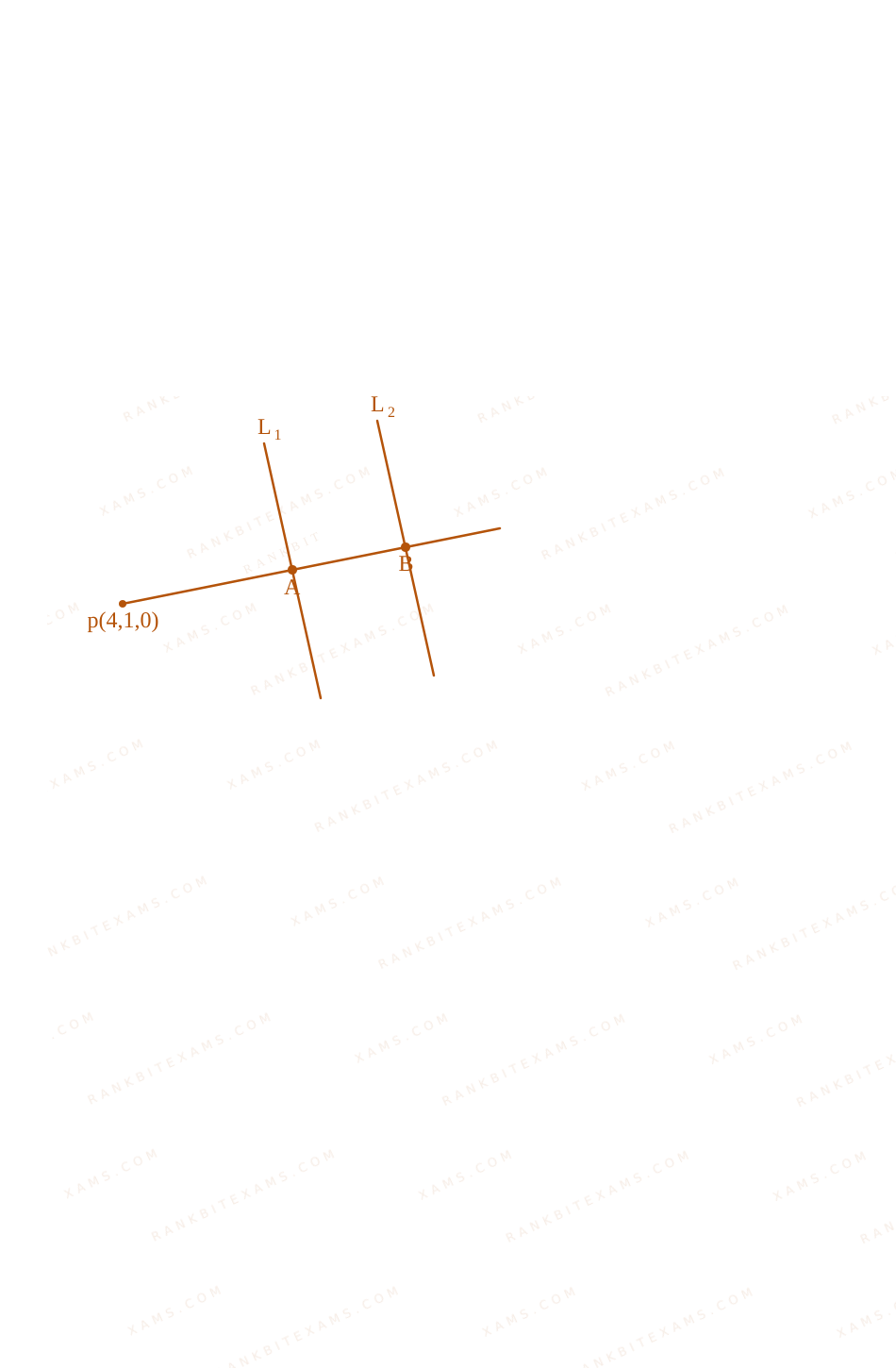
Let a line passing through the point (4,1,0)$(4,1,0)$ intersect the line L₁:(x-1)/(2)=(y-2)/(3)=(z-3)/(4)$L_{1}:\frac{x-1}{2}=\frac{y-2}{3}=\frac{z-3}{4}$ at the point A(α, β, γ)$A(\alpha, \beta, \gamma)$ and the line L₂:x-6=y=-z+4$L_{2}:x-6=y=-z+4$ at the point B(a, b, c)$B(a, b, c)$. Then the value of the determinant vmatrix 1 & 0 & 1 α & β & γ a & b & c vmatrix$\begin{vmatrix} 1 & 0 & 1 \\ \alpha & \beta & \gamma \\ a & b & c \end{vmatrix}$ is equal to:
A. 8
B. 16
C. 12
D. 4
Solution
Related Formula
For three points P$P$, A$A$, and B$B$ to be collinear, their direction vectors must be proportional:
Shortcut: For collinearity across two skew lines with a known external point, express coordinates parametrically and equate direction ratios. Solving the linear relation between parameters rapidly leads to coordinates of A$A$ and B$B$.
Evaluation Rubric / Model Answer
8
Chapter Mix
Class 12 Mathematics: Three Dimensional Geometry
Class 12 Mathematics: Determinants
Q70jee_main_2025_03_april_morningShortest Distance between Skew Lines
Line L₁$L_{1}$ passes through the point (1, 2, 3)$(1, 2, 3)$ and is parallel to z-axis. Line L₂$L_{2}$ passes through the point (λ, 5, 6)$(\lambda, 5, 6)$ and is parallel to y-axis. Let for λ = λ₁, λ₂$\lambda = \lambda_{1}, \lambda_{2}$, λ₂ < λ₁$\lambda_{2} < \lambda_{1}$ the shortest distance between the two lines be 3. Then the square of the distance of the point (λ₁, λ₂, 7)$(\lambda_{1}, \lambda_{2}, 7)$ from the line L₁$L_{1}$ is:
A. 40
B. 32
C. 25
D. 37
Solution
Related Formula
Shortest distance between perpendicular axes vectors:
We need to find the square of distance from point P(4, -2, 7)$P(4, -2, 7)$ to line L₁$L_1$.
Any general matching point coordinates tracking along path L₁$L_1$ look like Q(1, 2, t+3)$Q(1, 2, t+3)$.
Form a perpendicular projection vector condition:
PQ = (-3, 4, t-4)$$\vec{PQ} = (-3, 4, t-4)$$
Since PQ · k = 0 t-4 = 0 t=4$\vec{PQ} \cdot \hat{k} = 0 \implies t-4 = 0 \implies t=4$.
Thus, the foot of perpendicular is Q(1, 2, 7)$Q(1, 2, 7)$.
Evaluate the squared distance component magnitude:
For lines parallel directly to independent Cartesian coordinate grid lines, the shortest paths are simply direct plane projections.
Chapter Mix
Class 12 Mathematics: Three Dimensional Geometry
Q56jee_main_2025_04_april_eveningShortest Distance Between Two Lines
Let the values of p$p$, for which the shortest distance between the lines (x + 1)/(3) = (y)/(4) = (z)/(5)$\frac{x + 1}{3} = \frac{y}{4} = \frac{z}{5}$ and r = (p i + 2 j + hatk) + λ (2hati + 3hatj + 4hatk)$\vec{r} = (p\hat{i} + 2\hat{j} + hat{k}) + \lambda (2hat{i} + 3hat{j} + 4hat{k})$ is 1sqrt6$\frac{1}{sqrt{6}}$, be a, b, (a < b$a < b$). Then the length of the latus rectum of the ellipse (x²)/(a²) + (y²)/(b²) = 1$\frac{x^2}{a^2} + \frac{y^2}{b^2} = 1$ is:
A.9$9$
B.(3)/(2)$\frac{3}{2}$
C.(2)/(3)$\frac{2}{3}$
D.18$18$
Solution
Related Formula
The shortest distance between two lines r = a₁ + λ b₁$\vec{r} = \vec{a}_1 + \lambda \vec{b}_1$ and r = a₂ + μ b₂$\vec{r} = \vec{a}_2 + \mu \vec{b}_2$ is given by:
Be careful with coordinate geometry variables; when an ellipse satisfies b > a$b > a$, the major axis is along the y-axis, making the latus rectum equal to (2a²)/(b)$\frac{2a^2}{b}$ instead of (2b²)/(a)$\frac{2b^2}{a}$.
Chapter Mix
Class 12 Mathematics: Three Dimensional Geometry
Class 11 Mathematics: Conic Sections
Q69jee_main_2025_04_april_eveningAngle Between Two Lines
Let A be the point of intersection of the lines L _ 1: (x - 7)/(1) = (y - 5)/(0) = (z - 3)/(- 1)$L _ {1}: \frac {x - 7}{1} = \frac {y - 5}{0} = \frac {z - 3}{- 1}$ and L₂: x - 13 = y + 34 = z + 75$\mathrm{L}_2:\frac{\mathrm{x} - 1}{3} = \frac{\mathrm{y} + 3}{4} = \frac{\mathrm{z} + 7}{5}$. Let B and C be the point on the lines L₁$\mathrm{L}_1$ and L₂$\mathrm{L}_2$ respectively such that AB = AC = √(15)$\mathrm{AB} = \mathrm{AC} = \sqrt{15}$. Then the square of the area of the triangle ABC is :
A.54$54$
B.63$63$
C.57$57$
D.60$60$
Solution
Core Logic
First, find the point of intersection A$A$ by solving the lines. Any point on L₁$L_1$ can be written as (λ + 7, 5, -λ + 3)$(\lambda + 7, 5, -\lambda + 3)$.
Substituting this point into the equation for L₂$L_2$:
Thus, the intersection point is A = (7, 5, 3)$A = (7, 5, 3)$.
Step 1: Calculating the Angle between lines
The directional vectors of lines L₁$L_1$ and L₂$L_2$ are u = i - k$\vec{u} = \hat{i} - \hat{k}$ and v = 3hati + 4hatj + 5hatk$\vec{v} = 3hat{i} + 4hat{j} + 5hat{k}$ respectively.
Since B$B$ and C$C$ lie on lines intersecting at A$A$, you don't need to determine their exact coordinates to find the area of the triangle. The standard side-angle-side area formula works perfectly using just the directional angle.
Chapter Mix
Class 12 Mathematics: Three Dimensional Geometry
Class 11 Mathematics: Properties of Triangles
Qjee_main_2025_04_april_morningLine and Point Relations
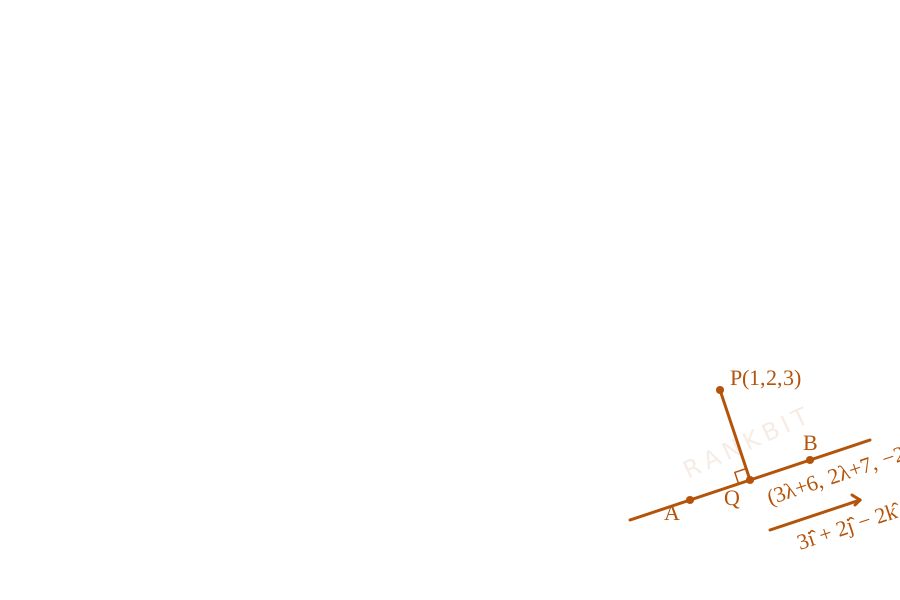
Let A and B be two distinct points on the line L: (x - 6)/(3) = (y - 7)/(2) = (z - 7)/(-2)$L: \frac{x - 6}{3} = \frac{y - 7}{2} = \frac{z - 7}{-2}$. Both A and B are at a distance 2√(17)$2\sqrt{17}$ from the foot of perpendicular drawn from the point (1,2,3)$(1,2,3)$ on the line L. If O is the origin, then OA· OB$\overrightarrow{OA}\cdot \overrightarrow{OB}$ is equal to:
A. 49
B. 47
C. 21
D. 62
Solution
Related Formula
Dot product of two vectors:
OA · OB = xA xB + yA yB + zA zB$$\overrightarrow{OA} \cdot \overrightarrow{OB} = x_A x_B + y_A y_B + z_A z_B$$
Since Q$Q$ is the foot of the perpendicular dropped from P$P$ onto L$L$, the vector PQ$\overrightarrow{PQ}$ is orthogonal to the line's direction vector b = 3 i + 2 j - 2 k$\vec{b} = 3\hat{i} + 2\hat{j} - 2\hat{k}$:
Substituting λ = -1$\lambda = -1$ gives the foot of perpendicular:
Q(3, 5, 9)$Q(3, 5, 9)$
Step 1: Locate Points A and B
Points A$A$ and B$B$ lie on line L$L$ at a distance d = 2√(17)$d = 2\sqrt{17}$ on either side of Q$Q$.
Let the coordinates of points on L$L$ relative to Q$Q$ be (3μ + 3, 2μ + 5, -2μ + 9)$(3\mu + 3,\, 2\mu + 5,\, -2\mu + 9)$. The distance squared from Q$Q$ is:
Points lying symmetrically at equal distances along a 3D line from a known central point can be found directly using parametric displacement along the unit direction vector (r = rQ ± d b$\vec{r} = \vec{r}_Q \pm d\,\hat{b}$).
Evaluation Rubric / Model Answer
Option B: 47
Chapter Mix
Class 12 Mathematics: Three Dimensional Geometry
More Three Dimensional Geometry Questions — jee_main_2024_29_jan_morning
Practice past-year questions one chapter at a time. Pick an exam → subject → chapter and get every PYQ for that topic — pulled together from all past papers — with the chapter's key formulas alongside.