A line with direction ratios 2, 1, 2 meets the lines x=y+2=z$x=y+2=z$ and x+2=2y=2z$x+2=2y=2z$ respectively at the point P and Q. if the length of the perpendicular from the point (1, 2, 12)$(1, 2, 12)$ to the line PQ is l$l$, then l²$l^2$ is
Numerical Answer Type:
Enter a numerical valueAnswer: 65 to 65+4 marks
Solution & Explanation
Related Formula
Dot Product for Orthogonality: A · B = 0 a₁b₁ + a₂b₂ + a₃b₃ = 0$$\text{Dot Product for Orthogonality: } \vec{A} \cdot \vec{B} = 0 \implies a_1b_1 + a_2b_2 + a_3b_3 = 0$$Distance between 3D points: d = √((x₂-x₁)²+(y₂-y₁)²+(z₂-z₁)²)$$\text{Distance between 3D points: } d = \sqrt{(x_2-x_1)^2+(y_2-y_1)^2+(z_2-z_1)^2}$$
Core Logic
Let the first line be L₁: x = y+2 = z = t$L_1: x = y+2 = z = t$.
Any point P$P$ on L₁$L_1$ has coordinates (t, t-2, t)$(t, t-2, t)$.
Let the second line be L₂: (x+2)/(2) = y = z = s$L_2: \frac{x+2}{2} = y = z = s$.
Any point Q$Q$ on L₂$L_2$ has coordinates (2s-2, s, s)$(2s-2, s, s)$.
The line segment PQ$PQ$ has direction ratios given by the difference of coordinates:
(s-t+2)/(1) = (s-t)/(2)$$\frac{s-t+2}{1} = \frac{s-t}{2}$$2s - 2t + 4 = s - t ⇒ s - t = -4 ⇒ t = s + 4$$2s - 2t + 4 = s - t \Rightarrow s - t = -4 \Rightarrow t = s + 4$$
Let F$F$ be the foot of the perpendicular from point A(1, 2, 12)$A(1, 2, 12)$ to the line PQ$PQ$.
Any general point on line PQ$PQ$ is F(2λ+2, λ+2, 2λ+2)$F(2\lambda+2, \lambda+2, 2\lambda+2)$.
Whenever you must link two skew lines with a third intersecting line given constant direction ratios, immediately construct generic parametric points on each skew line. Subtraction yields a vector that is directly proportional to the given constants, instantly solving the system.
Keywords:#length of the perpendicular#JEE Main 2024 Morning Q30#Three Dimensional Geometry JEE Main 2024#Shortest Distance Between Lines JEE Main 2024
More Three Dimensional Geometry Previous-Year Questions — Page 6
Q73jee_main_2025_08_april_eveningArea of Triangle Formed by Intersecting Lines
Let the area of the triangle formed by the lines x + 2 = y - 1 = z, (x - 3)/(5) = (y)/(-1) = (z - 1)/(1)$x + 2 = y - 1 = z, \frac{x - 3}{5} = \frac{y}{-1} = \frac{z - 1}{1}$ and x-3 = y - 33 = z - 21$\frac{\mathrm{x}}{-3} = \frac{\mathrm{y} - 3}{3} = \frac{\mathrm{z} - 2}{1}$ be A. Then A²$A^2$ is equal to
Numerical Answer.Answer: 56 to 56
Solution
Related Formula
Area A = (1)/(2) | AB × AC|$$\text{Area } A = \frac{1}{2} |\vec{AB} \times \vec{AC}|$$
Core Logic
Determine the three intersection vertex positions for the matching coordinate line segments, then calculate vector cross expansions to determine face boundaries.
Finding the area of a triangle formed by intersecting lines involves grouping directional cross vectors once coordinates are solved.
Chapter Mix
Class 12 Mathematics: Three Dimensional Geometry
Q56jee_main_2025_29_jan_eveningLine and Plane Intersections
Let a straight line L$L$ pass through the point P(2, -1, 3)$P(2, -1, 3)$ and be perpendicular to the lines (x - 1)/(2) = (y + 1)/(1) = (z - 3)/(-2)$\frac{x - 1}{2} = \frac{y + 1}{1} = \frac{z - 3}{-2}$ and \frac{x - 3}{1} = \frac{y - 2}{3} = \frac{z + 2}{4}. If the line L$L$ intersects the yz$yz$-plane at the point Q$Q$, then the distance between the points P$P$ and Q$Q$ is:
A.2$2$
B.√(10)$\sqrt{10}$
C.3$3$
D.2√(3)$2\sqrt{3}$
Solution
Related Formula
The direction vector of a line perpendicular to two vectors u$\vec{u}$ and v$\vec{v}$ is obtained via the cross product:
n = u × v$$\vec{n} = \vec{u} \times \vec{v}$$
Core Logic
Extract direction vectors of the given lines:
u = 2 i + j - 2 k$$\vec{u} = 2\hat{i} + \hat{j} - 2\hat{k}$$v = i + 3 j + 4 k$$\vec{v} = \hat{i} + 3\hat{j} + 4\hat{k}$$
Any random point on this line is Q(2λ + 2, -2λ - 1, λ + 3)$Q(2\lambda + 2, -2\lambda - 1, \lambda + 3)$.
For intersection with the yz$yz$-plane, set x = 0$x = 0$:
Perpendicularity to two lines always indicates using the cross-product to lock down the direction ratios. Intersection with the yz$yz$-plane simply forces x = 0$x = 0$ immediately.
Chapter Mix
Class 12 Mathematics: Three Dimensional Geometry
Q63jee_main_2025_29_jan_eveningShortest Distance and Intersection of Lines
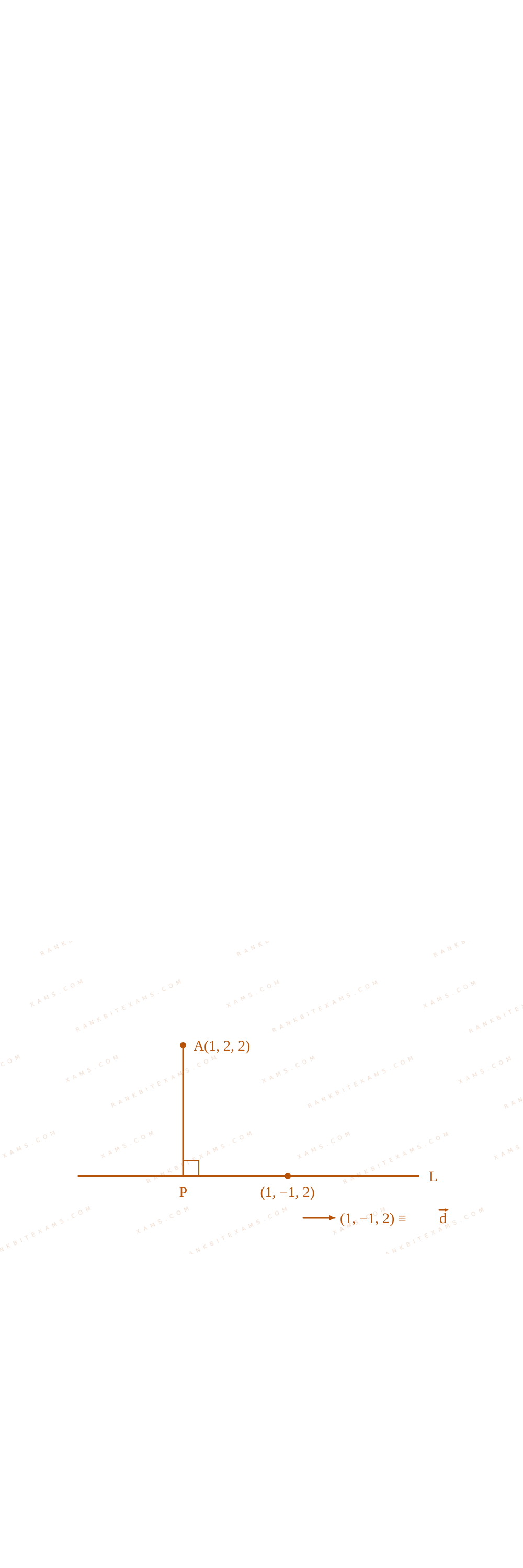
Let P$\mathbf{P}$ be the foot of the perpendicular from the point (1,2,2)$(1,2,2)$ on the line L: x - 11 = y + 1-1 = z - 22$\mathrm{L}:\frac{\mathrm{x} - 1}{1} = \frac{\mathrm{y} + 1}{-1} = \frac{\mathrm{z} - 2}{2}$. Let the line r = (- i + j -2 k) + λ ( i - j + k)$\vec{\mathrm{r}} = (-\hat{\mathrm{i}} +\hat{\mathrm{j}} -2\hat{\mathrm{k}}) + \lambda (\hat{\mathrm{i}} -\hat{\mathrm{j}} +\hat{\mathrm{k}})$, λ in R$\lambda \in \mathbb{R}$, intersect the line L$\mathrm{L}$ at Q. Then 2(PQ)²$2(\mathrm{PQ})^2$ is equal to:
A.27$27$
B.25$25$
C.29$29$
D.19$19$
Solution
Related Formula
Dot product of vector projection matching orthogonal axes equals zero:
AP · d = 0$$\vec{AP} \cdot \vec{d} = 0$$
Core Logic
Let the target source coordinates tracking point match A(1, 2, 2)$A(1, 2, 2)$. General parameter points on line L$L$ are defined by parameter μ$\mu$:
Always separate foot evaluations from line-intersection parameter updates to ensure you do not mix up variables tracking linear metrics.
Chapter Mix
Class 12 Mathematics: Three Dimensional Geometry
Qjee_main_2025_28_jan_morningDistance Formula and Properties of Triangles
Let A(x,y,z)$A(x,y,z)$ be a point in xy-plane, which is equidistant from three points (0, 3, 2), (2, 0, 3) and (0, 0, 1).
Let B = (1, 4, -1)$B = (1, 4, -1)$ and C = (2, 0, -2)$C = (2, 0, -2)$. Then among the statements
(S1) : Δ ABC$\Delta ABC$ is an isosceles right angled triangle and
(S2): the area of Δ ABC$\Delta ABC$ is 9√(2)2$\frac{9\sqrt{2}}{2}$.
Since A(x,y,z)$A(x,y,z)$ lies in the xy-plane, its z-coordinate must be zero (z = 0$z = 0$). Let the reference targets be P(0,3,2)$P(0,3,2)$, Q(2,0,3)$Q(2,0,3)$, and R(0,0,1)$R(0,0,1)$.
Planar locations instantly zero out specific coordinate dimensions (z=0$z=0$ for xy-planes), simplifying system matrices down rapidly.
Chapter Mix
Class 11 Maths: Three Dimensional Geometry
Qjee_main_2025_28_jan_morningImage of a Point in a Line
If the image of the point (4, 4, 3)$(4, 4, 3)$ in the line (x - 1)/(2) = (y - 2)/(1) = (z - 1)/(3)$\frac{x - 1}{2} = \frac{y - 2}{1} = \frac{z - 1}{3}$ is (α, β, γ)$(\alpha, \beta, \gamma)$, then α + β + γ$\alpha + \beta + \gamma$ is equal to
A. 9
B. 12
C. 8
D. 7
Solution
Related Formula
Perpendicularity condition for vectors:
u · v = 0$$\vec{u} \cdot \vec{v} = 0$$
Core Logic
Let Q$Q$ be the projection point on the given line parameterized by λ$\lambda$:
Q(2λ + 1, λ + 2, 3λ + 1)$Q(2\lambda + 1, \lambda + 2, 3\lambda + 1)$.
The vector PQ$\overrightarrow{PQ}$ from P(4,4,3)$P(4,4,3)$ is: Image of a Point in a Line diagram for Q62 - JEE Main 2025 MorningPQ = (2λ - 3) i + (λ - 2) j + (3λ - 2) k$\overrightarrow{PQ} = (2\lambda - 3)\hat{i} + (\lambda - 2)\hat{j} + (3\lambda - 2)\hat{k}$.
Step 1: Solving for Projected Intersection Points
Since PQ$\overrightarrow{PQ}$ is perpendicular to the line's direction vector (2, 1, 3)$(2, 1, 3)$:
Wait, checking the options from the paper layout: option (2) represents the correct numerical matrix sum choice value 12? Let's verify the options mapping sequence matching. Ah, let's look at the calculation value carefully: 2+2+5=9$2+2+5=9$, which corresponds to choice (1).
Pattern Recognition
Midpoint properties safely speed up spatial image transitions once you locate the perpendicular projection foot.
Chapter Mix
Class 12 Maths: Three Dimensional Geometry
More Three Dimensional Geometry Questions — jee_main_2024_29_jan_morning
Practice past-year questions one chapter at a time. Pick an exam → subject → chapter and get every PYQ for that topic — pulled together from all past papers — with the chapter's key formulas alongside.