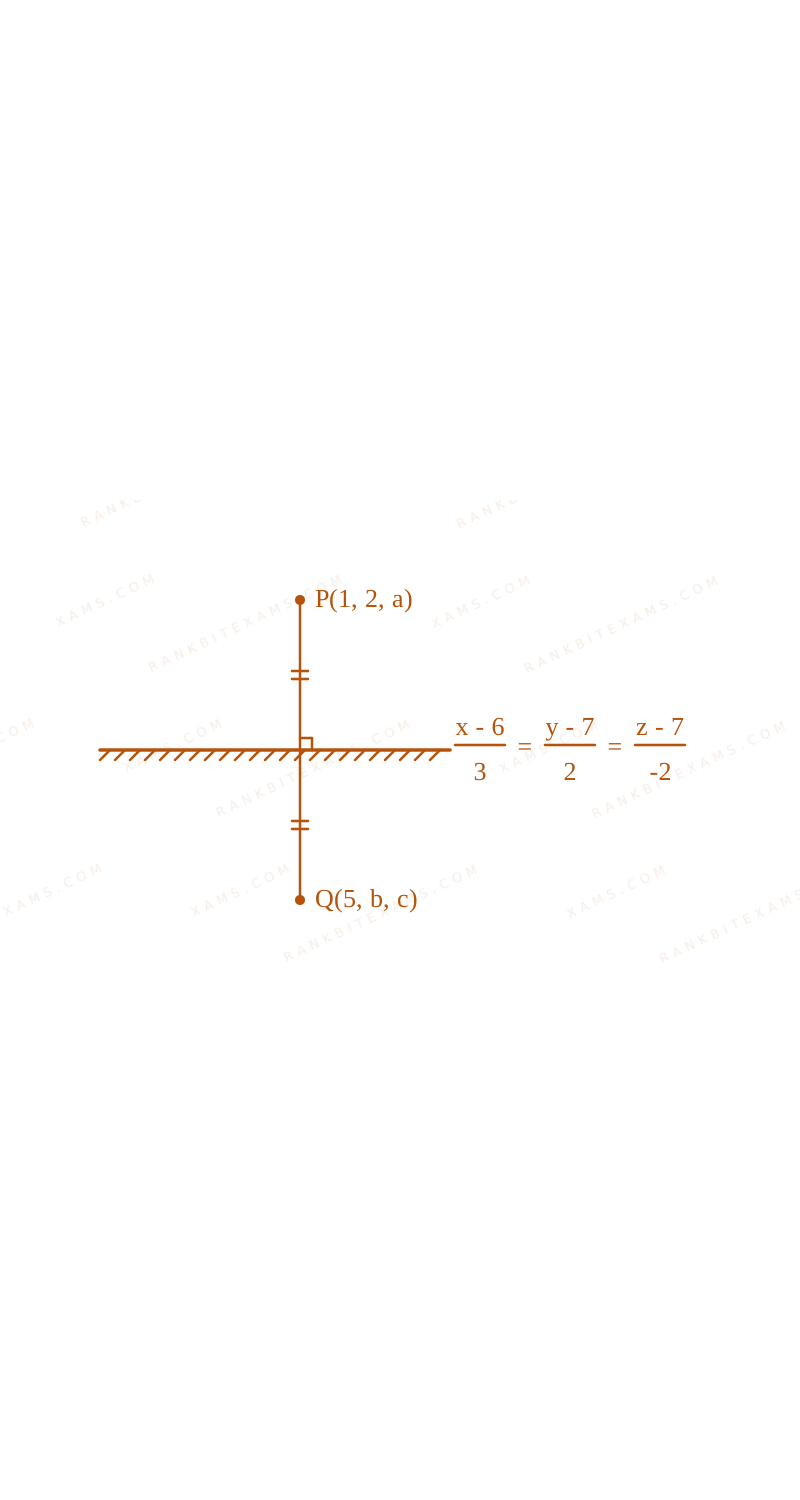
If the image of the point P (1, 2, a) in the line (x - 6)/(3) = (y - 7)/(2) = (7 - z)/(2)$\frac{x - 6}{3} = \frac{y - 7}{2} = \frac{7 - z}{2}$ is Q(5, b, c), then a² + b² + c²$a^2 + b^2 + c^2$ is equal to
A.293$293$
B.264$264$
C.298$298$
D.283$283$
Solution & Explanation
Related Formula
Midpoint M = ((x₁ + x₂)/(2), (y₁ + y₂)/(2), (z₁ + z₂)/(2)) lies on the given line.$$\text{Midpoint } M = \left(\frac{x_1 + x_2}{2}, \frac{y_1 + y_2}{2}, \frac{z_1 + z_2}{2}\right) \text{ lies on the given line.}$$Direction ratio of PQ is perpendicular to line's direction vector b, so PQ · b = 0.$$\text{Direction ratio of } PQ \text{ is perpendicular to line's direction vector } \vec{b}, \text{ so } \overrightarrow{PQ} \cdot \vec{b} = 0.$$
Core Logic
Given line L$L$: (x - 6)/(3) = (y - 7)/(2) = (z - 7)/(-2)$\frac{x - 6}{3} = \frac{y - 7}{2} = \frac{z - 7}{-2}$. Notice the standard form requires (z-7)/(-2)$(z-7)/(-2)$.
Point P = (1, 2, a)$P = (1, 2, a)$ and its image is Q = (5, b, c)$Q = (5, b, c)$.
The midpoint M$M$ of PQ$PQ$ must lie exactly on the line L$L$.
Image of a Point in a Line diagram for Q11 - JEE Main 2026 Morning
Pattern Recognition
Any 'image of a point' problem revolves around two strict constraints: 1) The line bisects the segment joining the point and its image (Midpoint lies on the line), and 2) The segment is orthogonal to the line (Dot product = 0). Directly imposing these generates decoupled simple linear equations.
Keywords:#image of the point#JEE Main 2026 Morning Q11#Three Dimensional Geometry JEE Main 2026#Image of a Point in a Line JEE Main 2026
More Three Dimensional Geometry Previous-Year Questions — Page 10
Q29jee_main_2024_01_february_morningShortest Distance Between Skew Lines
Let the line of the shortest distance between the lines L₁: r=( i+2 j+3 k)+λ( i- j+ k)$L_{1}:\vec{r}=(\hat{i}+2\hat{j}+3\hat{k})+\lambda(\hat{i}-\hat{j}+\hat{k})$ and L₂: r=(4 i+5 j+6 k)+μ( i+ j- k)$L_{2}:\vec{r}=(4\hat{i}+5\hat{j}+6\hat{k})+\mu(\hat{i}+\hat{j}-\hat{k})$ intersect L₁$L_{1}$ and L₂$L_{2}$ at P and Q respectively. If $(α, β, γ)$$$(\alpha, \beta, \gamma)$$is the midpoint of the line segment PQ, then$ is the midpoint of the line segment PQ, then $2(\alpha+\beta+\gamma)$ is equal to
Numerical Answer.Answer: 21 to 21
Solution
Related Formula
The vector connecting the shortest distance points P$P$ and Q$Q$ on two skew lines must be simultaneously perpendicular to the direction vectors b₁$\vec{b}_1$ and b₂$\vec{b}_2$ of both lines:
Angle Between Two Lines diagram for Q3 - JEE Main 2024 Evening
Since θ = (1)/(2)$\cos \theta = \frac{1}{2}$, we have:
θ = (π)/(3)$$\theta = \frac{\pi}{3}$$
Pattern Recognition
When asked for an angle like ∠ QPR$\angle QPR$, always ensure both vectors diverge from the common vertex P$P$ (i.e., use PQ$\overrightarrow{PQ}$ and PR$\overrightarrow{PR}$) to avoid sign errors.
Chapter Mix
Class 12 Mathematics: Three Dimensional Geometry
Q26jee_main_2024_29_january_eveningShortest Distance Between Two Lines
Let O$O$ be the origin, and M$M$ and N$N$ be the points on the lines (x - 5)/(4) = (y - 4)/(1) = (z - 5)/(3)$\frac{x - 5}{4} = \frac{y - 4}{1} = \frac{z - 5}{3}$ and (x + 8)/(12) = (y + 2)/(5) = (z + 11)/(9)$\frac{x + 8}{12} = \frac{y + 2}{5} = \frac{z + 11}{9}$ respectively such that MN$MN$ is the shortest distance between the given lines. Then OM· ON$\overline{\mathrm{OM}}\cdot \overline{\mathrm{ON}}$ is equal to
Numerical Answer.Answer: 9 to 9
Solution
Related Formula
The line segment of shortest distance MN$MN$ is perpendicular to both directing vectors b₁$\vec{b}_1$ and b₂$\vec{b}_2$.
Core Logic
Let general point coordinates be expressions of parameters λ$\lambda$ and μ$\mu$:
Shortest distance points constrain line segments to align with the direct cross product vector. Setting proportional components yields quick parameters.
Chapter Mix
Class 12 Mathematics: Three Dimensional Geometry
Q3jee_main_2024_27_jan_morningDistance of a Point from a Line
The distance of the point (7, -2, 11)$(7, -2, 11)$ from the line (x-6)/(1)=(y-4)/(0)=(z-8)/(3)$\frac{x-6}{1}=\frac{y-4}{0}=\frac{z-8}{3}$ along the line (x-5)/(2)=(y-1)/(-3)=(z-5)/(6)$\frac{x-5}{2}=\frac{y-1}{-3}=\frac{z-5}{6}$, is:
Let point A = (7, -2, 11)$A = (7, -2, 11)$. We want the distance from A$A$ to the line L₁: (x-6)/(1)=(y-4)/(0)=(z-8)/(3)$L_1: \frac{x-6}{1}=\frac{y-4}{0}=\frac{z-8}{3}$ measured along a line parallel to L₂: (x-5)/(2)=(y-1)/(-3)=(z-5)/(6)$L_2: \frac{x-5}{2}=\frac{y-1}{-3}=\frac{z-5}{6}$.
The line passing through A$A$ parallel to L₂$L_2$ will have the equation:
Distance of a point from a line along another direction means finding the intersection of the given line and a new line passing through the point parallel to the direction vector. The zero in the direction ratio is a massive shortcut—just equate the corresponding numerator to zero.
Chapter Mix
Class 12 Maths: Three Dimensional Geometry
Q8jee_main_2024_27_jan_morningShortest Distance Between Two Lines
If the shortest distance between the lines(x-4)/(1)=(y+1)/(2)=(z)/(-3)$\frac{x-4}{1}=\frac{y+1}{2}=\frac{z}{-3}$ and (x-λ)/(2)=(y+1)/(4)=(z-2)/(-5)$\frac{x-\lambda}{2}=\frac{y+1}{4}=\frac{z-2}{-5}$ is 6√(5)$\frac{6}{\sqrt{5}}$, then the sum of all possible values of λ$\lambda$ is:
Standard Shortest Distance methodology between skew lines. Cross product of direction vectors forms the perpendicular frame normal, and dot-producting the difference of positional anchor points yields the direct orthogonal projection.
Chapter Mix
Class 12 Maths: Three Dimensional Geometry
Class 12 Maths: Vector Algebra
More Three Dimensional Geometry Questions — jee_main_2026_22_january_morning
Practice past-year questions one chapter at a time. Pick an exam → subject → chapter and get every PYQ for that topic — pulled together from all past papers — with the chapter's key formulas alongside.