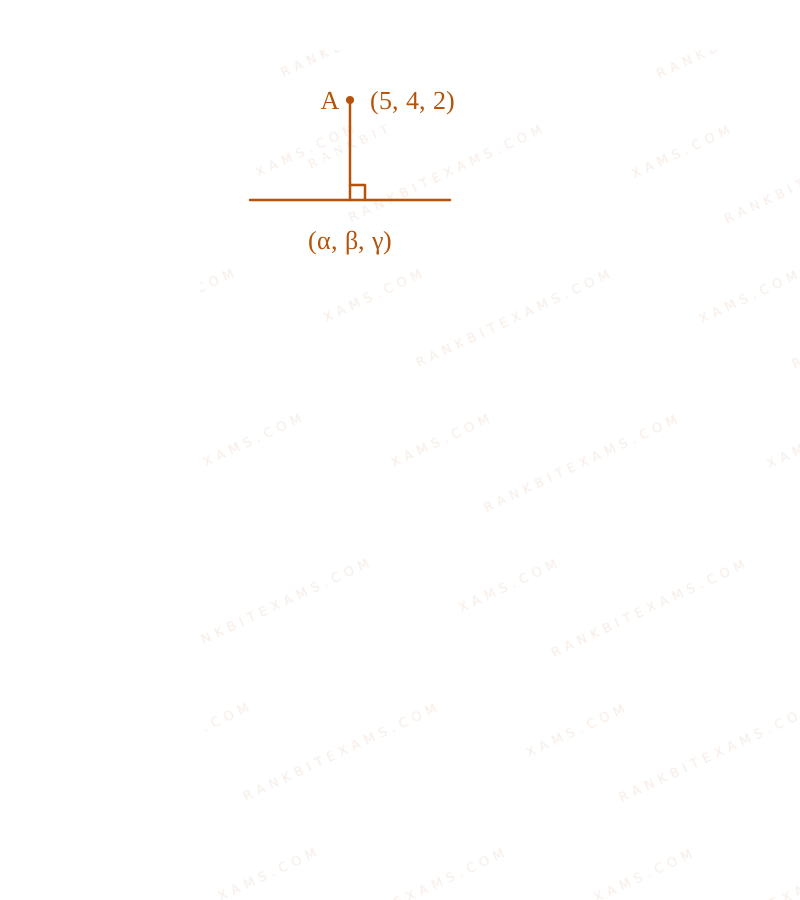
Let (alpha, beta, gamma) be the co-ordinates of the foot of the perpendicular drawn from the point (5, 4, 2) on the line vecr = (-hati + 3hatj + hatk) + lambda(2hati + 3hatj - hatk) . Then the length of the projection of the vector alphahati+betahatj+gammahatk on the vector 6hati+2hatj+3hatk is :

Solution & Explanation

### Related Formula textLength of projection of vecu text on vecw = frac|vecu cdot vecw||vecw| ### Core Logic Given point A(5, 4, 2) and line (L): vecr = (-hati + 3hatj + hatk) + lambda(2hati + 3hatj - hatk) Any general point P on this line has coordinates: (-1 + 2lambda, 3 + 3lambda, 1 - lambda) ### Step 1: Finding the foot of the perpendicular Vector vecAP = P - A = (-1 + 2lambda - 5)hati + (3 + 3lambda - 4)hatj + (1 - lambda - 2)hatk vecAP = (2lambda - 6)hati + (3lambda - 1)hatj + (-lambda - 1)hatk Since AP is perpendicular to line (L), the dot product of vecAP with the direction vector of the line (2hati + 3hatj - hatk) must be zero: vecAP cdot (2hati + 3hatj - hatk) = 0 2(2lambda - 6) + 3(3lambda - 1) - 1(-lambda - 1) = 0 4lambda - 12 + 9lambda - 3 + lambda + 1 = 0 14lambda - 14 = 0 Rightarrow lambda = 1
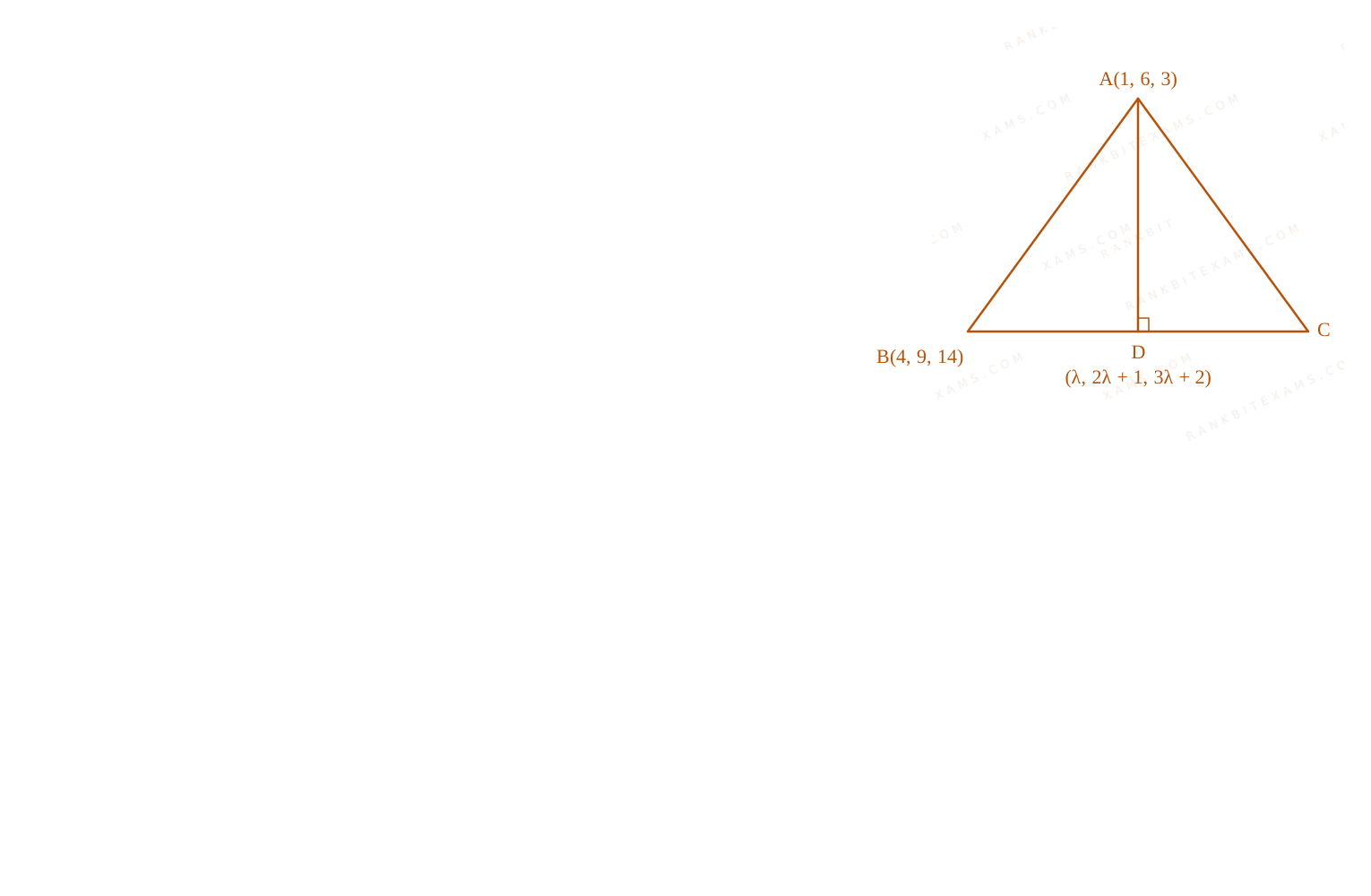
Foot of perpendicular 3D diagram for Q14 - JEE Main 2026 Morning
### Step 2: Coordinates of the foot Substitute lambda = 1 into general point P to get (alpha, beta, gamma): alpha = -1 + 2(1) = 1 beta = 3 + 3(1) = 6 gamma = 1 - 1 = 0 Foot of perpendicular is (1, 6, 0). ### Step 3: Calculate the projection Let vecu = alphahati + betahatj + gammahatk = hati + 6hatj + 0hatk Let vecw = 6hati + 2hatj + 3hatk textProjection = frac|vecu cdot vecw||vecw| = frac|1(6) + 6(2) + 0(3)|sqrt6^2 + 2^2 + 3^2 = frac6 + 12sqrt36 + 4 + 9 = frac18sqrt49 = frac187 ### Pattern Recognition Foot of perpendicular problems algorithm: 1) Frame general vector P(lambda). 2) Construct distance vector vecAP. 3) Dot product with direction vector vecd = 0. 4) Solve for lambda. ### Evaluation Rubric / Model Answer null ### Chapter Mix Class 12 Maths: Three Dimensional Geometry Class 12 Maths: Vector Algebra
Reference Study Guides

More Three Dimensional Geometry Previous-Year Questions — Page 2

Q jee_main_2025_02_april_morning Properties of Tetrahedron
Let ABCD be a tetrahedron such that the edges AB, AC and AD are mutually perpendicular. Let the areas of the triangles ABC, ACD and ADB be 5, 6 and 7 square units respectively. Then the area (in square units) of the Delta BCD is equal to:
  • A. sqrt340
  • B. 12
  • C. sqrt110
  • D. 7sqrt3

Solution

### Related Formula De Gua's Theorem (3D extension of Pythagorean theorem) for right corner tetrahedron states: [textArea(Delta BCD)]^2 = [textArea(Delta ABC)]^2 + [textArea(Delta ACD)]^2 + [textArea(Delta ADB)]^2 ### Core Logic Since the three edges meeting at vertex A are mutually perpendicular, we can align them directly with orthogonal coordinate axes to compute the slanted face area. ### Step 1: Apply Square Area Summation Let the target area be Delta. Delta^2 = 5^2 + 6^2 + 7^2 Delta^2 = 25 + 36 + 49 = 110 Delta = sqrt110 ### Pattern Recognition This is exactly analogous to finding the length of a vector given three perpendicular component lengths. Squaring, adding, and taking the square root yields the value immediately. ### Evaluation Rubric / Model Answer null ### Chapter Mix Class 12 Mathematics: Three Dimensional Geometry Class 12 Mathematics: Vector Algebra
Q jee_main_2025_03_april_evening Direction Cosines and Direction Ratios
Each of the angles beta and gamma that a given line makes with the positive y- and z-axes, respectively, is half of the angle that this line makes with the positive x-axis. Then the sum of all possible values of the angle beta is
  • A. frac3pi4
  • B. pi
  • C. fracpi2
  • D. frac3pi2

Solution

### Related Formula For any line making angles alpha, beta, gamma with the coordinate axes, the direction cosines satisfy: cos^2 alpha + cos^2 beta + cos^2 gamma = 1 ### Core Logic Given that: beta = fracalpha2 quad textand quad gamma = fracalpha2 Substituting these values into the identity: cos^2 alpha + 2cos^2left(fracalpha2right) = 1 ### Step 1: Solving the Trigonometric Equation Using the half-angle identity 2cos^2left(fracalpha2right) = 1 + cos alpha: cos^2 alpha + 1 + cos alpha = 1 cos^2 alpha + cos alpha = 0 cos alpha (cos alpha + 1) = 0 This yields two possible cases: 1. cos alpha = 0 implies alpha = fracpi2 2. cos alpha = -1 implies alpha = pi ### Step 2: Finding Values of beta and their Sum Now we find corresponding values for beta = fracalpha2: - If alpha = fracpi2 implies beta_1 = fracpi4 - If alpha = pi implies beta_2 = fracpi2 Sum of all possible values: beta_1 + beta_2 = fracpi4 + fracpi2 = frac3pi4 ### Pattern Recognition Direction cosines are bounded between [-1, 1]. Always utilize the identities relating double angles or half angles (2cos^2theta = 1 + cos 2theta) to simplify quadratic forms involving different multiples of the coordinate angles. ### Evaluation Rubric / Model Answer null ### Chapter Mix Class 12 Mathematics: Three Dimensional Geometry Class 11 Mathematics: Trigonometric Functions
Q69 jee_main_2025_03_april_evening Lines in 3D Space
The distance of the point (7, 10, 11) from the line fracx-41 = fracy-40 = fracz-23 along the line fracx-92 = fracy-133 = fracz-176 is
  • A. 18
  • B. 14
  • C. 12
  • D. 16

Solution

### Related Formula Distance 'along a line' means the direction vector of the line segment joining target point P to intersecting point Q must be parallel to the given direction ratios: vecPQ = k cdot vecd ### Core Logic Let point P = (7, 10, 11). Any general point Q on the first line fracx-41 = fracy-40 = fracz-23 = lambda is: Q = (lambda + 4, 4, 3lambda + 2) Direction ratios of PQ: vecPQ = (lambda + 4 - 7, 4 - 10, 3lambda + 2 - 11) = (lambda - 3, -6, 3lambda - 9) ### Step 1: Equating direction vectors Since distance is measured parallel to the line with direction vector (2, 3, 6), vecPQ must be parallel to (2, 3, 6): fraclambda - 32 = frac-63 = frac3lambda - 96 From the middle term: fraclambda - 32 = -2 implies lambda - 3 = -4 implies lambda = -1 Let's check consistency with the third term: frac3(-1) - 96 = -2 quad (textConsistent!)
3D Lines diagram for Q69 - JEE Main 2025 Evening Shift
### Step 2: Distance calculation For lambda = -1, the intersection point Q is: Q = (3, 4, -1) Distance PQ: PQ = sqrt(7 - 3)^2 + (10 - 4)^2 + (11 - (-1))^2 PQ = sqrt4^2 + 6^2 + 12^2 = sqrt16 + 36 + 144 = sqrt196 = 14 ### Pattern Recognition When solving distance parallel to a line in 3D, always write down the parametric coordinates of the general point first. Match the ratio of direction cosines directly to avoid setting up complicated systems of coordinate planes. ### Evaluation Rubric / Model Answer null ### Chapter Mix Class 12 Mathematics: Three Dimensional Geometry Class 12 Mathematics: Vector Algebra
Q52 jee_main_2025_07_april_morning Shortest Distance Between Two Lines
If the shortest distance between the lines fracx - 12 = fracy - 23 = fracz - 34 and fracx1 = fracyalpha = fracz - 51 is frac5sqrt6 , then the sum of all possible values of alpha is
  • A. frac32
  • B. -frac32
  • C. 3
  • D. -3

Solution

### Related Formula Shortest distance between two skewed lines with vector equations vecr = veca_1 + lambda vecb_1 and \vec{r} = \vec{a}_2 + \mu \vec{b}_2 is: S.D. = left| frac(veca_2 - veca_1) cdot (vecb_1 times vecb_2)|vecb_1 times vecb_2| right| ### Core Logic From the given lines: Line 1 passes through A(1, 2, 3) with direction vector vecb_1 = 2hati + 3hatj + 4hatk. Line 2 passes through B(0, 0, 5) with direction vector vecb_2 = hati + alphahatj + hatk. The vector connecting the two fixed points is: vecBA = (1-0)hati + (2-0)hatj + (3-5)hatk = hati + 2hatj - 2hatk ### Step 1: Compute Cross Product of Direction Vectors vecn = vecb_1 times vecb_2 = left| beginmatrix hati & hatj & hatk \\ 2 & 3 & 4 \\ 1 & alpha & 1 endmatrix right| = hati(3 - 4alpha) - hatj(2 - 4) + hatk(2alpha - 3) vecn = (3 - 4alpha)hati + 2hatj + (2alpha - 3)hatk ### Step 2: Apply Shortest Distance Formula
Shortest Distance Between Two Lines diagram for Q52 - JEE Main 2025 Morning
S.D. = left| frac(hati + 2hatj - 2hatk) cdot vecn|vecn| right| = frac5sqrt6 Taking dot product in numerator: (hati + 2hatj - 2hatk) cdot vecn = 1(3-4alpha) + 2(2) - 2(2alpha-3) = 3 - 4alpha + 4 - 4alpha + 6 = 13 - 8alpha Squaring both sides: frac(13 - 8alpha)^2(3 - 4alpha)^2 + 4 + (2alpha - 3)^2 = frac256 6(64alpha^2 - 208alpha + 169) = 25(16alpha^2 - 24alpha + 9 + 4 + 4alpha^2 - 12alpha + 9) 6(64alpha^2 - 208alpha + 169) = 25(20alpha^2 - 36alpha + 22) 384alpha^2 - 1248alpha + 1014 = 500alpha^2 - 900alpha + 550 116alpha^2 + 348alpha - 464 = 0 alpha^2 + 3alpha - 4 = 0 ### Step 3: Calculate the Sum of Roots The sum of all possible values of alpha is given by the relation: alpha_1 + alpha_2 = -frac31 = -3 ### Pattern Recognition Whenever asked for the sum of all possible parameter values resulting from a vector condition, look to directly read the linear term coefficient via Vieta's relations rather than explicitly factoring or computing the roots individually. ### Evaluation Rubric / Model Answer null ### Chapter Mix Class 12 Mathematics: Three Dimensional Geometry Class 12 Mathematics: Vector Algebra
Q68 jee_main_2025_07_april_morning Line Intersecting Two Lines
Let the line L pass through (1, 1, 1) and intersect the lines fracx - 12 = fracy + 13 = fracz - 14 and fracx - 31 = fracy - 42 = fracz1 . Then, which of the following points lies on the line L?
  • A. (4,22,7)
  • B. (5, 4, 3)
  • C. (10, -29, -50)
  • D. (7, 15, 13)

Solution

### Related Formula General coordinates of any variable point on a 3D line given symmetric form equations: P_1 = (2lambda + 1, \, 3lambda - 1, \, 4lambda + 1) P_2 = (mu + 3, \, 2mu + 4, \, mu) ### Core Logic Let line L intersect Line 1 at point A(2lambda + 1, 3lambda - 1, 4lambda + 1) and Line 2 at point B(mu + 3, 2mu + 4, mu). Since line L passes through C(1, 1, 1), the direction ratios computed from vector segment AC must be proportional to the direction ratios computed from vector segment BC. ### Step 1: Determine Direction Ratio Parameters
Line Intersecting Two Lines diagram for Q68 - JEE Main 2025 Morning
Direction ratios of AC segment: vecAC = (2lambda + 1 - 1, \, 3lambda - 1 - 1, \, 4lambda + 1 - 1) = (2lambda, \, 3lambda - 2, \, 4lambda) Direction ratios of BC segment: vecBC = (mu + 3 - 1, \, 2mu + 4 - 1, \, mu - 1) = (mu + 2, \, 2mu + 3, \, mu - 1) Equating directional proportionality ratios: fracmu + 22lambda = frac2mu + 33lambda - 2 = fracmu - 14lambda ### Step 2: Solve for Parameter Intersection values From the first and third fractional groups: fracmu + 22lambda = fracmu - 14lambda implies 2(mu + 2) = mu - 1 2mu + 4 = mu - 1 implies mu = -5 Substitute mu = -5 back into the second parameter group linkage to evaluate the target structural direction indicators, which gives the simplified direction ratio vector for BC as: textD.R.s = (-5 + 2, \, 2(-5) + 3, \, -5 - 1) = (-3, \, -7, \, -6) equiv (3, \, 7, \, 6) ### Step 3: Construct Line Equation and Verify Choice Equation of line L passing through C(1, 1, 1) with direction vector (3, 7, 6): fracx - 13 = fracy - 17 = fracz - 16 Let's check option (7, 15, 13): frac7 - 13 = frac63 = 2 frac15 - 17 = frac147 = 2 frac13 - 16 = frac126 = 2 Since all values match perfectly, (7, 15, 13) lies on the line L. ### Pattern Recognition By comparing the first and third fractional terms containing lambda in the denominator, you can solve for mu independently without tracking complex cross-multiplied quadratic lambdamu variations. ### Evaluation Rubric / Model Answer null ### Chapter Mix Class 12 Mathematics: Three Dimensional Geometry

More Three Dimensional Geometry Questions — jee_main_2026_21_jan_morning

Practice all Three Dimensional Geometry previous-year questions →

Rankbit System
JEE Physics: Waves (+15.5%) | Electrostatics: Concentric Shells (-29.7%) | Modern Physics: Photoelectric Clones (+34.2%) | Mathematics: Definite Integrals (+18.1%) | Chemistry: Coordination Splitting (-11.4%) | JEE Physics: Waves (+15.5%) | Electrostatics: Concentric Shells (-29.7%) | Modern Physics: Photoelectric Clones (+34.2%) | Mathematics: Definite Integrals (+18.1%) | Chemistry: Coordination Splitting (-11.4%)
YOUR FIRST PREP STEP STARTS HERE

We Map Every Repeating Question in Competitive Exams.

Say goodbye to generic mock test fatigue. RankBit uses smart analysis to group past exam questions into their foundational Repeating Question Types. Find chapter weightage, track repeating questions, and score higher with targeted practice.

Select Your Target Exam

Choose an exam track below to find formulas per chapter and patterns.

Syncing Exam Intelligence

Mapping formulas and patterns across all tracks…

PATH A — FULL LENGTH PRACTICE

Full Mock Test Hub

Simulate real NTA exam conditions with fully tracked mocks. Time yourself against past papers.

Now Live Open
PATH B — TARGETED PRACTICE

Topic-wise Practice Hub

Practice past-year questions one chapter at a time. Pick an exam → subject → chapter and get every PYQ for that topic — pulled together from all past papers — with the chapter's key formulas alongside.

Loading Questions... Browse Topics
Latest from the Blog
View all →

Loading articles...