JEE Main · Chemistry ↓ Falling

Chemical Bonding and Molecular Structure appeared 42 times across 3 years — 4.9% of Chemistry. This question is from VSEPR Theory and d-Electron Configurations.

Year 2026 2025 2024 Total
Questions 12 14 16 42

Consider 'n' is the number of lone pair of electrons present in the equatorial position of the most stable structure of ClF₃ . The ions from the following with 'n' number of unpaired electrons are : A. V3 + B. Ti³⁺ C. Cu2 + D. Ni²⁺ E. Ti²⁺ Choose the correct answer from the options given below:

Solution & Explanation

Step 1: Determine 'n'

ClF₃ has a central Chlorine atom with 7 valence electrons, bound to 3 Fluorine atoms. This leaves 2 lone pairs. The geometry is trigonal bipyramidal (T-shaped molecule). In its most stable geometry, both lone pairs lie in the equatorial plane to minimize lone pair-bonding pair repulsions. Thus, n = 2.

Step 2: Find ions with 2 unpaired electrons

Let us compute the number of unpaired electrons for each configuration:

  • A. V³⁺: [Ar] 3d² arrow 2 unpaired electrons.
  • B. Ti³⁺: [Ar] 3d¹ arrow 1 unpaired electron.
  • C. Cu²⁺: [Ar] 3d⁹ arrow 1 unpaired electron.
  • D. Ni²⁺: [Ar] 3d⁸ arrow 2 unpaired electrons.
  • E. Ti²⁺: [Ar] 3d² arrow 2 unpaired electrons.
  • Thus, A, D, and E have exactly n=2 unpaired electrons.

Pattern Recognition

Sees: Number of equatorial lone pairs linked to unpaired electrons. Shortcut: Remember ClF₃ is T-shaped with 2 equatorial lone pairs. Look for d² or d⁸ configurations among the transition metal ions.

Chapter Mix

Class 11 Chemistry: Chemical Bonding and Molecular Structure Class 12 Chemistry: The d-and f-Block Elements

Reference Study Guides

More Chemical Bonding and Molecular Structure Previous-Year Questions — Page 8

Q jee_main_2024_30_january_evening Dipole Moment
Given below are two statements: Statement-I: Since fluorine is more electronegative than nitrogen, the net dipole moment of NF₃ is greater than NH₃. Statement-II: In NH₃, the orbital dipole due to lone pair and the dipole moment of NH bonds are in opposite direction, but in NF₃ the orbital dipole due to lone pair and dipole moments of N-F bonds are in same direction. In the light of the above statements. Choose the most appropriate from the options given below.
  • A. Statement I is true but Statement II is false.
  • B. Both Statement I and Statement II are false.
  • C. Both statement I and Statement II is are true.
  • D. Statement I is false but Statement II is are true.

Solution

Core Logic

Statement I: The net dipole moment of NH₃ (1.47 D) is actually greater than that of NF₃ (0.23 D). Therefore, Statement I is false.

Statement II: In NH₃, the N-H bond dipole moments (pointing towards the more electronegative N) reinforce the orbital dipole moment of the lone pair. In NF₃, the N-F bond dipole moments point away from N (towards the more electronegative F), opposing the orbital dipole moment of the lone pair. This partial cancellation in NF₃ makes its net dipole moment lower. Therefore, Statement II is also false, as it reverses the correct orientations.
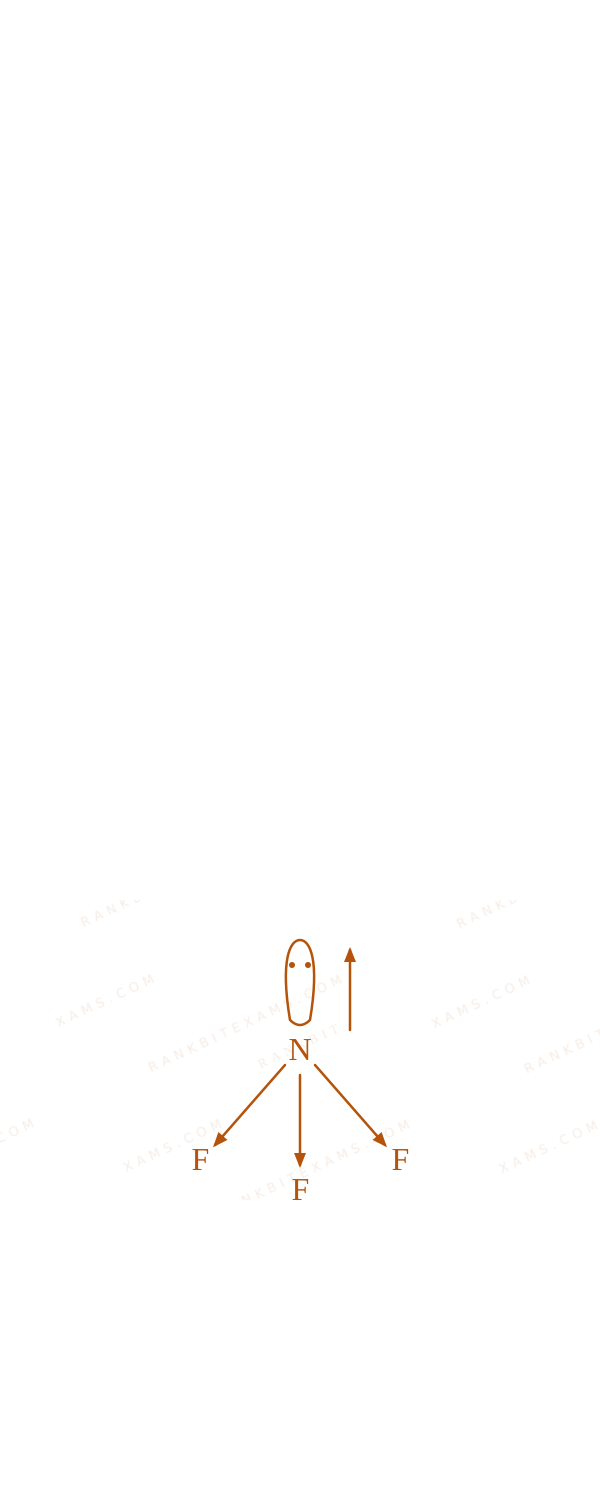
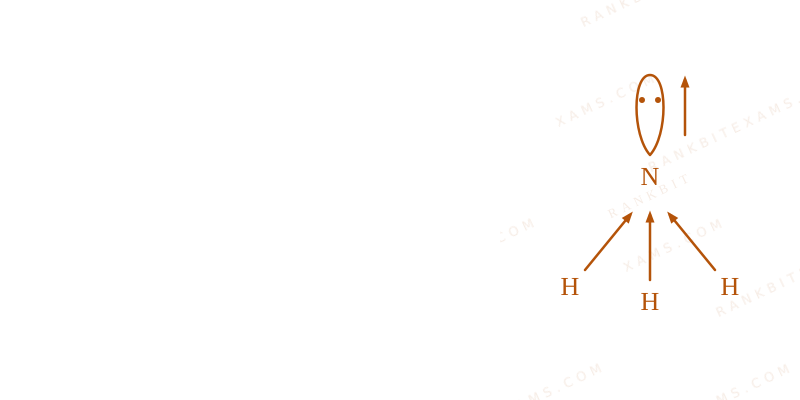
Dipole moments in NH3 and NF3 diagram for Q75 - JEE Main 2024 Evening

Step 1: Final Conclusion

Since both statements assert the opposite of established facts regarding NH₃ and NF₃, both are false.

Chapter Mix

Class 11 Chemistry: Chemical Bonding and Molecular Structure

Q jee_main_2024_30_jan_morning VSEPR Theory
Match List-I with List-II.
List-I (Molecule)List-II (Shape)
(A) BrF₅(I) T-shape
(B) H₂O(II) See saw
(C) ClF₃(III) Bent
(D) SF₄(IV) Square pyramidal
  • A. (A)-(I), (B)-(II), (C)-(IV), (D)-(III)
  • B. (A)-(II), (B)-(I), (C)-(III), (D)-(IV)
  • C. (A)-(III), (B)-(IV), (C)-(I), (D)-(II)
  • D. (A)-(IV), (B)-(III), (C)-(I), (D)-(II)

Solution

Core Logic

Using VSEPR theory: (A) BrF₅: Br has 7 valence electrons. 5 form bonds with F, leaving 1 lone pair. (5 bp + 1 lp) arrow sp³d² hybridization arrow Square pyramidal shape. (B) H₂O: O has 6 valence electrons. 2 form bonds with H, leaving 2 lone pairs. (2 bp + 2 lp) arrow sp³ hybridization arrow Bent shape. (C) ClF₃: Cl has 7 valence electrons. 3 form bonds with F, leaving 2 lone pairs. (3 bp + 2 lp) arrow sp³d hybridization arrow T-shape. (D) SF₄: S has 6 valence electrons. 4 form bonds with F, leaving 1 lone pair. (4 bp + 1 lp) arrow sp³d hybridization arrow See-saw shape.

Step 1: Matching

(A) - (IV) (B) - (III) (C) - (I) (D) - (II)

VSEPR Theory solution diagram for Q71 - JEE Main 2024 Morning

Chapter Mix

Class 11 Chemistry: Chemical Bonding and Molecular Structure

Q85 jee_main_2024_30_jan_morning Molecular Orbital Theory
The total number of molecular orbitals formed from 2s and 2p atomic orbitals of a diatomic molecule
Numerical Answer. Answer: 8 to 8

Solution

Core Logic

According to Molecular Orbital Theory (MOT), the number of molecular orbitals (MOs) formed is equal to the total number of atomic orbitals (AOs) combined.

Step 1: Counting atomic orbitals

For a single atom in the 2nd period, the valence shell has: One 2s orbital Three 2p orbitals (2pₓ, 2py, 2pz) Total = 4 atomic orbitals per atom. For a diatomic molecule, two such atoms combine. Total atomic orbitals = 4 × 2 = 8.

Step 2: Forming molecular orbitals

Combining these 8 atomic orbitals yields 8 molecular orbitals:

  • From 2s: σ₂ₛ and σ^*₂ₛ (2 MOs)
  • From 2p: σ2pz, π2pₓ, π2py, π^2pₓ, π^2py, σ^*2pz (6 MOs)
  • Total MOs = 2 + 6 = 8.

Chapter Mix

Class 11 Chemistry: Chemical Bonding and Molecular Structure

Q jee_main_2024_31_jan_evening Ionic Bond and Lattice Energy
Which of the following is least ionic?
  • A. BaCl₂
  • B. AgCl
  • C. KCl
  • D. CoCl₂

Solution

Core Logic

According to Fajan's rules, covalent character is favored by high charge and small size of the cation, and by cations with a pseudo-noble gas configuration. Ag^+ has a pseudo-noble gas configuration (ns²np⁶nd¹⁰), which results in high polarizing power compared to s-block and typical transition elements. Therefore, AgCl has the maximum covalent character and is the least ionic among the given options.

Ionic character order: AgCl < CoCl₂ < BaCl₂ < KCl

Step 1: Final Selection

Because AgCl is the most covalent, it is the least ionic. Hence, option (2) is correct.

Chapter Mix

Class 11 Chemistry: Chemical Bonding and Molecular Structure

Q81 jee_main_2024_31_jan_evening Dipole Moment and Fractional Charge
A diatomic molecule has a dipole moment of 1.2 D. If the bond distance is 1AA, then fractional charge on each atom is _________ × 10⁻¹⁰ esu. (Given: 1 D = 10⁻¹⁸ esu cm)
Numerical Answer. Answer: 1.2 to 1.2

Solution

Related Formula
μ = q × d
Core Logic

Given dipole moment, μ = 1.2 D = 1.2 × 10⁻¹⁸ esu cm. Bond distance, d = 1AA = 10⁻⁸ cm.

We need to find the fractional charge q.

Step 1: Calculation
q = (μ)/(d) q = 1.2 × 10⁻¹⁸ esu cm10⁻⁸ cm q = 1.2 × 10⁻¹⁰ esu
Step 2: Final Formatting

The question asks for the fractional charge in the form x × 10⁻¹⁰ esu. Therefore, the value is 1.2.

Note: Based on NTA officially accepting 12 (if asked for x × 10⁻¹¹) or 1.2. We will format it exactly as calculated.

Chapter Mix

Class 11 Chemistry: Chemical Bonding and Molecular Structure

More Chemical Bonding and Molecular Structure Questions — jee_main_2025_28_jan_morning

Practice all Chemical Bonding and Molecular Structure previous-year questions →

Rankbit System
JEE Physics: Waves (+15.5%) | Electrostatics: Concentric Shells (-29.7%) | Modern Physics: Photoelectric Clones (+34.2%) | Mathematics: Definite Integrals (+18.1%) | Chemistry: Coordination Splitting (-11.4%) | JEE Physics: Waves (+15.5%) | Electrostatics: Concentric Shells (-29.7%) | Modern Physics: Photoelectric Clones (+34.2%) | Mathematics: Definite Integrals (+18.1%) | Chemistry: Coordination Splitting (-11.4%)