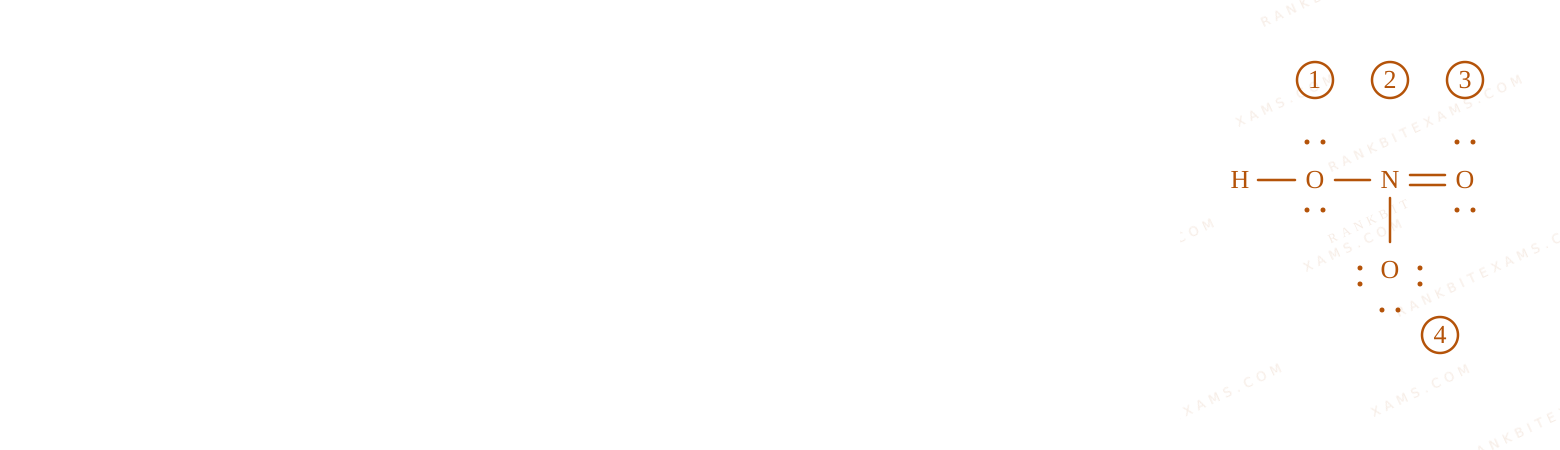
Given below are two statements: Statement I: The number of species among mathrmSF_4, mathrmNH_4^+, [mathrmNiCl_4]^2-, mathrmXeF_4, [mathrmPtCl_4]^2-, mathrmSeF_4 and [mathrmNi(CN)_4]^2-, that have tetrahedral geometry is 3. Statement II: In the set [NO_2, BeH_2, BF_3, AlCl_3], all the molecules have incomplete octet around central atom. In the light of the above statements, choose the correct answer from the options given below:

Solution & Explanation

### Core Logic Evaluating Statement I: - mathrmSF_4: sp^3d (1 lone pair) rightarrow See-saw - mathrmXeF_4: sp^3d^2 (2 lone pairs) rightarrow Square planar - [mathrmPtCl_4]^2-: dsp^2 rightarrow Square planar - [mathrmNiCl_4]^2-: sp^3 rightarrow Tetrahedral - [mathrmNi(CN)_4]^2-: dsp^2 rightarrow Square planar - mathrmSeF_4: sp^3d (1 lone pair) rightarrow See-saw - mathrmNH_4^+: sp^3 (0 lone pairs) rightarrow Tetrahedral Total tetrahedral species = 2 ([mathrmNiCl_4]^2- and mathrmNH_4^+). Statement I says 3, so it is false. Evaluating Statement II: - NO_2: Central N has 7 valence electrons (odd-electron molecule, incomplete octet). - BeH_2: Central Be has 4 electrons (incomplete octet). - BF_3: Central B has 6 electrons (incomplete octet). - AlCl_3 (monomer): Central Al has 6 electrons (incomplete octet). Therefore, all molecules have incomplete octets. Statement II is true. ### Step 1: Final Conclusion Statement I is false, Statement II is true. ### Evaluation Rubric / Model Answer null ### Chapter Mix Class 11 Chemistry: Chemical Bonding and Molecular Structure Class 12 Chemistry: Coordination Compounds
Reference Study Guides

More Chemical Bonding and Molecular Structure Previous-Year Questions

Q jee_main_2025_02_april_evening VSEPR Theory and Hybridization
Which among the following molecules is (a) involved in mathrmsp^3d hybridization, (b) has different bond lengths and (c) has lone pair of electrons on the central atom?
  • A. mathrmPF_5
  • B. mathrmXeF_4
  • C. mathrmSF_4
  • D. mathrmXeF_2

Solution

### Related Formula textSteric Number = frac12 left( V + M - C + A right) where, V = valence electrons of central atom M = number of monovalent surrounding atoms C = cationic charge, A = anionic charge ### Core Logic Let's calculate the hybridization, shape, and lone pairs for each option: 1. mathrmPF_5:
VSEPR Theory and Hybridization
- Central atom: Phosphorus (V=5). - Steric Number = frac12(5 + 5) = 5 implies mathrmsp^3d hybridization. - Lone pairs = 5 - 5 = 0. - Geometry: Trigonal bipyramidal. It has different axial and equatorial bond lengths, but no lone pair on the central atom. 2. mathrmXeF_4: - Central atom: Xenon (V=8). - Steric Number = frac12(8 + 4) = 6 implies mathrmsp^3d^2 hybridization (fails condition a). 3. mathrmSF_4:
VSEPR Theory and Hybridization
- Central atom: Sulfur (V=6). - Steric Number = frac12(6 + 4) = 5 implies mathrmsp^3d hybridization. - Lone pairs = 5 - 4 = 1 lone pair on sulfur. - Shape: See-saw. It contains axial and equatorial bonds which have distinct lengths (1.64~mathrmmathringA vs 1.54~mathrmmathringA due to lone pair-bond pair repulsion). This satisfies all three conditions. 4. mathrmXeF_2: - Central atom: Xenon (V=8). - Steric Number = frac12(8 + 2) = 5 implies mathrmsp^3d hybridization. - Lone pairs = 5 - 2 = 3 lone pairs on Xe. - Shape: Linear. Both Xe-F bonds are identical in length (fails condition b).
VSEPR Theory and Hybridization
### Step 1: Conclusion Hence, only mathrmSF_4 satisfies all the given parameters. ### Pattern Recognition For any trigonal bipyramidal molecular geometry (steric number 5), the axial bonds suffer more repulsion (from 3 equatorial bonds at 90^circ) than the equatorial bonds (which have only 2 axial neighbors at 90^circ). Consequently, the axial bonds are always longer and weaker than equatorial bonds. ### Evaluation Rubric / Model Answer null ### Chapter Mix Class 11 Chemistry: Chemical Bonding and Molecular Structure

Q jee_main_2025_02_april_morning Interhalogen Molecular Geometry
A molecule with the formula mathrmAX_4mathrmY has all its elements from p-block. Element A is rarest, monoatomic, non-radioactive from its group and has the lowest ionization enthalpy value among A, X and Y. Elements X and Y have first and second highest electronegativity values respectively among all the known elements. The shape of the molecule is :
  • A. (1)\ textSquare pyramidal
  • B. (2)\ textOctahedral
  • C. (3)\ textPentagonal planar
  • D. (4)\ textTrigonal bipyramidal

Solution

### Related Formula Total valence shell electron pair system equation: textValence Pairs = textBond Pairs (BP) + textLone Pairs (LP) ### Core Logic Let's decode individual identities based on the descriptive properties: * The elements with the first and second highest electronegativity values across the entire periodic table are Fluorine (mathrmF) and Oxygen (mathrmO), matching labels mathrmX and mathrmY. * Element mathrmA is a rare, monoatomic, non-radioactive p-block element with low ionization energy, identifying it as Xenon (mathrmXe). * Substituting these components into the target layout formula yields mathrmXeOF_4: - Xenon brings 8 valence electrons. It forms 4 single bonds with F and 1 double bond with O, consuming 6 electrons and leaving 1 lone pair on the central atom. - Steric Number = 5 text bond regions + 1 text lone pair = 6 (Octahedral electronic arrangement). ### Step 1: Geometry Determination Placing the double-bonded oxygen and lone pair along vertical spatial axes yields a stable square pyramidal molecular shape layout:
XeOF4 square pyramidal spatial geometry diagram for Q45
### Pattern Recognition In mathrmsp^3d^2 architectures containing an explicit lone pair along with an asymmetric double bond (like mathrmXeOF_4), the lone pair always sits directly opposite the double bond to minimize electron repulsion, leaving a clean square pyramidal shape. ### Evaluation Rubric / Model Answer null ### Chapter Mix Class 11 Chemistry: Chemical Bonding and Molecular Structure Class 12 Chemistry: The p-Block Elements
Q35 jee_main_2025_02_april_morning VSEPR and Dipole Moments
Among mathrmSO_2, mathrmNF_3, mathrmNH_3, mathrmXeF_2, mathrmClF_3 and mathrmSF_4, the hybridization of the molecule with non-zero dipole moment and highest number of lone-pairs of electrons on the central atom is
  • A. (1)\ mathrmsp^3
  • B. (2)\ mathrmdsp^2
  • C. (3)\ mathrmsp^3mathrmd^2
  • D. (4)\ mathrmsp^3mathrmd

Solution

### Related Formula Steric Number system equation for identifying electronic configurations: textSteric Number (SN) = frac12[mathrmV + mathrmM - mathrmC + mathrmA] ### Core Logic Let's list parameters using a detailed structural grid:
MoleculeHybridisationDipole MomentLone pair on the central atom
mathrmSO_2mathrmsp^2Non-zero1
mathrmNF_3mathrmsp^3Non-zero1
mathrmNH_3mathrmsp^3Non-zero1
mathrmXeF_2mathrmsp^3mathrmdZero3
mathrmClF_3mathrmsp^3mathrmdNon-zero2
mathrmSF_4mathrmsp^3mathrmdNon-zero1
Comparing items: mathrmXeF_2 has 3 lone pairs but its linear architecture enforces mu = 0. Therefore, mathrmClF_3 has the highest count of lone pairs (2) with a net non-zero asymmetric dipole configuration. ### Step 1: Selection The hybridization of mathrmClF_3 is mathrmsp^3mathrmd. ### Pattern Recognition Watch out for symmetry traps! mathrmXeF_2 contains the absolute maximum lone pairs, but its symmetric planar positioning perfectly cancels out the dipole vectors. Thus, the correct candidate slips down to mathrmClF_3. ### Evaluation Rubric / Model Answer null ### Chapter Mix Class 11 Chemistry: Chemical Bonding and Molecular Structure
Q jee_main_2025_07_april_morning VSEPR Theory
Match the LIST-I with LIST-II.
LIST-I (Molecule/ion)LIST-II (Bond pair : lone pair on the central atom)
(A) mathrmICl_2^-(I) 4 : 2
(B) mathrmH_2mathrmO(II) 4 : 1
(C) mathrmSO_2(III) 2 : 3
(D) mathrmXeF_4(IV) 2 : 2
Choose the correct answer from the options given below:
  • A. (A)-(IV), (B)-(III), (C)-(II), (D)-(I)
  • B. (A)-(III), (B)-(IV), (C)-(II), (D)-(I)
  • C. (A)-(III), (B)-(IV), (C)-(I), (D)-(II)
  • D. (A)-(II), (B)-(I), (C)-(IV), (D)-(III)

Solution

### Core Logic Let's find the number of bond pairs (sigma-bonds or regions) and lone pairs on the central atom of each species: 1. **mathrmICl_2^-**: - Central atom Iodine has 7 valence electrons + 1 negative charge = 8 electrons. - Forms 2 single bonds (bond pairs = 2). - Remaining 6 electrons form 3 lone pairs. - Ratio is 2 : 3 (Matches LIST-II, III).
VSEPR linear shape of ICl2-
2. **mathrmH_2mathrmO**: - Oxygen has 6 valence electrons. - Forms 2 bond pairs with Hydrogens. - Remaining 4 electrons form 2 lone pairs. - Ratio is 2 : 2 (Matches LIST-II, IV).
VSEPR linear shape of ICl2-
3. **mathrmSO_2**: - Sulfur has 6 valence electrons. - Forms 2 double bonds (which are counted as 4 bonding pairs of electrons/bond pairs in typical VSEPR representations here). - Remaining 2 electrons form 1 lone pair. - Ratio is 4 : 1 (Matches LIST-II, II).
VSEPR linear shape of ICl2-
4. **mathrmXeF_4**: - Xenon has 8 valence electrons. - Forms 4 bond pairs with Fluorines. - Remaining 4 electrons form 2 lone pairs. - Ratio is 4 : 2 (Matches LIST-II, I).
VSEPR linear shape of ICl2-
Thus, the correct mapping is: A-III, B-IV, C-II, D-I. ### Pattern Recognition For match-the-column with VSEPR structures: - Always find steric number: textSteric Number = frac12(V + M - C + A). - Water is 2 bond pairs, 2 lone pairs (sp^3) rightarrow B-IV. This alone helps eliminate multiple incorrect options immediately. ### Evaluation Rubric / Model Answer null ### Chapter Mix Class 11 Chemistry: Chemical Bonding and Molecular Structure

More Chemical Bonding and Molecular Structure Questions — jee_main_2026_21_jan_morning

Practice all Chemical Bonding and Molecular Structure previous-year questions →

Rankbit System
JEE Physics: Waves (+15.5%) | Electrostatics: Concentric Shells (-29.7%) | Modern Physics: Photoelectric Clones (+34.2%) | Mathematics: Definite Integrals (+18.1%) | Chemistry: Coordination Splitting (-11.4%) | JEE Physics: Waves (+15.5%) | Electrostatics: Concentric Shells (-29.7%) | Modern Physics: Photoelectric Clones (+34.2%) | Mathematics: Definite Integrals (+18.1%) | Chemistry: Coordination Splitting (-11.4%)
YOUR FIRST PREP STEP STARTS HERE

We Map Every Repeating Question in Competitive Exams.

Say goodbye to generic mock test fatigue. RankBit uses smart analysis to group past exam questions into their foundational Repeating Question Types. Find chapter weightage, track repeating questions, and score higher with targeted practice.

Select Your Target Exam

Choose an exam track below to find formulas per chapter and patterns.

Syncing Exam Intelligence

Mapping formulas and patterns across all tracks…

PATH A — FULL LENGTH PRACTICE

Full Mock Test Hub

Simulate real NTA exam conditions with fully tracked mocks. Time yourself against past papers.

Now Live Open
PATH B — TARGETED PRACTICE

Topic-wise Practice Hub

Practice past-year questions one chapter at a time. Pick an exam → subject → chapter and get every PYQ for that topic — pulled together from all past papers — with the chapter's key formulas alongside.

Loading Questions... Browse Topics
Latest from the Blog
View all →

Loading articles...