Identify the molecule(X) with maximum number of lone pairs of electrons (obtained using Lewis dot structure) among HNO_3, H_2SO_4, NF_3 and O_3. Choose the correct bond angle made by the central atom of the molecule (X).

Solution & Explanation

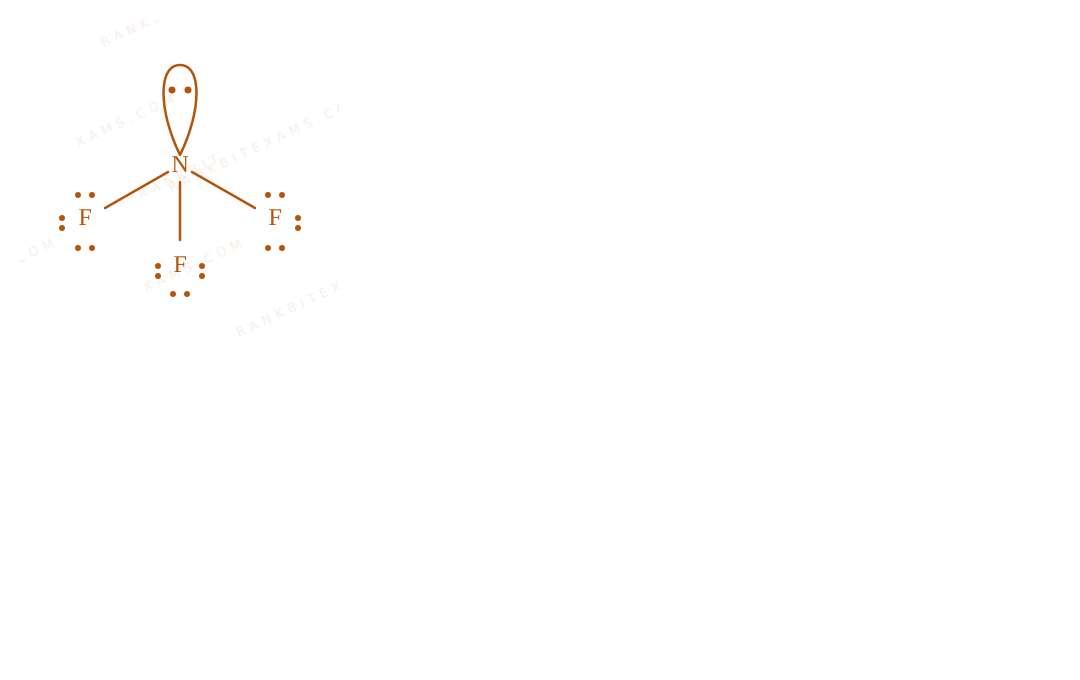
### Core Logic Draw Lewis structures for all given molecules and sum the total lone pairs on all atoms. HNO_3: 7 lone pairs total. H_2SO_4: 8 lone pairs total. O_3: 6 lone pairs total. NF_3: Nitrogen has 1 lone pair, and each of the three fluorine atoms has 3 lone pairs. Total = 1 + (3 times 3) = 10 lone pairs. ### Step 1: Identifying Molecule X Molecule X is NF_3 due to possessing the maximum number of lone pairs (10).
Lewis Structures and Lone Pairs diagram for Q65 - JEE Main 2026 Morning
### Step 2: Bond Angle Analysis In NF_3, Nitrogen is sp^3 hybridized. Due to the high electronegativity of Fluorine, the bond pair electron density shifts towards fluorine. This reduces bond pair-bond pair repulsion around the central nitrogen compared to ammonia (NH_3). As a result, the lone pair compresses the F-N-F bond angle more severely than in NH_3 (107^circ). The resulting F-N-F bond angle is approximately 102^circ. ### Pattern Recognition Electronegativity rules: If the surrounding atoms are more electronegative than the central atom, bond angles decrease because bonding electrons are pulled away from the central atom, allowing the lone pair to expand further and crush the angle. ### Evaluation Rubric / Model Answer null ### Chapter Mix Class 11 Chemistry: Chemical Bonding and Molecular Structure Class 12 Chemistry: The p-Block Elements
Lewis Structures and Lone Pairs diagram for Q65 - JEE Main 2026 Morning

Reference Study Guides

More Chemical Bonding and Molecular Structure Previous-Year Questions

Q64 jee_main_2026_21_jan_morning VSEPR Theory
Given below are two statements: Statement I: The number of species among mathrmSF_4, mathrmNH_4^+, [mathrmNiCl_4]^2-, mathrmXeF_4, [mathrmPtCl_4]^2-, mathrmSeF_4 and [mathrmNi(CN)_4]^2-, that have tetrahedral geometry is 3. Statement II: In the set [NO_2, BeH_2, BF_3, AlCl_3], all the molecules have incomplete octet around central atom. In the light of the above statements, choose the correct answer from the options given below:
  • A. textStatement I is true but Statement II is false
  • B. textBoth Statement I and Statement II are false
  • C. textStatement I is false but Statement II is true
  • D. textBoth Statement I and Statement II are true

Solution

### Core Logic Evaluating Statement I: - mathrmSF_4: sp^3d (1 lone pair) rightarrow See-saw - mathrmXeF_4: sp^3d^2 (2 lone pairs) rightarrow Square planar - [mathrmPtCl_4]^2-: dsp^2 rightarrow Square planar - [mathrmNiCl_4]^2-: sp^3 rightarrow Tetrahedral - [mathrmNi(CN)_4]^2-: dsp^2 rightarrow Square planar - mathrmSeF_4: sp^3d (1 lone pair) rightarrow See-saw - mathrmNH_4^+: sp^3 (0 lone pairs) rightarrow Tetrahedral Total tetrahedral species = 2 ([mathrmNiCl_4]^2- and mathrmNH_4^+). Statement I says 3, so it is false. Evaluating Statement II: - NO_2: Central N has 7 valence electrons (odd-electron molecule, incomplete octet). - BeH_2: Central Be has 4 electrons (incomplete octet). - BF_3: Central B has 6 electrons (incomplete octet). - AlCl_3 (monomer): Central Al has 6 electrons (incomplete octet). Therefore, all molecules have incomplete octets. Statement II is true. ### Step 1: Final Conclusion Statement I is false, Statement II is true. ### Evaluation Rubric / Model Answer null ### Chapter Mix Class 11 Chemistry: Chemical Bonding and Molecular Structure Class 12 Chemistry: Coordination Compounds
Q64 jee_main_2026_21_jan_evening Bond Length Trends
The correct increasing order of textC-H (A), textC-O (B), textC=O (C) and textCequivtextN (D) bonds in terms of covalent bond length is: (1) A < B < C < D (2) A < D < C < B (3) D < C < B < A (4) D < C < A < B
  • A. (1) \ A < B < C < D
  • B. (2) \ A < D < C < B
  • C. (3) \ D < C < B < A
  • D. (4) \ D < C < A < B

Solution

### Core Logic Comparing bond lengths: - C–H (A): sim 107 text pm - C≡N (D): sim 116 text pm - C=O (C): sim 121 text pm - C–O (B): sim 143 text pm ### Step 1: Final Conclusion Thus, the increasing order is A < D < C < B, corresponding to option (2). ### Pattern Recognition Sees: covalent bond length comparison across bond orders and atomic radii. Trap: Assuming triple bonds are always longer or shorter without accounting for smaller atomic radii like hydrogen. ### Chapter Mix Class 11 Chemistry: Chemical Bonding and Molecular Structure
Q69 jee_main_2026_21_jan_evening Bond Dissociation Enthalpy and Fajan's Rules
Given below are two statements: Statement I: The correct order in terms of bond dissociation enthalpy is textCl_2 > textBr_2 > textF_2 > textI_2. Statement II: The correct trend in the covalent character of the metal halides is [textSnCl_4 > textSnCl_2], [textPbCl_4 > textPbCl_2] and [textUF_4 > textUF_6] (or similar Fajan's rule trend). In the light of the above statements, choose the correct answer from the options given below:
  • A. (1) text Statement I is true but Statement II is false
  • B. (2) text Both Statement I and Statement II are true
  • C. (3) text Statement I is false but Statement II is true
  • D. (4) text Both Statement I and Statement II are false

Solution

### Core Logic - Statement I: Bond dissociation energy order for halogens is textCl_2 > textBr_2 > textF_2 > textI_2 due to small size and lone-pair repulsions in fluorine weakening its bond. Statement I is true. - Statement II: According to Fajan's rules, higher charge on cation increases covalent character, so textUF_6 > textUF_4 (higher oxidation state has greater covalent character), making the statement II claim regarding textUF_4 > textUF_6 false. ### Step 1: Final Conclusion Statement I is true but Statement II is false, corresponding to option (1). ### Pattern Recognition Sees: halogen bond dissociation energy anomalies and Fajan's rules for covalent character. Trap: Assuming fluorine has the highest bond dissociation energy among halogens. ### Chapter Mix Class 11 Chemistry: Chemical Bonding and Molecular Structure
Q52 jee_main_2026_22_january_morning Lewis Structures and Formal Charge
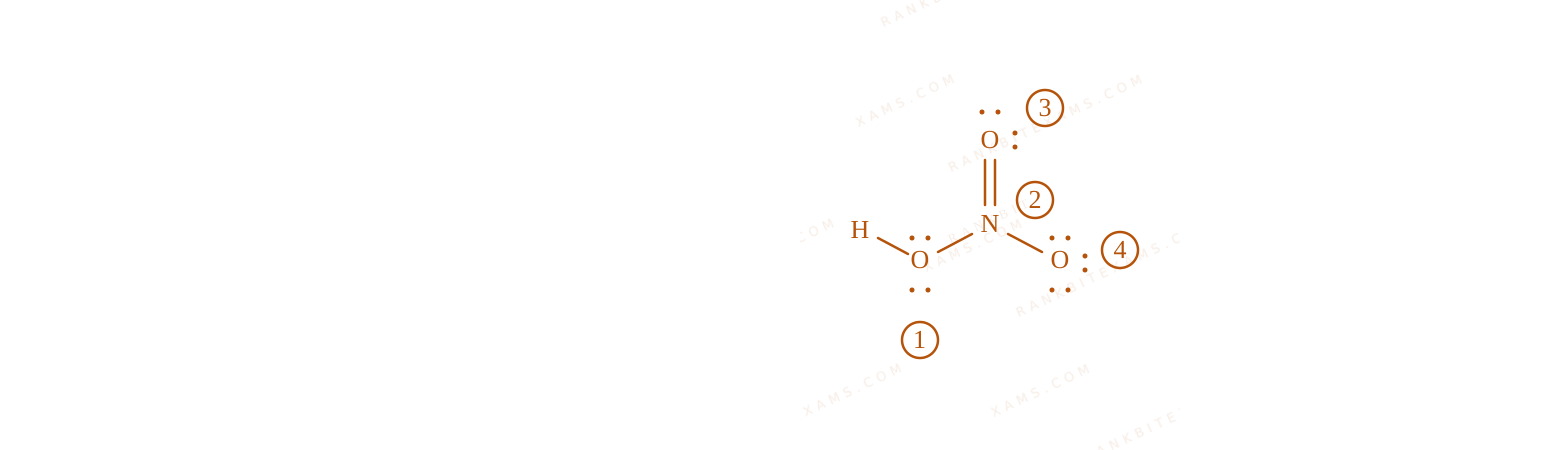
The formal changes on the atoms marked as (1) to (4) in the Lewis representation of HNO_3 molecule respectively are
Lewis structure of HNO3 diagram for Q52 - JEE Main 2026 Morning
The image shows the Lewis structure of HNO3 with four atoms numbered 1 through 4.
  • A. text+1, 0, 0, -1
  • B. text0, -1, 0, +1
  • C. text0, +1, 0, -1
  • D. text0, 0, -1, +1

Solution

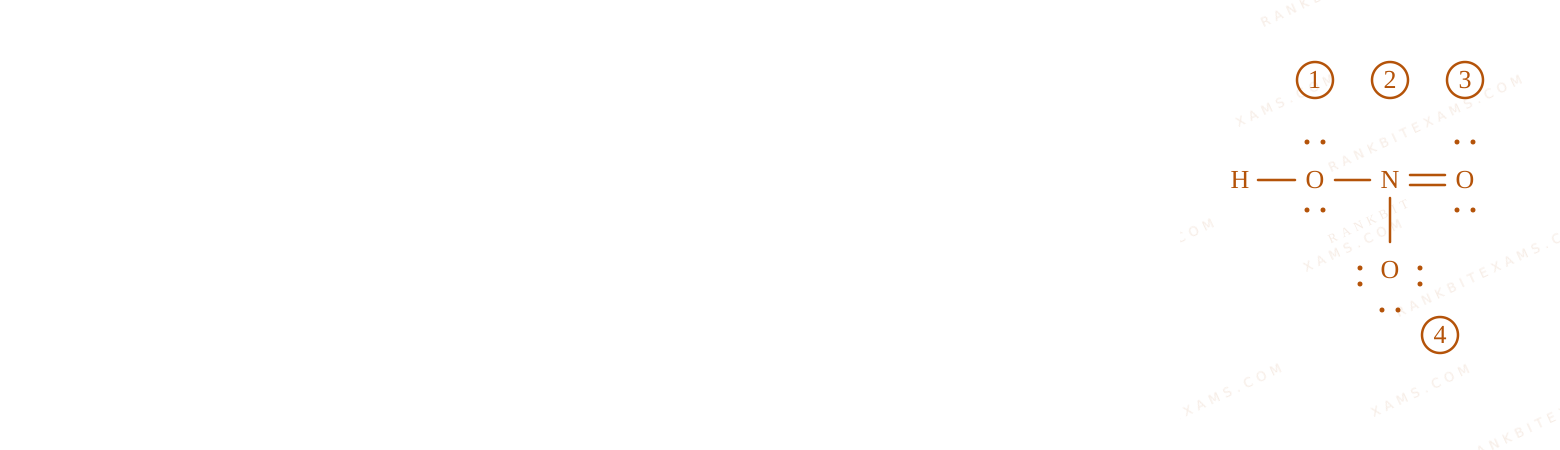
### Related Formula textFormal charge = (textValence e^-) - (textNon-bonding e^-) - fractextBonding e^-2 ### Core Logic Evaluate the structure of HNO_3 shown in the solution image:
Detailed Lewis structure of HNO3 diagram
The image shows the Lewis structure of HNO3 with four atoms numbered 1 through 4.
Atom 1 (Oxygen with H and N): F.C. = 6 - 4 - frac42 = 0 Atom 2 (Nitrogen): F.C. = 5 - 0 - frac82 = +1 Atom 3 (Double bonded Oxygen): F.C. = 6 - 4 - frac42 = 0 Atom 4 (Single bonded Oxygen): F.C. = 6 - 6 - frac22 = -1 ### Step 1: Final Conclusion The formal charges on atoms (1), (2), (3), and (4) are respectively 0, +1, 0, -1. ### Pattern Recognition In nitro groups (-NO_2), the central nitrogen is always +1, the single bonded oxygen is -1, and the double-bonded oxygen is 0. ### Evaluation Rubric / Model Answer null ### Chapter Mix Class 11 Chemistry: Chemical Bonding and Molecular Structure
Q68 jee_main_2026_22_january_morning Hybridization and VSEPR Theory
Two p-block elements X and Y form fluroides of the type EF_3. The fluoride compound XF_3 is a Lewis acid and YF_3 is a Lewis base. The hybridization of the central atoms of XF_3 and YF_3 respectively are
  • A. textBoth sp^3
  • B. sp^2 text and sp^3
  • C. sp^3 text and sp^2
  • D. textBoth sp^2

Solution

### Core Logic XF_3 acts as a Lewis acid, meaning it is an electron-deficient species capable of accepting an electron pair. A common example from the p-block is BF_3. The central Boron atom has 3 bond pairs and 0 lone pairs. Therefore, its steric number is 3, corresponding to sp^2 hybridization. YF_3 acts as a Lewis base, meaning it has an available lone pair to donate. A common example is NF_3. The central Nitrogen atom has 3 bond pairs and 1 lone pair. Its steric number is 4, corresponding to sp^3 hybridization. ### Step 1: Final Conclusion The hybridization of X and Y respectively are sp^2 and sp^3. ### Pattern Recognition Electron deficient central atoms (Group 13) form sp^2 planar molecules. Atoms with a lone pair (Group 15) form sp^3 pyramidal molecules. ### Evaluation Rubric / Model Answer null ### Chapter Mix Class 11 Chemistry: Chemical Bonding and Molecular Structure Class 11 Chemistry: p-Block Elements

More Chemical Bonding and Molecular Structure Questions — jee_main_2026_23_january_morning

Practice all Chemical Bonding and Molecular Structure previous-year questions →

Rankbit System
JEE Physics: Waves (+15.5%) | Electrostatics: Concentric Shells (-29.7%) | Modern Physics: Photoelectric Clones (+34.2%) | Mathematics: Definite Integrals (+18.1%) | Chemistry: Coordination Splitting (-11.4%) | JEE Physics: Waves (+15.5%) | Electrostatics: Concentric Shells (-29.7%) | Modern Physics: Photoelectric Clones (+34.2%) | Mathematics: Definite Integrals (+18.1%) | Chemistry: Coordination Splitting (-11.4%)