Chemical Bonding and Molecular Structure appeared 42 times across 3 years — 4.9% of Chemistry.
This question is from VSEPR Theory and d-Electron Configurations.
Consider 'n' is the number of lone pair of electrons present in the equatorial position of the most stable structure of ClF₃$\mathrm{ClF}_3$ . The ions from the following with 'n' number of unpaired electrons are :
A. V3 +$\mathrm{V}^{3 + }$
B. Ti³⁺$\mathrm{Ti}^{3+}$
C. Cu2 +$\mathrm{Cu}^{2 + }$
D. Ni²⁺$\mathrm{Ni}^{2+}$
E. Ti²⁺$\mathrm{Ti}^{2+}$
Choose the correct answer from the options given below:
A.A and C only$\text{A and C only}$
B.A, D and E only$\text{A, D and E only}$
C.B and C only$\text{B and C only}$
D.B and D only$\text{B and D only}$
Solution & Explanation
Step 1: Determine 'n'
ClF₃$\mathrm{ClF}_3$ has a central Chlorine atom with 7 valence electrons, bound to 3 Fluorine atoms. This leaves 2 lone pairs. The geometry is trigonal bipyramidal (T-shaped molecule). In its most stable geometry, both lone pairs lie in the equatorial plane to minimize lone pair-bonding pair repulsions. Thus, n = 2$n = 2$.
Step 2: Find ions with 2 unpaired electrons
Let us compute the number of unpaired electrons for each configuration:
A. V³⁺$\mathrm{V}^{3+}$:[Ar] 3d² arrow 2$[\mathrm{Ar}] 3d^2 \rightarrow 2$ unpaired electrons.
B. Ti³⁺$\mathrm{Ti}^{3+}$:[Ar] 3d¹ arrow 1$[\mathrm{Ar}] 3d^1 \rightarrow 1$ unpaired electron.
C. Cu²⁺$\mathrm{Cu}^{2+}$:[Ar] 3d⁹ arrow 1$[\mathrm{Ar}] 3d^9 \rightarrow 1$ unpaired electron.
D. Ni²⁺$\mathrm{Ni}^{2+}$:[Ar] 3d⁸ arrow 2$[\mathrm{Ar}] 3d^8 \rightarrow 2$ unpaired electrons.
E. Ti²⁺$\mathrm{Ti}^{2+}$:[Ar] 3d² arrow 2$[\mathrm{Ar}] 3d^2 \rightarrow 2$ unpaired electrons.
Thus, A, D, and E have exactly n=2$n=2$ unpaired electrons.
Pattern Recognition
Sees: Number of equatorial lone pairs linked to unpaired electrons.
Shortcut: Remember ClF₃$\mathrm{ClF}_3$ is T-shaped with 2 equatorial lone pairs. Look for d²$d^2$ or d⁸$d^8$ configurations among the transition metal ions.
Chapter Mix
Class 11 Chemistry: Chemical Bonding and Molecular Structure
Class 12 Chemistry: The d-and f-Block Elements
Keywords:#lone pair of electrons present in the equatorial position#JEE Main 2025 Morning Q31#Chemical Bonding JEE Main 2025#VSEPR Theory JEE Main 2025
More Chemical Bonding and Molecular Structure Previous-Year Questions — Page 2
Q61jee_main_2026_22_january_eveningDipole Moment and Lone Pair Determination
Among H₂S$\text{H}_2\text{S}$, H₂O$\text{H}_2\text{O}$, NF₃$\text{NF}_3$, NH₃$\text{NH}_3$ and CHCl₃$\text{CHCl}_3$, identify the molecule (X) with lowest dipole moment value. The number of lone pairs of electrons present on the central atom of the molecule (X) is:
A. 2
B. 0
C. 1
D. 3
Solution
Related Formula
Dipole Moment (μ) = q × d$$\text{Dipole Moment } (\mu) = q \times d$$For NF₃, lone pair dipole and N-F bond dipoles oppose each other.$$\text{For } \text{NF}_3, \text{ lone pair dipole and N-F bond dipoles oppose each other.}$$
Step 2: Identify molecule X = NF₃$X = \text{NF}_3$.
Step 3: Central atom is N (2s² 2p³$2s^2 2p^3$). It forms 3 single bonds with F atoms and retains 1 lone pair of electrons.
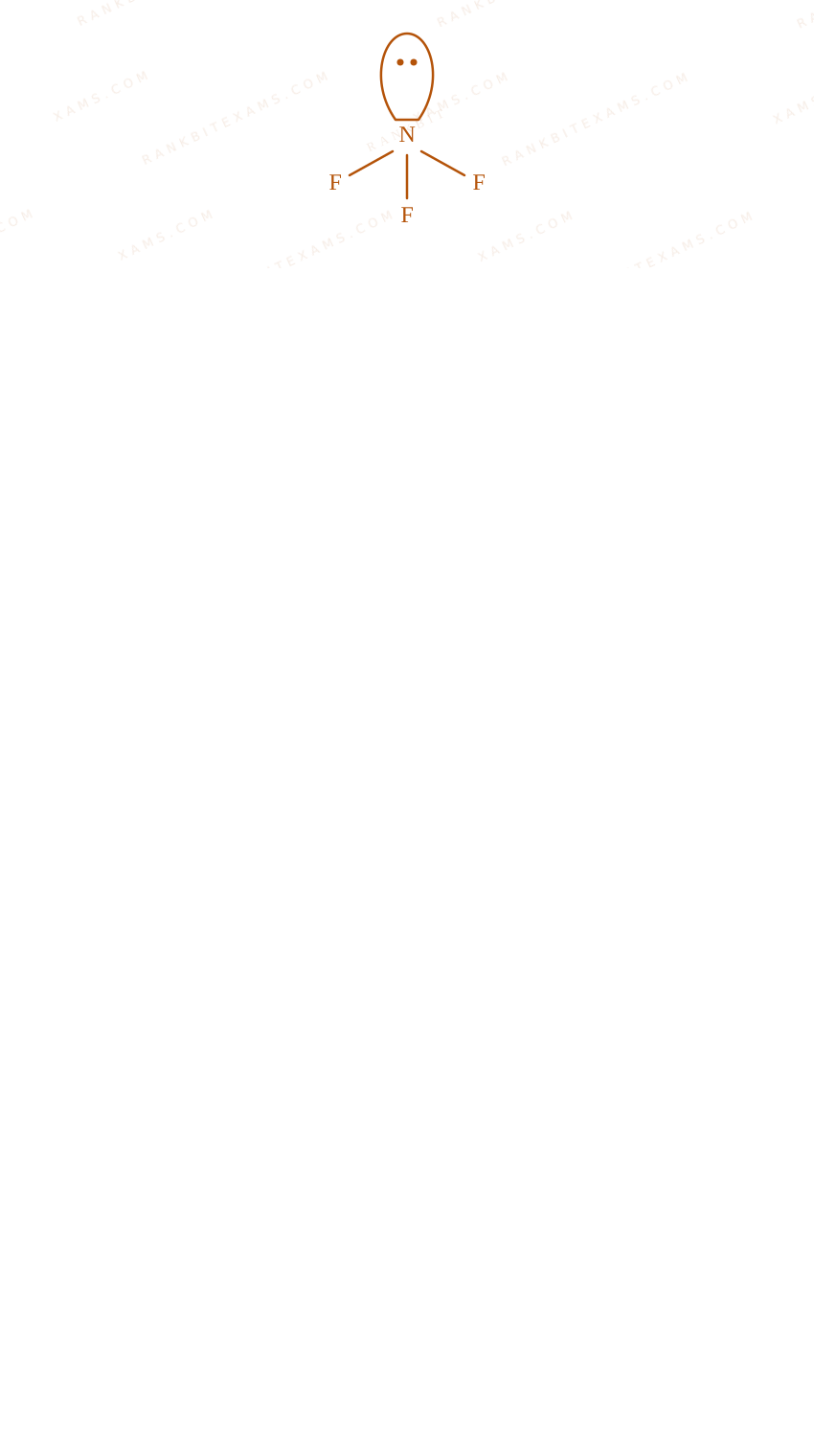
Dipole vector opposing structure for NF3 for Q61 - JEE Main 2026 Evening
Pattern Recognition
Sees: Comparison between NH₃$\text{NH}_3$ and NF₃$\text{NF}_3$ dipoles.
Shortcut: In NF₃$\text{NF}_3$, fluorine's high electronegativity pulls electron density away from the lone pair direction, resulting in an exceptionally low dipole moment (0.23 D).
Chapter Mix
Class 11 Chemistry: Chemical Bonding and Molecular Structure
Q65jee_main_2026_23_january_morningLewis Structures and Lone Pairs
Identify the molecule(X) with maximum number of lone pairs of electrons (obtained using Lewis dot structure) among HNO₃$HNO_{3}$, H₂SO₄$H_{2}SO_{4}$, NF₃$NF_{3}$ and O₃$O_{3}$. Choose the correct bond angle made by the central atom of the molecule (X).
A.120°$120^{\circ}$
B.107°$107^{\circ}$
C.102°$102^{\circ}$
D.116°$116^{\circ}$
Solution
Core Logic
Draw Lewis structures for all given molecules and sum the total lone pairs on all atoms.
HNO₃$HNO_3$: 7 lone pairs total.
H₂SO₄$H_2SO_4$: 8 lone pairs total.
O₃$O_3$: 6 lone pairs total.
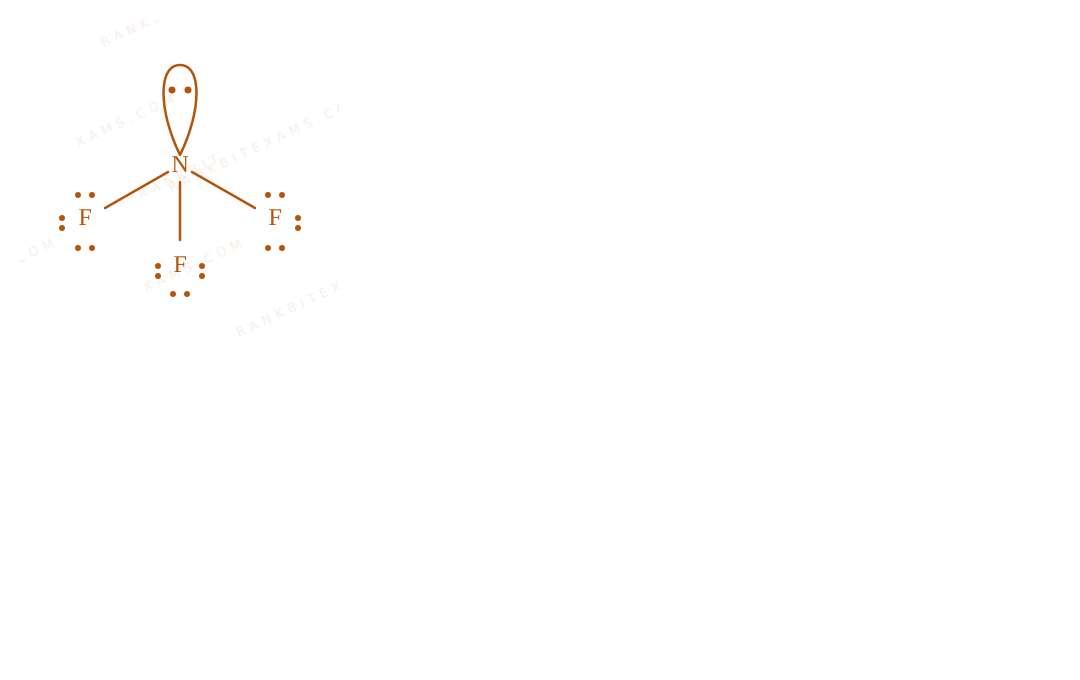
NF₃$NF_3$: Nitrogen has 1 lone pair, and each of the three fluorine atoms has 3 lone pairs. Total = 1 + (3 × 3) = 10$1 + (3 \times 3) = 10$ lone pairs.
Lewis Structures and Lone Pairs diagram for Q65 - JEE Main 2026 Morning
Step 2: Bond Angle Analysis
In NF₃$NF_3$, Nitrogen is sp³$sp^3$ hybridized. Due to the high electronegativity of Fluorine, the bond pair electron density shifts towards fluorine. This reduces bond pair-bond pair repulsion around the central nitrogen compared to ammonia (NH₃$NH_3$).
As a result, the lone pair compresses the F-N-F bond angle more severely than in NH₃$NH_3$ (107^°$107^\circ$).
The resulting F-N-F bond angle is approximately 102^°$102^\circ$.
Pattern Recognition
Electronegativity rules: If the surrounding atoms are more electronegative than the central atom, bond angles decrease because bonding electrons are pulled away from the central atom, allowing the lone pair to expand further and crush the angle.
Chapter Mix
Class 11 Chemistry: Chemical Bonding and Molecular Structure
Class 12 Chemistry: The p-Block Elements
Q54jee_main_2026_24_january_morningDipole Moment and Formal Charge
Given below are statements about some molecules/ions.
Identify the CORRECT statements.
A. The dipole moment value of NF₃$\mathrm{NF}_3$ is higher than that of NH₃$\mathrm{NH}_3$.
B. The dipole moment value of BeH₂$\mathrm{BeH}_2$ is zero.
C. The bond order of O₂²⁻$\mathrm{O}_2^{2-}$ and F₂$\mathrm{F}_2$ is same.
D. The formal charge on the central oxygen atom of ozone is -1.
E. In NO₂$\mathrm{NO}_2$, all the three atoms satisfy the octet rule, hence it is very stable.
Choose the correct answer from the options given below :
A.A, B, C, D & E$\text{A, B, C, D \& E}$
B.B & C only$\text{B \& C only}$
C.B, C & D only$\text{B, C \& D only}$
D.A, C & D only$\text{A, C \& D only}$
Solution
Core Logic
(A) Dipole moment of NF₃$\mathrm{NF}_3$ is lower than that of NH₃$\mathrm{NH}_3$ because in NF₃$\mathrm{NF}_3$, the orbital dipole due to the lone pair and the bond dipoles (N-F) are in opposite directions, whereas in NH₃$\mathrm{NH}_3$ they reinforce each other. (Statement A is false).
(B) BeH₂$\mathrm{BeH}_2$ is sp$sp$ hybridized, a linear molecule. The two Be-H bond dipoles cancel out, resulting in a zero net dipole moment. (Statement B is true).
(C) Bond order of O₂²⁻$\mathrm{O}_2^{2-}$ (peroxide ion, 18 e^-$18 e^-$) = 1$= 1$. Bond order of F₂$\mathrm{F}_2$ (18 e^-$18 e^-$) = 1$= 1$. They are isoelectronic and have the same bond order. (Statement C is true).
(D) The formal charge on the central oxygen atom in ozone (O₃$\mathrm{O}_3$) is +1$+1$, not -1$-1$. (Statement D is false).
(E) In NO₂$\mathrm{NO}_2$, nitrogen is an odd-electron species (7+16 = 23 e^-$7+16 = 23 e^-$), thus it does not follow the octet rule. (Statement E is false).
Step 1: Final Conclusion
Only statements B and C are correct.
Pattern Recognition
Ammonia vs Nitrogen trifluoride is a classic NCERT dipole exception. Central atoms with odd electrons (like N in NO$\mathrm{NO}$, NO₂$\mathrm{NO}_2$, ClO₂$\mathrm{ClO}_2$) inherently violate the octet rule.
Chapter Mix
Class 11 Chemistry: Chemical Bonding and Molecular Structure
Q56jee_main_2026_24_january_morningVSEPR Theory and Shapes
Among the following, the CORRECT combinations are:
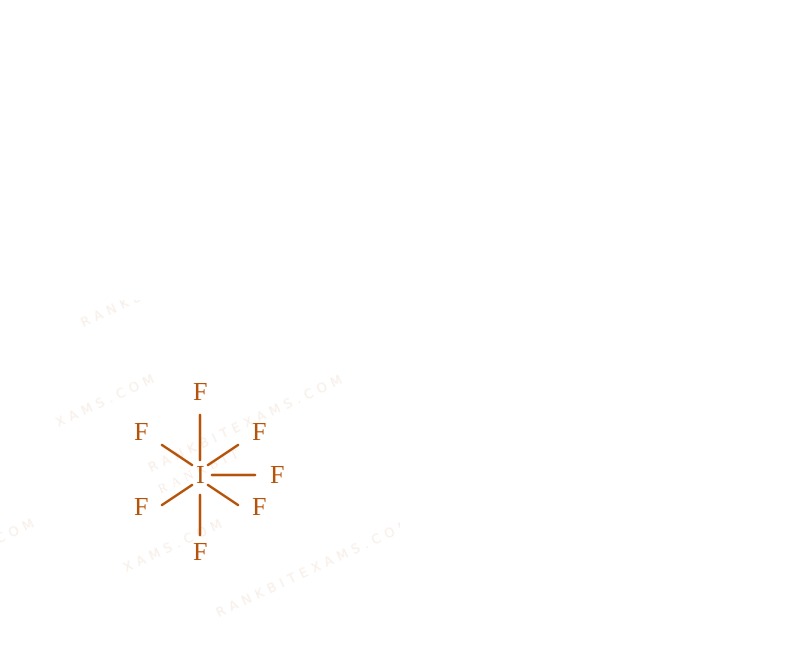
A. IF₃ arrow T-shaped (sp³d)$\mathrm{IF}_3 \rightarrow \text{T-shaped } (sp^3d)$
B. IF₅ arrow Square pyramidal (sp³d²)$\mathrm{IF}_5 \rightarrow \text{Square pyramidal } (sp^3d^2)$
C. IF₇ arrow Pentagonal bipyramidal (sp³d³)$\mathrm{IF}_7 \rightarrow \text{Pentagonal bipyramidal } (sp^3d^3)$
D. ClO₄^- arrow Square planar (sp²d)$\mathrm{ClO}_4^- \rightarrow \text{Square planar } (sp^2d)$
Choose the correct answer from the options given below :
A.A, B and C only$\text{A, B and C only}$
B.A and B only$\text{A and B only}$
C.A, B, C and D$\text{A, B, C and D}$
D.B, C and D Only$\text{B, C and D Only}$
Solution
Core Logic
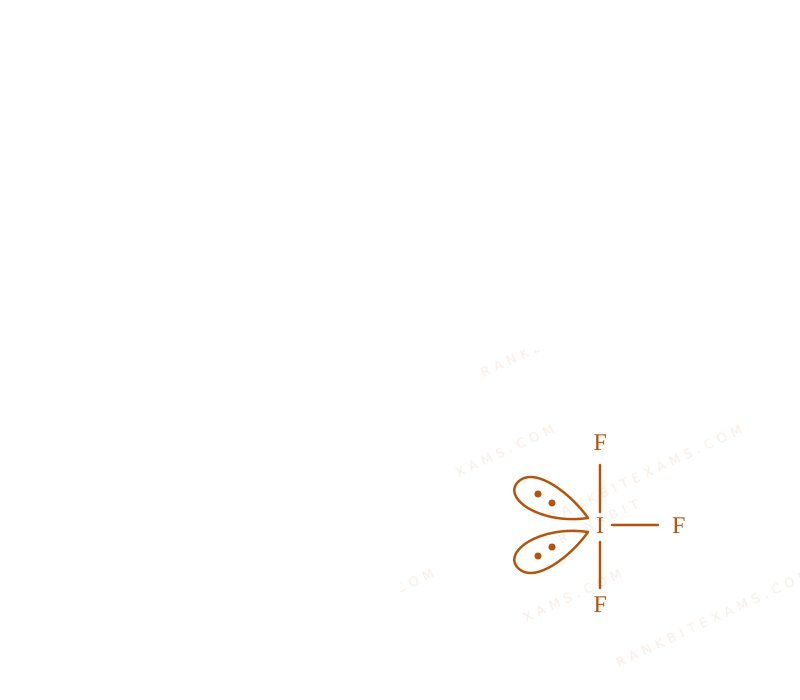
(A) IF₃$\mathrm{IF}_3$: Iodine has 7 valence electrons. 3$3$ are shared with F, leaving 2$2$ lone pairs. Total electron pairs = 3 (bond) + 2 (lone) = 5$3 \text{ (bond)} + 2 \text{ (lone)} = 5$. Hybridization is sp³d$sp^3d$. Geometry is trigonal bipyramidal, shape is T-shaped. (Correct)
VSEPR Shapes of IF3, IF5, IF7, ClO4-
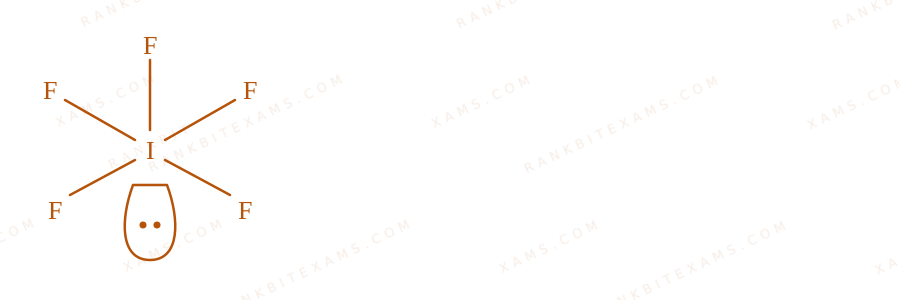
(B) IF₅$\mathrm{IF}_5$: Iodine has 7 valence electrons. 5$5$ are shared with F, leaving 1$1$ lone pair. Total electron pairs = 5 (bond) + 1 (lone) = 6$5 \text{ (bond)} + 1 \text{ (lone)} = 6$. Hybridization is sp³d²$sp^3d^2$. Shape is Square pyramidal. (Correct)
VSEPR Shapes of IF3, IF5, IF7, ClO4-
(C) IF₇$\mathrm{IF}_7$: Iodine has 7 valence electrons, all 7$7$ shared with F. Zero lone pairs. Total pairs = 7. Hybridization is sp³d³$sp^3d^3$. Shape is Pentagonal bipyramidal. (Correct)
VSEPR Shapes of IF3, IF5, IF7, ClO4-
(D) ClO₄^-$\mathrm{ClO}_4^-$: Chlorine forms 4 bonds (mostly double) with Oxygen, plus one extra electron overall. 4 bond regions + 0 lone pairs = 4$4 \text{ bond regions} + 0 \text{ lone pairs} = 4$. Hybridization is sp³$sp^3$. Shape is Tetrahedral. (Incorrect)
VSEPR Shapes of IF3, IF5, IF7, ClO4-
Step 1: Final Conclusion
Only combinations A, B, and C are correct.
Pattern Recognition
Steric Number (SN) = (Valence e^-$e^-$ on central atom + Monovalent atoms - Cation charge + Anion charge) / 2. Use SN to quickly deduce hybridization: 4 arrow sp³$\rightarrow sp^3$, 5 arrow sp³d$\rightarrow sp^3d$, 6 arrow sp³d²$\rightarrow sp^3d^2$, 7 arrow sp³d³$\rightarrow sp^3d^3$.
Chapter Mix
Class 11 Chemistry: Chemical Bonding and Molecular Structure
Class 12 Chemistry: The p-Block Elements
Q56jee_main_2026_24_january_eveningMolecular Orbital Theory
Pair of species among the following having same bond order as well as paramagnetic character will be-
A.O₂⁺, N₂²⁻$O_{2}^{+}, N_{2}^{2-}$
B.O₂⁻, N₂⁺$O_{2}^{-}, N_{2}^{+}$
C.O₂⁺, N₂⁻$O_{2}^{+}, N_{2}^{-}$
D.O₂⁻, N₂⁻$O_{2}^{-}, N_{2}^{-}$
Solution
Core Logic
We need to determine the bond order and magnetic nature of the given diatomic species using Molecular Orbital Theory.
Species
Bond order
Magnetic Nature
O₂⁺$O_{2}^{+}$
2.5
Paramagnetic
O₂⁻$O_{2}^{-}$
1.5
Paramagnetic
N₂⁺$N_{2}^{+}$
2.5
Paramagnetic
N₂⁻$N_{2}^{-}$
2.5
Paramagnetic
N₂²⁻$N_{2}^{2-}$
2
Paramagnetic
Molecular Orbital Theory diagram for Q56 - JEE Main 2026 Evening
As seen, both O₂^+$O_2^+$ and N₂^-$N_2^-$ have a bond order of 2.5 and contain unpaired electrons making them paramagnetic.
Pattern Recognition
Isoelectronic species or species with equivalent valence electrons (e.g., both having 15 electrons) will exhibit identical bond orders (2.5) and have 1 unpaired electron, ensuring paramagnetism.
Chapter Mix
Class 11 Chemistry: Chemical Bonding and Molecular Structure
More Chemical Bonding and Molecular Structure Questions — jee_main_2025_28_jan_morning
Practice past-year questions one chapter at a time. Pick an exam → subject → chapter and get every PYQ for that topic — pulled together from all past papers — with the chapter's key formulas alongside.
