


JEE Main · Chemistry ↓ Falling

Chemical Bonding and Molecular Structure appeared 42 times across 3 years — 4.9% of Chemistry. This question is from Molecular Geometry and VSEPR.

Year 2026 2025 2024 Total
Questions 12 14 16 42

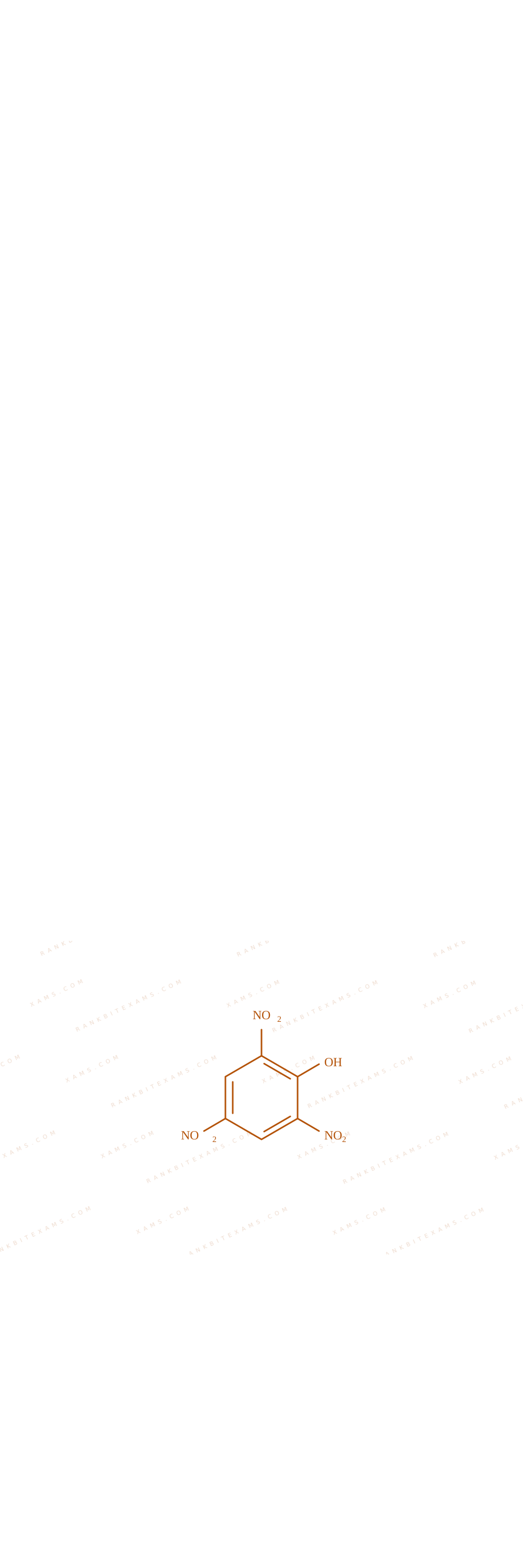
The molecules having square pyramidal geometry are

Solution & Explanation

Core Logic

Let us check the steric details using VSEPR theory:

  • BrF₅: Bromine has 7 valence electrons. It forms 5 single bonds with Fluorine and retains 1 lone pair. Steric number = 6 (sp³d²), geometry is square pyramidal.
  • XeOF₄: Xenon has 8 valence electrons. It forms 1 double bond with Oxygen, 4 single bonds with Fluorine, and retains 1 lone pair. Steric number = 6 (sp³d²), geometry is square pyramidal.
  • SbF₅ & PCl₅: Central element has 5 valence electrons, forming 5 bonds with no lone pairs. Steric number = 5 (sp³d), geometry is trigonal bipyramidal.
  • Visual representations of geometries:

    Geometry structure diagram 1 for Q35 - JEE Main 2025 Morning
    Geometry structure diagram 1 for Q35 - JEE Main 2025 Morning
    Geometry structure diagram 1 for Q35 - JEE Main 2025 Morning
    Geometry structure diagram 1 for Q35 - JEE Main 2025 Morning
    Geometry structure diagram 1 for Q35 - JEE Main 2025 Morning
    Geometry structure diagram 1 for Q35 - JEE Main 2025 Morning
    Geometry structure diagram 1 for Q35 - JEE Main 2025 Morning
    Geometry structure diagram 1 for Q35 - JEE Main 2025 Morning

Pattern Recognition

Sees: Steric count 6 with 5 bonded segments + 1 lone pair arrow always square pyramidal geometry.

Chapter Mix

Class 11 Chemistry: Chemical Bonding and Molecular Structure

Reference Study Guides

More Chemical Bonding and Molecular Structure Previous-Year Questions — Page 4

Q jee_main_2025_07_april_morning VSEPR Theory
Match the LIST-I with LIST-II.
LIST-I (Molecule/ion)LIST-II (Bond pair : lone pair on the central atom)
(A) ICl₂^-(I) 4 : 2
(B) H₂O(II) 4 : 1
(C) SO₂(III) 2 : 3
(D) XeF₄(IV) 2 : 2
Choose the correct answer from the options given below:
  • A. (A)-(IV), (B)-(III), (C)-(II), (D)-(I)
  • B. (A)-(III), (B)-(IV), (C)-(II), (D)-(I)
  • C. (A)-(III), (B)-(IV), (C)-(I), (D)-(II)
  • D. (A)-(II), (B)-(I), (C)-(IV), (D)-(III)

Solution

Core Logic

Let's find the number of bond pairs (σ-bonds or regions) and lone pairs on the central atom of each species:

  • ICl₂^-:
  • Central atom Iodine has 7 valence electrons + 1 negative charge = 8 electrons.
  • Forms 2 single bonds (bond pairs = 2).
  • Remaining 6 electrons form 3 lone pairs.
  • Ratio is 2 : 3 (Matches LIST-II, III).
  • VSEPR linear shape of ICl2-
    VSEPR linear shape of ICl2-

  • H₂O:
  • Oxygen has 6 valence electrons.
  • Forms 2 bond pairs with Hydrogens.
  • Remaining 4 electrons form 2 lone pairs.
  • Ratio is 2 : 2 (Matches LIST-II, IV).
  • VSEPR linear shape of ICl2-
    VSEPR linear shape of ICl2-

  • SO₂:
  • Sulfur has 6 valence electrons.
  • Forms 2 double bonds (which are counted as 4 bonding pairs of electrons/bond pairs in typical VSEPR representations here).
  • Remaining 2 electrons form 1 lone pair.
  • Ratio is 4 : 1 (Matches LIST-II, II).
  • VSEPR linear shape of ICl2-
    VSEPR linear shape of ICl2-

  • XeF₄:
  • Xenon has 8 valence electrons.
  • Forms 4 bond pairs with Fluorines.
  • Remaining 4 electrons form 2 lone pairs.
  • Ratio is 4 : 2 (Matches LIST-II, I).

  • VSEPR linear shape of ICl2-
    VSEPR linear shape of ICl2-

    Thus, the correct mapping is: A-III, B-IV, C-II, D-I.

Pattern Recognition

For match-the-column with VSEPR structures:

  • Always find steric number: Steric Number = (1)/(2)(V + M - C + A).
  • Water is 2 bond pairs, 2 lone pairs (sp³) arrow B-IV. This alone helps eliminate multiple incorrect options immediately.
Chapter Mix

Class 11 Chemistry: Chemical Bonding and Molecular Structure
Q50 jee_main_2025_29_jan_evening Lewis Structures and Valence Electrons
Total number of non bonded electrons present in NO2⁻ ion based on Lewis theory is ________.
Numerical Answer. Answer: 12 to 12

Solution

Core Logic

Let's compute the total valence electrons for the nitrite ion (NO₂^-):

Valence electrons = 5 (from N) + 2 × 6 (from O) + 1 (negative charge) = 18 electrons

In the valid Lewis structural representation:

  • The central nitrogen atom forms one single bond and one double bond with the terminal oxygens, consuming 2 + 4 = 6 bonding electrons.
  • Remaining non-bonded valence electrons = 18 - 6 = 12 electrons.
Step 1: Account for Lone Pairs

Distribution of non-bonded electrons across the individual atoms:

  • Central Nitrogen atom has 1 lone pair (2 electrons).
  • Single-bonded Oxygen atom has 3 lone pairs (6 electrons).
  • Double-bonded Oxygen atom has 2 lone pairs (4 electrons).
Total non-bonded electrons = 2 + 6 + 4 = 12
Pattern Recognition

Non-bonded electrons can always be obtained directly by subtracting total bonding electrons from total valence electrons.

Chapter Mix

Class 11 Chemistry: Chemical Bonding and Molecular Structure

Q31 jee_main_2025_28_jan_morning VSEPR Theory and d-Electron Configurations
Consider 'n' is the number of lone pair of electrons present in the equatorial position of the most stable structure of ClF₃ . The ions from the following with 'n' number of unpaired electrons are : A. V3 + B. Ti³⁺ C. Cu2 + D. Ni²⁺ E. Ti²⁺ Choose the correct answer from the options given below:
  • A. A and C only
  • B. A, D and E only
  • C. B and C only
  • D. B and D only

Solution

Step 1: Determine 'n'

ClF₃ has a central Chlorine atom with 7 valence electrons, bound to 3 Fluorine atoms. This leaves 2 lone pairs. The geometry is trigonal bipyramidal (T-shaped molecule). In its most stable geometry, both lone pairs lie in the equatorial plane to minimize lone pair-bonding pair repulsions. Thus, n = 2.

Step 2: Find ions with 2 unpaired electrons

Let us compute the number of unpaired electrons for each configuration:

  • A. V³⁺: [Ar] 3d² arrow 2 unpaired electrons.
  • B. Ti³⁺: [Ar] 3d¹ arrow 1 unpaired electron.
  • C. Cu²⁺: [Ar] 3d⁹ arrow 1 unpaired electron.
  • D. Ni²⁺: [Ar] 3d⁸ arrow 2 unpaired electrons.
  • E. Ti²⁺: [Ar] 3d² arrow 2 unpaired electrons.
  • Thus, A, D, and E have exactly n=2 unpaired electrons.

Pattern Recognition

Sees: Number of equatorial lone pairs linked to unpaired electrons. Shortcut: Remember ClF₃ is T-shaped with 2 equatorial lone pairs. Look for d² or d⁸ configurations among the transition metal ions.

Chapter Mix

Class 11 Chemistry: Chemical Bonding and Molecular Structure Class 12 Chemistry: The d-and f-Block Elements

Q jee_main_2025_03_april_morning Hybridisation
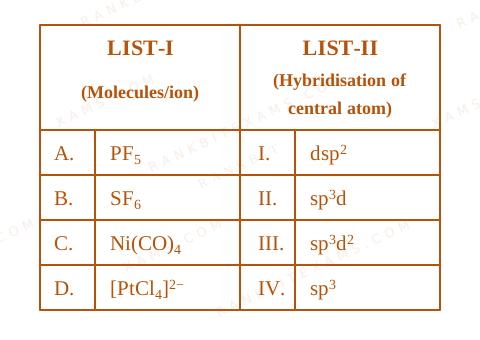
Match the LIST-I with LIST-II. Choose the correct answer from the options given below:
Hybridisation
Hybridisation
  • A. A-II, B-III, C-IV, D-I
  • B. A-IV, B-I, C-II, D-III
  • C. A-I, B-II, C-III, D-IV
  • D. A-III, B-I, C-IV, D-II

Solution

Core Logic

Let us evaluate each central atom configuration systematically:

  • A. PF₅: Phosphorus has 5 valence electrons, forming 5σ bonds with zero lone pairs. Steric number = 5 sp³d hybridisation.
  • B. SF₆: Sulfur has 6 valence electrons, forming 6σ bonds with zero lone pairs. Steric number = 6 sp³d² hybridisation.
  • C. Ni(CO)₄: Nickel is in a 0 oxidation state (3d⁸ 4s²). Carbon monoxide is a strong field ligand, forcing rearrangement into a filled 3d¹⁰ state. The vacant 4s and three 4p orbitals hybridise to give an sp³ configuration.
    Orbital configuration matrix for Q43 - JEE Main 2025 Morning
    Orbital configuration matrix for Q43 - JEE Main 2025 Morning
  • D. [PtCl₄]²⁻: Platinum is in the +2 oxidation state (5d⁸). Since it belongs to the 5d transition series, all ligands behave as strong field elements, leading to interior spin-pairing and an inner orbital square-planar dsp² hybridisation state.
    Orbital configuration matrix for Q43 - JEE Main 2025 Morning
    Orbital configuration matrix for Q43 - JEE Main 2025 Morning
Pattern Recognition

Shortcut: Match main-group species first: PF₅ arrow sp³d (II), SF₆ arrow sp³d² (III). This immediately isolates Option (A) without needing to evaluate coordination fields.

Evaluation Rubric / Model Answer

Option (A)

Chapter Mix

Class 11 Chemistry: Chemical Bonding and Molecular Structure Class 12 Chemistry: Coordination Compounds

More Chemical Bonding and Molecular Structure Questions — jee_main_2025_28_jan_morning

Practice all Chemical Bonding and Molecular Structure previous-year questions →

Rankbit System
JEE Physics: Waves (+15.5%) | Electrostatics: Concentric Shells (-29.7%) | Modern Physics: Photoelectric Clones (+34.2%) | Mathematics: Definite Integrals (+18.1%) | Chemistry: Coordination Splitting (-11.4%) | JEE Physics: Waves (+15.5%) | Electrostatics: Concentric Shells (-29.7%) | Modern Physics: Photoelectric Clones (+34.2%) | Mathematics: Definite Integrals (+18.1%) | Chemistry: Coordination Splitting (-11.4%)