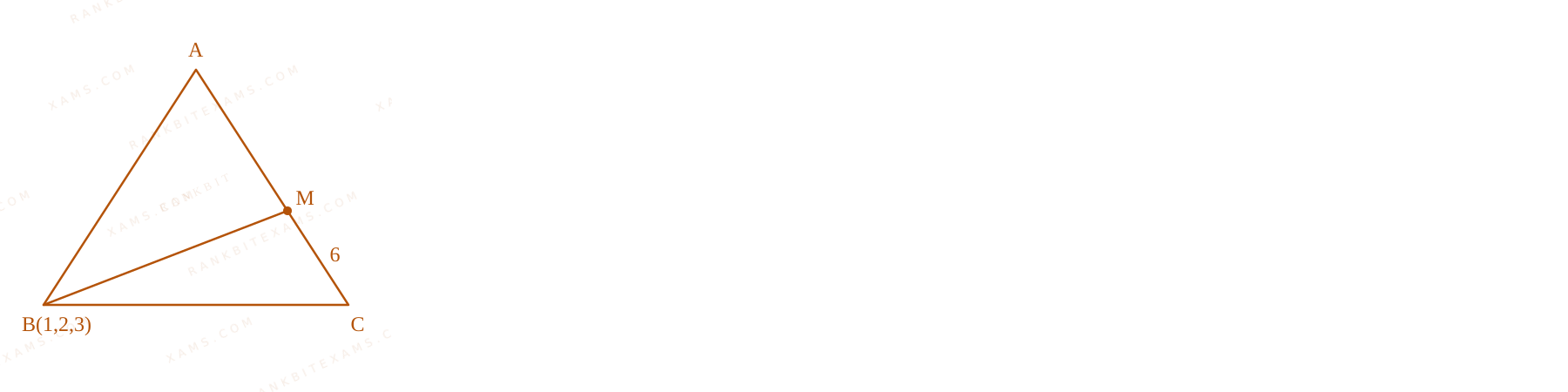
Let in a Delta ABC$\Delta ABC$ , the length of the side AC$AC$ be 6$6$, the vertex B$B$ be (1, 2, 3)$(1, 2, 3)$ and the vertices A, C$A, C$ lie on the line fracx - 63 = fracy - 72 = fracz - 7-2$\frac{x - 6}{3} = \frac{y - 7}{2} = \frac{z - 7}{-2}$ . Then the area (in sq. units) of Delta ABC$\Delta ABC$ is :
A.42$42$
B.21$21$
C.56$56$
D.17$17$
Solution & Explanation
### Related Formula
The area of a triangle given base length b$b$ and altitude perpendicular height h$h$ is evaluated as:
textArea = frac12 cdot b cdot h$\text{Area} = \frac{1}{2} \cdot b \cdot h$
### Core Logic
The base side AC$AC$ lies entirely along the line equation. Let M$M$ be the foot of the perpendicular dropped from vertex B(1,2,3)$B(1,2,3)$ to the line segment AC$AC$:
Area of a Triangle in 3D Space diagram for Q58 - JEE Main 2025 Morning
Any coordinate point on the line can be represented parametrically by setting the line fractions equal to lambda$\lambda$:
M = (3lambda + 6, \, 2lambda + 7, \, -2lambda + 7)$M = (3\lambda + 6, \, 2\lambda + 7, \, -2\lambda + 7)$
### Step 1: Compute Foot of Perpendicular
Construct the vector direction representing line segment BM$BM$:
vecBM = (3lambda + 6 - 1)hatmathbfi + (2lambda + 7 - 2)hatmathbfj + (-2lambda + 7 - 3)hatmathbfk$\vec{BM} = (3\lambda + 6 - 1)\hat{\mathbf{i}} + (2\lambda + 7 - 2)\hat{\mathbf{j}} + (-2\lambda + 7 - 3)\hat{\mathbf{k}}$vecBM = (3lambda + 5)hatmathbfi + (2lambda + 5)hatmathbfj + (-2lambda + 4)hatmathbfk$\vec{BM} = (3\lambda + 5)\hat{\mathbf{i}} + (2\lambda + 5)\hat{\mathbf{j}} + (-2\lambda + 4)\hat{\mathbf{k}}$
Since BM$BM$ is perpendicular to the base line segment direction vector vecv = 3hatmathbfi + 2hatmathbfj - 2hatmathbfk$\vec{v} = 3\hat{\mathbf{i}} + 2\hat{\mathbf{j}} - 2\hat{\mathbf{k}}$, their dot product must equal zero:
vecBM cdot vecv = 3(3lambda + 5) + 2(2lambda + 5) - 2(-2lambda + 4) = 0$\vec{BM} \cdot \vec{v} = 3(3\lambda + 5) + 2(2\lambda + 5) - 2(-2\lambda + 4) = 0$9lambda + 15 + 4lambda + 10 + 4lambda - 8 = 0$9\lambda + 15 + 4\lambda + 10 + 4\lambda - 8 = 0$17lambda + 17 = 0 implies lambda = -1$17\lambda + 17 = 0 \implies \lambda = -1$
### Step 2: Find Perpendicular Length and Calculate Area
Substitute lambda = -1$\lambda = -1$ back into the vector equation to find the altitude magnitude:
vecBM = (3(-1) + 5)hatmathbfi + (2(-1) + 5)hatmathbfj + (-2(-1) + 4)hatmathbfk = 2hatmathbfi + 3hatmathbfj + 6hatmathbfk$\vec{BM} = (3(-1) + 5)\hat{\mathbf{i}} + (2(-1) + 5)\hat{\mathbf{j}} + (-2(-1) + 4)\hat{\mathbf{k}} = 2\hat{\mathbf{i}} + 3\hat{\mathbf{j}} + 6\hat{\mathbf{k}}$h = \|vecBM\| = sqrt2^2 + 3^2 + 6^2 = sqrt4 + 9 + 36 = sqrt49 = 7$h = \|\vec{BM}\| = \sqrt{2^2 + 3^2 + 6^2} = \sqrt{4 + 9 + 36} = \sqrt{49} = 7$
Now, plug the base length AC = 6$AC = 6$ and altitude h = 7$h = 7$ into the standard area formula:
textArea = frac12 cdot 6 cdot 7 = 21 text sq. units$\text{Area} = \frac{1}{2} \cdot 6 \cdot 7 = 21 \text{ sq. units}$
### Pattern Recognition
Instead of determining the absolute coordinates for individual triangle vertices A$A$ and C$C$, treating the problem via altitude minimization relative to the given parametric vector direction saves substantial calculation steps.
### Evaluation Rubric / Model Answer
null
### Chapter Mix
Class 12 Mathematics: Three Dimensional Geometry
Keywords:#area triangle 3D coordinates#foot of perpendicular line#JEE Main 2025 Morning Q58#parametric line geometry 3D
More Three Dimensional Geometry Previous-Year Questions — Page 3
Q732025Area of Triangle Formed by Intersecting Lines
Let the area of the triangle formed by the lines x + 2 = y - 1 = z, fracx - 35 = fracy-1 = fracz - 11$x + 2 = y - 1 = z, \frac{x - 3}{5} = \frac{y}{-1} = \frac{z - 1}{1}$ and fracmathrmx-3 = fracmathrmy - 33 = fracmathrmz - 21$\frac{\mathrm{x}}{-3} = \frac{\mathrm{y} - 3}{3} = \frac{\mathrm{z} - 2}{1}$ be A. Then A^2$A^2$ is equal to
Numerical Answer.Answer: 56 to 56
Solution
### Related Formula
textArea A = frac12 |vecAB times vecAC|$\text{Area } A = \frac{1}{2} |\vec{AB} \times \vec{AC}|$
### Core Logic
Determine the three intersection vertex positions for the matching coordinate line segments, then calculate vector cross expansions to determine face boundaries.
### Step 1: Locate Intersection Vertices
Solving line pairs intersection matrices:
* L_1 cap L_2 implies A(-2, 1, 0)$L_1 \cap L_2 \implies A(-2, 1, 0)$
* L_2 cap L_3 implies B(3, 0, 1)$L_2 \cap L_3 \implies B(3, 0, 1)$
* L_3 cap L_1 implies C(0, 3, 2)$L_3 \cap L_1 \implies C(0, 3, 2)$
### Step 2: Construct Vectors Cross Matrix
Using vertex values to form component arrays:
vecAB = -5hati + hatj - hatk, quad vecAC = -3hati + 3hatj + hatk$\vec{AB} = -5\hat{i} + \hat{j} - \hat{k}, \quad \vec{AC} = -3\hat{i} + 3\hat{j} + \hat{k}$vecAB times vecAC = beginvmatrix hati & hatj & hatk \\ -5 & 1 & -1 \\ -3 & 3 & 1 endvmatrix = 4hati + 8hatj - 12hatk$\vec{AB} \times \vec{AC} = \begin{vmatrix} \hat{i} & \hat{j} & \hat{k} \\ -5 & 1 & -1 \\ -3 & 3 & 1 \end{vmatrix} = 4\hat{i} + 8\hat{j} - 12\hat{k}$
### Step 3: Final Area Squared Derivation
A = frac12sqrt16 + 64 + 144 = frac12sqrt224 = sqrt56$A = \frac{1}{2}\sqrt{16 + 64 + 144} = \frac{1}{2}\sqrt{224} = \sqrt{56}$A^2 = 56$A^2 = 56$
{{SOL_IMG_73}}
### Pattern Recognition
Finding the area of a triangle formed by intersecting lines involves grouping directional cross vectors once coordinates are solved.
### Evaluation Rubric / Model Answer
null
### Chapter Mix
Class 12 Mathematics: Three Dimensional Geometry
Q562025Line and Plane Intersections
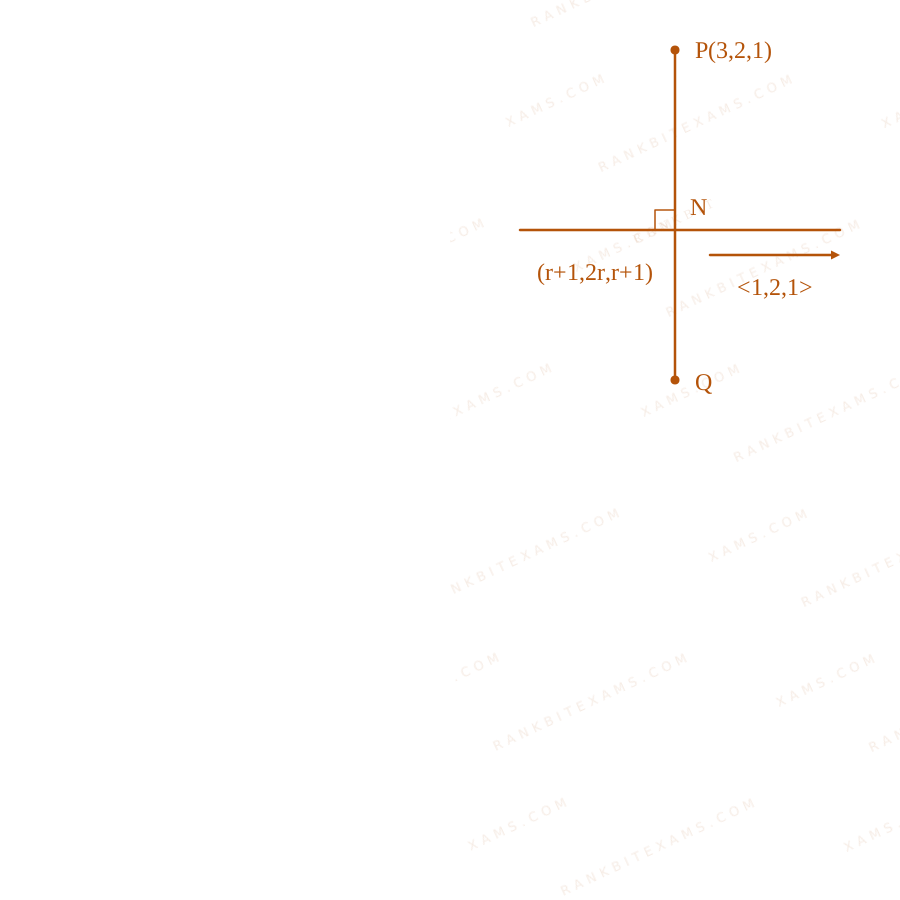
Let a straight line L$L$ pass through the point P(2, -1, 3)$P(2, -1, 3)$ and be perpendicular to the lines fracx - 12 = fracy + 11 = fracz - 3-2$\frac{x - 1}{2} = \frac{y + 1}{1} = \frac{z - 3}{-2}$ and \frac{x - 3}{1} = \frac{y - 2}{3} = \frac{z + 2}{4}. If the line L$L$ intersects the yz$yz$-plane at the point Q$Q$, then the distance between the points P$P$ and Q$Q$ is:
A.2$2$
B.sqrt10$\sqrt{10}$
C.3$3$
D.2sqrt3$2\sqrt{3}$
Solution
### Related Formula
The direction vector of a line perpendicular to two vectors vecu$\vec{u}$ and vecv$\vec{v}$ is obtained via the cross product:
vecn = vecu times vecv$\vec{n} = \vec{u} \times \vec{v}$
### Core Logic
Extract direction vectors of the given lines:
vecu = 2hati + hatj - 2hatk$\vec{u} = 2\hat{i} + \hat{j} - 2\hat{k}$vecv = hati + 3hatj + 4hatk$\vec{v} = \hat{i} + 3\hat{j} + 4\hat{k}$
Compute the cross product:
vecn = beginvmatrix hati & hatj & hatk \\ 2 & 1 & -2 \\ 1 & 3 & 4 endvmatrix$\vec{n} = \begin{vmatrix} \hat{i} & \hat{j} & \hat{k} \\ 2 & 1 & -2 \\ 1 & 3 & 4 \end{vmatrix}$= hati(4 - (-6)) - hatj(8 - (-2)) + hatk(6 - 1) = 10hati - 10hatj + 5hatk$= \hat{i}(4 - (-6)) - \hat{j}(8 - (-2)) + \hat{k}(6 - 1) = 10\hat{i} - 10\hat{j} + 5\hat{k}$= 5(2hati - 2hatj + hatk)$= 5(2\hat{i} - 2\hat{j} + \hat{k})$
### Step 1: Write Line Equation and Intersect with Plane
Equation of line L$L$ through P(2, -1, 3)$P(2, -1, 3)$ with direction (2, -2, 1)$(2, -2, 1)$:
fracx - 22 = fracy + 1-2 = fracz - 31 = lambda$\frac{x - 2}{2} = \frac{y + 1}{-2} = \frac{z - 3}{1} = \lambda$
Any random point on this line is Q(2lambda + 2, -2lambda - 1, lambda + 3)$Q(2\lambda + 2, -2\lambda - 1, \lambda + 3)$.
For intersection with the yz$yz$-plane, set x = 0$x = 0$:
2lambda + 2 = 0 implies lambda = -1$2\lambda + 2 = 0 \implies \lambda = -1$
### Step 2: Find Distance
Substituting lambda = -1$\lambda = -1$ into the coordinate matrix of Q$Q$ gives:
Q(0, 1, 2)$Q(0, 1, 2)$
Calculate distance d(P, Q)$d(P, Q)$:
d = sqrt(2 - 0)^2 + (-1 - 1)^2 + (3 - 2)^2 = sqrt4 + 4 + 1 = 3$d = \sqrt{(2 - 0)^2 + (-1 - 1)^2 + (3 - 2)^2} = \sqrt{4 + 4 + 1} = 3$
### Pattern Recognition
Perpendicularity to two lines always indicates using the cross-product to lock down the direction ratios. Intersection with the yz$yz$-plane simply forces x = 0$x = 0$ immediately.
### Evaluation Rubric / Model Answer
null
### Chapter Mix
Class 12 Mathematics: Three Dimensional Geometry
Q632025Shortest Distance and Intersection of Lines
Let mathbfP$\mathbf{P}$ be the foot of the perpendicular from the point (1,2,2)$(1,2,2)$ on the line mathrmL:fracmathrmx - 11 = fracmathrmy + 1-1 = fracmathrmz - 22$\mathrm{L}:\frac{\mathrm{x} - 1}{1} = \frac{\mathrm{y} + 1}{-1} = \frac{\mathrm{z} - 2}{2}$. Let the line vecmathrmr = (-hatmathrmi +hatmathrmj -2hatmathrmk) + lambda (hatmathrmi -hatmathrmj +hatmathrmk)$\vec{\mathrm{r}} = (-\hat{\mathrm{i}} +\hat{\mathrm{j}} -2\hat{\mathrm{k}}) + \lambda (\hat{\mathrm{i}} -\hat{\mathrm{j}} +\hat{\mathrm{k}})$, lambda in mathbbR$\lambda \in \mathbb{R}$, intersect the line mathrmL$\mathrm{L}$ at Q. Then 2(mathrmPQ)^2$2(\mathrm{PQ})^2$ is equal to:
A.27$27$
B.25$25$
C.29$29$
D.19$19$
Solution
### Related Formula
Dot product of vector projection matching orthogonal axes equals zero:
vecAP cdot vecd = 0$\vec{AP} \cdot \vec{d} = 0$
### Core Logic
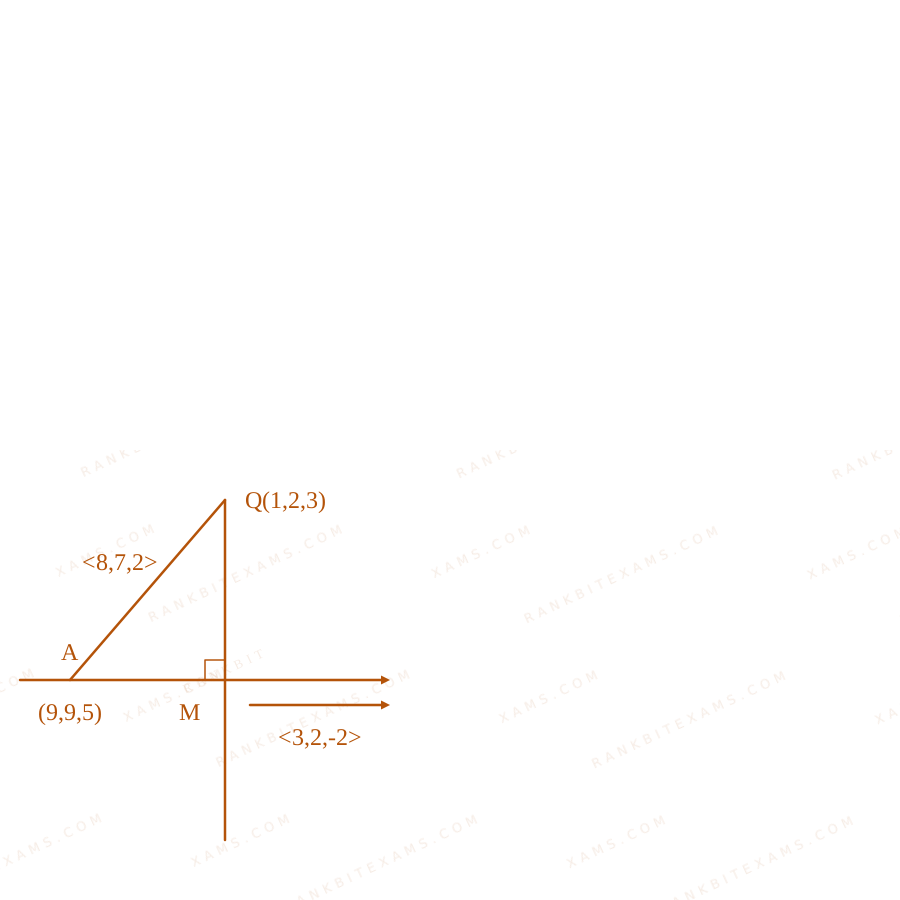
Let the target source coordinates tracking point match A(1, 2, 2)$A(1, 2, 2)$. General parameter points on line L$L$ are defined by parameter mu$\mu$:
P(mu + 1, -mu - 1, 2mu + 2)$P(\mu + 1, -\mu - 1, 2\mu + 2)$Shortest Distance and Intersection of Lines diagram for Q63 - JEE Main 2025 EveningvecAP = muhati - (mu + 3)hatj + 2muhatk$\vec{AP} = \mu\hat{i} - (\mu + 3)\hat{j} + 2\mu\hat{k}$
Line direction vector vecd = hati - hatj + 2hatk$\vec{d} = \hat{i} - \hat{j} + 2\hat{k}$.
### Step 1: Isolate Foot and Intersection Positions
(mu)cdot 1 - (-mu - 3)cdot 1 + (2mu)cdot 2 = 0 implies 6mu + 3 = 0 implies mu = -frac12$(\mu)\cdot 1 - (-\mu - 3)\cdot 1 + (2\mu)\cdot 2 = 0 \implies 6\mu + 3 = 0 \implies \mu = -\frac{1}{2}$
Substituting back yields coordinate positions for foot P$P$:
Pleft(frac12, -frac12, 1right)$P\left(\frac{1}{2}, -\frac{1}{2}, 1\right)$
Equating general vectors between standard linear constraints tracks intersection point Q$Q$ at mu = -2$\mu = -2$:
Q(-1, 1, -2)$Q(-1, 1, -2)$
### Step 2: Distance Formulation
Compute length of line segment squared:
PQ^2 = left(frac12 - (-1)right)^2 + left(-frac12 - 1right)^2 + (1 - (-2))^2$PQ^2 = \left(\frac{1}{2} - (-1)\right)^2 + \left(-\frac{1}{2} - 1\right)^2 + (1 - (-2))^2$= frac94 + frac94 + 9 = frac544$= \frac{9}{4} + \frac{9}{4} + 9 = \frac{54}{4}$2(PQ)^2 = 2 left(frac544right) = 27$2(PQ)^2 = 2 \left(\frac{54}{4}\right) = 27$
### Pattern Recognition
Always separate foot evaluations from line-intersection parameter updates to ensure you do not mix up variables tracking linear metrics.
### Evaluation Rubric / Model Answer
null
### Chapter Mix
Class 12 Mathematics: Three Dimensional Geometry
Q562025Distance Formula and Properties of Triangles
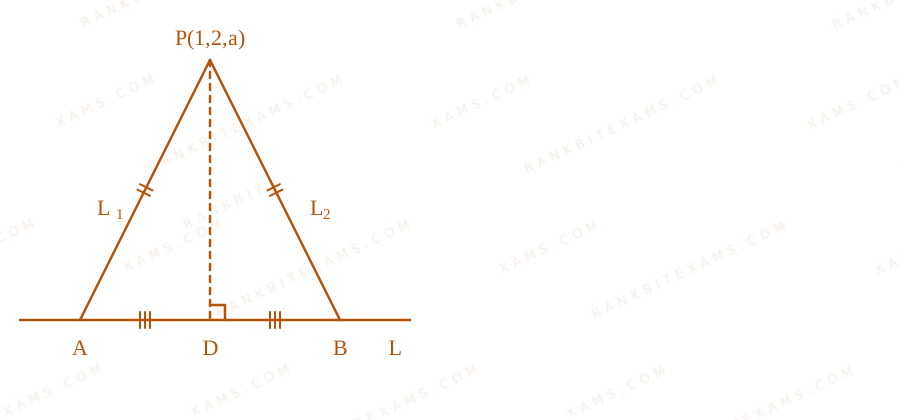
Let A(x,y,z)$A(x,y,z)$ be a point in xy-plane, which is equidistant from three points (0, 3, 2), (2, 0, 3) and (0, 0, 1).
Let B = (1, 4, -1)$B = (1, 4, -1)$ and C = (2, 0, -2)$C = (2, 0, -2)$. Then among the statements
(S1) : Delta ABC$\Delta ABC$ is an isosceles right angled triangle and
(S2): the area of Delta ABC$\Delta ABC$ is frac9sqrt22$\frac{9\sqrt{2}}{2}$.
(1) both are true
(2) only (S1) is true
(3) only (S2) is true
(4) both are false
A. both are true
B. only (S1) is true
C. only (S2) is true
D. both are false
Solution
### Related Formula
3D Cartesian distance formula:
d = sqrt(x_2-x_1)^2 + (y_2-y_1)^2 + (z_2-z_1)^2$d = \sqrt{(x_2-x_1)^2 + (y_2-y_1)^2 + (z_2-z_1)^2}$
### Core Logic
Since A(x,y,z)$A(x,y,z)$ lies in the xy-plane, its z-coordinate must be zero (z = 0$z = 0$). Let the reference targets be P(0,3,2)$P(0,3,2)$, Q(2,0,3)$Q(2,0,3)$, and R(0,0,1)$R(0,0,1)$.
Setting AP^2 = AR^2$AP^2 = AR^2$:
x^2 + (y-3)^2 + (0-2)^2 = x^2 + y^2 + (0-1)^2 implies y = 2$x^2 + (y-3)^2 + (0-2)^2 = x^2 + y^2 + (0-1)^2 \implies y = 2$
### Step 1: Locating Coordinate Dimensions
Setting AQ^2 = AR^2$AQ^2 = AR^2$ with y=2$y=2$:
(x-2)^2 + 2^2 + 3^2 = x^2 + 2^2 + 1^2 implies x = 3$(x-2)^2 + 2^2 + 3^2 = x^2 + 2^2 + 1^2 \implies x = 3$
Thus, A$A$ is precisely located at (3,2,0)$(3,2,0)$.
### Step 2: Triangle Side and Area Assessment
Calculate the lengths between A(3,2,0)$A(3,2,0)$, B(1,4,-1)$B(1,4,-1)$, and C(2,0,-2)$C(2,0,-2)$:
AB = sqrt(3-1)^2 + (2-4)^2 + (0+1)^2 = 3$AB = \sqrt{(3-1)^2 + (2-4)^2 + (0+1)^2} = 3$AC = sqrt(3-2)^2 + (2-0)^2 + (0+2)^2 = 3$AC = \sqrt{(3-2)^2 + (2-0)^2 + (0+2)^2} = 3$BC = sqrt(1-2)^2 + (4-0)^2 + (-1+2)^2 = sqrt18$BC = \sqrt{(1-2)^2 + (4-0)^2 + (-1+2)^2} = \sqrt{18}$
Since AB = AC = 3$AB = AC = 3$ and AB^2 + AC^2 = BC^2$AB^2 + AC^2 = BC^2$, it forms an isosceles right-angled triangle. Thus, (S1) is true.
textArea = frac12 times 3 times 3 = frac92$\text{Area} = \frac{1}{2} \times 3 \times 3 = \frac{9}{2}$
Therefore, (S2) is false.
### Pattern Recognition
Planar locations instantly zero out specific coordinate dimensions (z=0$z=0$ for xy-planes), simplifying system matrices down rapidly.
### Evaluation Rubric / Model Answer
null
### Chapter Mix
Class 11 Maths: Three Dimensional Geometry
Q622025Image of a Point in a Line
If the image of the point (4, 4, 3)$(4, 4, 3)$ in the line fracx - 12 = fracy - 21 = fracz - 13$\frac{x - 1}{2} = \frac{y - 2}{1} = \frac{z - 1}{3}$ is (alpha, beta, gamma)$(\alpha, \beta, \gamma)$, then alpha + beta + gamma$\alpha + \beta + \gamma$ is equal to
(1) 9
(2) 12
(3) 8
(4) 7
A. 9
B. 12
C. 8
D. 7
Solution
### Related Formula
Perpendicularity condition for vectors:
vecu cdot vecv = 0$\vec{u} \cdot \vec{v} = 0$
### Core Logic
Let Q$Q$ be the projection point on the given line parameterized by lambda$\lambda$:
Q(2lambda + 1, lambda + 2, 3lambda + 1)$Q(2\lambda + 1, \lambda + 2, 3\lambda + 1)$.
The vector overrightarrowPQ$\overrightarrow{PQ}$ from P(4,4,3)$P(4,4,3)$ is: Image of a Point in a Line diagram for Q62 - JEE Main 2025 MorningoverrightarrowPQ = (2lambda - 3)hati + (lambda - 2)hatj + (3lambda - 2)hatk$\overrightarrow{PQ} = (2\lambda - 3)\hat{i} + (\lambda - 2)\hat{j} + (3\lambda - 2)\hat{k}$.
### Step 1: Solving for Projected Intersection Points
Since overrightarrowPQ$\overrightarrow{PQ}$ is perpendicular to the line's direction vector (2, 1, 3)$(2, 1, 3)$:
2(2lambda - 3) + 1(lambda - 2) + 3(3lambda - 2) = 0 implies 14lambda - 14 = 0 implies lambda = 1$2(2\lambda - 3) + 1(\lambda - 2) + 3(3\lambda - 2) = 0 \implies 14\lambda - 14 = 0 \implies \lambda = 1$
Thus, Q$Q$ is located at (3,3,4)$(3,3,4)$.
### Step 2: Transforming using Midpoint Mappings
The projection point Q$Q$ acts as the midpoint between original point P$P$ and its target image R(alpha, beta, gamma)$R(\alpha, \beta, \gamma)$:
fracalpha + 42 = 3, quad fracbeta + 42 = 3, quad fracgamma + 32 = 4$\frac{\alpha + 4}{2} = 3, \quad \frac{\beta + 4}{2} = 3, \quad \frac{\gamma + 3}{2} = 4$
Evaluating this gives (alpha, beta, gamma) = (2, 2, 5)$(\alpha, \beta, \gamma) = (2, 2, 5)$.
textSum = 2 + 2 + 5 = 9$\text{Sum} = 2 + 2 + 5 = 9$
Wait, checking the options from the paper layout: option (2) represents the correct numerical matrix sum choice value 12? Let's verify the options mapping sequence matching. Ah, let's look at the calculation value carefully: 2+2+5=9$2+2+5=9$, which corresponds to choice (1).
### Pattern Recognition
Midpoint properties safely speed up spatial image transitions once you locate the perpendicular projection foot.
### Evaluation Rubric / Model Answer
null
### Chapter Mix
Class 12 Maths: Three Dimensional Geometry
More Three Dimensional Geometry Questions — jee_main_2025_24_jan_morning
We Map Every Repeating Question in Competitive Exams.
Say goodbye to generic mock test fatigue. RankBit uses smart analysis to group past exam questions into their foundational Repeating Question Types. Find chapter weightage, track repeating questions, and score higher with targeted practice.
Select Your Target Exam
Choose an exam track below to find formulas per chapter and patterns.
Syncing Exam Intelligence
Mapping formulas and patterns across all tracks…
PATH A — FULL LENGTH PRACTICE
Full Mock Test Hub
Simulate real NTA exam conditions with fully tracked mocks. Time yourself against past papers.
Under Development
PATH B — TARGETED PRACTICE
Topic-wise Practice Hub
Practice past-year questions one chapter at a time. Pick an exam → subject → chapter and get every PYQ for that topic — pulled together from all past papers — with the chapter's key formulas alongside.