JEE Main · Mathematics → Steady

Vector Algebra appeared 46 times across 3 years — 5.3% of Mathematics. This question is from Coplanar and Perpendicular Vectors.

Year 2026 2025 2024 Total
Questions 15 17 14 46

Let a = i + 2 j + k and b = 2 i + j - k. Let c be a unit vector in the plane of the vectors a and b and be perpendicular to a. Then such a vector c is:

Solution & Explanation

Related Formula
p = K( a + λ b) p · a = 0
Core Logic

Formulate a coplanar parameterization vector, apply the zero dot-product geometric orthogonality constraint to pin down the linear parameter, and then normalize.

Step 1: Define Coplanar Structural Form

Let the targeting vector path be:

p = K( a + λ b) = K( (1+2λ) i + (2+λ) j + (1-λ) k )
Step 2: Force Orthogonality Constraint

Impose p · a = 0:

1(1+2λ) + 2(2+λ) + 1(1-λ) = 0 1 + 2λ + 4 + 2λ + 1 - λ = 0 6 + 3λ = 0 λ = -2
Step 3: Substitute and Normalize

Substitute λ = -2 back into the base formulation:

p = K(-3 i + 3 k)

Normalizing to turn this vector into a proper unit scale form:

c = ± - i + k√(2)
Pattern Recognition

Finding coplanar vectors orthogonal to one base component matches taking cross expansions like ( a × b) × a up to scalar metrics.

Chapter Mix

Class 12 Mathematics: Vector Algebra

Reference Study Guides

More Vector Algebra Previous-Year Questions — Page 6

Q52 jee_main_2025_07_april_evening Vector Magnitude and Operations
Let a and b be the vectors of the same magnitude such that | a + b| + | a - b|| a + b| - | a - b| = √(2) + 1. Then | a + b|²| a|² is:
  • A. 2 + 4√(2)
  • B. 1 + √(2)
  • C. 2 + √(2)
  • D. 4 + 2√(2)

Solution

Related Formula

Componendo and Dividendo rule states that if (x)/(y) = (p)/(q), then:

(x+y)/(x-y) = (p+q)/(p-q)
Core Logic

Given expression:

| a + b| + | a - b|| a + b| - | a - b| = √(2) + 11

Applying Componendo and Dividendo:

2| a + b|2| a - b| = (√(2) + 1) + 1(√(2) + 1) - 1 = √(2) + 2√(2) = 1 + √(2)

Squaring both sides:

| a + b|² = (1 + √(2))² | a - b|² | a + b|² = (3 + 2√(2)) | a - b|²
Step 1: Vector Expansion

Expanding using dot products, keeping in mind that | a| = | b|:

| a|² + | b|² + 2 a· b = (3 + 2√(2))(| a|² + | b|² - 2 a· b) 2| a|² + 2 a· b = (3 + 2√(2))(2| a|² - 2 a· b) 2| a|² (1 - (3 + 2√(2))) = -2 a· b (1 + 3 + 2√(2))

Simplifying directly leads to:

a· b| a|² = 2 + 2√(2)4 + 2√(2) = 1√(2)
Step 2: Final Calculation

We need to find | a + b|²| a|²:

| a + b|²| a|² = | a|² + | b|² + 2 a· b| a|² = 1 + 1 + 2 a· b| a|² = 2 + 2( 1√(2)) = 2 + √(2)
Pattern Recognition

Whenever symmetric sums and differences like | x|+| y| and | x|-| y| occur in ratios, Componendo-Dividendo should be applied immediately to isolate the ratio of the individual magnitudes.

Chapter Mix

Class 12 Physics: Vector Algebra Class 12 Mathematics: Vector Algebra
Q56 jee_main_2025_24_jan_evening Centroid, Orthocenter, and Circumcenter
Let the position vectors of three vertices of a be 4 p+ q-3 r, -5 p+ q+2 r and 2 p- q+2 r If the position vectors of the orthocenter and the circumcenter of the are p+ q+ r4 and α p+β q+γ r respectively, then α+2β+5γ is equal to:
  • A. 3
  • B. 1
  • C. 6
  • D. 4

Solution

Related Formula
  • Centroid (G) of a with vertices A, B, C is given by:
G = A + B + C3
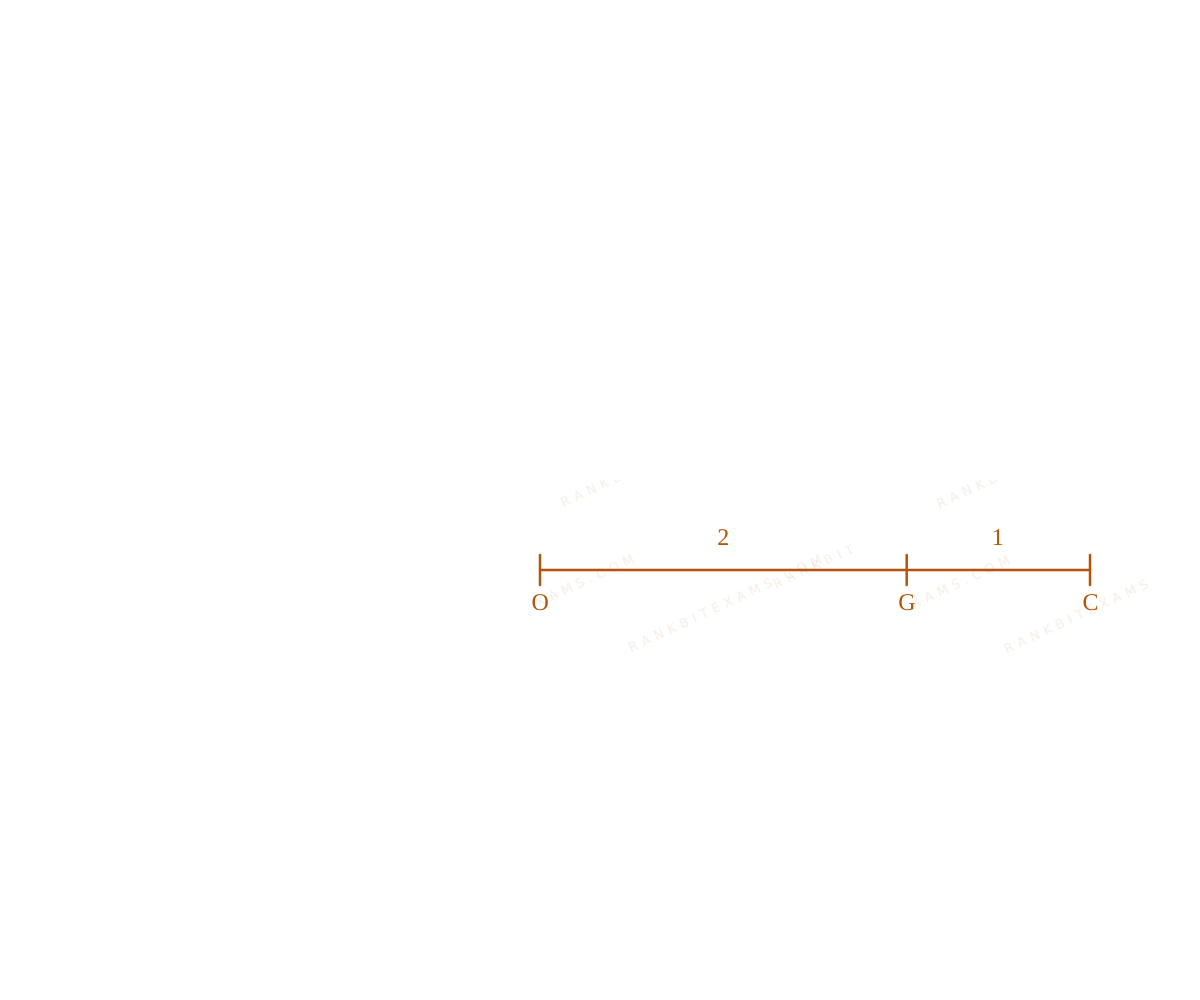
  • Euler's line property: The orthocenter (O), centroid (G), and circumcenter (C) are collinear, and G divides the segment OC internally in the ratio 2:1.
Step 1: Compute the Centroid Vector

Sum the vectors of the three given vertices:

A = 4 p+ q-3 r B = -5 p+ q+2 r C = 2 p- q+2 r G = (4 - 5 + 2) p + (1 + 1 - 1) q + (-3 + 2 + 2) r3 = p + q + r3
Step 2: Apply Euler Line Section Ratio

Using the section formula ratio O-G-C as 2:1:

Euler Line section diagram for Q56 - JEE Main 2025 Evening

G = 2 C + O3 ⇒ 3 G = 2 C + O 2 C = 3 G - O = 3( p + q + r3) - p + q + r4 2 C = ( p + q + r) - (1)/(4)( p + q + r) = (3)/(4)( p + q + r) C = (3)/(8) p + (3)/(8) q + (3)/(8) r
Step 3: Coefficient Matching

Compare with the given circumcenter format α p + β q + γ r:

α = (3)/(8), β = (3)/(8), γ = (3)/(8)

Calculate α + 2β + 5γ:

(3)/(8) + 2((3)/(8)) + 5((3)/(8)) = (3 + 6 + 15)/(8) = (24)/(8) = 3
Pattern Recognition

Euler line configuration is universally O-G-C in 2:1. Remember the mnemonic 'Oil-Gas-Company' or simply 3G = 2C + O to prevent swapping structural coefficients under exam stress.

Chapter Mix

Class 12 Mathematics: Vector Algebra Class 11 Mathematics: Properties of Triangles

Q64 jee_main_2025_24_jan_evening Vector Triple Product and Projection
Let a=3 i- j+2 k, b= a×( i-2 k) and c= b× k. Then the projection of c-2 j on a is:
  • A. 3√(7)
  • B. √(14)
  • C. 2√(14)
  • D. 2√(7)

Solution

Related Formula

The scalar projection of vector v onto vector w is calculated as:

Projection = v · w| w|
Step 1: Calculate b

Compute the cross product using standard matrix expansion:

b = a × ( i - 2 k) = vmatrix i & j & k 3 & -1 & 2 1 & 0 & -2 vmatrix b = i(2 - 0) - j(-6 - 2) + k(0 - (-1)) = 2 i + 8 j + k
Step 2: Calculate c and c - 2 j

Perform the second cross product with unit vector k:

c = b × k = (2 i + 8 j + k) × k = 2( i × k) + 8( j × k) + 0 c = 2(- j) + 8( i) = 8 i - 2 j

Subtract 2 j:

c - 2 j = (8 i - 2 j) - 2 j = 8 i - 4 j
Step 3: Compute the projection onto a

Using the dot product formula :

Projection = ( c - 2 j) · a| a| = 8, -4, 0 · 3, -1, 2 √(3² + (-1)² + 2²) Projection = 24 + 4 + 0√(9 + 1 + 4) = 28√(14) = 2√(14)
Pattern Recognition

Keep cyclic unit cross products clear: i × k = - j and j × k = i. Missing a negative sign during basic cross multiplications ruins multi-step vector projections easily.

Chapter Mix

Class 12 Mathematics: Vector Algebra

Q51 jee_main_2025_24_jan_morning Coplanar Vectors and Vector Products
Let a = i + 2 j + 3 k , b = 3 i + j - k and \|\vec{\mathbf{c}}\| be three vectors such that c is coplanar with a and b . If the vector c is perpendicular to b and a · c = 5 , then | c| is equal to :
  • A. 13√(2)
  • B. 18
  • C. 16
  • D. √((11)/(6))

Solution

Related Formula

A vector c coplanar with a and b and perpendicular to b can be expressed using the vector triple product command template:

c = λ ( b × ( a × b)) = λ [( b · b) a - ( a · b) b]
Core Logic

First, find the dot products of the given vectors:

b · b = 3² + 1² + (-1)² = 9 + 1 + 1 = 11 a · b = (1)(3) + (2)(1) + (3)(-1) = 3 + 2 - 3 = 2

Substituting these values into the expression for c:

c = λ [11 a - 2 b] c = λ [11( i + 2 j + 3 k) - 2(3 i + j - k)] c = λ (5 i + 20 j + 35 k) = 5λ ( i + 4 j + 7 k)
Step 1: Determine Lambda

Using the given condition a · c = 5:

a · [5λ ( i + 4 j + 7 k)] = 5 5λ (1 · 1 + 2 · 4 + 3 · 7) = 5 5λ (1 + 8 + 21) = 5 30λ = 1 λ = (1)/(30)

Thus, the vector c is:

c = (5)/(30)( i + 4 j + 7 k) = (1)/(6)( i + 4 j + 7 k)
Step 2: Calculate Magnitude

The magnitude of c is evaluated as:

| c| = √(1² + 4² + 7²)6 = √(1 + 16 + 49)6 = √(66)6 = √((66)/(36)) = √((11)/(6))
Pattern Recognition

Whenever a vector is specified to be coplanar with a, b and perpendicular to b, direct setup with the cross-product template b × ( a × b) circumvents solving cumbersome linear systems of scalar variables.

Chapter Mix

Class 12 Mathematics: Vector Algebra

Q52 jee_main_2025_28_jan_evening Vector Operations and Components
Let A, B, C be three points in xy-plane, whose position vector are given by √(3) i+ j, i+√(3) j and a i+(1-a) j respectively with respect to the origin O. If the distance of the point C from the line bisecting the angle between the vectors OA and OB is 9√(2) then the sum of all the possible values of a is:
  • A. 1
  • B. 9/2
  • C. 0
  • D. 2

Solution

Related Formula

The line bisecting the angle between two symmetric vectors passing through the origin in the first quadrant is given by y = x or x - y = 0.

Distance from point (x₁, y₁) to line Ax + By + C = 0 is:

d = |Ax₁ + By₁ + C|√(A² + B²)
Core Logic

Vectors OA = √(3) i+ j and OB = i+√(3) j are symmetric about the line y = x. Therefore, the angle bisector of OA and OB is the line x - y = 0.

Point C has coordinates (a, 1 - a).

Step 1: Calculate Distance and Solve for a

The perpendicular distance from C(a, 1 - a) to x - y = 0 is:

d = |a - (1 - a)|√(1² + (-1)²) = |2a - 1|√(2)

Given that this distance is 9√(2):

|2a - 1|√(2) = 9√(2) |2a - 1| = 9

This gives two solutions:

  • 2a - 1 = 9 2a = 10 a = 5
  • 2a - 1 = -9 2a = -8 a = -4
Step 2: Find the Sum of Values

Sum of all possible values of a:

Sum = 5 + (-4) = 1
Pattern Recognition

Notice that OA and OB have swapped coordinates, meaning they are symmetric with respect to y=x. Thus, the angle bisector equation is immediate (x-y=0), simplifying the problem to a standard point-to-line distance calculation.

Chapter Mix

Class 11 Mathematics: Straight Lines Class 12 Mathematics: Vector Algebra

More Vector Algebra Questions — jee_main_2025_08_april_evening

Practice all Vector Algebra previous-year questions →

Rankbit System
JEE Physics: Waves (+15.5%) | Electrostatics: Concentric Shells (-29.7%) | Modern Physics: Photoelectric Clones (+34.2%) | Mathematics: Definite Integrals (+18.1%) | Chemistry: Coordination Splitting (-11.4%) | JEE Physics: Waves (+15.5%) | Electrostatics: Concentric Shells (-29.7%) | Modern Physics: Photoelectric Clones (+34.2%) | Mathematics: Definite Integrals (+18.1%) | Chemistry: Coordination Splitting (-11.4%)
