JEE Main · Mathematics → Steady

Vector Algebra appeared 46 times across 3 years — 5.3% of Mathematics. This question is from Coplanar and Perpendicular Vectors.

Year 2026 2025 2024 Total
Questions 15 17 14 46

Let a = i + 2 j + k and b = 2 i + j - k. Let c be a unit vector in the plane of the vectors a and b and be perpendicular to a. Then such a vector c is:

Solution & Explanation

Related Formula
p = K( a + λ b) p · a = 0
Core Logic

Formulate a coplanar parameterization vector, apply the zero dot-product geometric orthogonality constraint to pin down the linear parameter, and then normalize.

Step 1: Define Coplanar Structural Form

Let the targeting vector path be:

p = K( a + λ b) = K( (1+2λ) i + (2+λ) j + (1-λ) k )
Step 2: Force Orthogonality Constraint

Impose p · a = 0:

1(1+2λ) + 2(2+λ) + 1(1-λ) = 0 1 + 2λ + 4 + 2λ + 1 - λ = 0 6 + 3λ = 0 λ = -2
Step 3: Substitute and Normalize

Substitute λ = -2 back into the base formulation:

p = K(-3 i + 3 k)

Normalizing to turn this vector into a proper unit scale form:

c = ± - i + k√(2)
Pattern Recognition

Finding coplanar vectors orthogonal to one base component matches taking cross expansions like ( a × b) × a up to scalar metrics.

Chapter Mix

Class 12 Mathematics: Vector Algebra

Reference Study Guides

More Vector Algebra Previous-Year Questions — Page 7

Q53 jee_main_2025_28_jan_evening Components of Vectors
If the components of a=α i+β j+γ k along and perpendicular to b=3 i+ j- k respectively, are (16)/(11)(3 i+ j- k) and (1)/(11)(-4 i-5 j-17 k), then α²+β²+γ² is equal to:
  • A. 23
  • B. 18
  • C. 16
  • D. 26

Solution

Related Formula

Any vector a can be written as the sum of its component parallel to b (along b) and its component perpendicular to b:

a = a∥ + a⊥

Magnitude squared:

| a|² = α² + β² + γ²
Core Logic

Given:

a∥ = (16)/(11)(3 i+ j- k) a⊥ = (1)/(11)(-4 i-5 j-17 k)
Step 1: Reconstruct Vector a

Add both components to find a:

a = (16)/(11)(3 i+ j- k) + (1)/(11)(-4 i-5 j-17 k) a = (1)/(11) [ (48 - 4) i + (16 - 5) j + (-16 - 17) k ] a = (1)/(11) [ 44 i + 11 j - 33 k ] = 4 i + j - 3 k

Therefore, α = 4, β = 1, γ = -3.

Step 2: Calculate Sum of Squares
α² + β² + γ² = 4² + 1² + (-3)² = 16 + 1 + 9 = 26
Pattern Recognition

Since parallel and perpendicular components are orthogonal vectors, you can also use directly | a|² = | a∥|² + | a⊥|² to save algebra step: | a∥|² = (16²)/(11²)(9+1+1) = (256)/(11), | a⊥|² = (1)/(11²)(16+25+289) = (330)/(121) = (30)/(11). Total = (286)/(11) = 26.

Chapter Mix

Class 12 Mathematics: Vector Algebra

Q55 jee_main_2025_29_jan_morning Vector Cross Product and Dot Product
Let a = 2 i - j + 3 k , b = 3 i - 5 j + k and c be a vector such that a × c = c × b and ( a + c) . ( b + c) = 168. Then the maximum value of | c|² is:
  • A. 77
  • B. 462
  • C. 308
  • D. 154

Solution

Related Formula
u × v = - v × u If u × v = 0 u ∥ v u = λ v
Core Logic

Given a × c = c × b a × c + b × c = 0

( a + b) × c = 0 c = λ( a + b)
Step 1: Compute a + b
a + b = (2+3) i + (-1-5) j + (3+1) k = 5 i - 6 j + 4 k c = λ(5 i - 6 j + 4 k) | c|² = λ²(25 + 36 + 16) = 77λ²
Step 2: Expand the Dot Product Condition
( a + c) · ( b + c) = 168 a · b + c · ( a + b) + | c|² = 168

Evaluate a · b = (2)(3) + (-1)(-5) + (3)(1) = 6 + 5 + 3 = 14. Substitute c · ( a + b) = λ | a + b|² = 77λ:

14 + 77λ + 77λ² = 168 77λ² + 77λ - 154 = 0 λ² + λ - 2 = 0 λ = 1 or λ = -2
Step 3: Maximize | c|²

Maximum value occurs when λ = -2:

| c|² = 77(-2)² = 77 × 4 = 308
Pattern Recognition

Recognize the cross-product rule inversion immediately: x × y = y × z ( x+ z) ∥ y. This linear reduction circumvents solving complex linear systems.

Chapter Mix

Class 12 Mathematics: Vector Algebra

Q8 jee_main_2024_01_february_morning Vector Triple Product
Let a=-5 i+ j-3 k, b= i+2 j-4 k and c=((( a× b)× i)× i)× i. Then c·(- i+ j+ k) is equal to:
  • A. -12
  • B. -10
  • C. -13
  • D. -15

Solution

Related Formula

Vector Triple Product Identity:

( u × v) × w = ( u · w) v - ( v · w) a
Core Logic

Given vectors a and b: First, let's find the inner vector triple product ( a × b) × i:

( a × b) × i = ( a · i) b - ( b · i) a

From the given components:

  • a · i = -5
  • b · i = 1
( a × b) × i = -5 b - a
Step 1: Substitute Vector Coordinates

Substitute coordinates of a and b into the expression:

-5 b - a = -5( i + 2 j - 4 k) - (-5 i + j - 3 k) = -5 i - 10 j + 20 k + 5 i - j + 3 k = -11 j + 23 k

Now, perform successive cross products with i:

Next Step = (-11 j + 23 k) × i = -11( j × i) + 23( k × i) = 11 k + 23 j Final Vector c = (23 j + 11 k) × i = 23( j × i) + 11( k × i) = -23 k + 11 j
Step 2: Calculate Dot Product

Now evaluate c · (- i + j + k):

c = 11 j - 23 k c · (- i + j + k) = (0)( -1) + (11)(1) + (-23)(1) = 11 - 23 = -12
Pattern Recognition

Sees: Repeated vector cross products with standard unit vectors. Shortcut: Observe that crossing a vector in the y-z plane with i rotates its components by 90° in that plane. Doing it twice returns it to the original plane with flipped coefficients and signs (v × i × i = - v).

Chapter Mix

Class 12 Mathematics: Vector Algebra

Q jee_main_2024_29_january_evening Area of Quadrilateral and Parallelogram
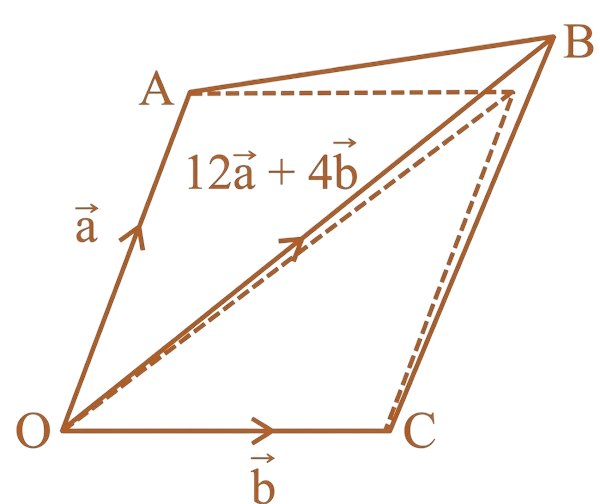
Let OA = a, OB = 12 a + 4 b and OC = b, where O is the origin. If S is the parallelogram with adjacent sides OA and OC, then the ratio of the area of the quadrilateral OABC to the area of S is equal to
  • A. 6
  • B. 10
  • C. 7
  • D. 8

Solution

Related Formula
Area of Parallelogram S = | a × b| Area of Quadrilateral OABC = Area(Δ OAB) + Area(Δ OBC)
Core Logic

Let us compute the component areas using vector cross products:

Area(Δ OAB) = (1)/(2) | OA × OB| = (1)/(2) | a × (12 a + 4 b)| = (1)/(2) |4( a × b)| = 2| a × b| Area(Δ OBC) = (1)/(2) | OB × OC| = (1)/(2) |(12 a + 4 b) × b| = (1)/(2) |12( a × b)| = 6| a × b|
Step 1: Finding Total Ratio

Adding both triangles to find the total area of the quadrilateral OABC:

Area(OABC) = 2| a × b| + 6| a × b| = 8| a × b|

Area of Quadrilateral and Parallelogram diagram for Q8 - JEE Main 2024 Evening

Dividing this total by the area of the baseline parallelogram S = | a × b|:

Ratio = 8| a × b|| a × b| = 8
Pattern Recognition

Since a × a = 0 and b × b = 0, cross product distributions yield terms with purely a × b, ensuring absolute scalability independent of vectors chosen.

Chapter Mix

Class 12 Mathematics: Vector Algebra

Q jee_main_2024_29_january_evening Vector Operations and Angles
Let a unit vector u = x i + y j + z k make angles (π)/(2), (π)/(3), and (2π)/(3) with the vectors 1√(2) i + 1√(2) k, 1√(2) j + 1√(2) k, and 1√(2) i + 1√(2) j respectively. If v = 1√(2) i + 1√(2) j + 1√(2) k, then | u - v|² is equal to
  • A. (11)/(2)
  • B. (5)/(2)
  • C. 9
  • D. 7

Solution

Related Formula
A · B = | A| | B| φ
Core Logic

Let the given baseline vectors be p₁, p₂, p₃. Note that | p₁| = | p₂| = | p₃| = 1.

  • Angle with p₁ is (π)/(2):
u · p₁ = 0 x√(2) + z√(2) = 0 x + z = 0 (i)
  • Angle with p₂ is (π)/(3):
u · p₂ = (π)/(3) y√(2) + z√(2) = (1)/(2) y + z = 1√(2) (ii)
  • Angle with p₃ is (2π)/(3):
u · p₃ = (2π)/(3) x√(2) + y√(2) = -(1)/(2) x + y = - 1√(2) (iii)
Step 1: Finding Vector Coordinates

Subtracting (ii) from (iii):

(x + y) - (y + z) = - 1√(2) - 1√(2) x - z = -√(2) (iv)

Solving (i) and (iv):

2x = -√(2) x = - 1√(2) z = 1√(2)

From (ii): y = 1√(2) - 1√(2) = 0. So, u = - 1√(2) i + 0 j + 1√(2) k.

Step 2: Evaluating the Norm Difference

Given v = 1√(2) i + 1√(2) j + 1√(2) k:

u - v = (- 1√(2) - 1√(2)) i + (0 - 1√(2)) j + ( 1√(2) - 1√(2)) k u - v = -√(2) i - 1√(2) j + 0 k

Evaluating the squared magnitude:

| u - v|² = (-√(2))² + (- 1√(2))² = 2 + (1)/(2) = (5)/(2)
Pattern Recognition

Setting up dot products systematically transforms descriptive geometric angles into solvable sets of linear equations.

Chapter Mix

Class 12 Mathematics: Vector Algebra
More Vector Algebra Questions — jee_main_2025_08_april_evening

Practice all Vector Algebra previous-year questions →

Rankbit System
JEE Physics: Waves (+15.5%) | Electrostatics: Concentric Shells (-29.7%) | Modern Physics: Photoelectric Clones (+34.2%) | Mathematics: Definite Integrals (+18.1%) | Chemistry: Coordination Splitting (-11.4%) | JEE Physics: Waves (+15.5%) | Electrostatics: Concentric Shells (-29.7%) | Modern Physics: Photoelectric Clones (+34.2%) | Mathematics: Definite Integrals (+18.1%) | Chemistry: Coordination Splitting (-11.4%)
