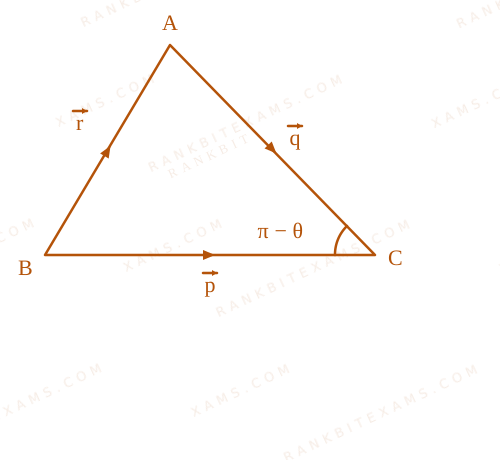
Let the position vectors of three vertices of a \triangle be 4vecp+vecq-3vecr$4\vec{p}+\vec{q}-3\vec{r}$, -5vecp+vecq+2vecr$-5\vec{p}+\vec{q}+2\vec{r}$ and 2vecp-vecq+2vecr$2\vec{p}-\vec{q}+2\vec{r}$ If the position vectors of the orthocenter and the circumcenter of the \triangle are fracvecp+vecq+vecr4$\frac{\vec{p}+\vec{q}+\vec{r}}{4}$ and alphavecp+betavecq+gammavecr$\alpha\vec{p}+\beta\vec{q}+\gamma\vec{r}$ respectively, then alpha+2beta+5gamma$\alpha+2\beta+5\gamma$ is equal to: [cite: 3266, 3267, 3268, 3269, 3270, 3271, 3272]
A.3$3$
B.1$1$
C.6$6$
D.4$4$
Solution & Explanation
### Related Formula
1. Centroid (G$G$) of a \triangle with vertices A, B, C$A, B, C$ is given by:
vecG = fracvecA + vecB + vecC3$\vec{G} = \frac{\vec{A} + \vec{B} + \vec{C}}{3}$
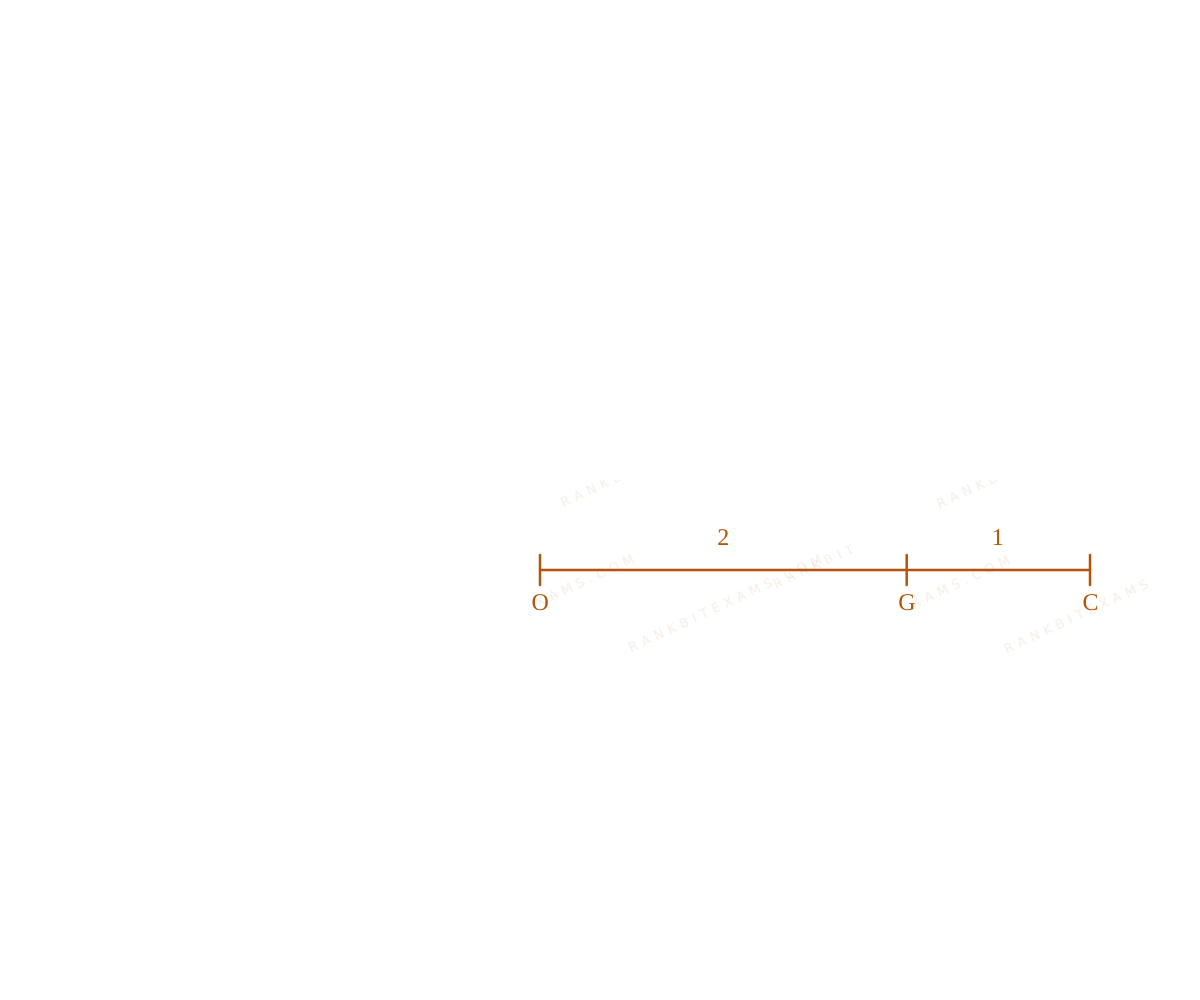
2. Euler\'s line property: The orthocenter (O$O$), centroid (G$G$), and circumcenter (C$C$) are collinear, and G$G$ divides the segment OC$OC$ internally in the ratio 2:1$2:1$.
### Step 1: Compute the Centroid Vector
Sum the vectors of the three given vertices [cite: 3266, 3268]:
vecA = 4vecp+vecq-3vecr$\vec{A} = 4\vec{p}+\vec{q}-3\vec{r}$vecB = -5vecp+vecq+2vecr$\vec{B} = -5\vec{p}+\vec{q}+2\vec{r}$vecC = 2vecp-vecq+2vecr$\vec{C} = 2\vec{p}-\vec{q}+2\vec{r}$vecG = frac(4 - 5 + 2)vecp + (1 + 1 - 1)vecq + (-3 + 2 + 2)vecr3 = fracvecp + vecq + vecr3$\vec{G} = \frac{(4 - 5 + 2)\vec{p} + (1 + 1 - 1)\vec{q} + (-3 + 2 + 2)\vec{r}}{3} = \frac{\vec{p} + \vec{q} + \vec{r}}{3}$
### Step 2: Apply Euler Line Section Ratio
Using the section formula ratio O-G-C$O-G-C$ as 2:1$2:1$ [cite: 3931, 3932]:
Euler Line section diagram for Q56 - JEE Main 2025 EveningvecG = frac2vecC + vecO3 Rightarrow 3vecG = 2vecC + vecO$\vec{G} = \frac{2\vec{C} + \vec{O}}{3} \Rightarrow 3\vec{G} = 2\vec{C} + \vec{O}$2vecC = 3vecG - vecO = 3left(fracvecp + vecq + vecr3right) - fracvecp + vecq + vecr4$2\vec{C} = 3\vec{G} - \vec{O} = 3\left(\frac{\vec{p} + \vec{q} + \vec{r}}{3}\right) - \frac{\vec{p} + \vec{q} + \vec{r}}{4}$2vecC = (vecp + vecq + vecr) - frac14(vecp + vecq + vecr) = frac34(vecp + vecq + vecr)$2\vec{C} = (\vec{p} + \vec{q} + \vec{r}) - \frac{1}{4}(\vec{p} + \vec{q} + \vec{r}) = \frac{3}{4}(\vec{p} + \vec{q} + \vec{r})$vecC = frac38vecp + frac38vecq + frac38vecr$\vec{C} = \frac{3}{8}\vec{p} + \frac{3}{8}\vec{q} + \frac{3}{8}\vec{r}$
### Step 3: Coefficient Matching
Compare with the given circumcenter format alphavecp + betavecq + gammavecr$\alpha\vec{p} + \beta\vec{q} + \gamma\vec{r}$ [cite: 3270, 3939]:
alpha = frac38, quad beta = frac38, quad gamma = frac38$\alpha = \frac{3}{8}, \quad \beta = \frac{3}{8}, \quad \gamma = \frac{3}{8}$
Calculate alpha + 2beta + 5gamma$\alpha + 2\beta + 5\gamma$ [cite: 3272, 3949]:
frac38 + 2left(frac38right) + 5left(frac38right) = frac3 + 6 + 158 = frac248 = 3$\frac{3}{8} + 2\left(\frac{3}{8}\right) + 5\left(\frac{3}{8}\right) = \frac{3 + 6 + 15}{8} = \frac{24}{8} = 3$
### Pattern Recognition
Euler line configuration is universally O-G-C$O-G-C$ in 2:1$2:1$. Remember the mnemonic 'Oil-Gas-Company' or simply 3G = 2C + O$3G = 2C + O$ to prevent swapping structural coefficients under exam stress.
### Evaluation Rubric / Model Answer
null
### Chapter Mix
Class 12 Mathematics: Vector Algebra
Class 11 Mathematics: Properties of Triangles
Keywords:#Euler line section formula \triangle#JEE Main 2025 Evening Q56#Centroid vector calculation#orthocenter circumcenter vector relationship
More Vector Algebra Previous-Year Questions
Q682025Properties of Vectors
Let veca = 2hati - 3hatj + hatk$\vec{a} = 2\hat{i} - 3\hat{j} + \hat{k}$, vecb = 3hati + 2hatj + 5hatk$\vec{b} = 3\hat{i} + 2\hat{j} + 5\hat{k}$ and a vector vecc$\vec{c}$ be such that (veca - vecc) times vecb = -18hati - 3hatj + 12hatk$(\vec{a} - \vec{c}) \times \vec{b} = -18\hat{i} - 3\hat{j} + 12\hat{k}$ and veca cdot vecc = 3$\vec{a} \cdot \vec{c} = 3$. If vecb times vecc = vecd$\vec{b} \times \vec{c} = \vec{d}$, then |veca cdot vecd|$|\vec{a} \cdot \vec{d}|$ is equal to:
A. 18
B. 12
C. 9
D. 15
Solution
### Related Formula
textVector Cross product distributes over subtraction: (veca - vecc) times vecb = veca times vecb - vecc times vecb$\text{Vector Cross product distributes over subtraction: } (\vec{a} - \vec{c}) \times \vec{b} = \vec{a} \times \vec{b} - \vec{c} \times \vec{b}$textScalar Triple Product cyclic identity: veca cdot (vecb times vecc) = (veca times vecb) cdot vecc$\text{Scalar Triple Product cyclic identity: } \vec{a} \cdot (\vec{b} \times \vec{c}) = (\vec{a} \times \vec{b}) \cdot \vec{c}$textAntisymmetry: vecc times vecb = - vecb times vecc$\text{Antisymmetry: } \vec{c} \times \vec{b} = - \vec{b} \times \vec{c}$
### Core Logic
Instead of solving for the individual coordinates of vector vecc$\vec{c}$, we apply vector algebraic identities to compute the target scalar triple product directly.
### Step 1: Expand and rewrite the cross product
Given (veca - vecc) times vecb = -18hatmathrmi - 3hatmathrmj + 12hatmathrmk$(\vec{a} - \vec{c}) \times \vec{b} = -18\hat{\mathrm{i}} - 3\hat{\mathrm{j}} + 12\hat{\mathrm{k}}$:
veca times vecb - vecc times vecb = -18hatmathrmi - 3hatmathrmj + 12hatmathrmk$\vec{a} \times \vec{b} - \vec{c} \times \vec{b} = -18\hat{\mathrm{i}} - 3\hat{\mathrm{j}} + 12\hat{\mathrm{k}}$veca times vecb + vecb times vecc = -18hatmathrmi - 3hatmathrmj + 12hatmathrmk$\vec{a} \times \vec{b} + \vec{b} \times \vec{c} = -18\hat{\mathrm{i}} - 3\hat{\mathrm{j}} + 12\hat{\mathrm{k}}$vecb times vecc = (-18hatmathrmi - 3hatmathrmj + 12hatmathrmk) - (veca times vecb) quad text--- (1)$\vec{b} \times \vec{c} = (-18\hat{\mathrm{i}} - 3\hat{\mathrm{j}} + 12\hat{\mathrm{k}}) - (\vec{a} \times \vec{b}) \quad \text{--- (1)}$
### Step 2: Calculate a x b
Evaluate the cross product:
veca times vecb = beginvmatrix hatmathrmi & hatmathrmj & hatmathrmk \\ 2 & -3 & 1 \\ 3 & 2 & 5 endvmatrix$\vec{a} \times \vec{b} = \begin{vmatrix} \hat{\mathrm{i}} & \hat{\mathrm{j}} & \hat{\mathrm{k}} \\ 2 & -3 & 1 \\ 3 & 2 & 5 \end{vmatrix}$veca times vecb = hatmathrmi(-15 - 2) - hatmathrmj(10 - 3) + hatmathrmk(4 - (-9)) = -17hatmathrmi - 7hatmathrmj + 13hatmathrmk$\vec{a} \times \vec{b} = \hat{\mathrm{i}}(-15 - 2) - \hat{\mathrm{j}}(10 - 3) + \hat{\mathrm{k}}(4 - (-9)) = -17\hat{\mathrm{i}} - 7\hat{\mathrm{j}} + 13\hat{\mathrm{k}}$
### Step 3: Solve for the vector d
Substitute veca times vecb$\vec{a} \times \vec{b}$ back into equation (1):
vecd = vecb times vecc = (-18hatmathrmi - 3hatmathrmj + 12hatmathrmk) - (-17hatmathrmi - 7hatmathrmj + 13hatmathrmk)$\vec{d} = \vec{b} \times \vec{c} = (-18\hat{\mathrm{i}} - 3\hat{\mathrm{j}} + 12\hat{\mathrm{k}}) - (-17\hat{\mathrm{i}} - 7\hat{\mathrm{j}} + 13\hat{\mathrm{k}})$vecd = -hatmathrmi + 4hatmathrmj - hatmathrmk$\vec{d} = -\hat{\mathrm{i}} + 4\hat{\mathrm{j}} - \hat{\mathrm{k}}$
### Step 4: Compute the final dot product
Now compute the requested dot product:
veca cdot vecd = (2hatmathrmi - 3hatmathrmj + hatmathrmk) cdot (-hatmathrmi + 4hatmathrmj - hatmathrmk)$\vec{a} \cdot \vec{d} = (2\hat{\mathrm{i}} - 3\hat{\mathrm{j}} + \hat{\mathrm{k}}) \cdot (-\hat{\mathrm{i}} + 4\hat{\mathrm{j}} - \hat{\mathrm{k}})$veca cdot vecd = 2(-1) + (-3)(4) + 1(-1) = -2 - 12 - 1 = -15$\vec{a} \cdot \vec{d} = 2(-1) + (-3)(4) + 1(-1) = -2 - 12 - 1 = -15$left| veca cdot vecd right| = 15$\left| \vec{a} \cdot \vec{d} \right| = 15$
### Pattern Recognition
Scalar triple product shortcut: Recognizing that veca cdot vecd = veca cdot (vecb times vecc) = [ veca \, vecb \, vecc ]$\vec{a} \cdot \vec{d} = \vec{a} \cdot (\vec{b} \times \vec{c}) = [ \vec{a} \, \vec{b} \, \vec{c} ]$ allows you to find the scalar value through simple determinants and linear equations instead of solving for the vector components.
### Evaluation Rubric / Model Answer
null
### Chapter Mix
Class 12 Mathematics: Vector Algebra
Q2025Vector Projections
If veca$\vec{a}$ is a nonzero vector such that its projections on the vectors 2hatmathbfi - hatmathbfj + 2hatmathbfk$2\hat{\mathbf{i}} - \hat{\mathbf{j}} + 2\hat{\mathbf{k}}$, hatmathbfi + 2hatmathbfj - 2hatmathbfk$\hat{\mathbf{i}} + 2\hat{\mathbf{j}} - 2\hat{\mathbf{k}}$ and hatmathbfk$\hat{\mathbf{k}}$ are equal, then a unit vector along veca$\vec{a}$ is:
Let the angle theta, 0 < theta < fracpi2$\theta, 0 < \theta < \frac{\pi}{2}$ between two unit vectors hata$\hat{a}$ and hatb$\hat{b}$ be sin^-1left(fracsqrt659right)$\sin^{-1}\left(\frac{\sqrt{65}}{9}\right)$ . If the vector vecc = 3hata + 6hatb + 9(hata times hatb)$\vec{c} = 3\hat{a} + 6\hat{b} + 9(\hat{a} \times \hat{b})$ , then the value of 9(vecc cdot hata) - 3(vecc cdot hatb)$9(\vec{c} \cdot \hat{a}) - 3(\vec{c} \cdot \hat{b})$ is
Let veca = hati + 2hatj + hatk$\vec{a} = \hat{i} + 2\hat{j} + \hat{k}$ and vecb = 2hati + hatj - hatk$\vec{b} = 2\hat{i} + \hat{j} - \hat{k}$. Let hatc$\hat{c}$ be a unit vector in the plane of the vectors veca$\vec{a}$ and vecb$\vec{b}$ and be perpendicular to veca$\vec{a}$. Then such a vector hatc$\hat{c}$ is:
We Map Every Repeating Question in Competitive Exams.
Say goodbye to generic mock test fatigue. RankBit uses smart analysis to group past exam questions into their foundational Repeating Question Types. Find chapter weightage, track repeating questions, and score higher with targeted practice.
Select Your Target Exam
Choose an exam track below to find formulas per chapter and patterns.
Syncing Exam Intelligence
Mapping formulas and patterns across all tracks…
PATH A — FULL LENGTH PRACTICE
Full Mock Test Hub
Simulate real NTA exam conditions with fully tracked mocks. Time yourself against past papers.
Under Development
PATH B — TARGETED PRACTICE
Topic-wise Practice Hub
Practice past-year questions one chapter at a time. Pick an exam → subject → chapter and get every PYQ for that topic — pulled together from all past papers — with the chapter's key formulas alongside.