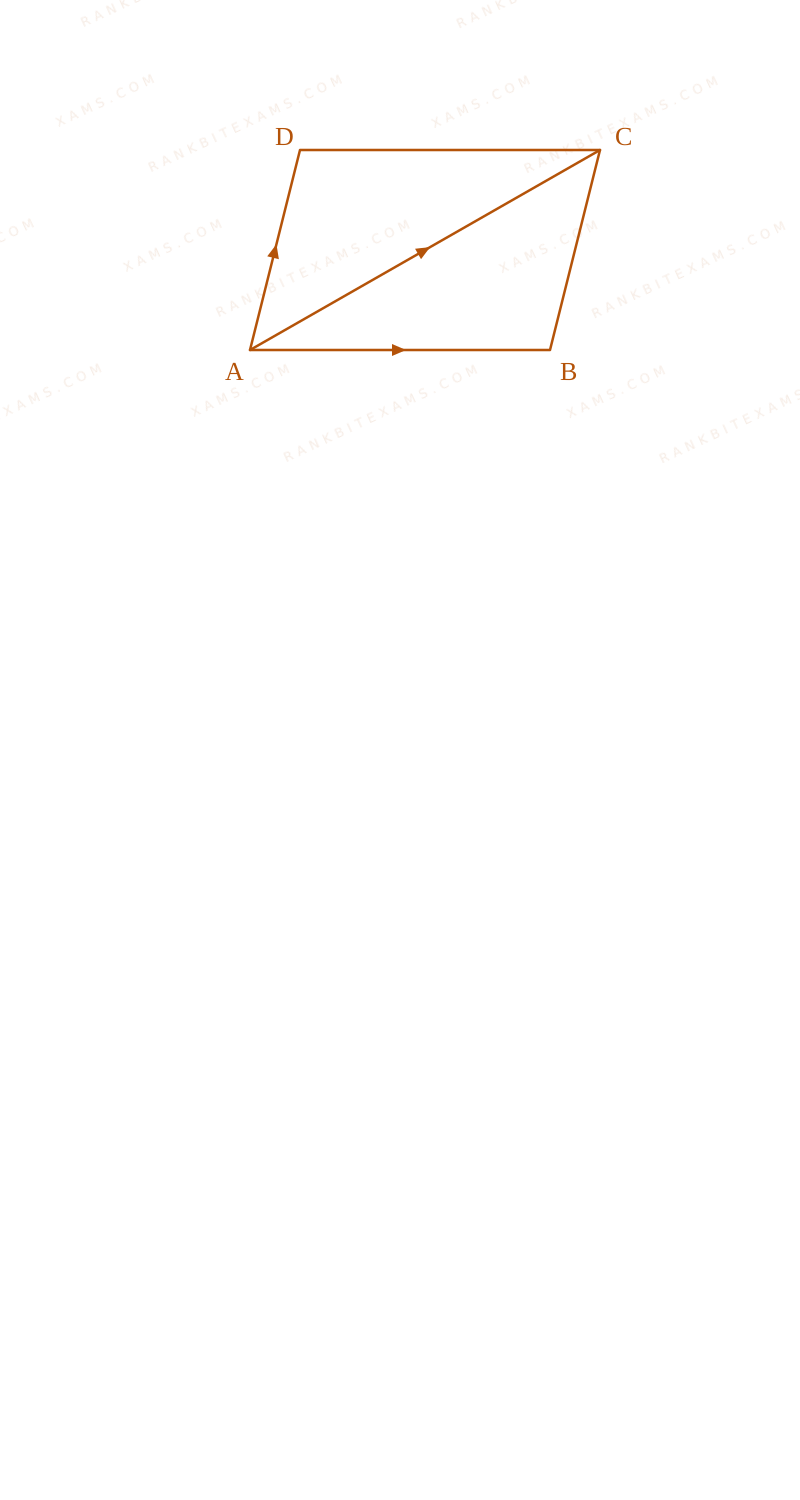
Let overrightarrowAB=2hati+4hatj-5hatk$\overrightarrow{AB}=2\hat{i}+4\hat{j}-5\hat{k}$ and overrightarrowAD=hati+2hatj+lambda hatk, lambdain mathbbR$\overrightarrow{AD}=\hat{i}+2\hat{j}+\lambda \hat{k}, \lambda\in \mathbb{R}$. Let the projection of the vectorvecv=hati+hatj+hatk$\vec{v}=\hat{i}+\hat{j}+\hat{k}$ on the diagonal overrightarrowAC$\overrightarrow{AC}$ of the parallelogram ABCD be of length one unit. If alpha,beta$\alpha,\beta$, where alpha>beta$\alpha>\beta$, be the roots of the equation lambda^2x^2-6lambda x+5=0$\lambda^{2}x^{2}-6\lambda x+5=0$, then 2alpha-beta$2\alpha-\beta$ is equal to
A.1$1$
B.4$4$
C.3$3$
D.6$6$
Solution & Explanation
### Related Formula
textProjection of vecv text on veca = fracvecv cdot veca|veca|$$\text{Projection of } \vec{v} \text{ on } \vec{a} = \frac{\vec{v} \cdot \vec{a}}{|\vec{a}|}$$overrightarrowAC = overrightarrowAB + overrightarrowAD$$\overrightarrow{AC} = \overrightarrow{AB} + \overrightarrow{AD}$$
### Core Logic
Using the parallelogram law of vector addition, the diagonal overrightarrowAC$\overrightarrow{AC}$ is given by:
overrightarrowAC = overrightarrowAB + overrightarrowAD = (2hati+4hatj-5hatk) + (hati+2hatj+lambda hatk)$$\overrightarrow{AC} = \overrightarrow{AB} + \overrightarrow{AD} = (2\hat{i}+4\hat{j}-5\hat{k}) + (\hat{i}+2\hat{j}+\lambda \hat{k})$$overrightarrowAC = 3hati + 6hatj + (lambda - 5)hatk$$\overrightarrow{AC} = 3\hat{i} + 6\hat{j} + (\lambda - 5)\hat{k}$$
### Step 1: Applying the Projection Condition
The projection of vecv = hati+hatj+hatk$\vec{v} = \hat{i}+\hat{j}+\hat{k}$ on overrightarrowAC$\overrightarrow{AC}$ is 1. Therefore:
fracvecv cdot overrightarrowAC|overrightarrowAC| = 1$$\frac{\vec{v} \cdot \overrightarrow{AC}}{|\overrightarrow{AC}|} = 1$$frac3(1) + 6(1) + (lambda - 5)(1)sqrt3^2 + 6^2 + (lambda - 5)^2 = 1$$\frac{3(1) + 6(1) + (\lambda - 5)(1)}{\sqrt{3^2 + 6^2 + (\lambda - 5)^2}} = 1$$3 + 6 + lambda - 5 = sqrt9 + 36 + (lambda - 5)^2$$3 + 6 + \lambda - 5 = \sqrt{9 + 36 + (\lambda - 5)^2}$$lambda + 4 = sqrt45 + (lambda - 5)^2$$\lambda + 4 = \sqrt{45 + (\lambda - 5)^2}$$
Squaring both sides:
(lambda + 4)^2 = 45 + (lambda - 5)^2$$(\lambda + 4)^2 = 45 + (\lambda - 5)^2$$lambda^2 + 8lambda + 16 = lambda^2 - 10lambda + 25 + 45$$\lambda^2 + 8\lambda + 16 = \lambda^2 - 10\lambda + 25 + 45$$18lambda = 54 implies lambda = 3$$18\lambda = 54 \implies \lambda = 3$$
### Step 2: Solving the Quadratic Equation
Substitute lambda = 3$\lambda = 3$ into the given quadratic equation lambda^2x^2 - 6lambda x + 5 = 0$\lambda^2x^2 - 6\lambda x + 5 = 0$:
9x^2 - 18x + 5 = 0$$9x^2 - 18x + 5 = 0$$(3x - 1)(3x - 5) = 0 implies x = frac13, frac53$$(3x - 1)(3x - 5) = 0 \implies x = \frac{1}{3}, \frac{5}{3}$$
Given alpha > beta$\alpha > \beta$, we have alpha = frac53$\alpha = \frac{5}{3}$ and beta = frac13$\beta = \frac{1}{3}$.
Calculate 2alpha - beta$2\alpha - \beta$:
2left(frac53right) - frac13 = frac10 - 13 = 3$$2\left(\frac{5}{3}\right) - \frac{1}{3} = \frac{10 - 1}{3} = 3$$Projection of A Vector diagram for Q1 - JEE Main 2026 Morning
### Pattern Recognition
Projection questions in 3D geometry often couple a simple dot product identity with an unknown parameter. Squaring a linear equation derived from vector magnitudes often cancels the squared terms, making it easily solvable.
### Evaluation Rubric / Model Answer
null
### Chapter Mix
Class 12 Maths: Vector Algebra
Class 11 Maths: Quadratic Equations
Q7jee_main_2026_21_jan_morningCollinearity and Cross Product of Vectors
Let vecc$\vec{c}$ and vecd$\vec{d}$ be vectors such that |vecc+vecd|=sqrt29$|\vec{c}+\vec{d}|=\sqrt{29}$ and vecctimes(2hati+3hatj+4hatk)=(2hati+3hatj+4hatk)timesvecd$\vec{c}\times(2\hat{i}+3\hat{j}+4\hat{k})=(2\hat{i}+3\hat{j}+4\hat{k})\times\vec{d}$ . If lambda_1,lambda_2(lambda_1>lambda_2)$\lambda_{1},\lambda_{2}(\lambda_{1}>\lambda_{2})$ are the possible values of (vecc+vecd).(-7hati+2hatj+3hatk)$(\vec{c}+\vec{d}).(-7\hat{i}+2\hat{j}+3\hat{k})$ , then the equation K^2x^2+(K^2-5K+lambda_1)xy+left(3K+fraclambda_22right)y^2-8x+12y+lambda_2=0$K^{2}x^{2}+(K^{2}-5K+\lambda_{1})xy+\left(3K+\frac{\lambda_{2}}{2}\right)y^{2}-8x+12y+\lambda_{2}=0$ represents a circle, for k equal to:
A. 4
B. 1
C. -1
D. 2
Solution
### Related Formula
vecu times vecv = -(vecv times vecu)$$\vec{u} \times \vec{v} = -(\vec{v} \times \vec{u})$$
General equation of a circle requires coefficient of x^2$x^2$ = coefficient of y^2$y^2$ and coefficient of xy$xy$ = 0$0$.
### Core Logic
Given vecc times (2hati + 3hatj + 4hatk) = (2hati + 3hatj + 4hatk) times vecd$\vec{c} \times (2\hat{i} + 3\hat{j} + 4\hat{k}) = (2\hat{i} + 3\hat{j} + 4\hat{k}) \times \vec{d}$
Rearranging:
vecc times (2hati + 3hatj + 4hatk) + vecd times (2hati + 3hatj + 4hatk) = vec0$$\vec{c} \times (2\hat{i} + 3\hat{j} + 4\hat{k}) + \vec{d} \times (2\hat{i} + 3\hat{j} + 4\hat{k}) = \vec{0}$$(vecc + vecd) times (2hati + 3hatj + 4hatk) = vec0$$(\vec{c} + \vec{d}) \times (2\hat{i} + 3\hat{j} + 4\hat{k}) = \vec{0}$$
This implies vecc + vecd$\vec{c} + \vec{d}$ is parallel to 2hati + 3hatj + 4hatk$2\hat{i} + 3\hat{j} + 4\hat{k}$.
Let vecc + vecd = lambda (2hati + 3hatj + 4hatk)$\vec{c} + \vec{d} = \lambda (2\hat{i} + 3\hat{j} + 4\hat{k})$.
### Step 1: Find the scaling factor
Given |vecc + vecd| = sqrt29$|\vec{c} + \vec{d}| = \sqrt{29}$|lambda| sqrt2^2 + 3^2 + 4^2 = sqrt29$$|\lambda| \sqrt{2^2 + 3^2 + 4^2} = \sqrt{29}$$|lambda| sqrt4 + 9 + 16 = sqrt29$$|\lambda| \sqrt{4 + 9 + 16} = \sqrt{29}$$|lambda| sqrt29 = sqrt29 Rightarrow lambda = pm 1$$|\lambda| \sqrt{29} = \sqrt{29} \Rightarrow \lambda = \pm 1$$
Therefore, vecc + vecd = pm(2hati + 3hatj + 4hatk)$\vec{c} + \vec{d} = \pm(2\hat{i} + 3\hat{j} + 4\hat{k})$.
### Step 2: Evaluate the dot product limits
We need values of (vecc + vecd) cdot (-7hati + 2hatj + 3hatk)$(\vec{c} + \vec{d}) \cdot (-7\hat{i} + 2\hat{j} + 3\hat{k})$.
Dot product = lambda(2(-7) + 3(2) + 4(3)) = lambda(-14 + 6 + 12) = 4lambda$= \lambda(2(-7) + 3(2) + 4(3)) = \lambda(-14 + 6 + 12) = 4\lambda$.
Since lambda = pm 1$\lambda = \pm 1$, the possible values are 4$4$ and -4$-4$.
Given lambda_1 > lambda_2$\lambda_1 > \lambda_2$, we have lambda_1 = 4$\lambda_1 = 4$ and lambda_2 = -4$\lambda_2 = -4$.
### Step 3: Apply circle constraints
Substitute lambda_1$\lambda_1$ and lambda_2$\lambda_2$ into the conic equation:
K^2 x^2 + (K^2 - 5K + 4)xy + left(3K - 2right)y^2 - 8x + 12y - 4 = 0$$K^2 x^2 + (K^2 - 5K + 4)xy + \left(3K - 2\right)y^2 - 8x + 12y - 4 = 0$$
For this to represent a circle:
1) Coefficient of xy$xy$ must be 0$0$:
K^2 - 5K + 4 = 0 Rightarrow K = 1, 4$$K^2 - 5K + 4 = 0 \Rightarrow K = 1, 4$$
2) Coefficient of x^2$x^2$ must equal coefficient of y^2$y^2$:
K^2 = 3K - 2 Rightarrow K^2 - 3K + 2 = 0 Rightarrow K = 1, 2$$K^2 = 3K - 2 \Rightarrow K^2 - 3K + 2 = 0 \Rightarrow K = 1, 2$$
The common value satisfying both conditions is K = 1$K = 1$.
### Pattern Recognition
Cross-product equations mapping to X times A = -Y times A$X \times A = -Y \times A$ perfectly factor out to (X+Y) times A = 0$(X+Y) \times A = 0$, guaranteeing (X+Y)$(X+Y)$ is a scalar multiple of A$A$. This immediately unlocks vector magnitudes.
### Evaluation Rubric / Model Answer
null
### Chapter Mix
Class 12 Maths: Vector Algebra
Class 11 Maths: Conic Sections
Q15jee_main_2026_21_jan_eveningCross Product
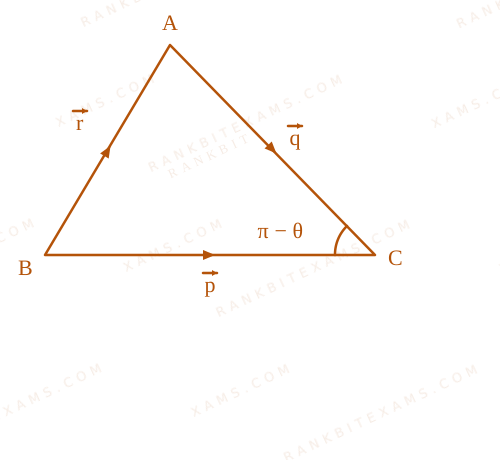
For a triangle ABC, let vecp=overrightarrowBC,vecq=overrightarrowCA$\vec{p}=\overrightarrow{BC},\vec{q}=\overrightarrow{CA}$ and vecr=overrightarrowBA$\vec{r}=\overrightarrow{BA}$. If |vecp|=2sqrt3,|vecq|=2$|\vec{p}|=2\sqrt{3},|\vec{q}|=2$ and costheta=frac1sqrt3$\cos\theta=\frac{1}{\sqrt{3}}$, where theta$\theta$ is the angle between vecp$\vec{p}$ and vecq$\vec{q}$, then left|vecptimes(vecq-3vecr)right|^2+3left|vecrright|^2$\left|\vec{p}\times(\vec{q}-3\vec{r})\right|^{2}+3\left|\vec{r}\right|^{2}$ is equal to:
A.340$340$
B.220$220$
C.410$410$
D.200$200$
Solution
### Related Formula
textCosine Rule in triangle: cos(pi-theta) = frac|vecp|^2+|vecq|^2-|vecr|^22|vecp||vecq|$$\text{Cosine Rule in triangle: } \cos(\pi-\theta) = \frac{|\vec{p}|^2+|\vec{q}|^2-|\vec{r}|^2}{2|\vec{p}||\vec{q}|}$$textCross product identity: vecA times vecA = 0 quad ; quad |vecA times vecB| = |A||B|sintheta$$\text{Cross product identity: } \vec{A} \times \vec{A} = 0 \quad ; \quad |\vec{A} \times \vec{B}| = |A||B|\sin\theta$$
### Core Logic
Vector triangle diagram for Q15 - JEE Main 2026 Evening
From triangle law of addition, overrightarrowBC + overrightarrowCA = overrightarrowBA implies vecp + vecq = vecr$\overrightarrow{BC} + \overrightarrow{CA} = \overrightarrow{BA} \implies \vec{p} + \vec{q} = \vec{r}$.
The angle between vectors vecp$\vec{p}$ and vecq$\vec{q}$ extended head-to-tail is theta$\theta$. The internal angle of the triangle is pi - theta$\pi - \theta$.
### Step 1: Calculate magnitude of r
Using cosine rule for the side |vecr|$|\vec{r}|$:
cos(pi - theta) = frac|vecp|^2 + |vecq|^2 - |vecr|^22|vecp||vecq|$$\cos(\pi - \theta) = \frac{|\vec{p}|^2 + |\vec{q}|^2 - |\vec{r}|^2}{2|\vec{p}||\vec{q}|}$$
Since costheta = 1/sqrt3$\cos\theta = 1/\sqrt{3}$, cos(pi - theta) = -1/sqrt3$\cos(\pi - \theta) = -1/\sqrt{3}$.
-frac1sqrt3 = frac(2sqrt3)^2 + (2)^2 - |vecr|^22(2sqrt3)(2)$$-\frac{1}{\sqrt{3}} = \frac{(2\sqrt{3})^2 + (2)^2 - |\vec{r}|^2}{2(2\sqrt{3})(2)}$$-frac1sqrt3 = frac12 + 4 - |vecr|^28sqrt3$$-\frac{1}{\sqrt{3}} = \frac{12 + 4 - |\vec{r}|^2}{8\sqrt{3}}$$-8 = 16 - |vecr|^2 implies |vecr|^2 = 24$$-8 = 16 - |\vec{r}|^2 \implies |\vec{r}|^2 = 24$$
### Step 2: Simplify the Cross Product term
We need to evaluate |vecp times (vecq - 3vecr)|^2$|\vec{p} \times (\vec{q} - 3\vec{r})|^2$.
Substitute vecr = vecp + vecq$\vec{r} = \vec{p} + \vec{q}$:
= |vecp times (vecq - 3(vecp + vecq))|^2$$= |\vec{p} \times (\vec{q} - 3(\vec{p} + \vec{q}))|^2$$= |vecp times (-3vecp - 2vecq)|^2$$= |\vec{p} \times (-3\vec{p} - 2\vec{q})|^2$$
Since vecp times vecp = 0$\vec{p} \times \vec{p} = 0$:
= |-2 (vecp times vecq)|^2 = 4 |vecp times vecq|^2$$= |-2 (\vec{p} \times \vec{q})|^2 = 4 |\vec{p} \times \vec{q}|^2$$= 4 ( |vecp|^2 |vecq|^2 sin^2theta )$$= 4 ( |\vec{p}|^2 |\vec{q}|^2 \sin^2\theta )$$
### Step 3: Final Calculation
Given costheta = 1/sqrt3 implies cos^2theta = 1/3 implies sin^2theta = 2/3$\cos\theta = 1/\sqrt{3} \implies \cos^2\theta = 1/3 \implies \sin^2\theta = 2/3$.
4 |vecp times vecq|^2 = 4 (12)(4)left(frac23right) = 4(4)(4)(2) = 128$$4 |\vec{p} \times \vec{q}|^2 = 4 (12)(4)\left(\frac{2}{3}\right) = 4(4)(4)(2) = 128$$
The required expression is:
|vecp times (vecq - 3vecr)|^2 + 3|vecr|^2 = 128 + 3(24) = 128 + 72 = 200$$|\vec{p} \times (\vec{q} - 3\vec{r})|^2 + 3|\vec{r}|^2 = 128 + 3(24) = 128 + 72 = 200$$
### Pattern Recognition
Always convert secondary vectors back to base components using the triangle condition vecp + vecq = vecr$\vec{p} + \vec{q} = \vec{r}$. It zeroes out self-cross products instantly.
### Evaluation Rubric / Model Answer
null
### Chapter Mix
Class 12 Maths: Vector Algebra
Q68jee_main_2025_02_april_eveningProperties of Vectors
Let veca = 2hati - 3hatj + hatk$\vec{a} = 2\hat{i} - 3\hat{j} + \hat{k}$, vecb = 3hati + 2hatj + 5hatk$\vec{b} = 3\hat{i} + 2\hat{j} + 5\hat{k}$ and a vector vecc$\vec{c}$ be such that (veca - vecc) times vecb = -18hati - 3hatj + 12hatk$(\vec{a} - \vec{c}) \times \vec{b} = -18\hat{i} - 3\hat{j} + 12\hat{k}$ and veca cdot vecc = 3$\vec{a} \cdot \vec{c} = 3$. If vecb times vecc = vecd$\vec{b} \times \vec{c} = \vec{d}$, then |veca cdot vecd|$|\vec{a} \cdot \vec{d}|$ is equal to:
A. 18
B. 12
C. 9
D. 15
Solution
### Related Formula
textVector Cross product distributes over subtraction: (veca - vecc) times vecb = veca times vecb - vecc times vecb$$\text{Vector Cross product distributes over subtraction: } (\vec{a} - \vec{c}) \times \vec{b} = \vec{a} \times \vec{b} - \vec{c} \times \vec{b}$$textScalar Triple Product cyclic identity: veca cdot (vecb times vecc) = (veca times vecb) cdot vecc$$\text{Scalar Triple Product cyclic identity: } \vec{a} \cdot (\vec{b} \times \vec{c}) = (\vec{a} \times \vec{b}) \cdot \vec{c}$$textAntisymmetry: vecc times vecb = - vecb times vecc$$\text{Antisymmetry: } \vec{c} \times \vec{b} = - \vec{b} \times \vec{c}$$
### Core Logic
Instead of solving for the individual coordinates of vector vecc$\vec{c}$, we apply vector algebraic identities to compute the target scalar triple product directly.
### Step 1: Expand and rewrite the cross product
Given (veca - vecc) times vecb = -18hatmathrmi - 3hatmathrmj + 12hatmathrmk$(\vec{a} - \vec{c}) \times \vec{b} = -18\hat{\mathrm{i}} - 3\hat{\mathrm{j}} + 12\hat{\mathrm{k}}$:
veca times vecb - vecc times vecb = -18hatmathrmi - 3hatmathrmj + 12hatmathrmk$$\vec{a} \times \vec{b} - \vec{c} \times \vec{b} = -18\hat{\mathrm{i}} - 3\hat{\mathrm{j}} + 12\hat{\mathrm{k}}$$veca times vecb + vecb times vecc = -18hatmathrmi - 3hatmathrmj + 12hatmathrmk$$\vec{a} \times \vec{b} + \vec{b} \times \vec{c} = -18\hat{\mathrm{i}} - 3\hat{\mathrm{j}} + 12\hat{\mathrm{k}}$$vecb times vecc = (-18hatmathrmi - 3hatmathrmj + 12hatmathrmk) - (veca times vecb) quad text--- (1)$$\vec{b} \times \vec{c} = (-18\hat{\mathrm{i}} - 3\hat{\mathrm{j}} + 12\hat{\mathrm{k}}) - (\vec{a} \times \vec{b}) \quad \text{--- (1)}$$
### Step 2: Calculate a x b
Evaluate the cross product:
veca times vecb = beginvmatrix hatmathrmi & hatmathrmj & hatmathrmk \\ 2 & -3 & 1 \\ 3 & 2 & 5 endvmatrix$$\vec{a} \times \vec{b} = \begin{vmatrix} \hat{\mathrm{i}} & \hat{\mathrm{j}} & \hat{\mathrm{k}} \\ 2 & -3 & 1 \\ 3 & 2 & 5 \end{vmatrix}$$veca times vecb = hatmathrmi(-15 - 2) - hatmathrmj(10 - 3) + hatmathrmk(4 - (-9)) = -17hatmathrmi - 7hatmathrmj + 13hatmathrmk$$\vec{a} \times \vec{b} = \hat{\mathrm{i}}(-15 - 2) - \hat{\mathrm{j}}(10 - 3) + \hat{\mathrm{k}}(4 - (-9)) = -17\hat{\mathrm{i}} - 7\hat{\mathrm{j}} + 13\hat{\mathrm{k}}$$
### Step 3: Solve for the vector d
Substitute veca times vecb$\vec{a} \times \vec{b}$ back into equation (1):
vecd = vecb times vecc = (-18hatmathrmi - 3hatmathrmj + 12hatmathrmk) - (-17hatmathrmi - 7hatmathrmj + 13hatmathrmk)$$\vec{d} = \vec{b} \times \vec{c} = (-18\hat{\mathrm{i}} - 3\hat{\mathrm{j}} + 12\hat{\mathrm{k}}) - (-17\hat{\mathrm{i}} - 7\hat{\mathrm{j}} + 13\hat{\mathrm{k}})$$vecd = -hatmathrmi + 4hatmathrmj - hatmathrmk$$\vec{d} = -\hat{\mathrm{i}} + 4\hat{\mathrm{j}} - \hat{\mathrm{k}}$$
### Step 4: Compute the final dot product
Now compute the requested dot product:
veca cdot vecd = (2hatmathrmi - 3hatmathrmj + hatmathrmk) cdot (-hatmathrmi + 4hatmathrmj - hatmathrmk)$$\vec{a} \cdot \vec{d} = (2\hat{\mathrm{i}} - 3\hat{\mathrm{j}} + \hat{\mathrm{k}}) \cdot (-\hat{\mathrm{i}} + 4\hat{\mathrm{j}} - \hat{\mathrm{k}})$$veca cdot vecd = 2(-1) + (-3)(4) + 1(-1) = -2 - 12 - 1 = -15$$\vec{a} \cdot \vec{d} = 2(-1) + (-3)(4) + 1(-1) = -2 - 12 - 1 = -15$$left| veca cdot vecd right| = 15$$\left| \vec{a} \cdot \vec{d} \right| = 15$$
### Pattern Recognition
Scalar triple product shortcut: Recognizing that veca cdot vecd = veca cdot (vecb times vecc) = [ veca \, vecb \, vecc ]$\vec{a} \cdot \vec{d} = \vec{a} \cdot (\vec{b} \times \vec{c}) = [ \vec{a} \, \vec{b} \, \vec{c} ]$ allows you to find the scalar value through simple determinants and linear equations instead of solving for the vector components.
### Evaluation Rubric / Model Answer
null
### Chapter Mix
Class 12 Mathematics: Vector Algebra
More Vector Algebra Questions — jee_main_2026_22_january_morning
We Map Every Repeating Question in Competitive Exams.
Say goodbye to generic mock test fatigue. RankBit uses smart analysis to group past exam questions into their foundational Repeating Question Types. Find chapter weightage, track repeating questions, and score higher with targeted practice.
Select Your Target Exam
Choose an exam track below to find formulas per chapter and patterns.
Syncing Exam Intelligence
Mapping formulas and patterns across all tracks…
PATH A — FULL LENGTH PRACTICE
Full Mock Test Hub
Simulate real NTA exam conditions with fully tracked mocks. Time yourself against past papers.
Practice past-year questions one chapter at a time. Pick an exam → subject → chapter and get every PYQ for that topic — pulled together from all past papers — with the chapter's key formulas alongside.