JEE Main · Mathematics → Steady

Vector Algebra appeared 46 times across 3 years — 5.3% of Mathematics. This question is from Vector Angle Bisector.

Year 2026 2025 2024 Total
Questions 15 17 14 46

Let O be the origin and the position vector of A and B be 2 i+2 j+ k and 2 i+4 j+4 k respectively. If the internal bisector of ∠ AOB meets the line AB at C, then the length of OC is

Solution & Explanation

Related Formula
Internal Angle Bisector Theorem: (AC)/(CB) = | OA|| OB| Section Formula: OC = m OB + n OAm+n
Core Logic

Find the magnitudes of the position vectors OA and OB:

| OA| = √(2² + 2² + 1²) = √(4+4+1) = √(9) = 3 | OB| = √(2² + 4² + 4²) = √(4+16+16) = √(36) = 6

According to the internal angle bisector theorem in Δ AOB, the point C divides the segment AB in the ratio of the adjacent sides:

(AC)/(CB) = | OA|| OB| = (3)/(6) = (1)/(2)

Vector Angle Bisector

Step 1: Apply Section Formula

Using the section formula to find the position vector of C, dividing AB internally in ratio m:n = 1:2:

OC = 1( OB) + 2( OA)1 + 2 OC = 1(2 i+4 j+4 k) + 2(2 i+2 j+ k)3 OC = (2+4) i + (4+4) j + (4+2) k3 OC = 6 i + 8 j + 6 k3 = 2 i + (8)/(3) j + 2 k
Step 2: Compute Length of OC

Now, find the magnitude (length) of the vector OC:

| OC| = √(2² + ((8)/(3))² + 2²) = √(4 + (64)/(9) + 4) = √(8 + (64)/(9)) = √((72 + 64)/(9)) = √((136)/(9)) = √(4 × 34)3 = 2√(34)3
Pattern Recognition

Vector angle bisector questions invariably test the geometric property that the bisector divides the opposite side in the ratio of the side lengths. Combine this directly with the 3D coordinate section formula.

Chapter Mix

Class 12 Mathematics: Vector Algebra

Reference Study Guides

More Vector Algebra Previous-Year Questions

Q5 jee_main_2026_21_jan_morning Cross Product and Dot Product Operations
Let a = - i + 2 j + 2 k , b = 8 i + 7 j - 3 k and c be a vector such that a × c = b . If c. ( i + j + k) = 4 , then | a + c|² is equal to:
  • A. 33
  • B. 30
  • C. 35
  • D. 27

Solution

Related Formula
a × c = vmatrix i & j & k a₁ & a₂ & a₃ c₁ & c₂ & c₃ vmatrix
Core Logic

Let the unknown vector be c = c₁ i + c₂ j + c₃ k. Given a = - i + 2 j + 2 k and b = 8 i + 7 j - 3 k.

Compute the cross product a × c:

a × c = (2c₃ - 2c₂) i + (-1 · c₃ - 2c₁)(-1) j + (-1 · c₂ - 2c₁) k = (2c₃ - 2c₂) i + (c₃ + 2c₁) j - (c₂ + 2c₁) k
Step 1: Equate components to find c

Equating this to b: 2c₃ - 2c₂ = 8 ⇒ c₃ - c₂ = 4 c₃ + 2c₁ = 7 -(c₂ + 2c₁) = -3 ⇒ c₂ + 2c₁ = 3

We are also given c · ( i + j + k) = 4:

c₁ + c₂ + c₃ = 4

Cross product vectors calculation Q5 - JEE Main 2026 Morning

Step 2: Solve the linear system

From the dot product equation: c₁ = 4 - c₂ - c₃. Substitute into c₂ + 2c₁ = 3:

c₂ + 2(4 - c₂ - c₃) = 3 ⇒ 8 - c₂ - 2c₃ = 3 ⇒ c₂ + 2c₃ = 5

We have the system: c₃ - c₂ = 4 ⇒ c₂ = c₃ - 4 Substitute into above: (c₃ - 4) + 2c₃ = 5 ⇒ 3c₃ = 9 ⇒ c₃ = 3 Then c₂ = 3 - 4 = -1. Then c₁ = 4 - (-1) - 3 = 2. So, c = 2 i - j + 3 k.

Step 3: Evaluate the final expression
a + c = (- i + 2 j + 2 k) + (2 i - j + 3 k) = i + j + 5 k | a + c|² = 1² + 1² + 5² = 1 + 1 + 25 = 27
Pattern Recognition

Whenever a × c = b and a dot product constraint is given, simply expand c algebraically as (c₁, c₂, c₃). The cross product and dot product create an easily solvable 3x3 linear system.

Chapter Mix

Class 12 Maths: Vector Algebra

Q7 jee_main_2026_21_jan_morning Collinearity and Cross Product of Vectors
Let c and d be vectors such that | c+ d|=√(29) and c×(2 i+3 j+4 k)=(2 i+3 j+4 k)× d . If λ₁,λ₂(λ₁>λ₂) are the possible values of ( c+ d).(-7 i+2 j+3 k) , then the equation K²x²+(K²-5K+λ₁)xy+(3K+ λ₂2)y²-8x+12y+λ₂=0 represents a circle, for k equal to:
  • A. 4
  • B. 1
  • C. -1
  • D. 2

Solution

Related Formula
u × v = -( v × u)

General equation of a circle requires coefficient of x² = coefficient of y² and coefficient of xy = 0.

Core Logic

Given c × (2 i + 3 j + 4 k) = (2 i + 3 j + 4 k) × d Rearranging:

c × (2 i + 3 j + 4 k) + d × (2 i + 3 j + 4 k) = 0 ( c + d) × (2 i + 3 j + 4 k) = 0

This implies c + d is parallel to 2 i + 3 j + 4 k. Let c + d = λ (2 i + 3 j + 4 k).

Step 1: Find the scaling factor

Given | c + d| = √(29)

|λ| √(2² + 3² + 4²) = √(29) |λ| √(4 + 9 + 16) = √(29) |λ| √(29) = √(29) ⇒ λ = ± 1

Therefore, c + d = ±(2 i + 3 j + 4 k).

Step 2: Evaluate the dot product limits

We need values of ( c + d) · (-7 i + 2 j + 3 k). Dot product = λ(2(-7) + 3(2) + 4(3)) = λ(-14 + 6 + 12) = 4λ. Since λ = ± 1, the possible values are 4 and -4. Given λ₁ > λ₂, we have λ₁ = 4 and λ₂ = -4.

Step 3: Apply circle constraints

Substitute λ₁ and λ₂ into the conic equation:

K² x² + (K² - 5K + 4)xy + (3K - 2)y² - 8x + 12y - 4 = 0

For this to represent a circle:

  • Coefficient of xy must be 0:
K² - 5K + 4 = 0 ⇒ K = 1, 4
  • Coefficient of x² must equal coefficient of y²:
K² = 3K - 2 ⇒ K² - 3K + 2 = 0 ⇒ K = 1, 2

The common value satisfying both conditions is K = 1.

Pattern Recognition

Cross-product equations mapping to X × A = -Y × A perfectly factor out to (X+Y) × A = 0, guaranteeing (X+Y) is a scalar multiple of A. This immediately unlocks vector magnitudes.

Chapter Mix

Class 12 Maths: Vector Algebra Class 11 Maths: Conic Sections

Q15 jee_main_2026_21_jan_evening Cross Product
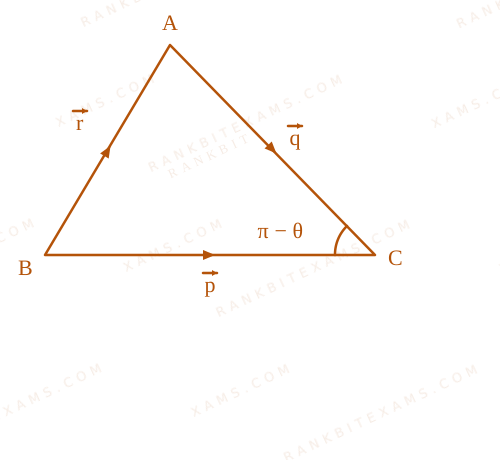
For a triangle ABC, let p= BC, q= CA and r= BA. If | p|=2√(3),| q|=2 and θ= 1√(3), where θ is the angle between p and q, then | p×( q-3 r)|²+3| r|² is equal to:
  • A. 340
  • B. 220
  • C. 410
  • D. 200

Solution

Related Formula
Cosine Rule in triangle: (π-θ) = | p|²+| q|²-| r|²2| p|| q| Cross product identity: A × A = 0 ; | A × B| = |A||B| θ
Core Logic

Vector triangle diagram for Q15 - JEE Main 2026 Evening
From triangle law of addition, BC + CA = BA p + q = r. The angle between vectors p and q extended head-to-tail is θ. The internal angle of the triangle is π - θ.

Step 1: Calculate magnitude of r

Using cosine rule for the side | r|:

(π - θ) = | p|² + | q|² - | r|²2| p|| q|

Since θ = 1/√(3), (π - θ) = -1/√(3).

- 1√(3) = (2√(3))² + (2)² - | r|²2(2√(3))(2) - 1√(3) = 12 + 4 - | r|²8√(3) -8 = 16 - | r|² | r|² = 24
Step 2: Simplify the Cross Product term

We need to evaluate | p × ( q - 3 r)|². Substitute r = p + q:

= | p × ( q - 3( p + q))|² = | p × (-3 p - 2 q)|²

Since p × p = 0:

= |-2 ( p × q)|² = 4 | p × q|² = 4 ( | p|² | q|² ²θ )
Step 3: Final Calculation

Given θ = 1/√(3) ²θ = 1/3 ²θ = 2/3.

4 | p × q|² = 4 (12)(4)((2)/(3)) = 4(4)(4)(2) = 128

The required expression is:

| p × ( q - 3 r)|² + 3| r|² = 128 + 3(24) = 128 + 72 = 200
Pattern Recognition

Always convert secondary vectors back to base components using the triangle condition p + q = r. It zeroes out self-cross products instantly.

Chapter Mix

Class 12 Maths: Vector Algebra

Q1 jee_main_2026_22_january_morning Projection Of A Vector On Another Vector
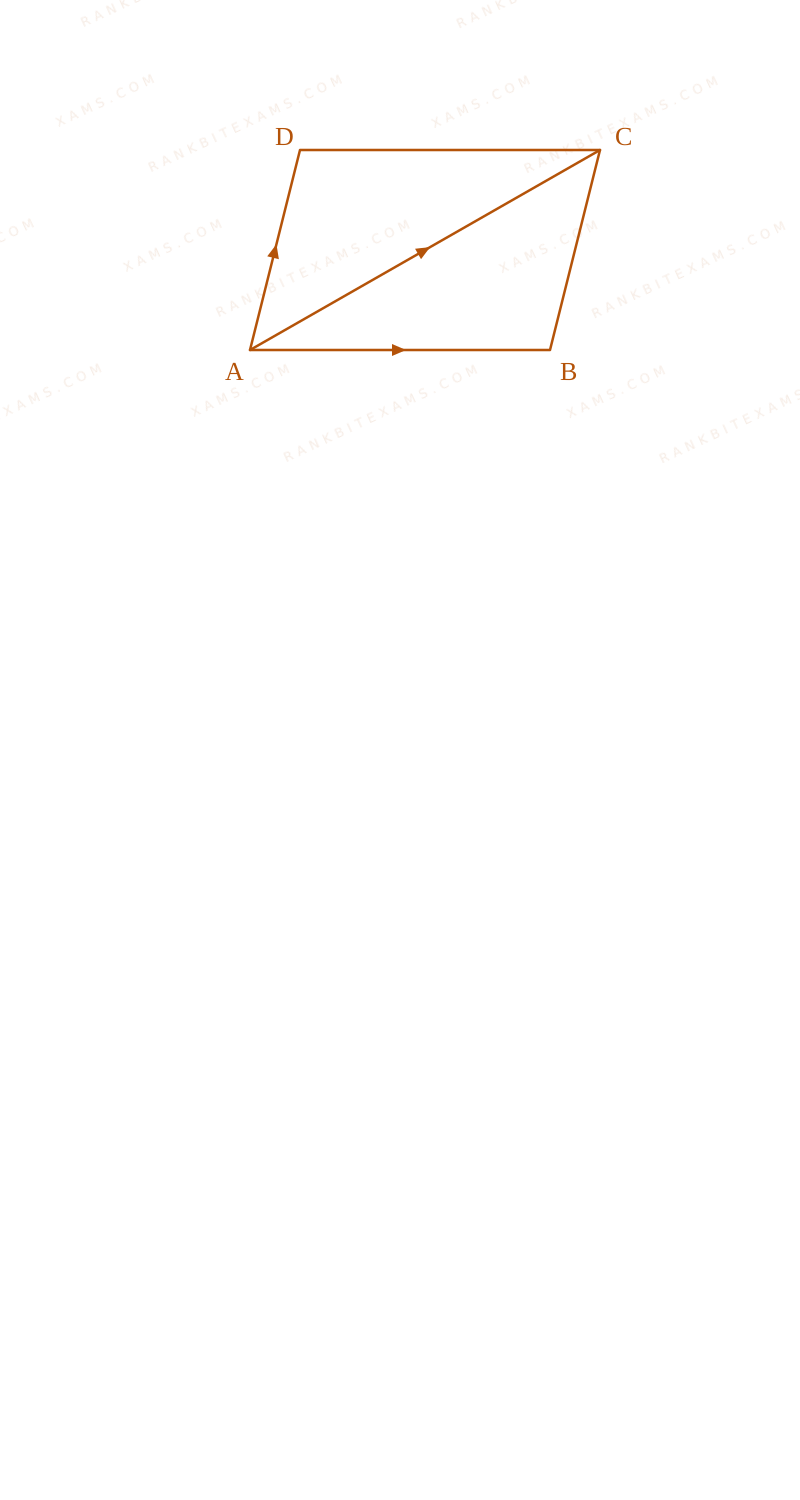
Let AB=2 i+4 j-5 k and AD= i+2 j+λ k, λin R. Let the projection of the vector v= i+ j+ k on the diagonal AC of the parallelogram ABCD be of length one unit. If α,β, where α>β, be the roots of the equation λ²x²-6λ x+5=0, then 2α-β is equal to
  • A. 1
  • B. 4
  • C. 3
  • D. 6

Solution

Related Formula
Projection of v on a = v · a| a| AC = AB + AD
Core Logic

Using the parallelogram law of vector addition, the diagonal AC is given by:

AC = AB + AD = (2 i+4 j-5 k) + ( i+2 j+λ k) AC = 3 i + 6 j + (λ - 5) k
Step 1: Applying the Projection Condition

The projection of v = i+ j+ k on AC is 1. Therefore:

v · AC| AC| = 1 3(1) + 6(1) + (λ - 5)(1)√(3² + 6² + (λ - 5)²) = 1 3 + 6 + λ - 5 = √(9 + 36 + (λ - 5)²) λ + 4 = √(45 + (λ - 5)²)

Squaring both sides:

(λ + 4)² = 45 + (λ - 5)² λ² + 8λ + 16 = λ² - 10λ + 25 + 45 18λ = 54 λ = 3
Step 2: Solving the Quadratic Equation

Substitute λ = 3 into the given quadratic equation λ²x² - 6λ x + 5 = 0:

9x² - 18x + 5 = 0 (3x - 1)(3x - 5) = 0 x = (1)/(3), (5)/(3)

Given α > β, we have α = (5)/(3) and β = (1)/(3).

Calculate 2α - β:

2((5)/(3)) - (1)/(3) = (10 - 1)/(3) = 3

Projection of A Vector diagram for Q1 - JEE Main 2026 Morning

Pattern Recognition

Projection questions in 3D geometry often couple a simple dot product identity with an unknown parameter. Squaring a linear equation derived from vector magnitudes often cancels the squared terms, making it easily solvable.

Chapter Mix

Class 12 Maths: Vector Algebra Class 11 Maths: Quadratic Equations

Q8 jee_main_2026_22_january_evening Vector Dot Product and Cross Product
Let a = 2 i - j + k and b = λ j + 2 k, λ in Z be two vectors. Let c = a × b and d be a vector of magnitude 2 in yz-plane. If | c| = √(53), then the maximum possible value of ( c · d)² is equal to:
  • A. 26
  • B. 104
  • C. 208
  • D. 52

Solution

Related Formula

Cauchy-Schwarz Inequality for vectors:

( c · d)² ≤ | cyz|² | d|²
Core Logic

Calculate cross product c = a × b:

c = vmatrix i & j & k 2 & -1 & 1 0 & λ & 2 vmatrix = (-2-λ) i - 4 j + 2λ k

Given | c| = √(53):

(-2-λ)² + 16 + 4λ² = 53 5λ² + 4λ - 33 = 0 (5λ - 11)(λ + 3) = 0

Since λ in Z, we get λ = -3. Thus, c = i - 4 j - 6 k.

Step 1: Maximum Value of Dot Product Squared

Vector d lies in yz-plane: d = y j + z k with y² + z² = 4.

( c · d)² = (-4y - 6z)²

By Cauchy-Schwarz inequality:

(-4y - 6z)² ≤ ((-4)² + (-6)²)(y² + z²) = (16 + 36)(4) = 52 × 4 = 208
Pattern Recognition

Project c onto yz-plane components and apply Cauchy-Schwarz inequality to maximize dot product.

Chapter Mix

Class 12 Maths: Vector Algebra

More Vector Algebra Questions — jee_main_2024_29_jan_morning

Practice all Vector Algebra previous-year questions →

Rankbit System
JEE Physics: Waves (+15.5%) | Electrostatics: Concentric Shells (-29.7%) | Modern Physics: Photoelectric Clones (+34.2%) | Mathematics: Definite Integrals (+18.1%) | Chemistry: Coordination Splitting (-11.4%) | JEE Physics: Waves (+15.5%) | Electrostatics: Concentric Shells (-29.7%) | Modern Physics: Photoelectric Clones (+34.2%) | Mathematics: Definite Integrals (+18.1%) | Chemistry: Coordination Splitting (-11.4%)