JEE Main · Mathematics → Steady

Vector Algebra appeared 46 times across 3 years — 5.3% of Mathematics. This question is from Coplanar and Perpendicular Vectors.

Year 2026 2025 2024 Total
Questions 15 17 14 46

Let a = i + 2 j + k and b = 2 i + j - k. Let c be a unit vector in the plane of the vectors a and b and be perpendicular to a. Then such a vector c is:

Solution & Explanation

Related Formula
p = K( a + λ b) p · a = 0
Core Logic

Formulate a coplanar parameterization vector, apply the zero dot-product geometric orthogonality constraint to pin down the linear parameter, and then normalize.

Step 1: Define Coplanar Structural Form

Let the targeting vector path be:

p = K( a + λ b) = K( (1+2λ) i + (2+λ) j + (1-λ) k )
Step 2: Force Orthogonality Constraint

Impose p · a = 0:

1(1+2λ) + 2(2+λ) + 1(1-λ) = 0 1 + 2λ + 4 + 2λ + 1 - λ = 0 6 + 3λ = 0 λ = -2
Step 3: Substitute and Normalize

Substitute λ = -2 back into the base formulation:

p = K(-3 i + 3 k)

Normalizing to turn this vector into a proper unit scale form:

c = ± - i + k√(2)
Pattern Recognition

Finding coplanar vectors orthogonal to one base component matches taking cross expansions like ( a × b) × a up to scalar metrics.

Chapter Mix

Class 12 Mathematics: Vector Algebra

Reference Study Guides

More Vector Algebra Previous-Year Questions — Page 5

Q69 jee_main_2025_29_jan_evening Vector Products and Angles
Let a be a unit vector perpendicular to the vectors b = i -2 j +3 k and c = 2 i +3 j - k, and makes an angle of ⁻¹(-(1)/(3)) with the vector i + j + k. If a makes an angle of (π)/(3) with the vector i +α j + k, then the value of α is :
  • A. -√(3)
  • B. √(6)
  • C. -√(6)
  • D. √(3)

Solution

Related Formula

Cross product for vector perpendicular direction alignment:

u = b × c

Angle projection formula:

θ = a · v| a|| v|
Core Logic

Compute cross product of b and c:

b × c = vmatrix i & j & k 1 & -2 & 3 2 & 3 & -1 vmatrix = -7 i + 7 j + 7 k = -7( i - j - k)

Hence, unit vector a matches form:

a = ± i - j - k√(3)
Step 1: Isolate Core Angle Direction

Check conditions against vector v = i + j + k: Using a = i - j - k√(3):

θ = 1 - 1 - 1√(3)√(3) = -(1)/(3)

This confirms the direction for a.

Step 2: Solve for Unknown Scalar Variable

Now compute angle with vector i + α j + k for θ = (π)/(3):

(π)/(3) = 1√(3) · 1 - α - 1√(2 + α²) (1)/(2) = -α√(3)√(α² + 2)

Since left hand side is positive, α must be strictly negative. Squaring both sides:

(1)/(4) = (α²)/(3(α² + 2)) 3α² + 6 = 4α² α² = 6

Since α < 0, α = -√(6).

Pattern Recognition

Keep strict track of signs when dealing with algebra containing square roots. Checking value constraints early on allows you to drop phantom positive/negative branches seamlessly.

Chapter Mix

Class 12 Mathematics: Vector Algebra
Q jee_main_2025_28_jan_morning Vector Dot and Cross Products
Let a = i + j + k, b = 2 i +2 j + k and d = a× b. If c is a vector such that a. c = | c |, | c -2 a|² = 8 and the angle between d and vecc is (π)/(4), then |10 - 3 b. c| + |vecd× vecc|² is equal to ....
Numerical Answer. Answer: 6 to 6

Solution

Related Formula

Vector magnitude expansion identity:

| u - v|² = | u|² + | v|² - 2( u · v)
Core Logic

Calculate the reference vector values: a = i + j + k | a|² = 3 b = 2 i + 2 j + k d = a × b = - i + j | d|² = 2

Expanding | c - 2 a|² = 8:

| c|² + 4| a|² - 4( a · c) = 8

Substituting | a|² = 3 and a · c = | c|:

| c|² - 4| c| + 4 = 0 (| c| - 2)² = 0 | c| = 2
Step 1: Evaluating the Cross Product Vector Component

Using the given angle (π)/(4) between d and c:

| d × c|² = (| d|| c| (π)/(4))² = (√(2) · 2 · 1√(2))² = 4
Step 2: Solving for the Vector Dot Product

Expanding using standard vector identities yields b · c = (8)/(3).

Substituting this back into the target expression:

Value = |10 - 3((8)/(3))| + 4 = |10 - 8| + 4 = 6
Pattern Recognition

Recognizing a perfect square trinomial (x² - 4x + 4 = 0) instantly isolates the unknown vector magnitude.

Chapter Mix

Class 12 Maths: Vectors

Q73 jee_main_2025_03_april_morning Vector Triple Products and Vector Equations
Let a = i + j + k, b = 3 i + 2 j - k, c = λ j + μ k and d be a unit vector such that a × d = b × d and c · d = 1[cite: 694]. If c is perpendicular to a[cite: 694], then |3lambda d + μ c|² is equal to:
Numerical Answer. Answer: 5 to 5

Solution

Related Formula

Vector cross distribution property:

( a - b) × d = 0 d ∥ ( a - b)
Core Logic

Gather cross products to solve for collineation lines [cite: 1472, 1473]: ( a - b) × d = 0 d = t( a - b) [cite: 1473, 1474]

Compute the baseline difference vector [cite: 1475]: a - b = (1-3) i + (1-2) j + (1 - (-1)) k = -2 i - j + 2 k [cite: 1475] d = t(-2 i - j + 2 k) [cite: 1475]

Since d is a unit vector[cite: 1476]: |t| · √((-2)² + (-1)² + 2²) = 1 3|t| = 1 |t| = (1)/(3) [cite: 1476, 1479]

Step 1: Applying orthogonality constraints

Using orthogonal information given for vectors c and a [cite: 1482]: c · a = 0 (0)(1) + λ(1) + μ(1) = 0 μ = -λ [cite: 1483, 1484] c = λ( j - k) | c|² = 2λ² [cite: 1485]

Use product condition c · d = 1 to isolate scalar values [cite: 1486]: t(-2 i - j + 2 k) · λ( j - k) = 1 [cite: 1487] tλ(-1 - 2) = 1 -3tλ = 1 tλ = -(1)/(3) [cite: 1488]

Since |t|² = (1)/(9), squaring components yields [cite: 1488]: λ² = 1 [cite: 1488]

Step 2: Vector magnitude resolution

Expand target expression using standard inner dot product expansions [cite: 1488]: |3λ d + μ c|² = 9λ²| d|² + μ²| c|² + 6λμ( d · c) [cite: 1488] Substitute values evaluated throughout sections [cite: 1488, 1489]:

= 9(1)(1) + (λ)²(2λ²) + 6λ(-λ)(1)

= 9 + 2λ⁴ - 6λ² = 9 + 2(1) - 6(1) = 5 [cite: 1489, 1490]

Pattern Recognition

Translating vector cross equalities directly into linear scale parameter multipliers prevents manual determinant expansions, leaving clean system variables behind.

Chapter Mix

Class 12 Mathematics: Vector Algebra

Q jee_main_2025_04_april_evening Properties of Vectors in Triangles
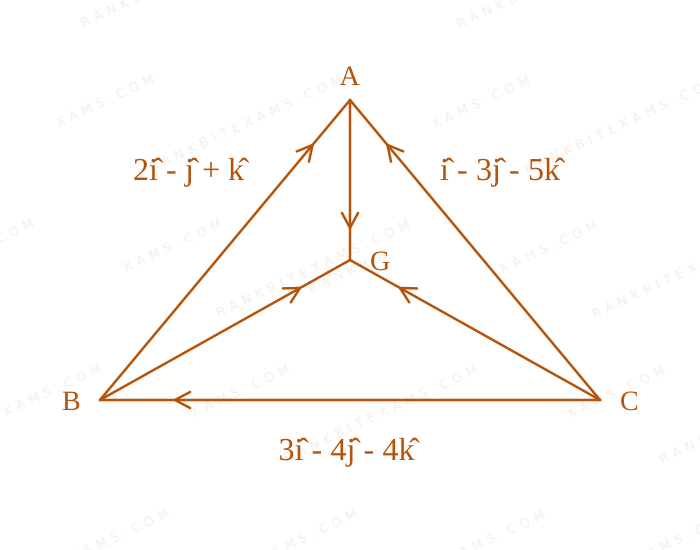
Let the three sides of a triangle ABC be given by the vectors 2 i - j + k, i - 3 j - 5 k, and 3 i - 4 j - 4 k. Let G be the centroid of the triangle ABC. Then 6(| AG|² + | BG|² + | CG|²) is equal to
Numerical Answer. Answer: 164 to 164

Solution

Core Logic

Let the vertices of the triangle be A, B, and C. The vectors representing the side paths are:

AB = 2 i - j + k CA = i - 3 j - 5 k CB = 3 i - 4 j - 4 k

Notice that AB + CA = (2+1) i + (-1-3) j + (1-5) k = 3 i - 4 j - 4 k = CB. This structurally validates vector addition rules.

Vector algebra diagram for Q75 - JEE Main 2025 Evening

Step 1: Finding Position Vectors relative to A

Let's set vertex A as the origin origin point (Position vector A = 0):

  • Position vector of B: B = 2 i - j + k
  • Position vector of C: Since CA = A - C = - C C = - i + 3 j + 5hatk
  • Now, calculate the position vector of the centroid G:

G = A + B + C3 = 0 + (2 i - j + k) + (- i + 3 j + 5 k)3 = (1)/(3)( i + 2 j + 6 k)
Step 2: Calculating Squared Lengths to the Centroid

Let's find each individual vector distance block:

  • AG = G - A = (1)/(3)( i + 2 j + 6 k) | AG|² = (1)/(9)(1² + 2² + 6²) = (41)/(9)
  • BG = G - B = ((1)/(3)-2) i + ((2)/(3)+1) j + (2-1) k = -(5)/(3) i + (5)/(3) j + 1 k
| BG|² = (-(5)/(3))² + ((5)/(3))² + 1² = (25)/(9) + (25)/(9) + 1 = (59)/(9)
  • CG = G - C = ((1)/(3)+1) i + ((2)/(3)-3) j + (2-5) k = (4)/(3) i - (7)/(3) j - 3 k
| CG|² = ((4)/(3))² + (-(7)/(3))² + (-3)² = (16)/(9) + (49)/(9) + 9 = (146)/(9)
Step 3: Final Targeted Evaluation

Summing the squared values and multiplying by 6:

Value = 6 [ | AG|² + | BG|² + | CG|² ] = 6 [ (41)/(9) + (59)/(9) + (146)/(9) ] Value = 6 × (246)/(9) = 2 × (246)/(3) = 2 × 82 = 164
Pattern Recognition

Setting one vector node as the origin point (A = 0) heavily dampens intermediate coordinate math steps, avoiding dealing with an absolute baseline origin orientation.

Chapter Mix

Class 12 Mathematics: Vector Algebra

Q64 jee_main_2025_04_april_morning Components of Vectors
Consider two vectors u = 3 i - j and v = 2 i + j - λ k, where λ > 0. The angle between them is given by ⁻¹( √(5)2sqrt7). Let v = v₁ + v₂, where v₁ is parallel to u and v₂ is perpendicular to u. Then the value | v₁|² + | v₂|² is equal to
  • A. (23)/(2)
  • B. 14
  • C. (25)/(2)
  • D. 10

Solution

Related Formula

By orthogonal vector decomposition (Pythagorean property):

| v|² = | v₁|² + | v₂|² when v₁ · v₂ = 0
Core Logic

Compute λ using dot product formula:

θ = u · v| u|| v| √(5)2√(7) = 3(2) + (-1)(1)√(3² + (-1)²) √(2² + 1² + (-λ)²) √(5)2√(7) = 5√(10)√(5 + λ²) 12√(7) = √(5)√(10)√(5 + λ²) = 1√(2)√(5 + λ²)
Step 1: Solve for lambda

Square both sides of equation:

(1)/(28) = (1)/(2(5 + λ²)) 2(5 + λ²) = 28 5 + λ² = 14 λ² = 9 λ = 3

Since v = 2 i + j - 3 k.

Step 2: Apply Identity

Since components are orthogonal, direct magnitude squared holds:

| v₁|² + | v₂|² = | v|² = 2² + 1² + (-3)² = 4 + 1 + 9 = 14
Pattern Recognition

Do not waste time explicitly projecting components v₁ and v₂ if only the sum of their squared magnitudes is requested. The scalar length matches the total vector length invariant under any orthogonal basis change.

Chapter Mix

Class 12 Mathematics: Vector Algebra

More Vector Algebra Questions — jee_main_2025_08_april_evening

Practice all Vector Algebra previous-year questions →

Rankbit System
JEE Physics: Waves (+15.5%) | Electrostatics: Concentric Shells (-29.7%) | Modern Physics: Photoelectric Clones (+34.2%) | Mathematics: Definite Integrals (+18.1%) | Chemistry: Coordination Splitting (-11.4%) | JEE Physics: Waves (+15.5%) | Electrostatics: Concentric Shells (-29.7%) | Modern Physics: Photoelectric Clones (+34.2%) | Mathematics: Definite Integrals (+18.1%) | Chemistry: Coordination Splitting (-11.4%)