JEE Main · Mathematics → Steady

Vector Algebra appeared 46 times across 3 years — 5.3% of Mathematics. This question is from Vector Products and Angles.

Year 2026 2025 2024 Total
Questions 15 17 14 46

Let a be a unit vector perpendicular to the vectors b = i -2 j +3 k and c = 2 i +3 j - k, and makes an angle of ⁻¹(-(1)/(3)) with the vector i + j + k. If a makes an angle of (π)/(3) with the vector i +α j + k, then the value of α is :

Solution & Explanation

Related Formula

Cross product for vector perpendicular direction alignment:

u = b × c

Angle projection formula:

θ = a · v| a|| v|
Core Logic

Compute cross product of b and c:

b × c = vmatrix i & j & k 1 & -2 & 3 2 & 3 & -1 vmatrix = -7 i + 7 j + 7 k = -7( i - j - k)

Hence, unit vector a matches form:

a = ± i - j - k√(3)
Step 1: Isolate Core Angle Direction

Check conditions against vector v = i + j + k: Using a = i - j - k√(3):

θ = 1 - 1 - 1√(3)√(3) = -(1)/(3)

This confirms the direction for a.

Step 2: Solve for Unknown Scalar Variable

Now compute angle with vector i + α j + k for θ = (π)/(3):

(π)/(3) = 1√(3) · 1 - α - 1√(2 + α²) (1)/(2) = -α√(3)√(α² + 2)

Since left hand side is positive, α must be strictly negative. Squaring both sides:

(1)/(4) = (α²)/(3(α² + 2)) 3α² + 6 = 4α² α² = 6

Since α < 0, α = -√(6).

Pattern Recognition

Keep strict track of signs when dealing with algebra containing square roots. Checking value constraints early on allows you to drop phantom positive/negative branches seamlessly.

Chapter Mix

Class 12 Mathematics: Vector Algebra

Reference Study Guides

More Vector Algebra Previous-Year Questions

Q5 jee_main_2026_21_jan_morning Cross Product and Dot Product Operations
Let a = - i + 2 j + 2 k , b = 8 i + 7 j - 3 k and c be a vector such that a × c = b . If c. ( i + j + k) = 4 , then | a + c|² is equal to:
  • A. 33
  • B. 30
  • C. 35
  • D. 27

Solution

Related Formula
a × c = vmatrix i & j & k a₁ & a₂ & a₃ c₁ & c₂ & c₃ vmatrix
Core Logic

Let the unknown vector be c = c₁ i + c₂ j + c₃ k. Given a = - i + 2 j + 2 k and b = 8 i + 7 j - 3 k.

Compute the cross product a × c:

a × c = (2c₃ - 2c₂) i + (-1 · c₃ - 2c₁)(-1) j + (-1 · c₂ - 2c₁) k = (2c₃ - 2c₂) i + (c₃ + 2c₁) j - (c₂ + 2c₁) k
Step 1: Equate components to find c

Equating this to b: 2c₃ - 2c₂ = 8 ⇒ c₃ - c₂ = 4 c₃ + 2c₁ = 7 -(c₂ + 2c₁) = -3 ⇒ c₂ + 2c₁ = 3

We are also given c · ( i + j + k) = 4:

c₁ + c₂ + c₃ = 4

Cross product vectors calculation Q5 - JEE Main 2026 Morning

Step 2: Solve the linear system

From the dot product equation: c₁ = 4 - c₂ - c₃. Substitute into c₂ + 2c₁ = 3:

c₂ + 2(4 - c₂ - c₃) = 3 ⇒ 8 - c₂ - 2c₃ = 3 ⇒ c₂ + 2c₃ = 5

We have the system: c₃ - c₂ = 4 ⇒ c₂ = c₃ - 4 Substitute into above: (c₃ - 4) + 2c₃ = 5 ⇒ 3c₃ = 9 ⇒ c₃ = 3 Then c₂ = 3 - 4 = -1. Then c₁ = 4 - (-1) - 3 = 2. So, c = 2 i - j + 3 k.

Step 3: Evaluate the final expression
a + c = (- i + 2 j + 2 k) + (2 i - j + 3 k) = i + j + 5 k | a + c|² = 1² + 1² + 5² = 1 + 1 + 25 = 27
Pattern Recognition

Whenever a × c = b and a dot product constraint is given, simply expand c algebraically as (c₁, c₂, c₃). The cross product and dot product create an easily solvable 3x3 linear system.

Chapter Mix

Class 12 Maths: Vector Algebra

Q7 jee_main_2026_21_jan_morning Collinearity and Cross Product of Vectors
Let c and d be vectors such that | c+ d|=√(29) and c×(2 i+3 j+4 k)=(2 i+3 j+4 k)× d . If λ₁,λ₂(λ₁>λ₂) are the possible values of ( c+ d).(-7 i+2 j+3 k) , then the equation K²x²+(K²-5K+λ₁)xy+(3K+ λ₂2)y²-8x+12y+λ₂=0 represents a circle, for k equal to:
  • A. 4
  • B. 1
  • C. -1
  • D. 2

Solution

Related Formula
u × v = -( v × u)

General equation of a circle requires coefficient of x² = coefficient of y² and coefficient of xy = 0.

Core Logic

Given c × (2 i + 3 j + 4 k) = (2 i + 3 j + 4 k) × d Rearranging:

c × (2 i + 3 j + 4 k) + d × (2 i + 3 j + 4 k) = 0 ( c + d) × (2 i + 3 j + 4 k) = 0

This implies c + d is parallel to 2 i + 3 j + 4 k. Let c + d = λ (2 i + 3 j + 4 k).

Step 1: Find the scaling factor

Given | c + d| = √(29)

|λ| √(2² + 3² + 4²) = √(29) |λ| √(4 + 9 + 16) = √(29) |λ| √(29) = √(29) ⇒ λ = ± 1

Therefore, c + d = ±(2 i + 3 j + 4 k).

Step 2: Evaluate the dot product limits

We need values of ( c + d) · (-7 i + 2 j + 3 k). Dot product = λ(2(-7) + 3(2) + 4(3)) = λ(-14 + 6 + 12) = 4λ. Since λ = ± 1, the possible values are 4 and -4. Given λ₁ > λ₂, we have λ₁ = 4 and λ₂ = -4.

Step 3: Apply circle constraints

Substitute λ₁ and λ₂ into the conic equation:

K² x² + (K² - 5K + 4)xy + (3K - 2)y² - 8x + 12y - 4 = 0

For this to represent a circle:

  • Coefficient of xy must be 0:
K² - 5K + 4 = 0 ⇒ K = 1, 4
  • Coefficient of x² must equal coefficient of y²:
K² = 3K - 2 ⇒ K² - 3K + 2 = 0 ⇒ K = 1, 2

The common value satisfying both conditions is K = 1.

Pattern Recognition

Cross-product equations mapping to X × A = -Y × A perfectly factor out to (X+Y) × A = 0, guaranteeing (X+Y) is a scalar multiple of A. This immediately unlocks vector magnitudes.

Chapter Mix

Class 12 Maths: Vector Algebra Class 11 Maths: Conic Sections

Q15 jee_main_2026_21_jan_evening Cross Product
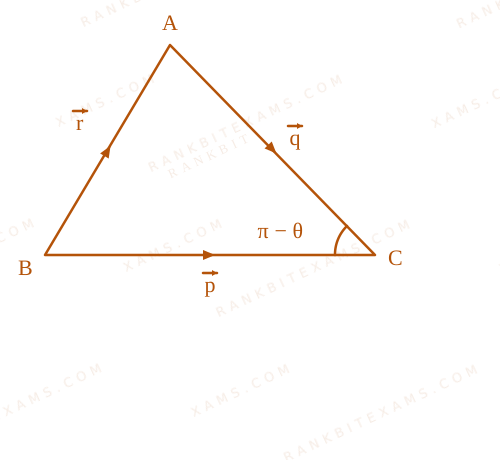
For a triangle ABC, let p= BC, q= CA and r= BA. If | p|=2√(3),| q|=2 and θ= 1√(3), where θ is the angle between p and q, then | p×( q-3 r)|²+3| r|² is equal to:
  • A. 340
  • B. 220
  • C. 410
  • D. 200

Solution

Related Formula
Cosine Rule in triangle: (π-θ) = | p|²+| q|²-| r|²2| p|| q| Cross product identity: A × A = 0 ; | A × B| = |A||B| θ
Core Logic

Vector triangle diagram for Q15 - JEE Main 2026 Evening
From triangle law of addition, BC + CA = BA p + q = r. The angle between vectors p and q extended head-to-tail is θ. The internal angle of the triangle is π - θ.

Step 1: Calculate magnitude of r

Using cosine rule for the side | r|:

(π - θ) = | p|² + | q|² - | r|²2| p|| q|

Since θ = 1/√(3), (π - θ) = -1/√(3).

- 1√(3) = (2√(3))² + (2)² - | r|²2(2√(3))(2) - 1√(3) = 12 + 4 - | r|²8√(3) -8 = 16 - | r|² | r|² = 24
Step 2: Simplify the Cross Product term

We need to evaluate | p × ( q - 3 r)|². Substitute r = p + q:

= | p × ( q - 3( p + q))|² = | p × (-3 p - 2 q)|²

Since p × p = 0:

= |-2 ( p × q)|² = 4 | p × q|² = 4 ( | p|² | q|² ²θ )
Step 3: Final Calculation

Given θ = 1/√(3) ²θ = 1/3 ²θ = 2/3.

4 | p × q|² = 4 (12)(4)((2)/(3)) = 4(4)(4)(2) = 128

The required expression is:

| p × ( q - 3 r)|² + 3| r|² = 128 + 3(24) = 128 + 72 = 200
Pattern Recognition

Always convert secondary vectors back to base components using the triangle condition p + q = r. It zeroes out self-cross products instantly.

Chapter Mix

Class 12 Maths: Vector Algebra

Q1 jee_main_2026_22_january_morning Projection Of A Vector On Another Vector
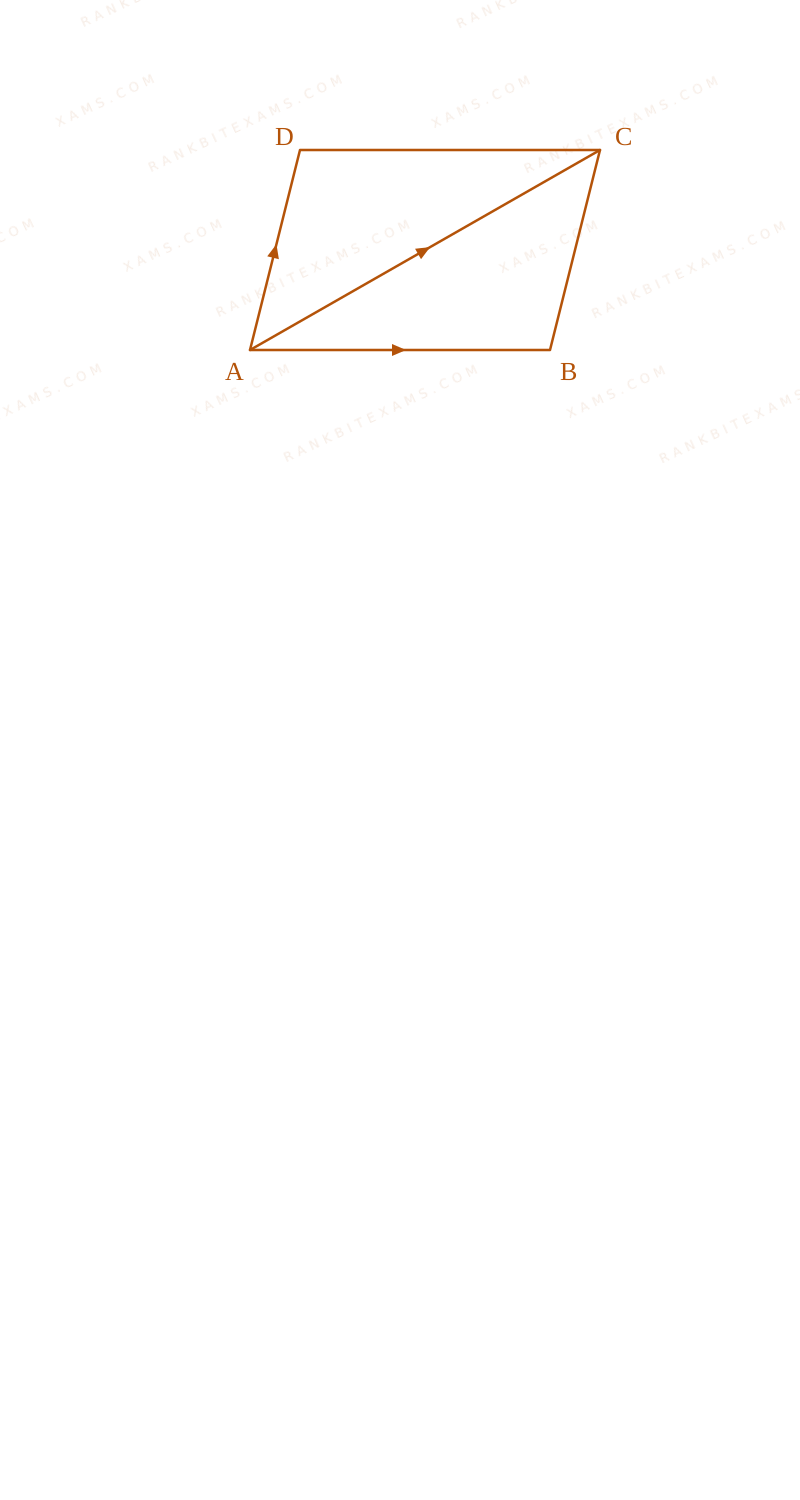
Let AB=2 i+4 j-5 k and AD= i+2 j+λ k, λin R. Let the projection of the vector v= i+ j+ k on the diagonal AC of the parallelogram ABCD be of length one unit. If α,β, where α>β, be the roots of the equation λ²x²-6λ x+5=0, then 2α-β is equal to
  • A. 1
  • B. 4
  • C. 3
  • D. 6

Solution

Related Formula
Projection of v on a = v · a| a| AC = AB + AD
Core Logic

Using the parallelogram law of vector addition, the diagonal AC is given by:

AC = AB + AD = (2 i+4 j-5 k) + ( i+2 j+λ k) AC = 3 i + 6 j + (λ - 5) k
Step 1: Applying the Projection Condition

The projection of v = i+ j+ k on AC is 1. Therefore:

v · AC| AC| = 1 3(1) + 6(1) + (λ - 5)(1)√(3² + 6² + (λ - 5)²) = 1 3 + 6 + λ - 5 = √(9 + 36 + (λ - 5)²) λ + 4 = √(45 + (λ - 5)²)

Squaring both sides:

(λ + 4)² = 45 + (λ - 5)² λ² + 8λ + 16 = λ² - 10λ + 25 + 45 18λ = 54 λ = 3
Step 2: Solving the Quadratic Equation

Substitute λ = 3 into the given quadratic equation λ²x² - 6λ x + 5 = 0:

9x² - 18x + 5 = 0 (3x - 1)(3x - 5) = 0 x = (1)/(3), (5)/(3)

Given α > β, we have α = (5)/(3) and β = (1)/(3).

Calculate 2α - β:

2((5)/(3)) - (1)/(3) = (10 - 1)/(3) = 3

Projection of A Vector diagram for Q1 - JEE Main 2026 Morning

Pattern Recognition

Projection questions in 3D geometry often couple a simple dot product identity with an unknown parameter. Squaring a linear equation derived from vector magnitudes often cancels the squared terms, making it easily solvable.

Chapter Mix

Class 12 Maths: Vector Algebra Class 11 Maths: Quadratic Equations

Q8 jee_main_2026_22_january_evening Vector Dot Product and Cross Product
Let a = 2 i - j + k and b = λ j + 2 k, λ in Z be two vectors. Let c = a × b and d be a vector of magnitude 2 in yz-plane. If | c| = √(53), then the maximum possible value of ( c · d)² is equal to:
  • A. 26
  • B. 104
  • C. 208
  • D. 52

Solution

Related Formula

Cauchy-Schwarz Inequality for vectors:

( c · d)² ≤ | cyz|² | d|²
Core Logic

Calculate cross product c = a × b:

c = vmatrix i & j & k 2 & -1 & 1 0 & λ & 2 vmatrix = (-2-λ) i - 4 j + 2λ k

Given | c| = √(53):

(-2-λ)² + 16 + 4λ² = 53 5λ² + 4λ - 33 = 0 (5λ - 11)(λ + 3) = 0

Since λ in Z, we get λ = -3. Thus, c = i - 4 j - 6 k.

Step 1: Maximum Value of Dot Product Squared

Vector d lies in yz-plane: d = y j + z k with y² + z² = 4.

( c · d)² = (-4y - 6z)²

By Cauchy-Schwarz inequality:

(-4y - 6z)² ≤ ((-4)² + (-6)²)(y² + z²) = (16 + 36)(4) = 52 × 4 = 208
Pattern Recognition

Project c onto yz-plane components and apply Cauchy-Schwarz inequality to maximize dot product.

Chapter Mix

Class 12 Maths: Vector Algebra

More Vector Algebra Questions — jee_main_2025_29_jan_evening

Practice all Vector Algebra previous-year questions →

Rankbit System
JEE Physics: Waves (+15.5%) | Electrostatics: Concentric Shells (-29.7%) | Modern Physics: Photoelectric Clones (+34.2%) | Mathematics: Definite Integrals (+18.1%) | Chemistry: Coordination Splitting (-11.4%) | JEE Physics: Waves (+15.5%) | Electrostatics: Concentric Shells (-29.7%) | Modern Physics: Photoelectric Clones (+34.2%) | Mathematics: Definite Integrals (+18.1%) | Chemistry: Coordination Splitting (-11.4%)