JEE Main · Mathematics ↓ Falling

Three Dimensional Geometry appeared 62 times across 3 years — 7.2% of Mathematics. This question is from Shortest Distance Between Lines.

Year 2026 2025 2024 Total
Questions 15 29 18 62

Let the values of λ for which the shortest distance between the lines (x - 1)/(2) = (y - 2)/(3) = (z - 3)/(4) (x - λ)/(3) = (y - 4)/(4) = (z - 5)/(5) is 1√(6) be λ₁ and λ₂. Then the radius of the circle passing through the points (0, 0), (λ₁, λ₂) and (λ₂, λ₁) is

Solution & Explanation

Related Formula
Shortest Distance = | AB · ( p × q)| p × q| |
Core Logic

Identify points A(1, 2, 3) and B(λ, 4, 5) on the lines with directions p = 2 i + 3 j + 4 k and q = 3 i + 4 j + 5 k respectively. Use the shortest distance formula to determine λ₁ and λ₂.

Step 1: Calculate Cross Product and Direction Vector
p × q = vmatrix i & j & k 2 & 3 & 4 3 & 4 & 5 vmatrix = - i + 2 j - k | p × q| = √((-1)² + 2² + (-1)²) = √(6) AB = (λ - 1) i + 2 j + 2 k
Step 2: Solve for Lambda
1√(6) = | ((λ - 1) i + 2 j + 2 k) · (- i + 2 j - k)√(6) | |-λ + 1 + 4 - 2| = 1 |λ - 3| = 1 λ = 4 or 2
Step 3: Radius of the Passing Circle

The circle passes through (0,0), (4,2) and (2,4). Using the circumradius formula R = (abc)/(4Δ):

a = √(20), b = √(20), c = √(8) Δ = (1)/(2) vmatrix 1 & 1 & 1 0 & 4 & 2 0 & 2 & 4 vmatrix = 6 R = √(20) × √(20) × √(8)4 × 6 = 40√(2)24 = 5√(2)3
Pattern Recognition

Shortest distance values create symmetric configurations. When finding a circle passing through (0,0), (x,y), and (y,x), the symmetry about y=x simplifies radius calculations immediately.

Chapter Mix

Class 12 Mathematics: Three Dimensional Geometry Class 11 Mathematics: Circles

Reference Study Guides

More Three Dimensional Geometry Previous-Year Questions — Page 2

Q10 jee_main_2026_22_january_evening Distance Between Points on Line
Let L be the line (x+1)/(2) = (y+1)/(3) = (z+3)/(6) and let S be the set of all points (a,b,c) on L, whose distance from the line (x+1)/(2) = (y+1)/(3) = (z-9)/(0) along the line L is 7. Then Σ(a,b,c) in S (a+b+c) is equal to:
  • A. 34
  • B. 28
  • C. 40
  • D. 6

Solution

Related Formula

Distance along a line from intersection point M using parametric coordinates.

Core Logic

Find intersection point M of L₁ and L₂:

2λ - 1 = 2μ - 1, 3λ - 1 = 3μ - 1, 6λ - 3 = 9 λ = 2, μ = 2

Point of intersection M = (3, 5, 9).

Any parametric point P on L₁ is (2K-1, 3K-1, 6K-3).

Step 1: Solve for Points P and Q

Distance PM = 7:

√((2K-4)² + (3K-6)² + (6K-12)²) = 7 7|K-2| = 7 K = 1 or 3
  • For K=1: P = (1, 2, 3), sum = 6
  • For K=3: Q = (5, 8, 15), sum = 28
Step 2: Total Sum

Total sum = 6 + 28 = 34.

Pattern Recognition

Intersection point gives central reference; unit direction vector gives required offset points along the line.

Chapter Mix

Class 12 Maths: Three Dimensional Geometry

Q15 jee_main_2026_23_january_morning Lines in 3D
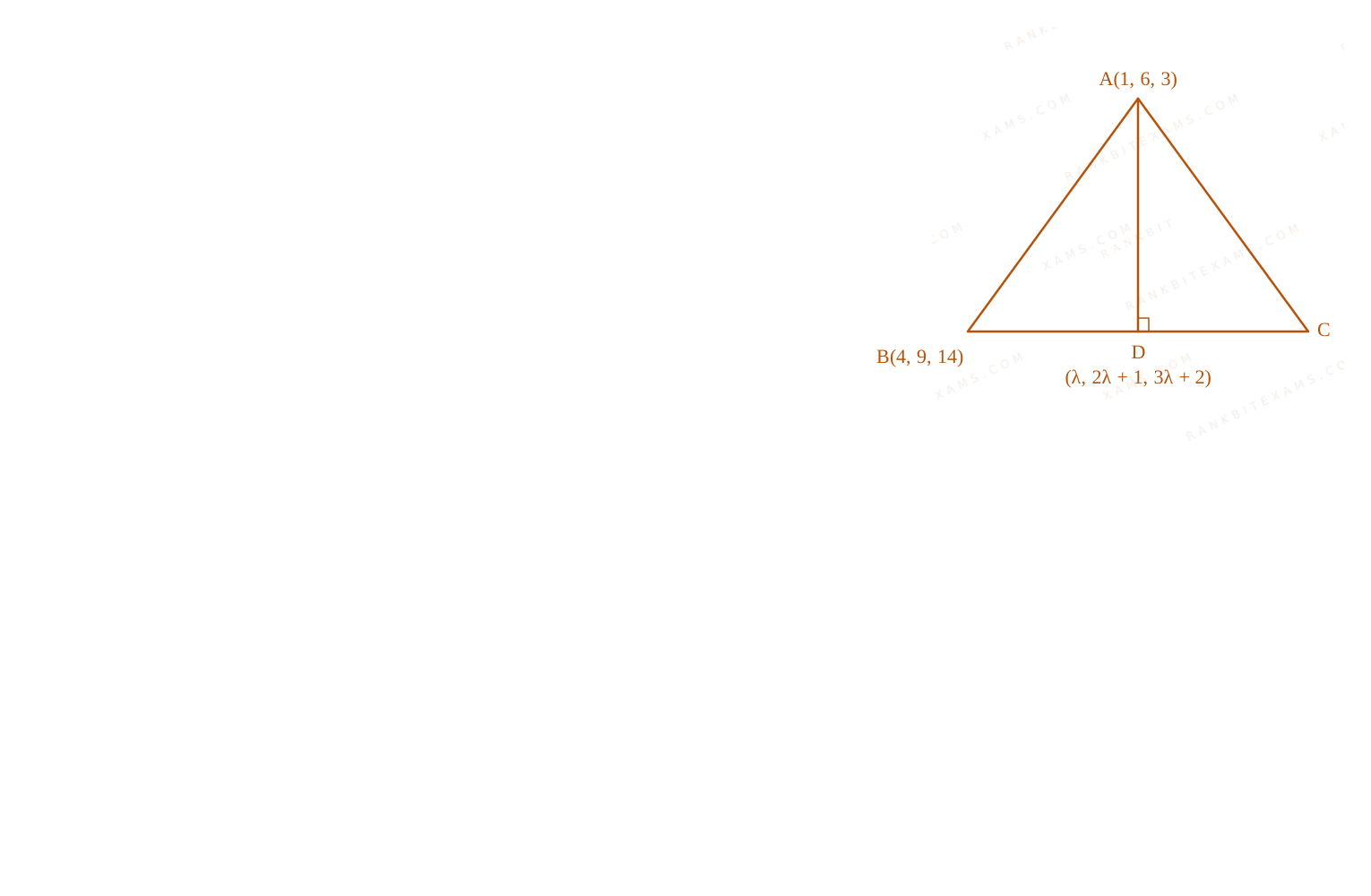
The vertices B and C of a triangle ABC lie on the line (x)/(1) = (1 - y)/(-2) = (z - 2)/(3). The coordinates of A and B are (1, 6, 3) and (4, 9, α) respectively and C is at a distance of 10 units from B. The area (in sq. units) of Δ ABC is:
  • A. 5√(13)
  • B. 15√(13)
  • C. 20√(13)
  • D. 10√(13)

Solution

Related Formula
Area of Δ = (1)/(2) × base × height = (1)/(2) × BC × AD
Core Logic

The line is standardly written as (x)/(1) = (y - 1)/(2) = (z - 2)/(3) = λ. Point B (4, 9, α) lies on this line, so we can solve for α by substituting it in:

(4)/(1) = (9 - 1)/(2) = (α - 2)/(3) ⇒ 4 = 4 = (α - 2)/(3) ⇒ α = 14

Thus, B is (4, 9, 14).

Lines in 3D diagram for Q15 - JEE Main 2026 Morning

Step 1: Find the Perpendicular Foot (D)

Let D be the foot of the perpendicular from A(1, 6, 3) to the line BC. The coordinates of a general point on the line are D = (λ, 2λ + 1, 3λ + 2). The direction vector of AD is AD = (λ - 1) i + (2λ - 5) j + (3λ - 1) k. Since AD is perpendicular to the line whose direction ratios are 1, 2, 3:

1(λ - 1) + 2(2λ - 5) + 3(3λ - 1) = 0 λ - 1 + 4λ - 10 + 9λ - 3 = 0 14λ - 14 = 0 ⇒ λ = 1
Step 2: Calculate Height (AD)

Substitute λ = 1 into D: D = (1, 3, 5). The perpendicular distance AD is:

AD = √((1-1)² + (6-3)² + (3-5)²) = √(0² + 3² + (-2)²) = √(9 + 4) = √(13)
Step 3: Calculate Area of Triangle

We are given that the base BC is 10 units.

Area = (1)/(2) × BC × AD = (1)/(2) × 10 × √(13) = 5√(13)
Pattern Recognition

When a triangle area is requested given a line equation containing the base, dropping a generic lambda-perpendicular establishes height (AD), decoupling the problem from finding the exact coordinate of C.

Chapter Mix

Class 12 Maths: Three Dimensional Geometry

Q20 jee_main_2026_23_january_morning Direction Cosines
Let the direction cosines of two lines satisfy the equations: 4 + m - n = 0 and 2mn + 10n + 3 m = 0. Then the cosine of the acute angle between these lines is:
  • A. 10√(38)
  • B. 203√(38)
  • C. 107√(38)
  • D. 103√(38)

Solution

Related Formula
θ = |a₁a₂ + b₁b₂ + c₁c₂|√(a₁²+b₁²+c₁²)√(a₂²+b₂²+c₂²)
Core Logic

From the first linear equation, isolate n: n = 4 + m Substitute this into the second quadratic relation:

2m(4 + m) + 10 (4 + m) + 3 m = 0 8 m + 2m² + 40 ² + 10 m + 3 m = 0 40 ² + 21 m + 2m² = 0

Factorizing the quadratic equation:

(8 + m)(5 + 2m) = 0

This gives two cases, generating the direction ratios of the two lines.

Step 1: Determine Direction Ratios

Case 1: m = -8 Then n = 4 - 8 = -4. Direction Ratios (D.R.s) for line L₁: ( , -8 , -4 ) ≡ (1, -8, -4).

Case 2: m = -(5)/(2) Then n = 4 - (5)/(2) = (3)/(2). Direction Ratios (D.R.s) for line L₂: ( , -(5)/(2) , (3)/(2) ) ≡ (1, -(5)/(2), (3)/(2)) ≡ (2, -5, 3).

Step 2: Calculate Angle Between Lines

Use the angle formula with D.R.s d₁ = (1, -8, -4) and d₂ = (2, -5, 3):

θ = |(1)(2) + (-8)(-5) + (-4)(3)|√(1² + (-8)² + (-4)²) √(2² + (-5)² + 3²) θ = |2 + 40 - 12|√(1 + 64 + 16) √(4 + 25 + 9) θ = 30√(81) √(38) = 309√(38) = 103√(38)
Pattern Recognition

When direction cosines are entangled in one linear and one quadratic equation, isolate the single-degree variable from the linear plane equation and plug it into the cone equation to split it into two generating lines.

Chapter Mix

Class 12 Maths: Three Dimensional Geometry

Q22 jee_main_2026_23_january_evening Line in 3D
If the image of the point P(a, 2, a) in the line (x)/(2) = (y + a)/(1) = (z)/(1) is Q and the image of Q in the line (x - 2b)/(2) = (y - a)/(1) = (z + 2b)/(-5) is P, then a + b is equal to
Numerical Answer. Answer: 3 to 3

Solution

Related Formula

For a point and its image across a line, the midpoint of the segment connecting them lies exactly on the line. The segment itself is perpendicular to the line.

Core Logic

Line in 3D diagram for Q22 - JEE Main 2026 Evening
Let the first line be L₁: (x)/(2) = (y + a)/(1) = (z)/(1) = λ. A general point on L₁ is (2λ, λ - a, λ). This is the midpoint M₁ of P(a, 2, a) and Q(x₁, y₁, z₁).

Thus, Q is given by:

x₁ = 4λ - a y₁ = 2λ - 2a - 2 z₁ = 2λ - a

Now, the image of Q across L₂: (x - 2b)/(2) = (y - a)/(1) = (z + 2b)/(-5) = μ is P(a, 2, a). The midpoint M₂ of PQ lies on L₂. But M₂ is the exact same set of coordinates in space as M₁ since they are both the midpoint of the segment PQ!

Step 1: Equating Midpoints

General point on L₂ is (2μ + 2b, μ + a, -5μ - 2b). Since the midpoint must be the same: (a + (4λ - a))/(2) = 2μ + 2b 2λ = 2μ + 2b λ - μ = b (2 + (2λ - 2a - 2))/(2) = μ + a λ - a = μ + a λ - μ = 2a (a + (2λ - a))/(2) = -5μ - 2b λ = -5μ - 2b λ + 5μ = -2b

Step 2: Solving System

From the first two equations, b = 2a. Substitute b = 2a into the third: λ + 5μ = -4a. Also λ - μ = 2a. Subtracting gives 6μ = -6a μ = -a. Thus λ = a.

Line in 3D diagram for Q22 - JEE Main 2026 Evening
The direction vector of segment PQ is proportional to the vector from P to M₁. PM₁ = (2λ - a) i + (λ - a - 2) j + (λ - a) k. Since λ = a: PM₁ = a i - 2 j + 0 k.

This vector must be perpendicular to L₁ (direction vector 2 i + j + k): (a)(2) + (-2)(1) + (0)(1) = 0 2a - 2 = 0 a = 1.

Step 3: Final Values

Since a = 1, and b = 2a, we have b = 2. Therefore, a + b = 1 + 2 = 3.

Pattern Recognition

If P is the image of Q on L₁, and Q is the image of P on L₂, then L₁ and L₂ must intersect segment PQ at the exact same midpoint. Using the midpoint consistency across both lines creates a rapid linear system.

Chapter Mix

Class 12 Maths: Three Dimensional Geometry

Q3 jee_main_2026_24_january_morning Intersection of Lines and Distances
Let the lines L₁: r = i + 2 j + 3 k + λ(2 i + 3 j + 4 k), λ in R and L₂: r = (4 i + j) + μ(5 i + 2 j + k), μ in R, intersect at the point R. Let P and Q be the points lying on lines L₁ and L₂, respectively, such that | PR| = √(29) and | PQ| = √((47)/(3)). If the point P lies in the first octant, then 27(QR)² is equal to
  • A. 340
  • B. 360
  • C. 320
  • D. 348

Solution

Related Formula
Distance formula: d² = (x₂ - x₁)² + (y₂ - y₁)² + (z₂ - z₁)²
Core Logic

Find the point of intersection R by equating general points on L₁ and L₂: General point on L₁: (2λ + 1, 3λ + 2, 4λ + 3) General point on L₂: (5μ + 4, 2μ + 1, μ)

Equating coordinates:

2λ + 1 = 5μ + 4 3λ + 2 = 2μ + 1 4λ + 3 = μ

Solving yields λ = -1 and μ = -1. Point of intersection R is (-1, -1, -1).

Step 1: Finding Point P

Let point P be (2λ + 1, 3λ + 2, 4λ + 3). PR² = 29

(2λ + 1 + 1)² + (3λ + 2 + 1)² + (4λ + 3 + 1)² = 29 (2λ + 2)² + (3λ + 3)² + (4λ + 4)² = 29 4(λ + 1)² + 9(λ + 1)² + 16(λ + 1)² = 29 29(λ + 1)² = 29 ⇒ (λ + 1)² = 1 λ + 1 = ± 1 ⇒ λ = 0 or λ = -2

If λ = -2, P(-3, -4, -5) (not in first octant, rejected). If λ = 0, P(1, 2, 3) (in first octant, accepted).

Step 2: Finding Point Q

Let Q be (5μ + 4, 2μ + 1, μ).

PQ² = (47)/(3) (5μ + 4 - 1)² + (2μ + 1 - 2)² + (μ - 3)² = (47)/(3) (5μ + 3)² + (2μ - 1)² + (μ - 3)² = (47)/(3) 25μ² + 30μ + 9 + 4μ² - 4μ + 1 + μ² - 6μ + 9 = (47)/(3) 30μ² + 20μ + 19 = (47)/(3) 90μ² + 60μ + 57 = 47 ⇒ 90μ² + 60μ + 10 = 0 9μ² + 6μ + 1 = 0 ⇒ (3μ + 1)² = 0 μ = -(1)/(3)
Step 3: Calculating QR^2

Point Q = ( 5(-(1)/(3))+4, 2(-(1)/(3))+1, -(1)/(3) ) = ( (7)/(3), (1)/(3), -(1)/(3) ). R(-1, -1, -1).

(QR)² = ( (7)/(3) + 1 )² + ( (1)/(3) + 1 )² + ( -(1)/(3) + 1 )² = ( (10)/(3) )² + ( (4)/(3) )² + ( (2)/(3) )² = (100 + 16 + 4)/(9) = (120)/(9) 27 × (QR)² = 27 × (120)/(9) = 3 × 120 = 360
Pattern Recognition

When given fixed line parameters and distances, expressing all points in terms of their single parameter (λ or μ) converts 3D distance problems into simple single-variable quadratic equations.

Chapter Mix

Class 12 Maths: Three Dimensional Geometry
More Three Dimensional Geometry Questions — jee_main_2025_08_april_evening

Practice all Three Dimensional Geometry previous-year questions →

Rankbit System
JEE Physics: Waves (+15.5%) | Electrostatics: Concentric Shells (-29.7%) | Modern Physics: Photoelectric Clones (+34.2%) | Mathematics: Definite Integrals (+18.1%) | Chemistry: Coordination Splitting (-11.4%) | JEE Physics: Waves (+15.5%) | Electrostatics: Concentric Shells (-29.7%) | Modern Physics: Photoelectric Clones (+34.2%) | Mathematics: Definite Integrals (+18.1%) | Chemistry: Coordination Splitting (-11.4%)
