Let r be the radius of the circle, which touches x -axis at point (a, 0) , a < 0 and the parabola y^2 = 9x at the point (4, 6) . Then r is equal to

Numerical Answer Type:
Enter a numerical value Answer: 30 to 30 +4 marks

Solution & Explanation

### Related Formula textTangent line at point (x_1, y_1) implies yy_1 = 2a(x+x_1) ### Core Logic Establish the tangent vector expression at the parabola intersection mark. Since this path line functions as a shared contact tangent boundaries sheet for the circular arc, impose radius equations. ### Step 1: Derive Shared Parabola Tangent Line Tangent line profile for y^2 = 9x at coordinate indicator (4,6): 6y = 9 cdot left( fracx+42 right) implies 3x - 4y + 12 = 0 ### Step 2: Build Geometric Metric Connections Circle touches axis at (a,0), mapping coordinates center directly to C(a,r). Perpendicular boundary constraint steps require: frac3a - 4r + 125 = pm r implies 3a + 12 = 4r pm 5r ### Step 3: Solve for Radius Matrix Bounds Enforce circle equation intersection constraint profile (x-a)^2 + (y-r)^2 = r^2 at point (4,6): a^2 - 8a - 12r + 52 = 0 Evaluating the target systems from structural logic tracks rejects positive value parameters, providing: a = -14, quad r = 30 {{SOL_IMG_75}} ### Pattern Recognition Shared tangent elements connect independent conic fields. Locating circular center boundaries using axial coordinate tracking simplifies secondary equations. ### Evaluation Rubric / Model Answer null ### Chapter Mix Class 11 Mathematics: Conic Sections Class 11 Mathematics: Circles
Tangent to Parabola and Circle Properties diagram for Q75 - JEE Main 2025 Evening

Reference Study Guides

More Conic Sections Previous-Year Questions — Page 10

Q7 jee_main_2024_27_jan_morning Normal to a Parabola
If the shortest distance of the parabola y^2=4x from the centre of the circle x^2+y^2-4x-16y+64=0 is d, then d^2 is equal to:
  • A. 16
  • B. 24
  • C. 20
  • D. 36

Solution

### Related Formula y = mx - 2am - am^3 quad text(Equation of normal to y^2 = 4ax) ### Core Logic First, extract the centre C of the circle x^2 + y^2 - 4x - 16y + 64 = 0: C equiv (2, 8) For the parabola y^2 = 4x, comparing with y^2 = 4ax, we get a = 1. The shortest distance between a point and a curve is measured along the normal to the curve passing through that point. We need the normal to the parabola that passes through the circle's centre (2, 8). ### Step 1: Applying Normal Condition Equation of normal in slope form (a=1): y = mx - 2m - m^3 Since it passes through (2, 8): 8 = m(2) - 2m - m^3 8 = -m^3 Rightarrow m^3 = -8 Rightarrow m = -2 ### Step 2: Finding Coordinate Point on Parabola The foot of the normal on the parabola is given by the coordinate P(am^2, -2am). Substitute a=1, m=-2: P equiv (1(-2)^2, -2(1)(-2)) P equiv (4, 4) ### Step 3: Calculating Shortest Distance The distance d is between the point P(4, 4) and the centre C(2, 8): d = sqrt(4-2)^2 + (4-8)^2 d = sqrt2^2 + (-4)^2 = sqrt4 + 16 = sqrt20 Thus, d^2 = 20. ### Pattern Recognition Shortest distance between a curve and a fixed point (like a circle's center) ALWAYS lies exactly along their common normal. Write the parameterized normal equation and force it through the coordinate to extract the slope root. ### Evaluation Rubric / Model Answer null ### Chapter Mix Class 11 Maths: Circles Class 11 Maths: Parabola
Q15 jee_main_2024_27_jan_morning Chord with a given middle point
The length of the chord of the ellipse fracx^225+fracy^216=1, whose mid point is left(1, frac25right) is equal to :
  • A. fracsqrt16915
  • B. fracsqrt20095
  • C. fracsqrt17415
  • D. fracsqrt15415

Solution

### Related Formula T = S_1 Equation of chord with a given midpoint (x_1, y_1) for an ellipse fracx^2a^2 + fracy^2b^2 = 1 is: fracx x_1a^2 + fracy y_1b^2 = fracx_1^2a^2 + fracy_1^2b^2 ### Core Logic Given the ellipse fracx^225 + fracy^216 = 1 and midpoint (x_1, y_1) = (1, frac25). Substitute these into the T = S_1 formula: fracx(1)25 + fracy(2/5)16 = frac1^225 + frac(2/5)^216 fracx25 + fracy40 = frac125 + frac4/2516 frac8x + 5y200 = frac125 + frac1100 frac8x + 5y200 = frac5100 = frac10200 This simplifies to the chord equation: 8x + 5y = 10 Rightarrow y = frac10 - 8x5 ### Step 1: Finding Points of Intersection Substitute the chord equation back into the ellipse equation to find intersection coordinates: fracx^225 + frac(frac10 - 8x5)^216 = 1 fracx^225 + frac(10 - 8x)^2400 = 1 Multiply the entire equation by 400: 16x^2 + (10 - 8x)^2 = 400 16x^2 + 100 - 160x + 64x^2 = 400 80x^2 - 160x - 300 = 0 Divide by 20: 4x^2 - 8x - 15 = 0 ### Step 2: Solving the Quadratic Solve for roots x_1 and x_2: x = frac-(-8) pm sqrt(-8)^2 - 4(4)(-15)2(4) x = frac8 pm sqrt64 + 2408 = frac8 pm sqrt3048 Difference of x-coordinates: |x_1 - x_2| = fracsqrt3044 ### Step 3: Calculating Chord Length Because the points lie on the line y = frac10 - 8x5, the difference in y-coordinates relates to the slope m = -frac85: |y_1 - y_2| = |-frac85| |x_1 - x_2| The distance D between the points is: D = sqrt(x_1 - x_2)^2 + (y_1 - y_2)^2 = |x_1 - x_2| sqrt1 + m^2 D = fracsqrt3044 sqrt1 + left(frac-85right)^2 D = fracsqrt3044 sqrt1 + frac6425 = fracsqrt3044 fracsqrt895 D = fracsqrt16 times 194 fracsqrt895 = frac4sqrt194 fracsqrt895 = fracsqrt16915 ### Pattern Recognition For intersecting lines and conics, you rarely need to explicitly find y_1 and y_2. Use the slope property: Distance = |x_1 - x_2| sqrt1+m^2 to bypass entirely the substitution of messy quadratic roots back into the linear equation. ### Evaluation Rubric / Model Answer null ### Chapter Mix Class 11 Maths: Ellipse Class 11 Maths: Straight Lines
Q25 jee_main_2024_29_jan_morning Intersection of Conics
If the points of intersection of two distinct conics x^2+y^2=4b and fracx^216+fracy^2b^2=1 lie on the curve y^2=3x^2 then 3sqrt3 times the area of the rectangle formed by the intersection points is
Numerical Answer. Answer: 432 to 432

Solution

### Related Formula textArea of a rectangle bounded by x = pm x_1, y = pm y_1 text is (2x_1)(2y_1) = 4x_1y_1 ### Core Logic Since the points of intersection of the circle x^2+y^2=4b and the ellipse fracx^216+fracy^2b^2=1 satisfy the curve y^2 = 3x^2, we can substitute y^2 = 3x^2 into the circle equation to find these coordinates entirely in terms of b. Substitute y^2 = 3x^2 into x^2 + y^2 = 4b: x^2 + 3x^2 = 4b 4x^2 = 4b Rightarrow x^2 = b Since y^2 = 3x^2, substituting x^2=b gives: y^2 = 3b Now, these points (x^2=b, y^2=3b) must also lie perfectly on the ellipse. Substitute them into the ellipse equation: fracb16 + frac3bb^2 = 1 fracb16 + frac3b = 1 ### Step 1: Solve for Parameter b Multiply the equation by 16b: b^2 + 48 = 16b b^2 - 16b + 48 = 0 (b-4)(b-12) = 0 This gives two candidate values: b=4 and b=12. Check conditions: The problem specifically declares "two distinct conics". If b=4, the circle becomes x^2+y^2=16 and the ellipse becomes fracx^216+fracy^216=1 (which is identically x^2+y^2=16). The conics would coincide and not be distinct. Thus, reject b=4. We must use b=12. ### Step 2: Calculate Coordinates and Area With b=12, extract the point coordinates: x^2 = 12 Rightarrow x = pm 2sqrt3 y^2 = 36 Rightarrow y = pm 6 The four intersection points form a symmetrical rectangle in the cartesian plane with dimensions: Length = 2|x| = 2(2sqrt3) = 4sqrt3 Width = 2|y| = 2(6) = 12 Area of the rectangle = (4sqrt3) times 12 = 48sqrt3. ### Step 3: Evaluate Final Expression The question asks for 3sqrt3 times the area of the rectangle: 3sqrt3 times (48sqrt3) = 3 times 48 times 3 = 144 times 3 = 432 ### Pattern Recognition When intersection points of shapes are constrained to lie on a third curve (like y^2=kx^2), substitute the 3rd curve into the simplest conic first to lock x^2 and y^2 as scalars, then test those scalars strictly on the remaining complex conic. ### Evaluation Rubric / Model Answer null ### Chapter Mix Class 11 Mathematics: Conic Sections
Q3 jee_main_2024_30_january_evening Ellipse Properties
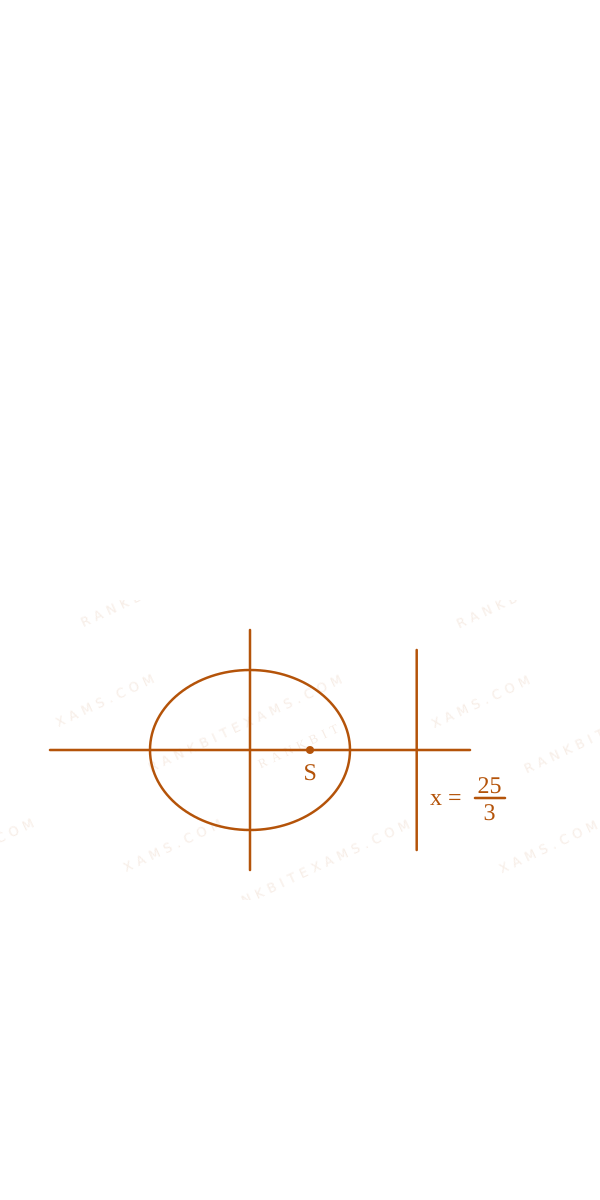
Let A(alpha, 0) and B(0, beta) be the points on the line 5x + 7y = 50 . Let the point P divide the line segment AB internally in the ratio 7:3 . Let 3x - 25 = 0 be a directrix of the ellipse E: fracx^2a^2 + fracy^2b^2 = 1 and the corresponding focus be S . If from S , the perpendicular on the x-axis passes through P , then the length of the latus rectum of E is equal to
  • A. frac253
  • B. frac329
  • C. frac259
  • D. frac325

Solution

### Related Formula textSection Formula: (x, y) = left(fracmx_2 + nx_1m+n, fracmy_2 + ny_1m+nright) textDirectrix of Ellipse: x = fracae textLength of Latus Rectum = frac2b^2a ### Core Logic First, find points A and B on 5x + 7y = 50. For A on x-axis: y = 0 Rightarrow 5x = 50 Rightarrow alpha = 10 Rightarrow A(10, 0) For B on y-axis: x = 0 Rightarrow 7y = 50 Rightarrow beta = frac507 Rightarrow Bleft(0, frac507right) ### Step 1: Finding Coordinates of P P divides AB in ratio 7:3. Using section formula: x_P = frac7(0) + 3(10)7 + 3 = frac3010 = 3 y_P = frac7left(frac507right) + 3(0)7 + 3 = frac5010 = 5 So, P = (3, 5). ### Step 2: Finding a and b for the Ellipse Directrix is 3x - 25 = 0 Rightarrow x = frac253. Thus, fracae = frac253.
Ellipse Properties diagram for Q3 - JEE Main 2024 Evening
Focus S has coordinates (ae, 0). A perpendicular from S to the x-axis is simply the vertical line x = ae. Since this line passes through P(3, 5), the x-coordinate of S must equal the x-coordinate of P. ae = 3 Now, solving for a: a = left(fracaeright) cdot e = frac253 cdot e Multiply the two equations: ae cdot fracae = 3 cdot frac253 Rightarrow a^2 = 25 Rightarrow a = 5. Also, ae = 3 Rightarrow 5e = 3 Rightarrow e = frac35. Calculate b^2: b^2 = a^2(1 - e^2) = 25left(1 - frac925right) = 25 cdot frac1625 = 16 Rightarrow b = 4 ### Step 3: Calculating Latus Rectum textLength of Latus Rectum = frac2b^2a = frac2(16)5 = frac325 ### Pattern Recognition Intersection of perpendicular from focus passing through a point purely locks the x-coordinate of the focus to the x-coordinate of that point. ### Evaluation Rubric / Model Answer null ### Chapter Mix Class 11 Maths: Straight Lines Class 11 Maths: Conic Sections
Q10 jee_main_2024_30_january_evening Hyperbola
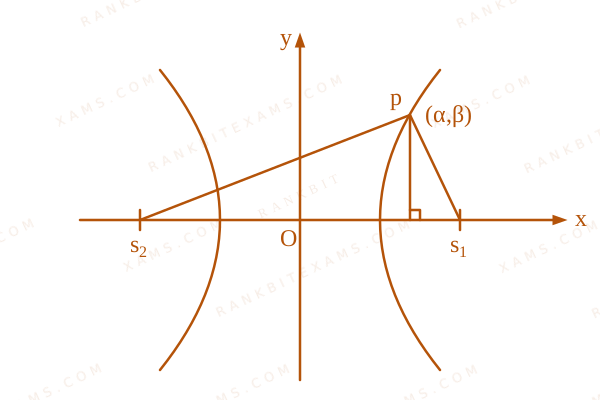
Let P be a point on the hyperbola H: fracx^29 -fracy^24 = 1 in the first quadrant such that the area of triangle formed by P and the two foci of H is 2sqrt13 . Then, the square of the distance of P from the origin is
  • A. 18
  • B. 26
  • C. 22
  • D. 20

Solution

### Related Formula textEccentricity of Hyperbola: e^2 = 1 + fracb^2a^2 textFoci coordinates: (pm ae, 0) textArea of Triangle: frac12 times textbase times textheight ### Core Logic For the hyperbola fracx^29 - fracy^24 = 1, we have a^2 = 9 and b^2 = 4. e^2 = 1 + frac49 = frac139 Rightarrow e = fracsqrt133 The distance between the two foci S_1, S_2 is 2ae: 2ae = 2(3)left(fracsqrt133right) = 2sqrt13 ### Step 1: Using the Triangle Area
Hyperbola diagram for Q10 - JEE Main 2024 Evening
Let point P on the hyperbola be (alpha, beta) in the first quadrant (so alpha, beta gt 0). The base of the triangle is the segment between foci, length = 2sqrt13. The height of the triangle is the y-coordinate of P, which is beta. Area of Delta PS_1S_2 = frac12 times textbase times textheight 2sqrt13 = frac12 times (2sqrt13) times beta 2sqrt13 = sqrt13 cdot beta Rightarrow beta = 2 ### Step 2: Finding P's coordinates and Distance Since P lies on the hyperbola: fracalpha^29 - fracbeta^24 = 1 Substitute beta = 2: fracalpha^29 - frac44 = 1 fracalpha^29 - 1 = 1 Rightarrow fracalpha^29 = 2 Rightarrow alpha^2 = 18 We need the square of the distance of P from the origin, which is alpha^2 + beta^2: textDistance^2 = alpha^2 + beta^2 = 18 + 2^2 = 18 + 4 = 22 ### Pattern Recognition Area formed by a point on a conic and its foci uses the interfocal distance 2ae as a flat base on the x-axis, directly exposing the point's y-coordinate. ### Evaluation Rubric / Model Answer null ### Chapter Mix Class 11 Maths: Conic Sections

More Conic Sections Questions — jee_main_2025_08_april_evening

Practice all Conic Sections previous-year questions →

Rankbit System
JEE Physics: Waves (+15.5%) | Electrostatics: Concentric Shells (-29.7%) | Modern Physics: Photoelectric Clones (+34.2%) | Mathematics: Definite Integrals (+18.1%) | Chemistry: Coordination Splitting (-11.4%) | JEE Physics: Waves (+15.5%) | Electrostatics: Concentric Shells (-29.7%) | Modern Physics: Photoelectric Clones (+34.2%) | Mathematics: Definite Integrals (+18.1%) | Chemistry: Coordination Splitting (-11.4%)