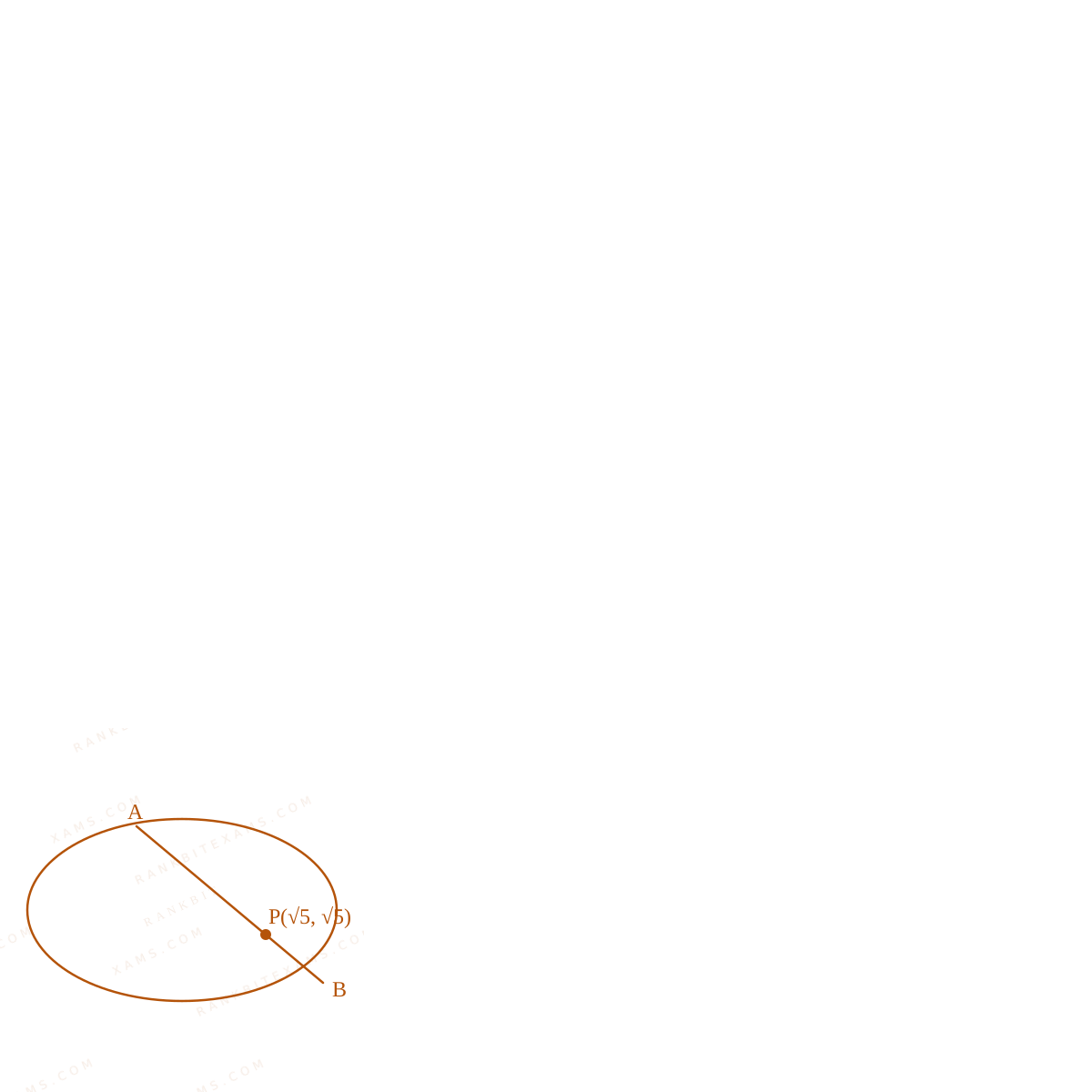
A line passing through the point P(sqrt5, sqrt5)$P(\sqrt{5}, \sqrt{5})$ intersects the ellipse fracx^236 + fracy^225 = 1$\frac{x^2}{36} + \frac{y^2}{25} = 1$ at A$A$ and B$B$ [cite: 567] such that (PA) cdot (PB)$(PA) \cdot (PB)$ is maximum. Then 5(PA^2 + PB^2)$5(PA^{2} + PB^{2})$ is equal to[cite: 570]:
A.218
B.377
C.290
D.338
Solution & Explanation
### Related Formula
Parametric line equation relative to an offset point P(x_0, y_0)$P(x_0, y_0)$:
x = x_0 + rcostheta, quad y = y_0 + rsintheta$x = x_0 + r\cos\theta, \quad y = y_0 + r\sin\theta$Ellipse and Line Properties diagram for Q56 - JEE Main 2025 Morning
### Core Logic
Assume any line through P$P$ can be represented parametrically by [cite: 1277]:
Q(sqrt5 + rcostheta, sqrt5 + rsintheta)$Q(\sqrt{5} + r\cos\theta, \sqrt{5} + r\sin\theta)$ [cite: 1277]
Substitute coordinates into the standard ellipse formula [cite: 1278]:
25(sqrt5 + rcostheta)^2 + 36(sqrt5 + rsintheta)^2 = 900$25(\sqrt{5} + r\cos\theta)^2 + 36(sqrt{5} + r\sin\theta)^2 = 900$ [cite: 1278]
Expanding and gathering powers of r$r$ yields [cite: 1280]:
r^2(25cos^2theta + 36sin^2theta) + 2sqrt5r(25costheta + 36sintheta) - 595 = 0$r^2(25\cos^2\theta + 36\sin^2\theta) + 2\sqrt{5}r(25\cos\theta + 36\sin\theta) - 595 = 0$ [cite: 1280]
The product of roots corresponds to the distance product value[cite: 1281, 1283]:
PA cdot PB = |r_1 r_2| = frac59525cos^2theta + 36sin^2theta = frac59525 + 11sin^2theta$PA \cdot PB = |r_1 r_2| = \frac{595}{25\cos^2\theta + 36\sin^2\theta} = \frac{595}{25 + 11\sin^2\theta}$ [cite: 1283]
### Step 1: Maximization condition
To make PA cdot PB$PA \cdot PB$ maximum, the denominator must be minimized [cite: 1284]:
sin^2theta = 0 implies theta = 0$\sin^2\theta = 0 \implies \theta = 0$ [cite: 1284]
This implies the chord line AB$AB$ must run parallel to the x-axis [cite: 1285]:
y_A = y_B = sqrt5$y_A = y_B = \sqrt{5}$ [cite: 1285]
Substitute y = sqrt5$y = \sqrt{5}$ back into the ellipse equation to calculate x-coordinates [cite: 1286]:
fracx^236 + frac525 = 1 implies fracx^236 = frac45 implies x^2 = frac1445$\frac{x^2}{36} + \frac{5}{25} = 1 \implies \frac{x^2}{36} = \frac{4}{5} \implies x^2 = \frac{144}{5}$ [cite: 1287]
Therefore, the coordinates are x = pm frac12sqrt5$x = \pm \frac{12}{\sqrt{5}}$.
### Step 2: Distance value summation
Compute PA^2 + PB^2$PA^2 + PB^2$ using coordinates directly [cite: 1289]:
PA^2 + PB^2 = left(sqrt5 - frac12sqrt5right)^2 + left(sqrt5 + frac12sqrt5right)^2$PA^2 + PB^2 = \left(\sqrt{5} - \frac{12}{\sqrt{5}}\right)^2 + \left(\sqrt{5} + \frac{12}{\sqrt{5}}\right)^2$ [cite: 1289]
= 2left(5 + frac1445right) = frac3385$= 2\left(5 + \frac{144}{5}\right) = \frac{338}{5}$ [cite: 1290]
Multiplying by 5 gives the target integer answer [cite: 1290]:
5(PA^2 + PB^2) = 338$5(PA^2 + PB^2) = 338$ [cite: 1290]
### Pattern Recognition
Parametric distances from a point intersecting a conic configuration usually form a standard quadratic equation in r$r$. The angle parameter immediately simplifies the boundary constraint optimization.
### Evaluation Rubric / Model Answer
null
### Chapter Mix
Class 11 Mathematics: Conic Sections (Ellipse)
Keywords:#line through point intersecting ellipse#JEE Main 2025 Morning Q56#Conic Sections JEE Main 2025#Ellipse and Line Properties
More Conic Sections Previous-Year Questions
Q552025Ellipse
If the length of the minor axis of an ellipse is equal to one fourth of the distance between the foci, then the eccentricity of the ellipse is :
A.frac4sqrt17$\frac{4}{\sqrt{17}}$
B.fracsqrt316$\frac{\sqrt{3}}{16}$
C.frac3sqrt19$\frac{3}{\sqrt{19}}$
D.fracsqrt57$\frac{\sqrt{5}}{7}$
Solution
### Related Formula
textLength of minor axis = 2b$\text{Length of minor axis} = 2b$textDistance between foci = 2ae$\text{Distance between foci} = 2ae$textEccentricity: e = sqrt1 - fracb^2a^2$\text{Eccentricity: } e = \sqrt{1 - \frac{b^2}{a^2}}$
### Core Logic
We set up an algebraic equation relating b$b$, a$a$, and e$e$ from the given geometric condition, then substitute it into the eccentricity identity.
### Step 1: Set up the geometric relation
Given that 2b = frac14 (2ae)$2b = \frac{1}{4} (2ae)$:
b = fracae4 implies fracba = frace4$b = \frac{ae}{4} \implies \frac{b}{a} = \frac{e}{4}$
Square both sides:
fracb^2a^2 = frace^216$\frac{b^2}{a^2} = \frac{e^2}{16}$
### Step 2: Solve for eccentricity
Using the eccentricity relation:
e^2 = 1 - fracb^2a^2$e^2 = 1 - \frac{b^2}{a^2}$e^2 = 1 - frace^216$e^2 = 1 - \frac{e^2}{16}$e^2 left(1 + frac116right) = 1$e^2 \left(1 + \frac{1}{16}\right) = 1$frac1716 e^2 = 1 implies e^2 = frac1617 implies e = frac4sqrt17$\frac{17}{16} e^2 = 1 \implies e^2 = \frac{16}{17} \implies e = \frac{4}{\sqrt{17}}$
### Pattern Recognition
Standard Ellipse relations: For standard ellipses, the ratio of axes and the eccentricity are coupled quadratic equations. Expressing b/a$b/a$ as a function of e$e$ allows direct solving of the eccentricity.
### Evaluation Rubric / Model Answer
null
### Chapter Mix
Class 11 Mathematics: Conic Sections
Q672025Parabola
Let the point mathrmP$\mathrm{P}$ of the focal chord mathrmPQ$\mathrm{PQ}$ of the parabola mathrmy^2 = 16mathrmx$\mathrm{y}^2 = 16\mathrm{x}$ be (1, -4)$(1, -4)$. If the focus of the parabola divides the chord mathrmPQ$\mathrm{PQ}$ in the ratio mathrmm : mathrmn$\mathrm{m} : \mathrm{n}$, gcd(mathrmm, mathrmn) = 1$\gcd(\mathrm{m}, \mathrm{n}) = 1$, then mathrmm^2 + mathrmn^2$\mathrm{m}^2 + \mathrm{n}^2$ is equal to:
A. 17
B. 10
C. 37
D. 26
Solution
### Related Formula
textParametric coordinates on y^2 = 4ax: quad (at^2, \, 2at)$\text{Parametric coordinates on } y^2 = 4ax: \quad (at^2, \, 2at)$textFocal Chord relation: t_1 t_2 = -1$\text{Focal Chord relation: } t_1 t_2 = -1$textSection Formula: (x_c, y_c) = left( fracm x_2 + n x_1m+n, \, fracm y_2 + n y_1m+n right)$\text{Section Formula: } (x_c, y_c) = \left( \frac{m x_2 + n x_1}{m+n}, \, \frac{m y_2 + n y_1}{m+n} \right)$
### Core Logic
We find the parametric parameters of coordinates P$P$ and Q$Q$, obtain their Cartesian values, and then apply the section formula with the focus S$S$ to calculate the splitting ratio.
### Step 1: Find coordinates of P and Q
For parabola y^2 = 16x$y^2 = 16x$, the focal parameter is a = 4$a = 4$.
Focus is S(4, 0)$S(4, 0)$.
Let P$P$ be (a t_1^2, 2a t_1) = (1, -4)$(a t_1^2, 2a t_1) = (1, -4)$:
2a t_1 = -4 implies 2(4) t_1 = -4 implies t_1 = -frac12$2a t_1 = -4 \implies 2(4) t_1 = -4 \implies t_1 = -\frac{1}{2}$
Since PQ$PQ$ is a focal chord, the parametric points are coupled:
t_1 t_2 = -1 implies t_2 = 2$t_1 t_2 = -1 \implies t_2 = 2$
Now, calculate the coordinates of Q$Q$:
Q equiv (a t_2^2, \, 2 a t_2) = (4(4), \, 2(4)(2)) = (16, \, 16)$Q \equiv (a t_2^2, \, 2 a t_2) = (4(4), \, 2(4)(2)) = (16, \, 16)$
### Step 2: Solve for the dividing ratio
Let the focus S(4, 0)$S(4, 0)$ divide the line segment PQ$PQ$ internally in the ratio lambda : 1$\lambda : 1$.
Using the y$y$-coordinate of the section formula:
y_s = fraclambda y_q + 1 y_plambda + 1$y_s = \frac{\lambda y_q + 1 y_p}{\lambda + 1}$0 = fraclambda(16) + 1(-4)lambda + 1 implies 16lambda - 4 = 0 implies lambda = frac14$0 = \frac{\lambda(16) + 1(-4)}{\lambda + 1} \implies 16\lambda - 4 = 0 \implies \lambda = \frac{1}{4}$
Thus, the focus S$S$ divides the chord internally in the ratio 1:4$1:4$.
Since gcd(1, 4) = 1$\gcd(1, 4) = 1$, we have m = 1$m = 1$ and n = 4$n = 4$:
m^2 + n^2 = 1^2 + 4^2 = 1 + 16 = 17$m^2 + n^2 = 1^2 + 4^2 = 1 + 16 = 17$
### Pattern Recognition
Harmonic Mean Shortcut: In any parabola, the focus divides a focal chord internally into segments of lengths SP$SP$ and SQ$SQ$ such that the semi-latus rectum 2a$2a$ is the harmonic mean of these segments: frac1SP + frac1SQ = frac1a$\frac{1}{SP} + \frac{1}{SQ} = \frac{1}{a}$.
### Evaluation Rubric / Model Answer
null
### Chapter Mix
Class 11 Mathematics: Conic Sections
Q2025Properties of Hyperbola
Let one focus of the hyperbola H: fracx^2a^2 - fracy^2b^2 = 1$H: \frac{x^2}{a^2} - \frac{y^2}{b^2} = 1$ be at (sqrt10, 0)$(\sqrt{10}, 0)$ and the corresponding directrix be x = frac9sqrt10$x = \frac{9}{\sqrt{10}}$. If e$e$ and l$l$ respectively are the eccentricity and the length of the latus rectum of H$H$, then 9(e^2 + l)$9(e^2 + l)$ is equal to:
A.14$14$
B.15$15$
C.16$16$
D.12$12$
Solution
### Related Formula
For a standard hyperbola:
Focus: (pm ae, 0)$(\pm ae, 0)$
Directrix: x = pm fracae$x = \pm \frac{a}{e}$
Eccentricity relation: (ae)^2 = a^2 + b^2$(ae)^2 = a^2 + b^2$
Length of latus rectum: l = frac2b^2a$l = \frac{2b^2}{a}$
### Core Logic
Given ae = sqrt10$ae = \sqrt{10}$ and fracae = frac9sqrt10$\frac{a}{e} = \frac{9}{\sqrt{10}}$. Multiplying these gives a^2$a^2$, which determines both parameters.
### Step 1: Find a and e
a^2 = (ae) cdot left(fracaeright) = sqrt10 cdot frac9sqrt10 = 9 implies a = 3$a^2 = (ae) \cdot \left(\frac{a}{e}\right) = \sqrt{10} \cdot \frac{9}{\sqrt{10}} = 9 \implies a = 3$
Substitute a = 3$a = 3$ into ae = sqrt10$ae = \sqrt{10}$:
e = fracsqrt103 implies e^2 = frac109$e = \frac{\sqrt{10}}{3} \implies e^2 = \frac{10}{9}$
### Step 2: Find b and l
Using (ae)^2 = a^2 + b^2$(ae)^2 = a^2 + b^2$:
10 = 9 + b^2 implies b^2 = 1$10 = 9 + b^2 \implies b^2 = 1$
Then the length of latus rectum l$l$ is:
l = frac2b^2a = frac2(1)3 = frac23$l = \frac{2b^2}{a} = \frac{2(1)}{3} = \frac{2}{3}$
### Step 3: Evaluate Final Expression
Calculate 9(e^2 + l)$9(e^2 + l)$:
9left(frac109 + frac23right) = 10 + 6 = 16$9\left(\frac{10}{9} + \frac{2}{3}\right) = 10 + 6 = 16$
### Pattern Recognition
Multiplying focus location by directrix location immediately eliminates e$e$, giving a^2$a^2$ directly. Once a^2$a^2$ is known, b^2$b^2$ follow seamlessly via (ae)^2 = a^2+b^2$(ae)^2 = a^2+b^2$.
### Evaluation Rubric / Model Answer
null
### Chapter Mix
Class 11 Mathematics: Conic Sections
Q2025Properties of Ellipse
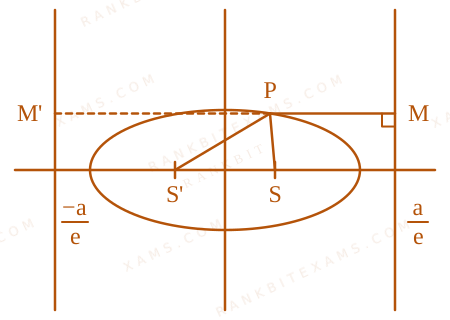
If S$S$ and S'$S'$ are the foci of the ellipse fracx^218 + fracy^29 = 1$\frac{x^2}{18} + \frac{y^2}{9} = 1$ and P$P$ be a point on the ellipse, then min(SP cdot S'P) + max(SP cdot S'P)$\min(SP \cdot S'P) + \max(SP \cdot S'P)$ is equal to:
A.3(1+sqrt2)$3(1+\sqrt{2})$
B.3(6+sqrt2)$3(6+\sqrt{2})$
C.9$9$
D.27$27$
Solution
### Related Formula
Focal distances of any point P(acostheta, bsintheta)$P(a\cos\theta, b\sin\theta)$ on an ellipse are given by:
SP = a - ex_P = a(1 - ecostheta)$SP = a - ex_P = a(1 - e\cos\theta)$S'P = a + ex_P = a(1 + ecostheta)$S'P = a + ex_P = a(1 + e\cos\theta)$
Product of focal distances:
SP cdot S'P = a^2(1 - e^2cos^2theta) = a^2 - e^2x_P^2$SP \cdot S'P = a^2(1 - e^2\cos^2\theta) = a^2 - e^2x_P^2$
### Core Logic
Compute the eccentricity e$e$, express the product SP cdot S'P$SP \cdot S'P$ in terms of cos^2theta$\cos^2\theta$, and analyze its bounds across the domain to find minimum and maximum limits. Properties of Ellipse diagram for Q66 - JEE Main 2025 Morning
### Step 1: Determine Ellipse Parameters
Given a^2 = 18$a^2 = 18$ and b^2 = 9$b^2 = 9$.
b^2 = a^2(1 - e^2) implies 9 = 18(1 - e^2) implies 1 - e^2 = frac12 implies e = frac1sqrt10$b^2 = a^2(1 - e^2) \implies 9 = 18(1 - e^2) \implies 1 - e^2 = \frac{1}{2} \implies e = \frac{1}{\sqrt{10}}$
### Step 2: Express Focal Product
The parametric coordinates are P(3sqrt2costheta, 3sintheta)$P(3\sqrt{2}\cos\theta, 3\sin\theta)$.
SP cdot S'P = a^2 - (ae)^2cos^2theta$SP \cdot S'P = a^2 - (ae)^2\cos^2\theta$
Since a^2=18$a^2=18$ and (ae)^2 = a^2-b^2 = 18-9 = 9$(ae)^2 = a^2-b^2 = 18-9 = 9$:
SP cdot S'P = 18 - 9cos^2theta$SP \cdot S'P = 18 - 9\cos^2\theta$
### Step 3: Evaluate Extrema and Sum
Since 0 le cos^2theta le 1$0 \le \cos^2\theta \le 1$:
* Maximum value occurs when cos^2theta = 0 implies max = 18$\cos^2\theta = 0 \implies \max = 18$.
* Minimum value occurs when cos^2theta = 1 implies min = 18 - 9 = 9$\cos^2\theta = 1 \implies \min = 18 - 9 = 9$.
textSum = min + max = 9 + 18 = 27$\text{Sum} = \min + \max = 9 + 18 = 27$
### Pattern Recognition
The product of focal distances can also be written directly as b^2$b^2$ at the minor axis vertices (max) and a^2(1-e^2)$a^2(1-e^2)$ varying down to a^2-c^2$a^2-c^2$. Summing them up yields b^2 + a^2 = 9 + 18 = 27$b^2 + a^2 = 9 + 18 = 27$ instantly.
### Evaluation Rubric / Model Answer
null
### Chapter Mix
Class 11 Mathematics: Conic Sections
Q2025Properties of Parabola
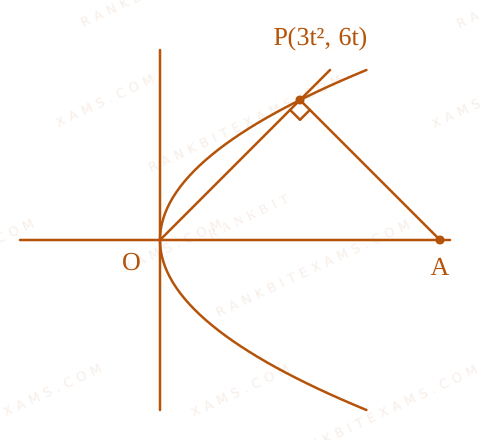
Let the focal chord PQ$PQ$ of the parabola y^2 = 4x$y^2 = 4x$ make an angle of 60^circ$60^\circ$ with the positive x$x$-axis, where P$P$ lies in the first quadrant. If the circle, whose one diameter is PS$PS$, S$S$ being the focus of the parabola, touches the y$y$-axis at the point (0, a)$(0, a)$, then 5a^2$5a^2$ is equal to:
A.15$15$
B.25$25$
C.30$30$
D.20$20$
Solution
### Related Formula
For a standard parabola y^2 = 4ax$y^2 = 4ax$:
Focus: S(a, 0)$S(a, 0)$
Parametric coordinates: (at^2, 2at)$(at^2, 2at)$
Equation of a circle on diametric endpoints (x_1, y_1)$(x_1, y_1)$ and (x_2, y_2)$(x_2, y_2)$:
(x - x_1)(x - x_2) + (y - y_1)(y - y_2) = 0$(x - x_1)(x - x_2) + (y - y_1)(y - y_2) = 0$
### Core Logic
Find the point P$P$ using the slope of the focal chord, write the equation of the circle with diameter PS$PS$, and find its y$y$-intercept. Properties of Parabola diagram for Q70 - JEE Main 2025 Morning
### Step 1: Determine P Coordinates
For y^2 = 4x$y^2 = 4x$, parameter a=1 implies S(1,0)$a=1 \implies S(1,0)$ and P(t^2, 2t)$P(t^2, 2t)$.
Slope of focal chord PS$PS$:
tan 60^circ = frac2t - 0t^2 - 1 = sqrt3 implies 2t = sqrt3t^2 - sqrt3$\tan 60^\circ = \frac{2t - 0}{t^2 - 1} = \sqrt{3} \implies 2t = \sqrt{3}t^2 - \sqrt{3}$sqrt3t^2 - 2t - sqrt3 = 0 implies (sqrt3t + 1)(t - sqrt3) = 0$\sqrt{3}t^2 - 2t - \sqrt{3} = 0 \implies (\sqrt{3}t + 1)(t - \sqrt{3}) = 0$
Since P$P$ is in the first quadrant, t > 0 implies t = sqrt3$t > 0 \implies t = \sqrt{3}$.
Thus, P((sqrt3)^2, 2sqrt3) = P(3, 2sqrt3)$P((\sqrt{3})^2, 2\sqrt{3}) = P(3, 2\sqrt{3})$.
### Step 2: Construct the Diametric Circle Equation
Endpoints are S(1,0)$S(1,0)$ and P(3, 2sqrt3)$P(3, 2\sqrt{3})$:
(x - 1)(x - 3) + (y - 0)(y - 2sqrt3) = 0$(x - 1)(x - 3) + (y - 0)(y - 2\sqrt{3}) = 0$
### Step 3: Solve for y-intercept
The circle touches/intersects the y$y$-axis at x = 0$x = 0$:
(0 - 1)(0 - 3) + y(y - 2sqrt3) = 0 implies 3 + y^2 - 2sqrt3y = 0$(0 - 1)(0 - 3) + y(y - 2\sqrt{3}) = 0 \implies 3 + y^2 - 2\sqrt{3}y = 0$
This is a perfect square expression (y - sqrt3)^2 = 0 implies y = sqrt3$(y - \sqrt{3})^2 = 0 \implies y = \sqrt{3}$.
Thus, the intercept value is a = sqrt3$a = \sqrt{3}$.
### Step 4: Compute Final Target Value
5a^2 = 5(sqrt3)^2 = 15$5a^2 = 5(\sqrt{3})^2 = 15$
### Pattern Recognition
A circle whose diameter is a focal radius always touches the tangent at the vertex (y$y$-axis for a standard parabola). The coordinate of the contact point is simply given by a t = 1 cdot sqrt3 = sqrt3$a t = 1 \cdot \sqrt{3} = \sqrt{3}$, bypasses the full equation construction entirely.
### Evaluation Rubric / Model Answer
null
### Chapter Mix
Class 11 Mathematics: Conic Sections
More Conic Sections Questions — jee_main_2025_03_april_morning
We Map Every Repeating Question in Competitive Exams.
Say goodbye to generic mock test fatigue. RankBit uses smart analysis to group past exam questions into their foundational Repeating Question Types. Find chapter weightage, track repeating questions, and score higher with targeted practice.
Select Your Target Exam
Choose an exam track below to find formulas per chapter and patterns.
Syncing Exam Intelligence
Mapping formulas and patterns across all tracks…
PATH A — FULL LENGTH PRACTICE
Full Mock Test Hub
Simulate real NTA exam conditions with fully tracked mocks. Time yourself against past papers.
Under Development
PATH B — TARGETED PRACTICE
Topic-wise Practice Hub
Practice past-year questions one chapter at a time. Pick an exam → subject → chapter and get every PYQ for that topic — pulled together from all past papers — with the chapter's key formulas alongside.