Q11
jee_main_2026_21_jan_morning
Coinciding Foci of Ellipse and Hyperbola
Let the foci of hyperbola coincide with the foci of the ellipse (x²)/(36) +(y²)/(16) = 1 . If the eccentricity of the hyperbola is 5, then the length of its latus rectum is:
Solution
Related Formula
Eccentricity of ellipse e₁ = √(1 - (b²)/(a²)) Foci = (± ae₁, 0) Length of Latus Rectum of hyperbola = 2bhyp²ahypCore Logic
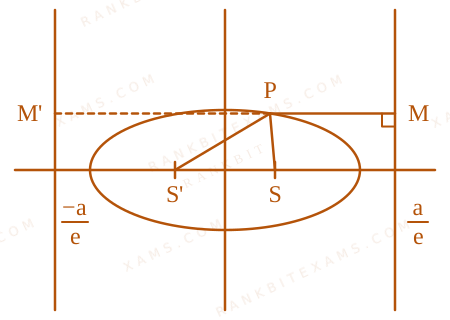
For the given ellipse (x²)/(36) + (y²)/(16) = 1: a² = 36 ⇒ a = 6 b² = 16
e₁ = √(1 - (16)/(36)) = √(1 - (4)/(9)) = √(5)3Foci of the ellipse are at (± ae₁, 0) = (± 6 · √(5)3, 0) = (± 2√(5), 0).
Step 1: Establish Hyperbola Parameters
Let the hyperbola be (x²)/(p²) - (y²)/(q²) = 1. Its foci coincide with the ellipse, so the foci of hyperbola are also (± 2√(5), 0). Let e be the eccentricity of the hyperbola. We are given e = 5. Focus of hyperbola is pe = 2√(5).
p(5) = 2√(5) ⇒ p = 2√(5)5 = 2√(5)Step 2: Find the Conjugate Axis (q)
For the hyperbola:
e² = 1 + (q²)/(p²) 25 = 1 + q²( 2√(5))² 24 = (q²)/(4/5) ⇒ 24 = (5q²)/(4) 5q² = 96 ⇒ q² = (96)/(5)Step 3: Calculate Latus Rectum
Length of Latus Rectum = (2q²)/(p)
= 2 ((96)/(5)) 2√(5) = (96)/(5) × √(5) = 96√(5)Pattern Recognition
Co-focal conics share the exact mathematical value of their focal length ae (or pe). Instantly extract c = ae from the first shape and map it directly to c = pe for the second.
Chapter Mix
Class 11 Maths: Conic Sections