Let C:x^2+y^2=4 and C^prime:x^2+y^2-4lambda x+9=0 be two circles. If the set of all values of lambda so that the circles C and C' intersect at two distinct points, is R - [a, b], then the point (8a+12,16b-20) lies on the curve:

Solution & Explanation

### Related Formula For two circles with centers C_1, C_2 and radii r_1, r_2 to intersect at two distinct real points, the distance between their centers must satisfy: |r_1 - r_2| < C_1C_2 < r_1 + r_2 ### Core Logic Extracting properties from the circle equations: - Circle C: x^2 + y^2 = 4 implies Center C_1 = (0,0), Radius r_1 = 2 - Circle C': x^2 + y^2 - 4lambda x + 9 = 0 implies Center C_2 = (2lambda, 0), Radius r_2 = sqrt(-2lambda)^2 - 9 = sqrt4lambda^2 - 9 For real intersection conditions, the radius must be defined: 4lambda^2 - 9 > 0 implies lambda^2 > frac94 quad implies (1) Distance between centers: C_1C_2 = sqrt(2lambda - 0)^2 + 0^2 = |2lambda|. ### Step 1: Formulate the Triangle Inequality Solutions Applying the intersection condition: |2 - sqrt4lambda^2 - 9| < |2lambda| < 2 + sqrt4lambda^2 - 9 The right side inequality |2lambda| < 2 + sqrt4lambda^2 - 9 is always valid for real radii. Solving the left side inequality by squaring: left(2 - sqrt4lambda^2 - 9right)^2 < (2lambda)^2 4 + (4lambda^2 - 9) - 4sqrt4lambda^2 - 9 < 4lambda^2 -5 - 4sqrt4lambda^2 - 9 < 0 implies 4sqrt4lambda^2 - 9 > -5 Since a square root is always non-negative, square both sides to get the strict bound: 16(4lambda^2 - 9) > 25 implies 64lambda^2 - 144 > 25 64lambda^2 > 169 implies lambda^2 > frac16964 quad implies (2) Combining bounds (1) and (2), condition (2) is more restrictive, meaning: lambda in left(-infty, -frac138right) cup left(frac138, inftyright) This can be written as mathbbR - left[-frac138, frac138right]. ### Step 2: Coordinate Analysis of the Target Point Comparing our interval with mathbbR - [a, b], we identify: a = -frac138, quad b = frac138 Now, substitute these bounds to locate the coordinates of our target point (8a+12, \, 16b-20): - x-coordinate: 8left(-frac138right) + 12 = -13 + 12 = -1 - y-coordinate: 16left(frac138right) - 20 = 26 - 20 = 6 Hence, the point is (-1, 6). ### Step 3: Test Point against the Options Substitute (-1, 6) into the given curves to find a match: Testing Option (4): 6x^2 + y^2 = 42 6(-1)^2 + (6)^2 = 6(1) + 36 = 42 Since LHS = RHS, the point satisfies the curve in Option (4). ### Pattern Recognition Sees: Dynamic variable interval limits forming loci requirements. Shortcut: When checking inequalities like |2 - sqrtz| < 2lambda, algebraic squaring helps simplify the terms quickly by eliminating the parameter 4lambda^2 from both sides. ### Evaluation Rubric / Model Answer null ### Chapter Mix Class 11 Mathematics: Conic Sections (Circles) Class 11 Mathematics: Linear Inequalities
Reference Study Guides

More Conic Sections Previous-Year Questions

Q11 jee_main_2026_21_jan_morning Coinciding Foci of Ellipse and Hyperbola
Let the foci of hyperbola coincide with the foci of the ellipse fracx^236 +fracy^216 = 1 . If the eccentricity of the hyperbola is 5, then the length of its latus rectum is:
  • A. 12
  • B. 16
  • C. frac96sqrt5
  • D. 24sqrt5

Solution

### Related Formula textEccentricity of ellipse e_1 = sqrt1 - fracb^2a^2 textFoci = (pm ae_1, 0) textLength of Latus Rectum of hyperbola = frac2b_hyp^2a_hyp ### Core Logic For the given ellipse fracx^236 + fracy^216 = 1: a^2 = 36 Rightarrow a = 6 b^2 = 16 e_1 = sqrt1 - frac1636 = sqrt1 - frac49 = fracsqrt53 Foci of the ellipse are at (pm ae_1, 0) = left(pm 6 cdot fracsqrt53, 0right) = (pm 2sqrt5, 0). ### Step 1: Establish Hyperbola Parameters Let the hyperbola be fracx^2p^2 - fracy^2q^2 = 1. Its foci coincide with the ellipse, so the foci of hyperbola are also (pm 2sqrt5, 0). Let e be the eccentricity of the hyperbola. We are given e = 5. Focus of hyperbola is pe = 2sqrt5. p(5) = 2sqrt5 Rightarrow p = frac2sqrt55 = frac2sqrt5 ### Step 2: Find the Conjugate Axis (q) For the hyperbola: e^2 = 1 + fracq^2p^2 25 = 1 + fracq^2left(frac2sqrt5right)^2 24 = fracq^24/5 Rightarrow 24 = frac5q^24 5q^2 = 96 Rightarrow q^2 = frac965 ### Step 3: Calculate Latus Rectum Length of Latus Rectum = frac2q^2p = frac2 left(frac965right)frac2sqrt5 = frac965 times sqrt5 = frac96sqrt5 ### Pattern Recognition Co-focal conics share the exact mathematical value of their focal length ae (or pe). Instantly extract c = ae from the first shape and map it directly to c = pe for the second. ### Evaluation Rubric / Model Answer null ### Chapter Mix Class 11 Maths: Conic Sections
Q20 jee_main_2026_21_jan_morning Locus of Internal Section Point
Let O be the vertex of the parabola x^2=4y and Q be any point on it. Let the locus of the point P, which divides the line segment OQ internally in the ratio 2: 3 be the conic C. Then the equation of the chord of C, which is bisected at the point (1, 2), is:
  • A. 5x-y-3=0
  • B. 4x-5y+6=0
  • C. x-2y + 3 = 0
  • D. 5x-4y+3=0

Solution

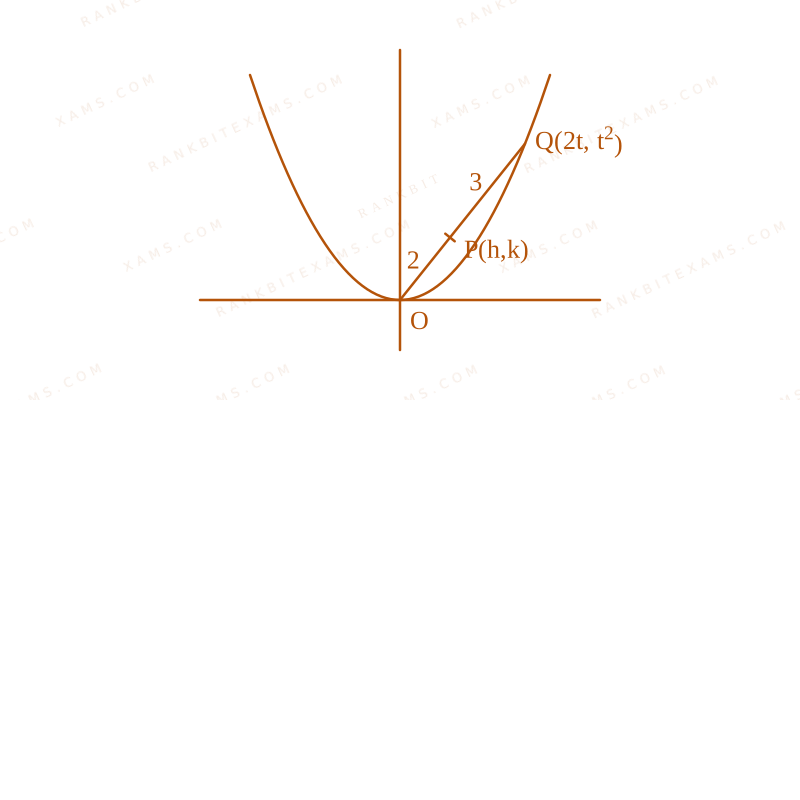
### Related Formula textSection Formula: quad P = fracm cdot Q + n cdot Om + n textChord bisected at (x_1, y_1) : quad T = S_1 ### Core Logic Given parabola x^2 = 4y, its vertex O = (0, 0). A general point Q on x^2 = 4y is (2t, t^2). Let P(h, k) divide OQ in ratio 2:3. By section formula: h = frac2(2t) + 3(0)5 = frac4t5 k = frac2(t^2) + 3(0)5 = frac2t^25
Locus of point dividing parabolic chord for Q20 - JEE Main 2026 Morning
### Step 1: Finding the Locus C From h = frac4t5, we get t = frac5h4. Substitute into k: k = frac25 left(frac5h4right)^2 = frac25 cdot frac25h^216 = frac5h^28 8k = 5h^2 Rightarrow 5x^2 = 8y So the conic C is the parabola 5x^2 = 8y. ### Step 2: Chord bisected at a point We need the equation of the chord of C: 5x^2 - 8y = 0 bisected at (x_1, y_1) = (1, 2). Use T = S_1. T = 5xx_1 - 4(y + y_1) = 5x(1) - 4(y + 2) = 5x - 4y - 8 S_1 = 5(1)^2 - 8(2) = 5 - 16 = -11 Equating T and S_1: 5x - 4y - 8 = -11 5x - 4y + 3 = 0 ### Pattern Recognition Internal division locus of a vertex chord on standard conic identically scales the conic. Once the child-conic is found, standard mid-point chord protocol (T=S_1) strictly applies algebraically. ### Evaluation Rubric / Model Answer null ### Chapter Mix Class 11 Maths: Parabola Class 11 Maths: Straight Lines
Q55 jee_main_2025_02_april_evening Ellipse
If the length of the minor axis of an ellipse is equal to one fourth of the distance between the foci, then the eccentricity of the ellipse is :
  • A. frac4sqrt17
  • B. fracsqrt316
  • C. frac3sqrt19
  • D. fracsqrt57

Solution

### Related Formula textLength of minor axis = 2b textDistance between foci = 2ae textEccentricity: e = sqrt1 - fracb^2a^2 ### Core Logic We set up an algebraic equation relating b, a, and e from the given geometric condition, then substitute it into the eccentricity identity. ### Step 1: Set up the geometric relation Given that 2b = frac14 (2ae): b = fracae4 implies fracba = frace4 Square both sides: fracb^2a^2 = frace^216 ### Step 2: Solve for eccentricity Using the eccentricity relation: e^2 = 1 - fracb^2a^2 e^2 = 1 - frace^216 e^2 left(1 + frac116right) = 1 frac1716 e^2 = 1 implies e^2 = frac1617 implies e = frac4sqrt17 ### Pattern Recognition Standard Ellipse relations: For standard ellipses, the ratio of axes and the eccentricity are coupled quadratic equations. Expressing b/a as a function of e allows direct solving of the eccentricity. ### Evaluation Rubric / Model Answer null ### Chapter Mix Class 11 Mathematics: Conic Sections
Q67 jee_main_2025_02_april_evening Parabola
Let the point mathrmP of the focal chord mathrmPQ of the parabola mathrmy^2 = 16mathrmx be (1, -4). If the focus of the parabola divides the chord mathrmPQ in the ratio mathrmm : mathrmn, gcd(mathrmm, mathrmn) = 1, then mathrmm^2 + mathrmn^2 is equal to:
  • A. 17
  • B. 10
  • C. 37
  • D. 26

Solution

### Related Formula textParametric coordinates on y^2 = 4ax: quad (at^2, \, 2at) textFocal Chord relation: t_1 t_2 = -1 textSection Formula: (x_c, y_c) = left( fracm x_2 + n x_1m+n, \, fracm y_2 + n y_1m+n right) ### Core Logic We find the parametric parameters of coordinates P and Q, obtain their Cartesian values, and then apply the section formula with the focus S to calculate the splitting ratio. ### Step 1: Find coordinates of P and Q For parabola y^2 = 16x, the focal parameter is a = 4. Focus is S(4, 0). Let P be (a t_1^2, 2a t_1) = (1, -4): 2a t_1 = -4 implies 2(4) t_1 = -4 implies t_1 = -frac12 Since PQ is a focal chord, the parametric points are coupled: t_1 t_2 = -1 implies t_2 = 2 Now, calculate the coordinates of Q: Q equiv (a t_2^2, \, 2 a t_2) = (4(4), \, 2(4)(2)) = (16, \, 16) ### Step 2: Solve for the dividing ratio Let the focus S(4, 0) divide the line segment PQ internally in the ratio lambda : 1. Using the y-coordinate of the section formula: y_s = fraclambda y_q + 1 y_plambda + 1 0 = fraclambda(16) + 1(-4)lambda + 1 implies 16lambda - 4 = 0 implies lambda = frac14 Thus, the focus S divides the chord internally in the ratio 1:4. Since gcd(1, 4) = 1, we have m = 1 and n = 4: m^2 + n^2 = 1^2 + 4^2 = 1 + 16 = 17 ### Pattern Recognition Harmonic Mean Shortcut: In any parabola, the focus divides a focal chord internally into segments of lengths SP and SQ such that the semi-latus rectum 2a is the harmonic mean of these segments: frac1SP + frac1SQ = frac1a. ### Evaluation Rubric / Model Answer null ### Chapter Mix Class 11 Mathematics: Conic Sections
Q jee_main_2025_02_april_morning Properties of Hyperbola
Let one focus of the hyperbola H: fracx^2a^2 - fracy^2b^2 = 1 be at (sqrt10, 0) and the corresponding directrix be x = frac9sqrt10. If e and l respectively are the eccentricity and the length of the latus rectum of H, then 9(e^2 + l) is equal to:
  • A. 14
  • B. 15
  • C. 16
  • D. 12

Solution

### Related Formula For a standard hyperbola: Focus: (pm ae, 0) Directrix: x = pm fracae Eccentricity relation: (ae)^2 = a^2 + b^2 Length of latus rectum: l = frac2b^2a ### Core Logic Given ae = sqrt10 and fracae = frac9sqrt10. Multiplying these gives a^2, which determines both parameters. ### Step 1: Find a and e a^2 = (ae) cdot left(fracaeright) = sqrt10 cdot frac9sqrt10 = 9 implies a = 3 Substitute a = 3 into ae = sqrt10: e = fracsqrt103 implies e^2 = frac109 ### Step 2: Find b and l Using (ae)^2 = a^2 + b^2: 10 = 9 + b^2 implies b^2 = 1 Then the length of latus rectum l is: l = frac2b^2a = frac2(1)3 = frac23 ### Step 3: Evaluate Final Expression Calculate 9(e^2 + l): 9left(frac109 + frac23right) = 10 + 6 = 16 ### Pattern Recognition Multiplying focus location by directrix location immediately eliminates e, giving a^2 directly. Once a^2 is known, b^2 follow seamlessly via (ae)^2 = a^2+b^2. ### Evaluation Rubric / Model Answer null ### Chapter Mix Class 11 Mathematics: Conic Sections

More Conic Sections Questions — jee_main_2024_01_february_morning

Practice all Conic Sections previous-year questions →

Rankbit System
JEE Physics: Waves (+15.5%) | Electrostatics: Concentric Shells (-29.7%) | Modern Physics: Photoelectric Clones (+34.2%) | Mathematics: Definite Integrals (+18.1%) | Chemistry: Coordination Splitting (-11.4%) | JEE Physics: Waves (+15.5%) | Electrostatics: Concentric Shells (-29.7%) | Modern Physics: Photoelectric Clones (+34.2%) | Mathematics: Definite Integrals (+18.1%) | Chemistry: Coordination Splitting (-11.4%)