Let r be the radius of the circle, which touches x -axis at point (a, 0) , a < 0 and the parabola y^2 = 9x at the point (4, 6) . Then r is equal to

Numerical Answer Type:
Enter a numerical value Answer: 30 to 30 +4 marks

Solution & Explanation

### Related Formula textTangent line at point (x_1, y_1) implies yy_1 = 2a(x+x_1) ### Core Logic Establish the tangent vector expression at the parabola intersection mark. Since this path line functions as a shared contact tangent boundaries sheet for the circular arc, impose radius equations. ### Step 1: Derive Shared Parabola Tangent Line Tangent line profile for y^2 = 9x at coordinate indicator (4,6): 6y = 9 cdot left( fracx+42 right) implies 3x - 4y + 12 = 0 ### Step 2: Build Geometric Metric Connections Circle touches axis at (a,0), mapping coordinates center directly to C(a,r). Perpendicular boundary constraint steps require: frac3a - 4r + 125 = pm r implies 3a + 12 = 4r pm 5r ### Step 3: Solve for Radius Matrix Bounds Enforce circle equation intersection constraint profile (x-a)^2 + (y-r)^2 = r^2 at point (4,6): a^2 - 8a - 12r + 52 = 0 Evaluating the target systems from structural logic tracks rejects positive value parameters, providing: a = -14, quad r = 30 {{SOL_IMG_75}} ### Pattern Recognition Shared tangent elements connect independent conic fields. Locating circular center boundaries using axial coordinate tracking simplifies secondary equations. ### Evaluation Rubric / Model Answer null ### Chapter Mix Class 11 Mathematics: Conic Sections Class 11 Mathematics: Circles
Tangent to Parabola and Circle Properties diagram for Q75 - JEE Main 2025 Evening

Reference Study Guides

More Conic Sections Previous-Year Questions — Page 11

Q14 jee_main_2024_30_jan_morning Intersection of Two Circles
If the circles (x + 1)^2 + (y + 2)^2 = r^2 and x^2 + y^2 - 4x - 4y + 4 = 0 intersect at exactly two distinct points, then
  • A. 5 < r < 9
  • B. 0 < r < 7
  • C. 3 < r < 7
  • D. frac12 < r < 7

Solution

### Related Formula |r_1 - r_2| < C_1 C_2 < r_1 + r_2 where C_1 C_2 is the distance between the centers and r_1, r_2 are the radii. ### Core Logic Circle 1: (x + 1)^2 + (y + 2)^2 = r^2 Center C_1(-1, -2), Radius r_1 = r Circle 2: x^2 + y^2 - 4x - 4y + 4 = 0 Convert to standard form: (x - 2)^2 - 4 + (y - 2)^2 - 4 + 4 = 0 Rightarrow (x - 2)^2 + (y - 2)^2 = 4 Center C_2(2, 2), Radius r_2 = 2 ### Step 1: Distance between centers Distance C_1C_2 = sqrt(2 - (-1))^2 + (2 - (-2))^2 = sqrt3^2 + 4^2 = sqrt9 + 16 = 5. ### Step 2: Applying inequality condition For exactly two intersection points: |r_1 - r_2| < C_1 C_2 < r_1 + r_2 |r - 2| < 5 < r + 2 Part A: r + 2 > 5 Rightarrow r > 3 quad dots (1) Part B: |r - 2| < 5 -5 < r - 2 < 5 -3 < r < 7 quad dots (2) ### Step 3: Intersection of inequalities Taking the intersection of (1) and (2): r in (3, infty) cap (-3, 7) = (3, 7) 3 < r < 7 ### Pattern Recognition Intersecting circles always strictly obey the triangle inequality formed by their radii and the distance between their centers. ### Evaluation Rubric / Model Answer null ### Chapter Mix Class 11 Maths: Conic Sections
Q15 jee_main_2024_30_jan_morning Ellipse Eccentricity
If the length of the minor axis of ellipse is equal to half of the distance between the foci, then the eccentricity of the ellipse is:
  • A. fracsqrt53
  • B. fracsqrt32
  • C. frac1sqrt3
  • D. frac2sqrt5

Solution

### Related Formula b^2 = a^2(1 - e^2) Length of minor axis = 2b Distance between foci = 2ae ### Core Logic Given condition: Length of minor axis = Half of the distance between foci. 2b = frac12(2ae) 2b = ae fracba = frace2 ### Step 1: Squaring and finding eccentricity Squaring both sides: fracb^2a^2 = frace^24 We know fracb^2a^2 = 1 - e^2. 1 - e^2 = frace^24 1 = e^2 + frace^24 = frac5e^24 e^2 = frac45 e = frac2sqrt5 ### Pattern Recognition Proportional relationships between a, b, and ae in an ellipse can be immediately plugged into the fundamental identity b^2 = a^2(1-e^2). ### Evaluation Rubric / Model Answer null ### Chapter Mix Class 11 Maths: Conic Sections
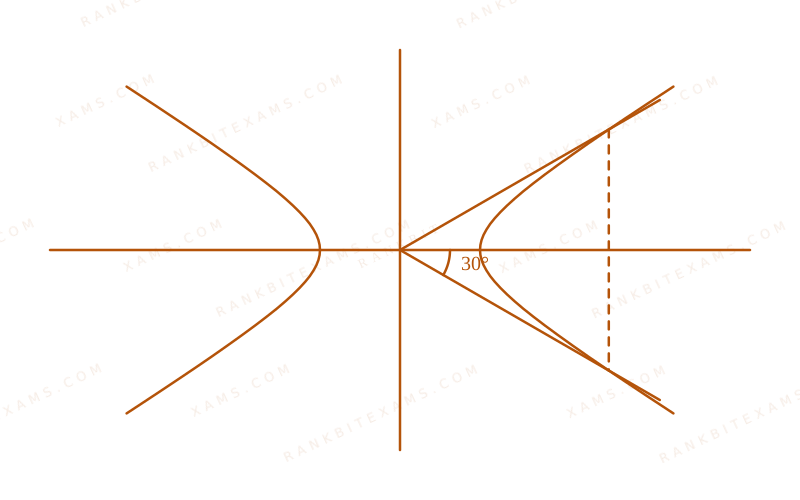
Q23 jee_main_2024_30_jan_morning Hyperbola
Let the latus rectum of the hyperbola fracx^29 - fracy^2b^2 = 1 subtend an angle of fracpi3 at the centre of the hyperbola. If b^2 is equal to fraclm(1 + sqrtn), where l and m are co-prime numbers, then l^2 + m^2 + n^2 is equal to
Numerical Answer. Answer: 182 to 182

Solution

### Related Formula Latus Rectum = frac2b^2a e^2 = 1 + fracb^2a^2 ### Core Logic
Hyperbola diagram for Q23 - JEE Main 2024 Morning
The endpoints of the latus rectum are (ae, fracb^2a) and (ae, -fracb^2a). It subtends 60^circ at the center (0,0). By symmetry, the line connecting the center to (ae, fracb^2a) makes an angle of 30^circ with the x-axis. tan 30^circ = fracfracb^2aae = fracb^2a^2e = frac1sqrt3 ### Step 1: Expressing e in terms of b Given a^2 = 9, so a = 3. fracb^29e = frac1sqrt3 Rightarrow e = fracsqrt3b^29 ### Step 2: Applying eccentricity relation We know e^2 = 1 + fracb^29. Substitute e: left(fracsqrt3b^29right)^2 = 1 + fracb^29 frac3b^481 = 1 + fracb^29 fracb^427 = frac9 + b^29 b^4 = 3(9 + b^2) = 27 + 3b^2 b^4 - 3b^2 - 27 = 0 ### Step 3: Solving for b^2 Using the quadratic formula for b^2: b^2 = frac3 pm sqrt9 - 4(1)(-27)2 = frac3 pm sqrt9 + 1082 = frac3 pm sqrt1172 Since b^2 > 0: b^2 = frac3 + 3sqrt132 = frac32(1 + sqrt13) Comparing this to fraclm(1 + sqrtn): l = 3, m = 2, n = 13. ### Step 4: Final calculation Target: l^2 + m^2 + n^2 = 3^2 + 2^2 + 13^2 = 9 + 4 + 169 = 182 ### Pattern Recognition Whenever an angle is subtended at the origin symmetrically, use half the angle mapping to the tangent of the coordinate ratio (y/x). ### Evaluation Rubric / Model Answer null ### Chapter Mix Class 11 Maths: Conic Sections

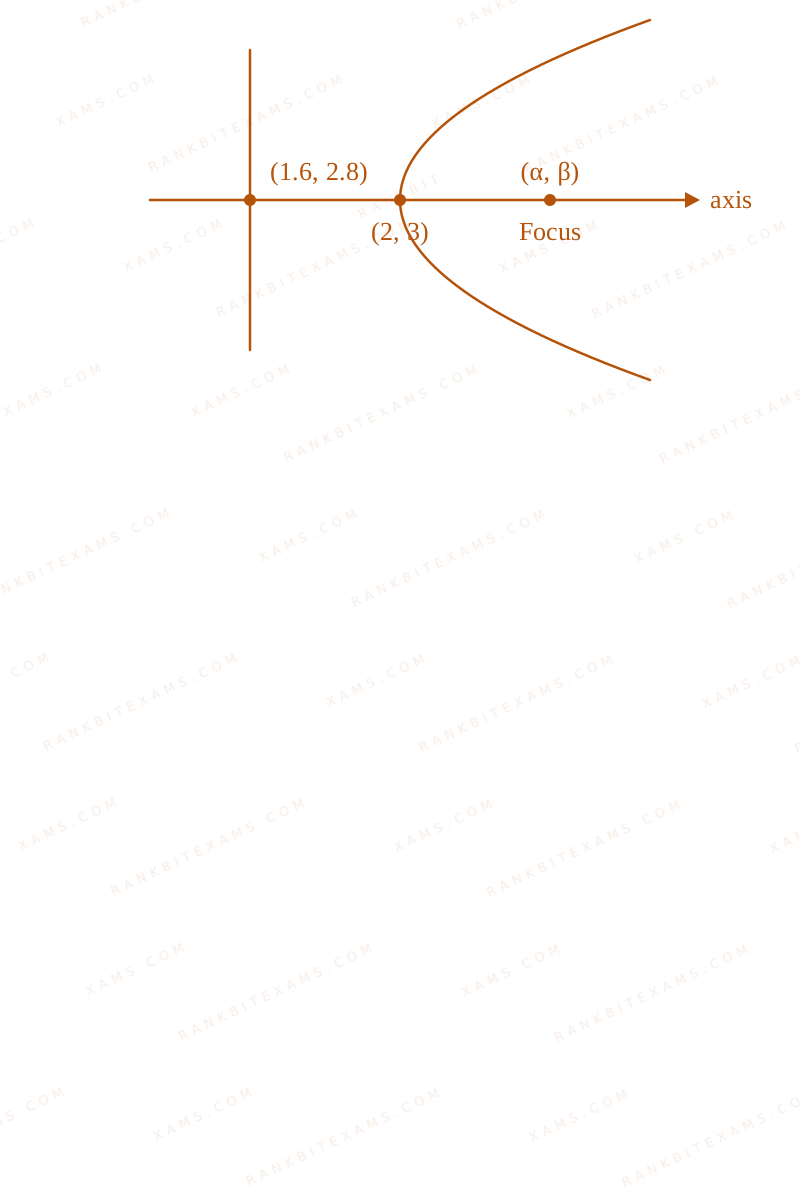
Q7 jee_main_2024_31_jan_evening Parabola and Ellipse intersection
Let P be a parabola with vertex (2, 3) and directrix 2x + y = 6. Let an ellipse E:fracx^2a^2 +fracy^2b^2 = 1,a > b of eccentricity frac1sqrt2 pass through the focus of the parabola P. Then the square of the length of the latus rectum of E, is
  • A. frac3858
  • B. frac3478
  • C. frac51225
  • D. frac65625

Solution

### Related Formula textLength of Latus Rectum of Ellipse = frac2b^2a e = sqrt1 - fracb^2a^2 ### Core Logic
Parabola and Ellipse intersection diagram for Q7 - JEE Main 2024 Evening
Directrix of parabola is 2x + y - 6 = 0. Axis is perpendicular to directrix and passes through vertex V(2,3). Slope of axis = 1/2. Equation of axis: y - 3 = frac12(x - 2) implies x - 2y + 4 = 0. Intersection of axis and directrix is K: 2x + y = 6 x - 2y = -4 Solving, K = (8/5, 14/5) = (1.6, 2.8). Vertex V(2,3) is the midpoint of focus S(alpha, beta) and K(1.6, 2.8): fracalpha + 1.62 = 2 implies alpha = 2.4 fracbeta + 2.82 = 3 implies beta = 3.2 So, focus S = (2.4, 3.2). Ellipse passes through S(2.4, 3.2): frac(2.4)^2a^2 + frac(3.2)^2b^2 = 1 Eccentricity e = frac1sqrt2 implies 1 - fracb^2a^2 = frac12 implies a^2 = 2b^2. Substitute a^2 = 2b^2: frac5.762b^2 + frac10.24b^2 = 1 implies frac2.88 + 10.24b^2 = 1 implies b^2 = 13.12 = frac32825 Square of Latus Rectum: L^2 = left(frac2b^2aright)^2 = frac4b^4a^2 = frac4b^42b^2 = 2b^2 = 2 times frac32825 = frac65625 ### Pattern Recognition Leverage geometry of parabola (Vertex is exactly midway between focus and directrix intersection on the axis) to find coordinate points before substituting into ellipse equation. ### Evaluation Rubric / Model Answer null ### Chapter Mix Class 11 Maths: Conic Sections
Q3 jee_main_2024_31_jan_morning Hyperbola and Ellipse Properties
If the foci of a hyperbola are same as that of the ellipse fracx^29 + fracy^225 = 1 and the eccentricity of the hyperbola is frac158 times the eccentricity of the ellipse, then the smaller focal distance of the point left(sqrt2, frac143sqrtfrac25right) on the hyperbola, is equal to
  • A. 7sqrtfrac25 - frac83
  • B. 14sqrtfrac25 - frac43
  • C. 14sqrtfrac25 - frac163
  • D. 7sqrtfrac25 + frac83

Solution

### Related Formula e = sqrt1 - fraca^2b^2 text (for vertical ellipse) textFocal distance of P(x_1, y_1) text on hyperbola = e_H |y_1 pm fracBe_H| ### Core Logic For the ellipse fracx^29 + fracy^225 = 1: a = 3, b = 5. Since b > a, the major axis is along the y-axis. e = sqrt1 - frac925 = frac45 Foci = (0, pm be) = (0, pm 4). ### Step 1: Hyperbola Properties Eccentricity of hyperbola e_H = frac45 times frac158 = frac32. Let the hyperbola be fracx^2A^2 - fracy^2B^2 = -1 since its foci (0, pm 4) are on the y-axis. Foci B e_H = 4 implies B = frac83. A^2 = B^2(e_H^2 - 1) = frac649left(frac94 - 1right) = frac809. Equation: fracx^280/9 - fracy^264/9 = -1. ### Step 2: Focal Distance Calculation Directrix of hyperbola: y = pm fracBe_H = pm frac169. Smaller focal distance PS = e_H cdot PM, where PM is the distance to the nearer directrix. PS = frac32 left| frac143sqrtfrac25 - frac169 right| = 7sqrtfrac25 - frac83 ### Pattern Recognition Smaller focal distance of a point (x_1, y_1) on a vertical hyperbola is given by e|y_1 - fracbe| where y_1 > 0 and we use the positive directrix. ### Evaluation Rubric / Model Answer null ### Chapter Mix Class 11 Maths: Conic Sections

More Conic Sections Questions — jee_main_2025_08_april_evening

Practice all Conic Sections previous-year questions →

Rankbit System
JEE Physics: Waves (+15.5%) | Electrostatics: Concentric Shells (-29.7%) | Modern Physics: Photoelectric Clones (+34.2%) | Mathematics: Definite Integrals (+18.1%) | Chemistry: Coordination Splitting (-11.4%) | JEE Physics: Waves (+15.5%) | Electrostatics: Concentric Shells (-29.7%) | Modern Physics: Photoelectric Clones (+34.2%) | Mathematics: Definite Integrals (+18.1%) | Chemistry: Coordination Splitting (-11.4%)