Let the foci of hyperbola coincide with the foci of the ellipse fracx^236 +fracy^216 = 1 . If the eccentricity of the hyperbola is 5, then the length of its latus rectum is:

Solution & Explanation

### Related Formula textEccentricity of ellipse e_1 = sqrt1 - fracb^2a^2 textFoci = (pm ae_1, 0) textLength of Latus Rectum of hyperbola = frac2b_hyp^2a_hyp ### Core Logic For the given ellipse fracx^236 + fracy^216 = 1: a^2 = 36 Rightarrow a = 6 b^2 = 16 e_1 = sqrt1 - frac1636 = sqrt1 - frac49 = fracsqrt53 Foci of the ellipse are at (pm ae_1, 0) = left(pm 6 cdot fracsqrt53, 0right) = (pm 2sqrt5, 0). ### Step 1: Establish Hyperbola Parameters Let the hyperbola be fracx^2p^2 - fracy^2q^2 = 1. Its foci coincide with the ellipse, so the foci of hyperbola are also (pm 2sqrt5, 0). Let e be the eccentricity of the hyperbola. We are given e = 5. Focus of hyperbola is pe = 2sqrt5. p(5) = 2sqrt5 Rightarrow p = frac2sqrt55 = frac2sqrt5 ### Step 2: Find the Conjugate Axis (q) For the hyperbola: e^2 = 1 + fracq^2p^2 25 = 1 + fracq^2left(frac2sqrt5right)^2 24 = fracq^24/5 Rightarrow 24 = frac5q^24 5q^2 = 96 Rightarrow q^2 = frac965 ### Step 3: Calculate Latus Rectum Length of Latus Rectum = frac2q^2p = frac2 left(frac965right)frac2sqrt5 = frac965 times sqrt5 = frac96sqrt5 ### Pattern Recognition Co-focal conics share the exact mathematical value of their focal length ae (or pe). Instantly extract c = ae from the first shape and map it directly to c = pe for the second. ### Evaluation Rubric / Model Answer null ### Chapter Mix Class 11 Maths: Conic Sections

Reference Study Guides

More Conic Sections Previous-Year Questions

Q20 jee_main_2026_21_jan_morning Locus of Internal Section Point
Let O be the vertex of the parabola x^2=4y and Q be any point on it. Let the locus of the point P, which divides the line segment OQ internally in the ratio 2: 3 be the conic C. Then the equation of the chord of C, which is bisected at the point (1, 2), is:
  • A. 5x-y-3=0
  • B. 4x-5y+6=0
  • C. x-2y + 3 = 0
  • D. 5x-4y+3=0

Solution

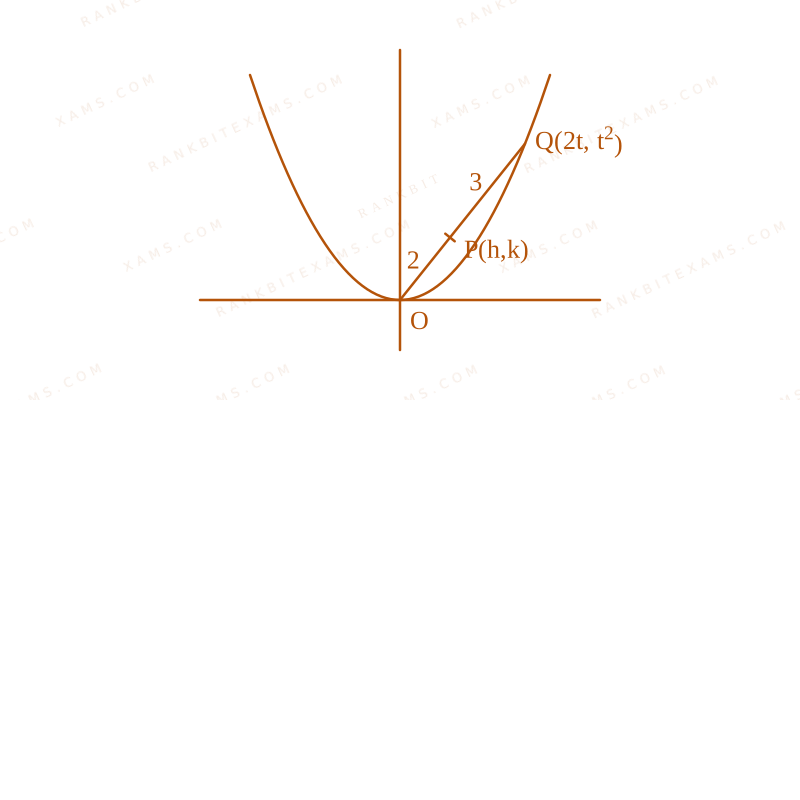
### Related Formula textSection Formula: quad P = fracm cdot Q + n cdot Om + n textChord bisected at (x_1, y_1) : quad T = S_1 ### Core Logic Given parabola x^2 = 4y, its vertex O = (0, 0). A general point Q on x^2 = 4y is (2t, t^2). Let P(h, k) divide OQ in ratio 2:3. By section formula: h = frac2(2t) + 3(0)5 = frac4t5 k = frac2(t^2) + 3(0)5 = frac2t^25
Locus of point dividing parabolic chord for Q20 - JEE Main 2026 Morning
### Step 1: Finding the Locus C From h = frac4t5, we get t = frac5h4. Substitute into k: k = frac25 left(frac5h4right)^2 = frac25 cdot frac25h^216 = frac5h^28 8k = 5h^2 Rightarrow 5x^2 = 8y So the conic C is the parabola 5x^2 = 8y. ### Step 2: Chord bisected at a point We need the equation of the chord of C: 5x^2 - 8y = 0 bisected at (x_1, y_1) = (1, 2). Use T = S_1. T = 5xx_1 - 4(y + y_1) = 5x(1) - 4(y + 2) = 5x - 4y - 8 S_1 = 5(1)^2 - 8(2) = 5 - 16 = -11 Equating T and S_1: 5x - 4y - 8 = -11 5x - 4y + 3 = 0 ### Pattern Recognition Internal division locus of a vertex chord on standard conic identically scales the conic. Once the child-conic is found, standard mid-point chord protocol (T=S_1) strictly applies algebraically. ### Evaluation Rubric / Model Answer null ### Chapter Mix Class 11 Maths: Parabola Class 11 Maths: Straight Lines
Q55 jee_main_2025_02_april_evening Ellipse
If the length of the minor axis of an ellipse is equal to one fourth of the distance between the foci, then the eccentricity of the ellipse is :
  • A. frac4sqrt17
  • B. fracsqrt316
  • C. frac3sqrt19
  • D. fracsqrt57

Solution

### Related Formula textLength of minor axis = 2b textDistance between foci = 2ae textEccentricity: e = sqrt1 - fracb^2a^2 ### Core Logic We set up an algebraic equation relating b, a, and e from the given geometric condition, then substitute it into the eccentricity identity. ### Step 1: Set up the geometric relation Given that 2b = frac14 (2ae): b = fracae4 implies fracba = frace4 Square both sides: fracb^2a^2 = frace^216 ### Step 2: Solve for eccentricity Using the eccentricity relation: e^2 = 1 - fracb^2a^2 e^2 = 1 - frace^216 e^2 left(1 + frac116right) = 1 frac1716 e^2 = 1 implies e^2 = frac1617 implies e = frac4sqrt17 ### Pattern Recognition Standard Ellipse relations: For standard ellipses, the ratio of axes and the eccentricity are coupled quadratic equations. Expressing b/a as a function of e allows direct solving of the eccentricity. ### Evaluation Rubric / Model Answer null ### Chapter Mix Class 11 Mathematics: Conic Sections
Q67 jee_main_2025_02_april_evening Parabola
Let the point mathrmP of the focal chord mathrmPQ of the parabola mathrmy^2 = 16mathrmx be (1, -4). If the focus of the parabola divides the chord mathrmPQ in the ratio mathrmm : mathrmn, gcd(mathrmm, mathrmn) = 1, then mathrmm^2 + mathrmn^2 is equal to:
  • A. 17
  • B. 10
  • C. 37
  • D. 26

Solution

### Related Formula textParametric coordinates on y^2 = 4ax: quad (at^2, \, 2at) textFocal Chord relation: t_1 t_2 = -1 textSection Formula: (x_c, y_c) = left( fracm x_2 + n x_1m+n, \, fracm y_2 + n y_1m+n right) ### Core Logic We find the parametric parameters of coordinates P and Q, obtain their Cartesian values, and then apply the section formula with the focus S to calculate the splitting ratio. ### Step 1: Find coordinates of P and Q For parabola y^2 = 16x, the focal parameter is a = 4. Focus is S(4, 0). Let P be (a t_1^2, 2a t_1) = (1, -4): 2a t_1 = -4 implies 2(4) t_1 = -4 implies t_1 = -frac12 Since PQ is a focal chord, the parametric points are coupled: t_1 t_2 = -1 implies t_2 = 2 Now, calculate the coordinates of Q: Q equiv (a t_2^2, \, 2 a t_2) = (4(4), \, 2(4)(2)) = (16, \, 16) ### Step 2: Solve for the dividing ratio Let the focus S(4, 0) divide the line segment PQ internally in the ratio lambda : 1. Using the y-coordinate of the section formula: y_s = fraclambda y_q + 1 y_plambda + 1 0 = fraclambda(16) + 1(-4)lambda + 1 implies 16lambda - 4 = 0 implies lambda = frac14 Thus, the focus S divides the chord internally in the ratio 1:4. Since gcd(1, 4) = 1, we have m = 1 and n = 4: m^2 + n^2 = 1^2 + 4^2 = 1 + 16 = 17 ### Pattern Recognition Harmonic Mean Shortcut: In any parabola, the focus divides a focal chord internally into segments of lengths SP and SQ such that the semi-latus rectum 2a is the harmonic mean of these segments: frac1SP + frac1SQ = frac1a. ### Evaluation Rubric / Model Answer null ### Chapter Mix Class 11 Mathematics: Conic Sections
Q jee_main_2025_02_april_morning Properties of Hyperbola
Let one focus of the hyperbola H: fracx^2a^2 - fracy^2b^2 = 1 be at (sqrt10, 0) and the corresponding directrix be x = frac9sqrt10. If e and l respectively are the eccentricity and the length of the latus rectum of H, then 9(e^2 + l) is equal to:
  • A. 14
  • B. 15
  • C. 16
  • D. 12

Solution

### Related Formula For a standard hyperbola: Focus: (pm ae, 0) Directrix: x = pm fracae Eccentricity relation: (ae)^2 = a^2 + b^2 Length of latus rectum: l = frac2b^2a ### Core Logic Given ae = sqrt10 and fracae = frac9sqrt10. Multiplying these gives a^2, which determines both parameters. ### Step 1: Find a and e a^2 = (ae) cdot left(fracaeright) = sqrt10 cdot frac9sqrt10 = 9 implies a = 3 Substitute a = 3 into ae = sqrt10: e = fracsqrt103 implies e^2 = frac109 ### Step 2: Find b and l Using (ae)^2 = a^2 + b^2: 10 = 9 + b^2 implies b^2 = 1 Then the length of latus rectum l is: l = frac2b^2a = frac2(1)3 = frac23 ### Step 3: Evaluate Final Expression Calculate 9(e^2 + l): 9left(frac109 + frac23right) = 10 + 6 = 16 ### Pattern Recognition Multiplying focus location by directrix location immediately eliminates e, giving a^2 directly. Once a^2 is known, b^2 follow seamlessly via (ae)^2 = a^2+b^2. ### Evaluation Rubric / Model Answer null ### Chapter Mix Class 11 Mathematics: Conic Sections

More Conic Sections Questions — jee_main_2026_21_jan_morning

Practice all Conic Sections previous-year questions →

Rankbit System
JEE Physics: Waves (+15.5%) | Electrostatics: Concentric Shells (-29.7%) | Modern Physics: Photoelectric Clones (+34.2%) | Mathematics: Definite Integrals (+18.1%) | Chemistry: Coordination Splitting (-11.4%) | JEE Physics: Waves (+15.5%) | Electrostatics: Concentric Shells (-29.7%) | Modern Physics: Photoelectric Clones (+34.2%) | Mathematics: Definite Integrals (+18.1%) | Chemistry: Coordination Splitting (-11.4%)
YOUR FIRST PREP STEP STARTS HERE

We Map Every Repeating Question in Competitive Exams.

Say goodbye to generic mock test fatigue. RankBit uses smart analysis to group past exam questions into their foundational Repeating Question Types. Find chapter weightage, track repeating questions, and score higher with targeted practice.

Select Your Target Exam

Choose an exam track below to find formulas per chapter and patterns.

Syncing Exam Intelligence

Mapping formulas and patterns across all tracks…

PATH A — FULL LENGTH PRACTICE

Full Mock Test Hub

Simulate real NTA exam conditions with fully tracked mocks. Time yourself against past papers.

Now Live Open
PATH B — TARGETED PRACTICE

Topic-wise Practice Hub

Practice past-year questions one chapter at a time. Pick an exam → subject → chapter and get every PYQ for that topic — pulled together from all past papers — with the chapter's key formulas alongside.

Loading Questions... Browse Topics
Latest from the Blog
View all →

Loading articles...