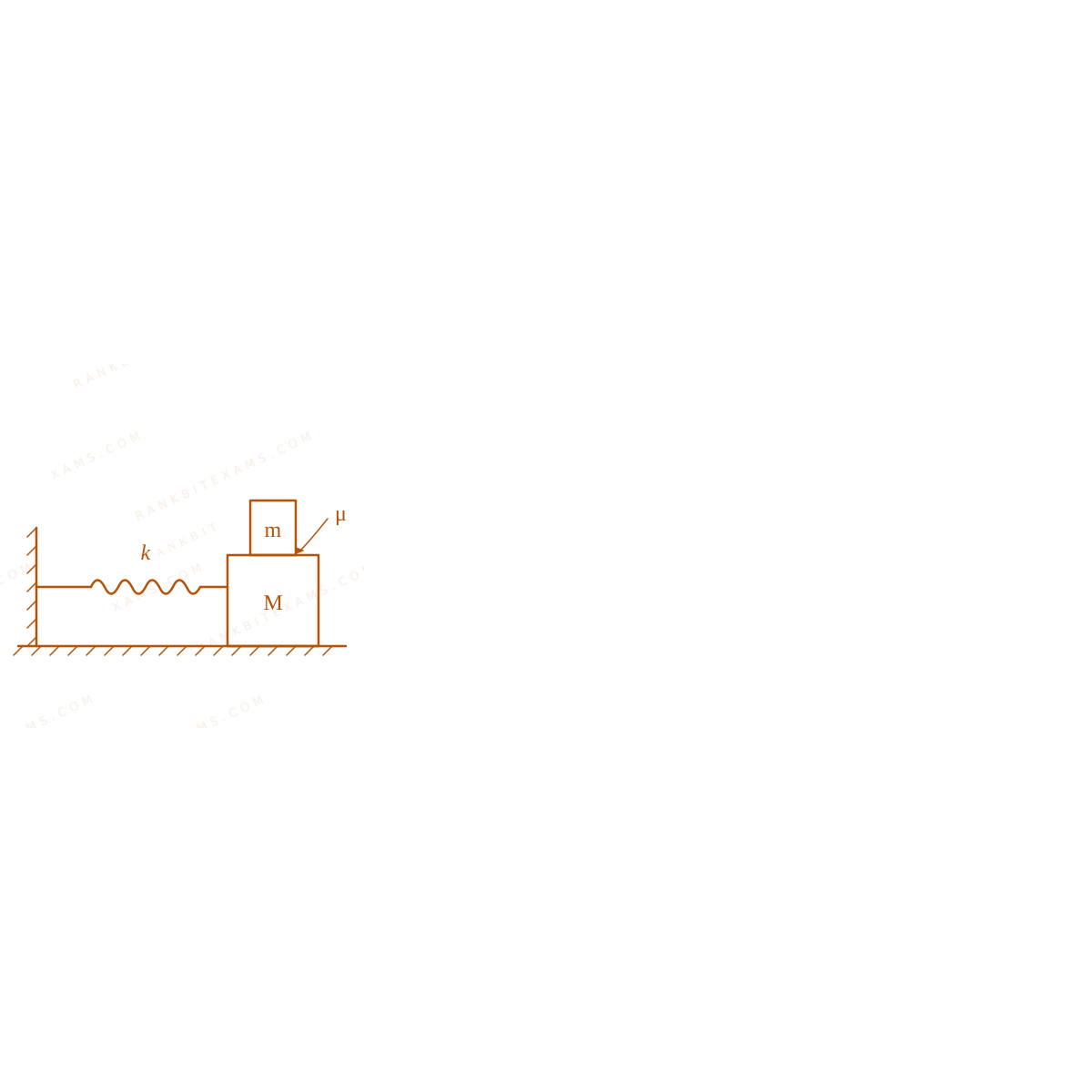
Two blocks of masses m and M, (M > m)$(\mathbf{M} > \mathbf{m})$ , are placed on a frictionless table as shown in figure. A massless spring with spring constant k is attached with the lower block. If the system is slightly displaced and released then
(μ =coefficient of friction between the two blocks)$(\mu =\text{coefficient of friction between the two blocks})$The diagram displays a smaller block of mass m placed on top of a larger block of mass M, which is connected to a horizontal spring on a smooth table.
(A) The time period of small oscillation of the two blocks is T = 2π (m + M)k$\mathrm{T} = 2\pi \sqrt{\frac{(\mathrm{m} + \mathrm{M})}{\mathrm{k}}}$
(B) The acceleration of the blocks is a = (kx)/(M + m)$a = \frac{kx}{M + m}$ (x = displacement of the blocks from the mean position)
(C) The magnitude of the frictional force on the upper block is mk|x|M + m$\frac{\mathrm{m}k|\mathrm{x}|}{\mathrm{M} + \mathrm{m}}$
(D) The maximum amplitude of the upper block, if it does not slip, is μ(M + m)gk$\frac{\mu(\mathbf{M} + \mathbf{m})\mathbf{g}}{\mathbf{k}}$
(E) Maximum frictional force can be μ (M + m)g$\mu (\mathbf{M} + \mathbf{m})\mathbf{g}$.
Choose the correct answer from the options given below:
A.A, B, D Only
B.B, C, D Only
C.C, D, E Only
D.A, B, C Only
Solution & Explanation
Related Formula
For combined system performing simple harmonic motion without relative slipping:
T = 2π mtotalk$$T = 2\pi \sqrt{\frac{m_{\text{total}}}{k}}$$a = -ω² x = -(k)/(M+m) x$$a = -\omega^2 x = -\frac{k}{M+m} x$$
Core Logic
Let's analyze each statement:
Statement (A): Since both blocks perform SHM together, the combined mass is (M + m)$(M + m)$. The spring constant is k$k$. Thus, the time period of small oscillation is:
T = 2π √((M+m)/(k))$$T = 2\pi \sqrt{\frac{M+m}{k}}$$
This is correct. (A is True)
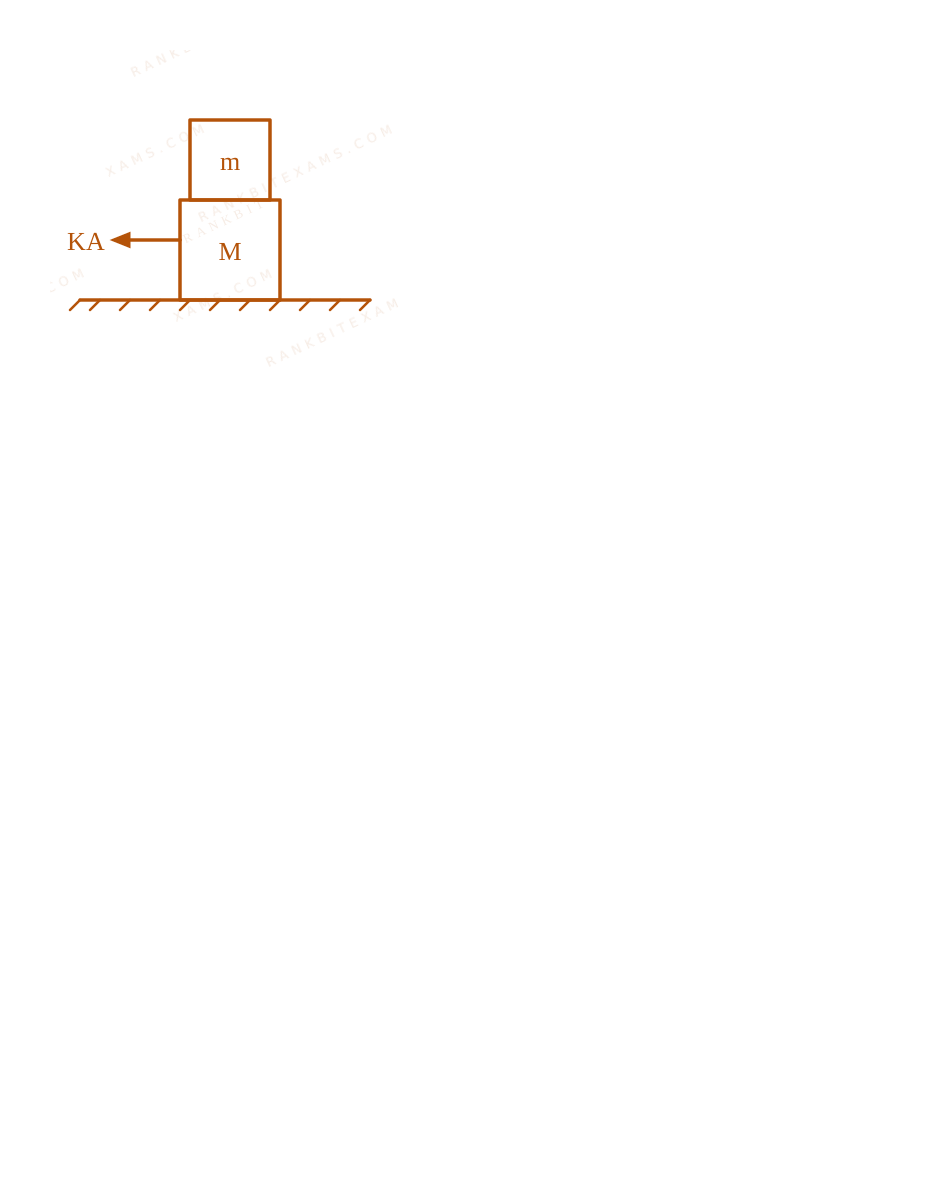
Statement (B): When the system is displaced by x$x$, the restoring spring force on the combined system is F = -kx$F = -kx$. The common acceleration of the combined mass is:
This matches the expression (taking magnitude). (B is True)
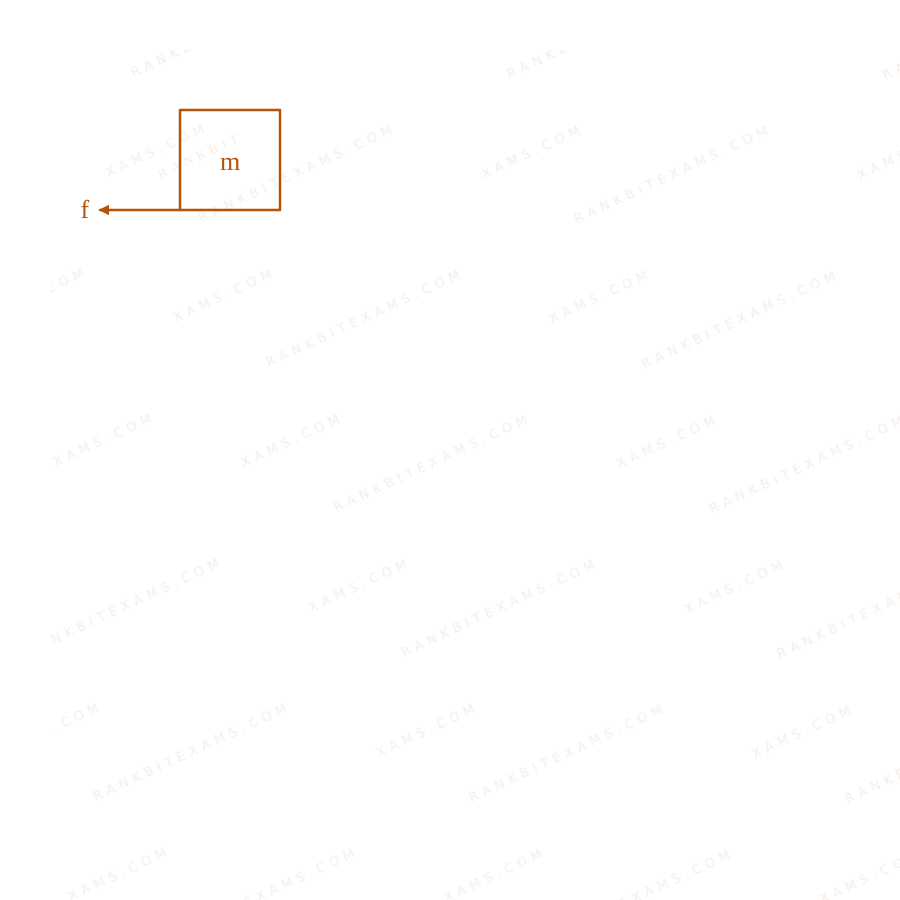
Statement (C): The upper block of mass m$m$ moves solely due to the static frictional force f$f$ acting on it. Thus:
f = m a = m ( (kx)/(M+m) ) = (mkx)/(M+m)$$f = m a = m \left( \frac{kx}{M+m} \right) = \frac{mkx}{M+m}$$
Statement (C) claims the frictional force is (mμ|x|)/(M+m)$\frac{m\mu|x|}{M+m}$, which is incorrect because friction is determined by acceleration, not by coefficient of friction μ$\mu$ during static grip. (C is False)
Statement (D): For no slipping to occur, the maximum frictional force required at peak amplitude A$A$ must be less than or equal to the limiting static friction fL = μ mg$f_L = \mu mg$:
fmax = (mkA)/(M+m) ≤ μ mg$$f_{\text{max}} = \frac{mkA}{M+m} \le \mu mg$$(kA)/(M+m) ≤ μ g A ≤ (μ(M+m)g)/(k)$$\frac{kA}{M+m} \le \mu g \implies A \le \frac{\mu(M+m)g}{k}$$
Thus, the maximum amplitude is (μ(M+m)g)/(k)$\frac{\mu(M+m)g}{k}$. (D is True)
Statement (E): The maximum static frictional force between the blocks is fL = μ mg$f_L = \mu mg$, not μ (M+m)g$\mu (M+m)g$. (E is False)
Step 1: Conclusion
Only statements A, B, and D are correct. Hence, the correct option is (1).
The diagram displays a smaller block of mass m placed on top of a larger block of mass M, which is connected to a horizontal spring on a smooth table.The diagram displays a smaller block of mass m placed on top of a larger block of mass M, which is connected to a horizontal spring on a smooth table.
Pattern Recognition
In stacked blocks with springs, always identify the force driving the non-spring-loaded block. Here, mass m$m$ is driven purely by friction, so f = m · a$f = m \cdot a$. Slipping begins when this required force exceeds flimit = μ m g$f_{\text{limit}} = \mu m g$. This simple boundary matches the derivation of maximum amplitude perfectly!
Chapter Mix
Class 11 Physics: Laws of Motion: Friction
Class 11 Physics: Oscillations: Simple Harmonic Motion
A ball of mass 0.5~kg$0.5\mathrm{~kg}$ is attached to a string of length 50~cm$50\mathrm{~cm}$. The ball is rotated on a horizontal circular path about its vertical axis. The maximum tension that the string can bear is 400~N$400\mathrm{~N}$. The maximum possible value of angular velocity of the ball in rad/s$\mathrm{rad/s}$ is:
A. 1600
B. 40
C. 1000
D. 20
Solution
Related Formula
Centripetal force configuration for simplified horizontal rotation layout:
T = mω² l$T = m\omega^2 l$
Core Logic
Given values:
m = 0.5~kg$m = 0.5\mathrm{~kg}$, l = 50~cm = 0.5~m$l = 50\mathrm{~cm} = 0.5\mathrm{~m}$, Tmax = 400~N$T_{\text{max}} = 400\mathrm{~N}$.
Ensure units are metric (50~cm → 0.5~m$50\mathrm{~cm} \to 0.5\mathrm{~m}$). Direct mapping to horizontal string projection metrics.
Chapter Mix
Class 11 Physics: Laws of Motion
Q36jee_main_2024_29_january_eveningCircular Motion and Tension
A stone of mass 900 g$900\text{ g}$ is tied to a string and moved in a vertical circle of radius 1 m$1\text{ m}$ making 10 rpm$10\text{ rpm}$. The tension in the string, when the stone is at the lowest point is (if π² = 9.8$\pi^2 = 9.8$ and g = 9.8 m/s²$g = 9.8\text{ m/s}^2$):
A.97 N$97\text{ N}$
B.9.8 N$9.8\text{ N}$
C.8.82 N$8.82\text{ N}$
D.17.8 N$17.8\text{ N}$
Solution
Related Formula
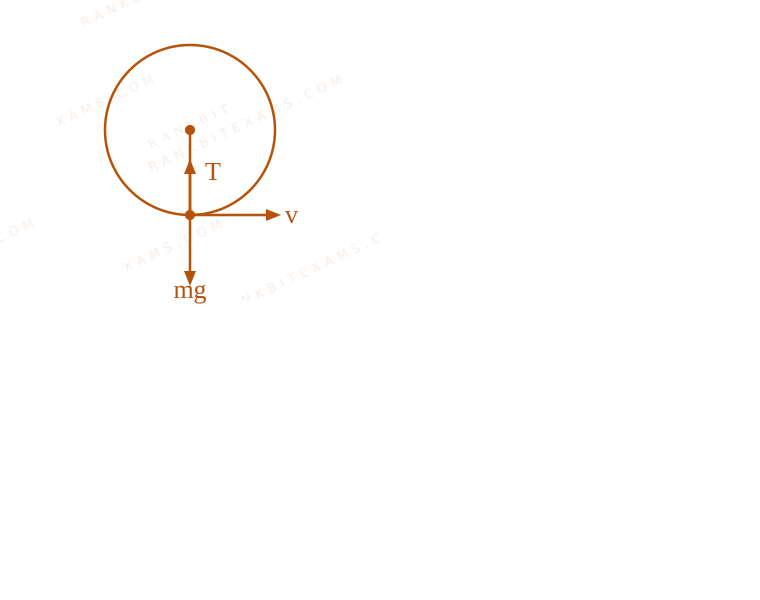
At the lowest point of a vertical circle, the equation of motion for a mass m$m$ is:
T - mg = m r ω²$$T - mg = m r \omega^2$$
Rearranging to solve for tension T$T$:
T = mg + m r ω²$$T = mg + m r \omega^2$$
Core Logic
Given data:
Mass, m = 900 g = 0.9 kg$m = 900\text{ g} = 0.9\text{ kg}$
Free-body diagram of stone at lowest point in vertical circle for Q36
Pattern Recognition
Always convert Mass to kg$\text{kg}$ and rotational speed to rad/s$\text{rad/s}$ first. Using the prompt constraint π² = 9.8$\pi^2 = 9.8$ yields a perfect decimal addition match.
A particle is moving in a circle of radius 50 cm$50\text{ cm}$ in such a way that at any instant the normal and tangential components of its acceleration are equal. If its speed at t = 0$t = 0$ is 4 m/s$4\text{ m/s}$, the time taken to complete the first revolution will be (1)/(α)[ 1 - e-2π ] s$\frac{1}{\alpha}\left[ 1 - e^{-2\pi} \right]\text{ s}$, where α =$\alpha =$ ________.
Numerical Answer.Answer: 8 to 8
Solution
Related Formula
For a particle in circular motion:
Normal (centripetal) acceleration: ac = (v²)/(r)$a_c = \frac{v^2}{r}$
Comparing this to (1)/(α)[ 1 - e-2π ] s$\frac{1}{\alpha}\left[ 1 - e^{-2\pi} \right]\text{ s}$, we get:
α = 8$\alpha = 8$
Pattern Recognition
The condition aₜ = ac v (dv)/(ds) = (v²)/(r) (dv)/(v) = (ds)/(r)$a_t = a_c \implies v \frac{dv}{ds} = \frac{v^2}{r} \implies \frac{dv}{v} = \frac{ds}{r}$. Integrating directly gives v = v₀ es/r$v = v_0 e^{s/r}$. Substituting this back into v = ds/dt$v = ds/dt$ makes the final time integral much more intuitive.
Chapter Mix
Class 11 Physics: Laws of Motion
Q36jee_main_2024_27_jan_morningBanking of Tracks
A train is moving with a speed of 12 m/s$12\text{ m/s}$ on rails which are 1.5 m$1.5\text{ m}$ apart. To negotiate a curve of radius 400 m$400\text{ m}$, the height by which the outer rail should be raised with respect to the inner rail is (Given, g = 10 m/s²$g = 10\text{ m/s}^{2}$):
A.6.0 cm$6.0\text{ cm}$
B.5.4 cm$5.4\text{ cm}$
C.4.8 cm$4.8\text{ cm}$
D.4.2 cm$4.2\text{ cm}$
Solution
Related Formula
θ = (v²)/(Rg)$$\tan\theta = \frac{v^2}{Rg}$$
For small angles, θ ≈ θ = (h)/(d)$\tan\theta \approx \sin\theta = \frac{h}{d}$, where h$h$ is the raised height and d$d$ is the separation between the tracks.
Whenever θ$\theta$ is small, geometry permits approximating θ$\tan\theta$ with hwidth$\frac{h}{\text{width}}$, vastly reducing computational transcendental overhead.
Chapter Mix
Class 11 Physics: Laws of Motion
Q45jee_main_2024_27_jan_morningConservation of Linear Momentum
A body of mass 1000 kg$1000\text{ kg}$ is moving horizontally with a velocity 6 m/s$6\text{ m/s}$. If 200 kg$200\text{ kg}$ extra mass is added, the final velocity (in m/s) is:
A.6$6$
B.2$2$
C.3$3$
D.5$5$
Solution
Related Formula
m₁ v₁ = m₂ v₂$$m_1 v_1 = m_2 v_2$$
Core Logic
Since there is no external horizontal force acting on the body, linear momentum along the horizontal axis is conserved.
Practice past-year questions one chapter at a time. Pick an exam → subject → chapter and get every PYQ for that topic — pulled together from all past papers — with the chapter's key formulas alongside.