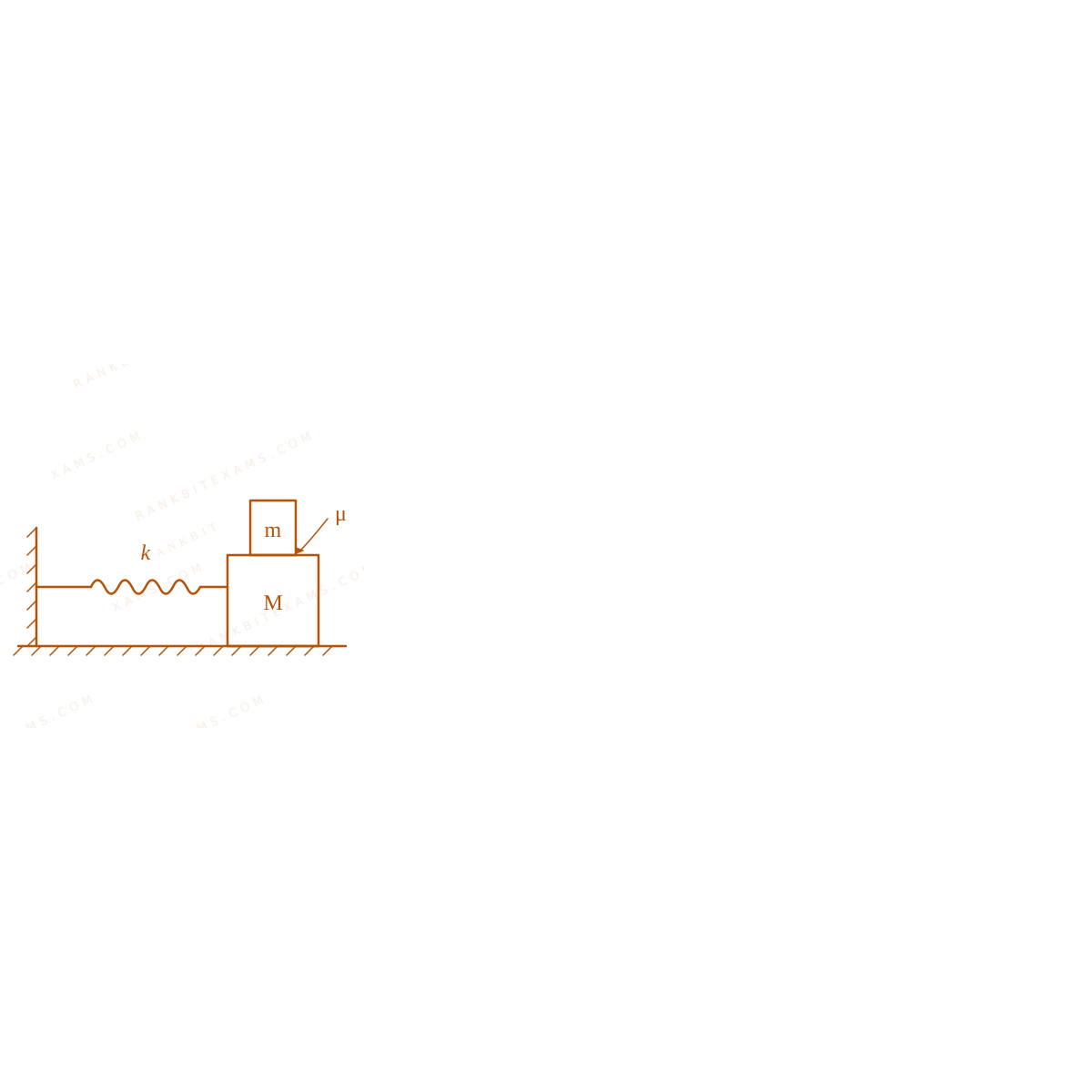
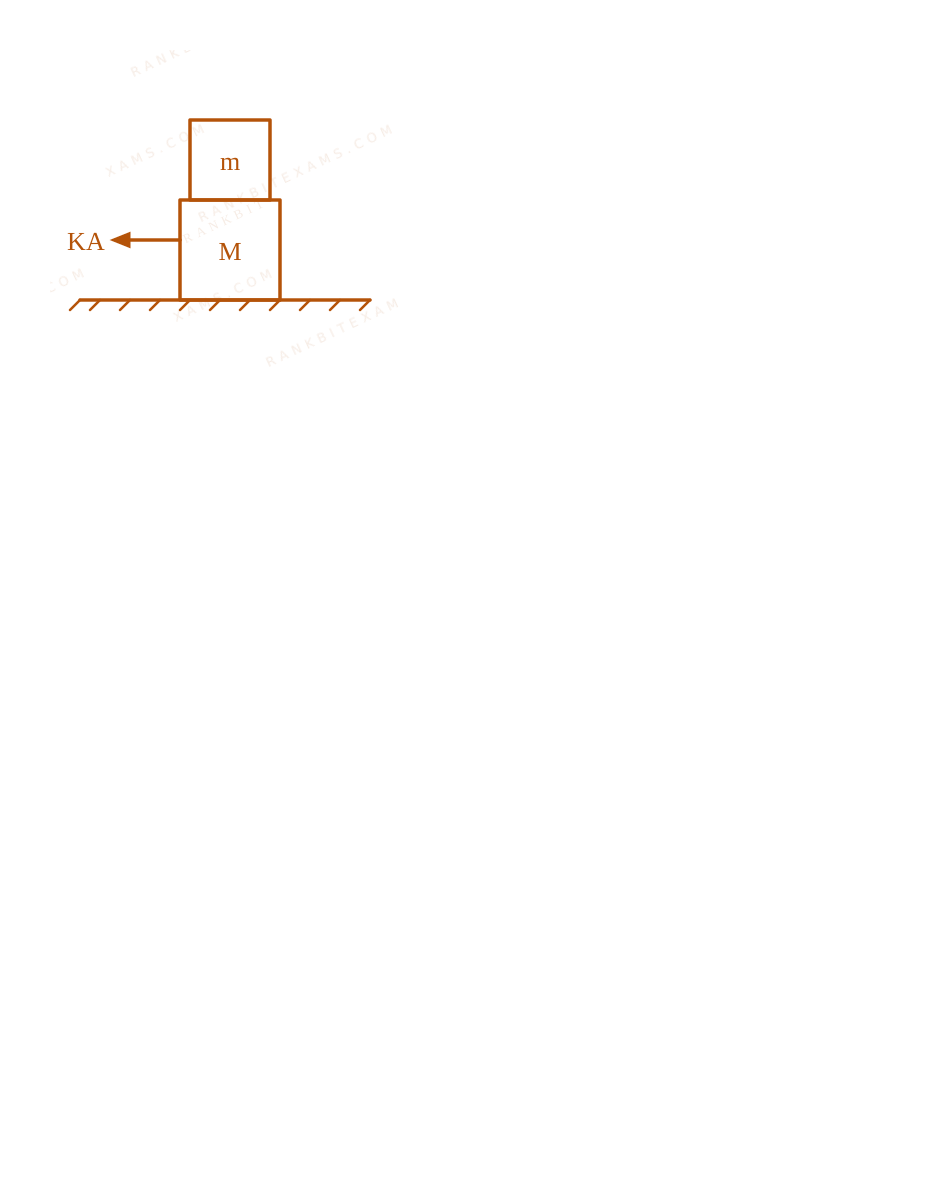
Two blocks of masses m and M, (M > m)$(\mathbf{M} > \mathbf{m})$ , are placed on a frictionless table as shown in figure. A massless spring with spring constant k is attached with the lower block. If the system is slightly displaced and released then
(μ =coefficient of friction between the two blocks)$(\mu =\text{coefficient of friction between the two blocks})$The diagram displays a smaller block of mass m placed on top of a larger block of mass M, which is connected to a horizontal spring on a smooth table.
(A) The time period of small oscillation of the two blocks is T = 2π (m + M)k$\mathrm{T} = 2\pi \sqrt{\frac{(\mathrm{m} + \mathrm{M})}{\mathrm{k}}}$
(B) The acceleration of the blocks is a = (kx)/(M + m)$a = \frac{kx}{M + m}$ (x = displacement of the blocks from the mean position)
(C) The magnitude of the frictional force on the upper block is mk|x|M + m$\frac{\mathrm{m}k|\mathrm{x}|}{\mathrm{M} + \mathrm{m}}$
(D) The maximum amplitude of the upper block, if it does not slip, is μ(M + m)gk$\frac{\mu(\mathbf{M} + \mathbf{m})\mathbf{g}}{\mathbf{k}}$
(E) Maximum frictional force can be μ (M + m)g$\mu (\mathbf{M} + \mathbf{m})\mathbf{g}$.
Choose the correct answer from the options given below:
A.A, B, D Only
B.B, C, D Only
C.C, D, E Only
D.A, B, C Only
Solution & Explanation
Related Formula
For combined system performing simple harmonic motion without relative slipping:
T = 2π mtotalk$$T = 2\pi \sqrt{\frac{m_{\text{total}}}{k}}$$a = -ω² x = -(k)/(M+m) x$$a = -\omega^2 x = -\frac{k}{M+m} x$$
Core Logic
Let's analyze each statement:
Statement (A): Since both blocks perform SHM together, the combined mass is (M + m)$(M + m)$. The spring constant is k$k$. Thus, the time period of small oscillation is:
T = 2π √((M+m)/(k))$$T = 2\pi \sqrt{\frac{M+m}{k}}$$
This is correct. (A is True)
Statement (B): When the system is displaced by x$x$, the restoring spring force on the combined system is F = -kx$F = -kx$. The common acceleration of the combined mass is:
This matches the expression (taking magnitude). (B is True)
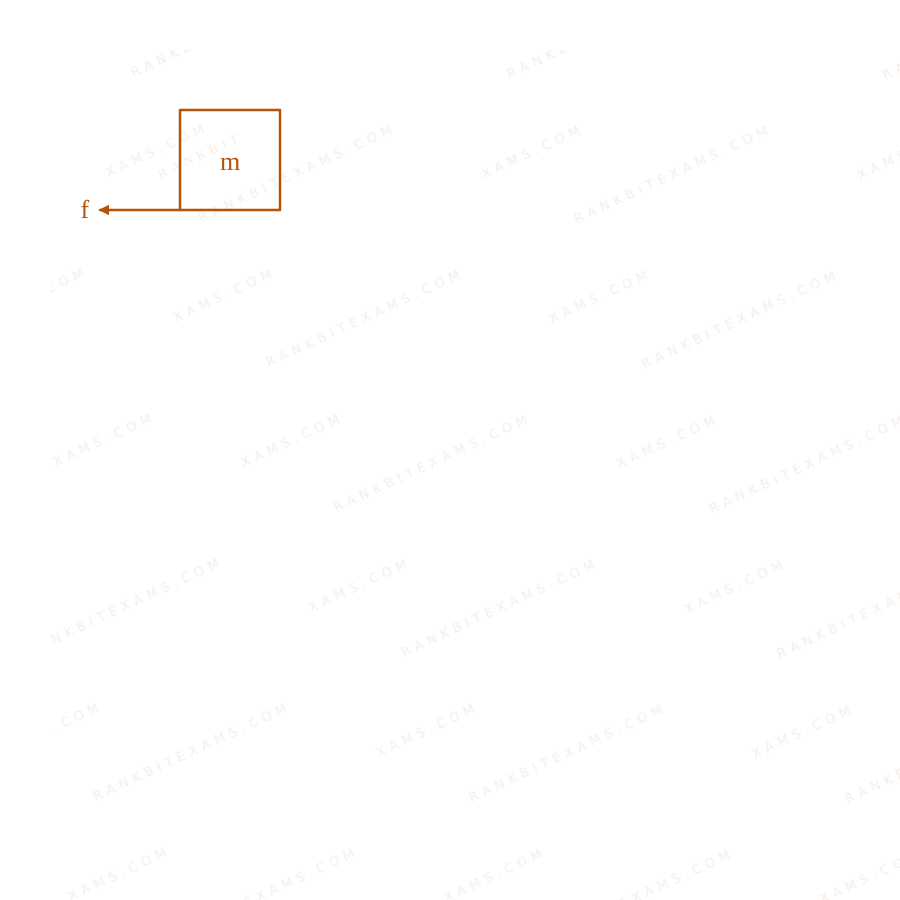
Statement (C): The upper block of mass m$m$ moves solely due to the static frictional force f$f$ acting on it. Thus:
f = m a = m ( (kx)/(M+m) ) = (mkx)/(M+m)$$f = m a = m \left( \frac{kx}{M+m} \right) = \frac{mkx}{M+m}$$
Statement (C) claims the frictional force is (mμ|x|)/(M+m)$\frac{m\mu|x|}{M+m}$, which is incorrect because friction is determined by acceleration, not by coefficient of friction μ$\mu$ during static grip. (C is False)
Statement (D): For no slipping to occur, the maximum frictional force required at peak amplitude A$A$ must be less than or equal to the limiting static friction fL = μ mg$f_L = \mu mg$:
fmax = (mkA)/(M+m) ≤ μ mg$$f_{\text{max}} = \frac{mkA}{M+m} \le \mu mg$$(kA)/(M+m) ≤ μ g A ≤ (μ(M+m)g)/(k)$$\frac{kA}{M+m} \le \mu g \implies A \le \frac{\mu(M+m)g}{k}$$
Thus, the maximum amplitude is (μ(M+m)g)/(k)$\frac{\mu(M+m)g}{k}$. (D is True)
Statement (E): The maximum static frictional force between the blocks is fL = μ mg$f_L = \mu mg$, not μ (M+m)g$\mu (M+m)g$. (E is False)
Step 1: Conclusion
Only statements A, B, and D are correct. Hence, the correct option is (1).
The diagram displays a smaller block of mass m placed on top of a larger block of mass M, which is connected to a horizontal spring on a smooth table.The diagram displays a smaller block of mass m placed on top of a larger block of mass M, which is connected to a horizontal spring on a smooth table.
Pattern Recognition
In stacked blocks with springs, always identify the force driving the non-spring-loaded block. Here, mass m$m$ is driven purely by friction, so f = m · a$f = m \cdot a$. Slipping begins when this required force exceeds flimit = μ m g$f_{\text{limit}} = \mu m g$. This simple boundary matches the derivation of maximum amplitude perfectly!
Chapter Mix
Class 11 Physics: Laws of Motion: Friction
Class 11 Physics: Oscillations: Simple Harmonic Motion
Keywords:#stacked block SHM friction#JEE Main 2025 Morning Q6#maximum amplitude no slipping#Oscillations and friction JEE#spring block system#stacked blocks#frictional oscillation
More Laws of Motion Previous-Year Questions — Page 4
Qjee_main_2025_04_april_morningEquilibrium of Forces
A body of mass m$m$ is suspended by two strings making angles θ1$\theta{1}$ and θ₂$\theta_{2}$ with the horizontal ceiling with tensions T₁$T_{1}$ and T₂$T_{2}$ simultaneously. T₁$T_{1}$ and T₂$T_{2}$ are related by T₁=√(3)T₂$T_{1}=\sqrt{3}T_{2}$ the angles \theta_{1} and \theta_{2} are
A.θ₁=30°, θ₂=60° with T₂=(3mg)/(4)$\theta_{1}=30^{\circ}, \theta_{2}=60^{\circ}\text{ with } T_{2}=\frac{3mg}{4}$
B.θ₁=60°, θ₂=30° with T₂=(mg)/(2)$\theta_{1}=60^{\circ}, \theta_{2}=30^{\circ}\text{ with } T_{2}=\frac{mg}{2}$
C.θ₁=45°, θ₂=45° with T₂=(3mg)/(4)$\theta_{1}=45^{\circ}, \theta_{2}=45^{\circ}\text{ with } T_{2}=\frac{3mg}{4}$
D.θ₁=30°, θ₂=60° with T₂=(4mg)/(5)$\theta_{1}=30^{\circ}, \theta_{2}=60^{\circ}\text{ with } T_{2}=\frac{4mg}{5}$
Lami's Theorem or standard rectangular resolution of forces. When tension is scaled by √(3)$\sqrt{3}$, it directly hints at complementary 30°--60°$30^{\circ}\text{--}60^{\circ}$ geometric alignments.
Evaluation Rubric / Model Answer
Option B: θ₁=60°, θ₂=30° with T₂=(mg)/(2)$\theta_{1}=60^{\circ}, \theta_{2}=30^{\circ}\text{ with } T_{2}=\frac{mg}{2}$
Chapter Mix
Class 11 Physics: Laws of Motion
Q22jee_main_2025_24_jan_eveningCircular Motion
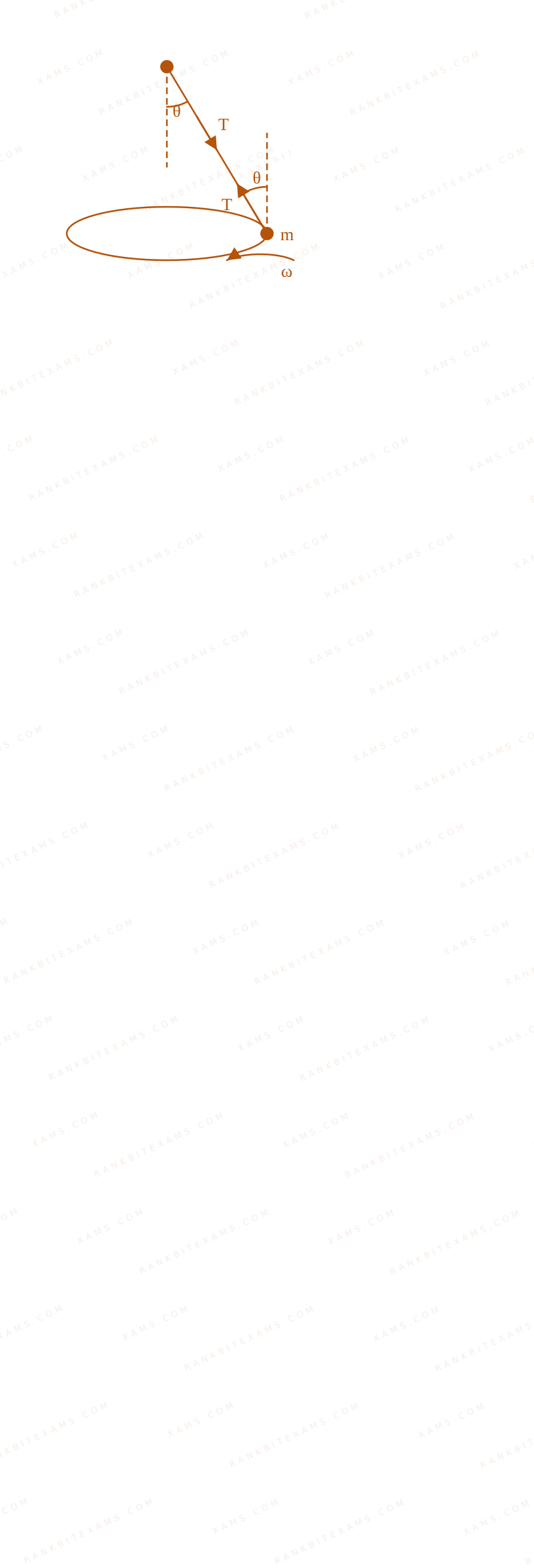
A string of length L is fixed at one end and carries a mass of M at the other end. The mass makes ((3)/(π))$\left(\frac{3}{\pi}\right)$ rotations per second about the vertical axis passing through end of the string as shown. The tension in the string is ____ ML.
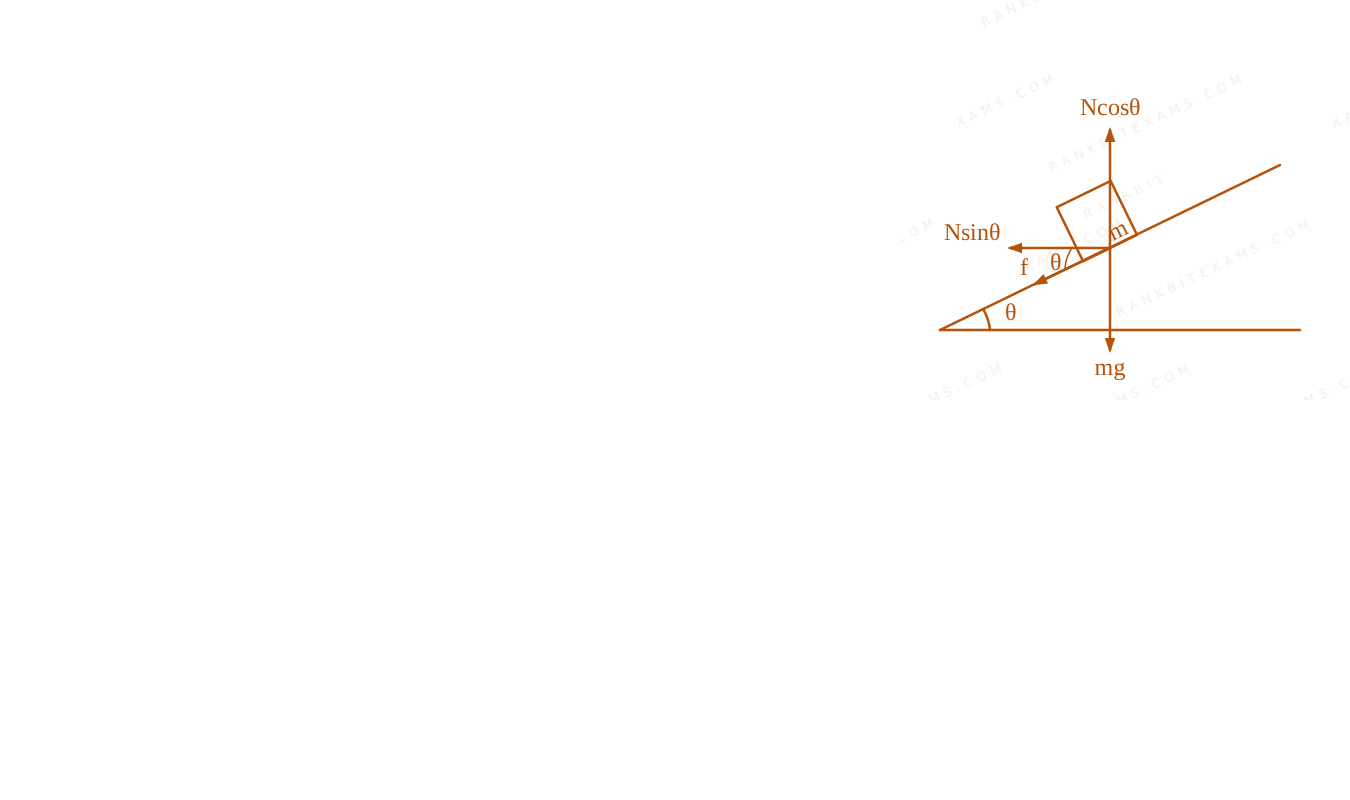
Substituting R = L θ$R = L \sin \theta$ into the centripetal equation: Conical pendulum string force vectors diagram Q22
T θ = M ω² (L θ)$$T \sin \theta = M \omega^2 (L \sin \theta)$$T = M ω² L$$T = M \omega^2 L$$
Given rotational frequency: f = (3)/(π) rev/s$f = \frac{3}{\pi}\ \mathrm{rev/s}$
Angular velocity:
ω = 2π f = 2π ((3)/(π)) = 6 rad/s$$\omega = 2\pi f = 2\pi \left(\frac{3}{\pi}\right) = 6\ \mathrm{rad/s}$$
Substituting ω$\omega$ back into the simplified tension equation:
T = M (6)² L = 36 ML$$T = M (6)^2 L = 36\ ML$$
Pattern Recognition
In a conical pendulum, the horizontal projection of tension provides the exact centripetal force. The θ$\sin\theta$ terms cancel out, making string tension independent of the semi-vertical angle.
Chapter Mix
Class 11 Physics: Laws of Motion
Qjee_main_2025_24_jan_morningCircular Motion and Banking of Roads
A car of mass 'm' moves on a banked road having radius 'r' and banking angle θ$\theta$ To avoid slipping from banked road, the maximum permissible speed of the car is v₀.$v_{0}.$ The coefficient of friction μ$\mu$ between the wheels of the car and the banked road is :-
Maximum limits always balance with plus signs in the numerator fraction. Simply rearrange that template expression directly to map the targeted parameter.
Chapter Mix
Class 11 Physics: Laws of Motion
Q20jee_main_2025_28_jan_eveningNewton Second Law Applications
A balloon and its content having mass M is moving up with an acceleration 'a'. The mass that must be released from the content so that the balloon starts moving up with an acceleration '3a' will be : (Take 'g' as acceleration due to gravity) [cite: 174, 175]
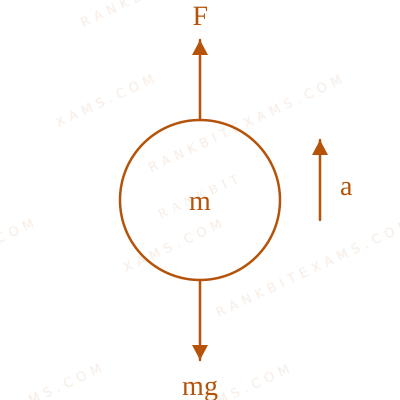
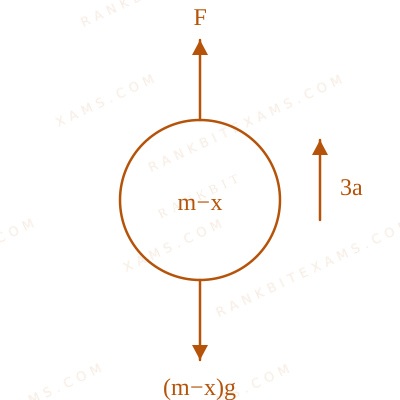
Substitute the value of F$F$ from Case 1 into Case 2 [cite: 836, 839]:
M(g + a) - (M - x)g = (M - x)3a$$M(g + a) - (M - x)g = (M - x)3a$$M g + M a - M g + x g = 3 M a - 3 x a$$M g + M a - M g + x g = 3 M a - 3 x a \quad \text{}$$M a + x g = 3 M a - 3 x a$$M a + x g = 3 M a - 3 x a$$x(g + 3a) = 2 M a$$x(g + 3a) = 2 M a$$x = (2 M a)/(3a + g)$$x = \frac{2 M a}{3a + g} \quad \text{}$$
Step 1: Visual Context
The free-body force layout for both accelerating phases is shown below:
Newton Second Law Applications free body diagrams for Q20
Newton Second Law Applications free body diagrams for Q20
Pattern Recognition
Since the upward buoyant force is completely determined by the balloon's volume, it remains constant. Expressing this constant force in terms of the initial conditions allows you to quickly solve for mass changes when acceleration states vary.
Chapter Mix
Class 11 Physics: Laws of Motion
Qjee_main_2024_01_february_morningFriction
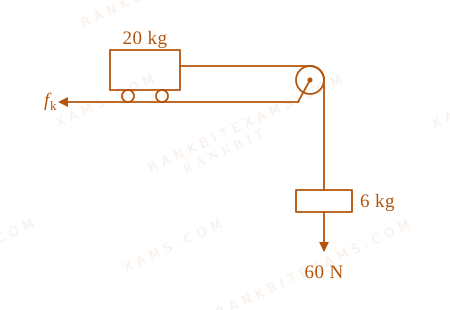
Consider a block and trolley system as shown in figure. If the coefficient of kinetic friction between the trolley and the surface is 0.04, the acceleration of the system in ms⁻²$\mathrm{ms}^{-2}$ is (Consider that the string is massless and unstretchable and the pulley is also massless and frictionless):
A block and trolley mass arrangement demonstrating a horizontal kinetic interface connected over a corner pulley driven by an explicit 60N forcing function loop.
A. 3
B. 4
C. 2
D. 1.2
Solution
Related Formula
Kinetic friction force:
fk = μk N = μk m₁ g$$f_k = \mu_k N = \mu_k m_1 g$$
System acceleration:
a = Fpull - fkmtotal$$a = \frac{F_{\text{pull}} - f_k}{m_{\text{total}}}$$
Core Logic
Given values:
Trolley mass m₁ = 20~kg$m_1 = 20\mathrm{~kg}$, total system mass component in frame mtotal = 26~kg$m_{\text{total}} = 26\mathrm{~kg}$ (from solution fraction (60-8)/(26)$\frac{60-8}{26}$).
Applied pulling force F = 60~N$F = 60\mathrm{~N}$.
μk = 0.04$\mu_k = 0.04$.
Calculate the kinetic friction resisting the trolley:
Practice past-year questions one chapter at a time. Pick an exam → subject → chapter and get every PYQ for that topic — pulled together from all past papers — with the chapter's key formulas alongside.