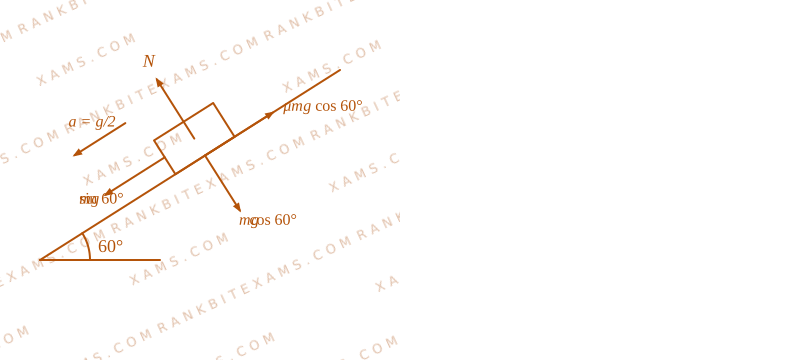
A cubic block of mass m is sliding down on an inclined plane at 60^circ with an acceleration of fracg2 , the value of coefficient of kinetic friction is

Solution & Explanation

### Related Formula For a block sliding down an inclined plane of inclination theta: mg sintheta - f_k = ma Where normal reaction is N = mg costheta and kinetic friction is: f_k = mu_k N = mu_k mg costheta ### Core Logic Substitute f_k into the equation of motion: mg sintheta - mu_k mg costheta = ma Divide by m: g sintheta - mu_k g costheta = a ### Step 1: Substitute Values Given a = fracg2 and theta = 60^circ: g sin 60^circ - mu_k g cos 60^circ = fracg2 fracsqrt32 - fracmu_k2 = frac12 sqrt3 - mu_k = 1 implies mu_k = sqrt3 - 1 ### Pattern Recognition Sees: Block sliding down with acceleration on an incline. Shortcut: The acceleration on an incline is a = g(sintheta - mu_k costheta). For theta = 60^circ, this is a = gleft(fracsqrt32 - fracmu_k2right). Equating to g/2 gives mu_k = sqrt3 - 1 directly. ### Evaluation Rubric / Model Answer null ### Chapter Mix Class 11 Physics: Laws of Motion
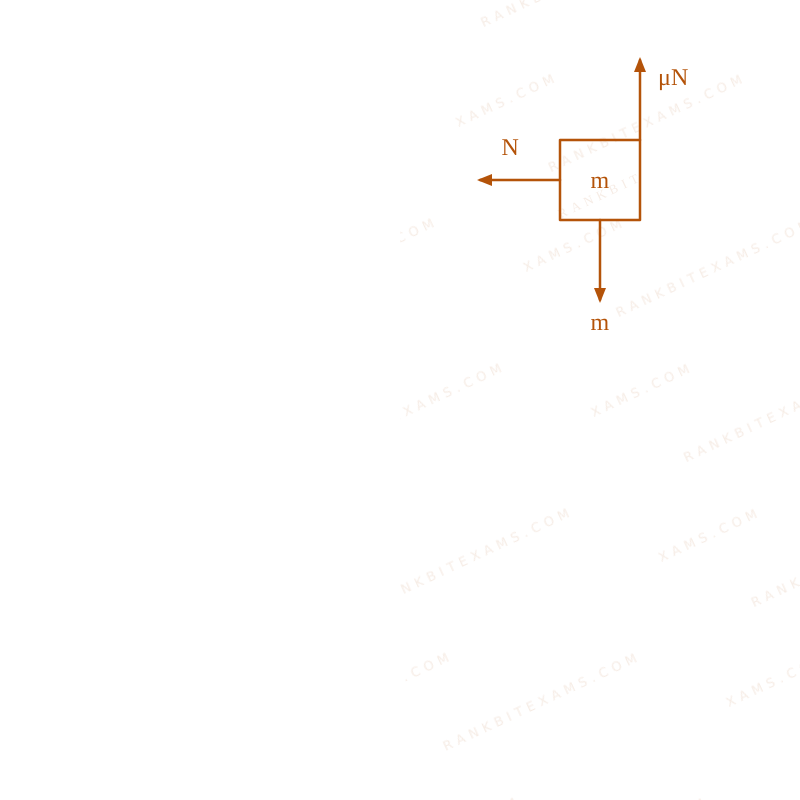
Free body diagram of sliding block on incline

Reference Study Guides

More Laws of Motion Previous-Year Questions

Q31 jee_main_2026_21_jan_morning Force and Acceleration
A 4 kg mass moves under the influence of a force vecmathrmF = (4mathrmt^3hatmathrmi - 3mathrmthatmathrmj)text N where t is the time in second. If mass starts from origin at t = 0, the velocity and position after t = 2texts will be:
  • A. vecmathrmv = 3hatmathrmi +frac32hatmathrmj, quad vecmathrmr = frac65hatmathrmi +hatmathrmj
  • B. vecmathrmv = 4hatmathrmi -frac32hatmathrmj, quad vecmathrmr = frac85hatmathrmi -hatmathrmj
  • C. vecmathrmv = 4hatmathrmi +frac52hatmathrmj, quad vecmathrmr = frac85hatmathrmi +2hatmathrmj
  • D. vecmathrmv = 4hatmathrmi -frac32hatmathrmj, quad vecmathrmr = frac65hatmathrmi -hatmathrmj

Solution

### Related Formula veca = fracvecFm vecv = int veca \, dt vecr = int vecv \, dt ### Core Logic Given vecF = 4t^3hati - 3thatj and mass m = 4text kg. Acceleration: veca = fracvecFm = frac4t^3hati - 3thatj4 = t^3hati - frac34thatj ### Step 1: Calculating Velocity Velocity is the integral of acceleration with v(0) = 0: vecv = int left( t^3hati - frac34thatj right) dt = fract^44hati - frac38t^2hatj At t = 2text s: vecv(2) = frac(2)^44hati - frac38(2)^2hatj = 4hati - frac32hatj ### Step 2: Calculating Position Position is the integral of velocity with vecr(0) = vec0: vecr = int vecv \, dt = int left( fract^44hati - frac38t^2hatj right) dt vecr = fract^520hati - frac324t^3hatj = fract^520hati - fract^38hatj At t = 2text s: vecr(2) = frac(2)^520hati - frac(2)^38hatj = frac3220hati - frac88hatj = frac85hati - hatj ### Pattern Recognition Recognize F to a to v to r means consecutive integrations. Because the initial state is from rest at origin, we don't have to worry about constants of integration. ### Evaluation Rubric / Model Answer null ### Chapter Mix Class 11 Physics: Laws of Motion Class 11 Physics: Kinematics
Q16 jee_main_2025_02_april_evening Equilibrium of Forces
A body of mass 1mathrmkg is suspended with the help of two strings making angles as shown in figure. Magnitude of tensions mathbfT_1 and mathbfT_2 , respectively, are (in N):
Suspended mass equilibrium with two angled strings
The diagram shows a suspended mass of 1 kg held by two strings making angles of 60 and 30 degrees with the horizontal.
  • A. 5, 5sqrt3
  • B. 5sqrt3, 5
  • C. 5sqrt3, 5sqrt3
  • D. 5, 5

Solution

### Related Formula For a system in static equilibrium: sum F_x = 0 quad textand quad sum F_y = 0 ### Core Logic Let's resolve the tension forces vecT_1 and vecT_2 into horizontal and vertical components: - T_1 makes 60^circ with the horizontal. - T_2 makes 30^circ with the horizontal. - Downward gravitational force: W = m g = 1 times 10 = 10 \ mathrmN. 1. **Horizontal Equilibrium (sum F_x = 0):** T_1 cos 60^circ = T_2 cos 30^circ T_1 cdot frac12 = T_2 cdot fracsqrt32 implies T_1 = T_2 sqrt3 2. **Vertical Equilibrium (sum F_y = 0):** T_1 sin 60^circ + T_2 sin 30^circ = m g = 10 T_1 cdot fracsqrt32 + T_2 cdot frac12 = 10 ### Step 1: Solve for Tensions Substitute T_1 = T_2 sqrt3 into the vertical equilibrium equation: (T_2 sqrt3) fracsqrt32 + fracT_22 = 10 frac3 T_22 + fracT_22 = 10 implies 2 T_2 = 10 implies T_2 = 5 \ mathrmN Substitute T_2 back to obtain T_1: T_1 = 5 sqrt3 \ mathrmN Thus, the tension magnitudes are T_1 = 5sqrt3 \ mathrmN and T_2 = 5 \ mathrmN. ### Pattern Recognition Sees: Suspending particle static equilibrium with asymmetric strings. Trap: Associating components with incorrect trigonometry axes or swapping T_1 and T_2 in options. Shortcut: Since the incline of T_1 (60^circ) is steeper than that of T_2 (30^circ), T_1 must carry a larger portion of the load, meaning T_1 > T_2. From the choices, only (2) satisfies this hierarchy. ### Evaluation Rubric / Model Answer null ### Chapter Mix Class 11 Physics: Laws of Motion
Q15 jee_main_2025_08_april_evening Newton's Second Law
A body of mass 2mathrm~kg moving with velocity of vecv_mathrmin = 3hati +4hatjmathrm~m/s enters into a constant force field of 6mathrm~N directed along positive z-axis. If the body remains in the field for a period of frac53 seconds, then velocity of the body when it emerges from force field is:
  • A. 4hati +3hatj +5hatk
  • B. 3hati +4hatj +5hatk
  • C. 3hati + 4hatj - 5hatk
  • D. 3hati + 4hatj + sqrt5hatk

Solution

### Related Formula vecF = m veca vecv = vecu + vecat where, vecF = constant force vector m = mass of body veca = acceleration vector vecu = initial velocity vector vecv = final velocity vector ### Core Logic Given parameters: - Mass, m = 2mathrm~kg - Initial velocity, vecu = 3hati + 4hatjmathrm~m/s - Force, vecF = 6hatkmathrm~N (directed along positive z-axis) - Time interval, t = frac53mathrm~s Calculate the acceleration vector veca: veca = fracvecFm = frac6hatk2 = 3hatkmathrm~m/s^2 ### Step 1: Compute Final Velocity Using the kinematic equation of motion: vecv = vecu + vecat vecv = (3hati + 4hatj) + (3hatk) left(frac53right) vecv = 3hati + 4hatj + 5hatkmathrm~m/s Thus, the emerging velocity of the body is 3hati + 4hatj + 5hatkmathrm~m/s. ### Pattern Recognition Sees: Orthogonal initial velocity and force field direction. Shortcut: Since the force acts entirely along the z-axis, the x and y components of the velocity remain unchanged (3hati + 4hatj). Simply compute the z-component change: v_z = a_z t = left(frac62right) left(frac53right) = 5. Result: 3hati + 4hatj + 5hatk. ✓ ### Evaluation Rubric / Model Answer null ### Chapter Mix Class 11 Physics: Laws of Motion Class 11 Physics: Kinematics
Q12 jee_main_2025_29_jan_evening Variable Mass System
A sand dropper drops sand of mass m(t) on a conveyer belt at a rate proportional to the square root of speed (v) of the belt, i.e. fracdmdt propto sqrtv . If P is the power delivered to run the belt at constant speed then which of the following relationship is true?
  • A. mathrmP^2propto mathrmv^3
  • B. mathrmP propto sqrtmathrmv
  • C. mathrmP propto mathrmv
  • D. mathbfP^2propto mathbfv^5

Solution

### Related Formula F_textthrust = left(fracdmdtright)v P = F cdot v ### Core Logic Given the sand dropping rate rule: fracdmdt = C sqrtv quad (textwhere C text is a constant) To maintain a constant velocity v, the continuous force applied by the conveyor system must balance the rate of gain of momentum of the dropped sand: F = left(fracdmdtright) v = (C sqrtv) cdot v = C v^3/2 Power delivered is the product of force and speed: P = F cdot v = (C v^3/2) cdot v = C v^5/2 Squaring both sides of the expression: P^2 propto v^5 ### Pattern Recognition In variable mass problems involving dropping dust/sand at rest onto a moving frame, the thrust force always simplifies to v cdot fracdmdt, which makes power scale as v^2 cdot fracdmdt. ### Evaluation Rubric / Model Answer null ### Chapter Mix Class 11 Physics: Laws of Motion

More Laws of Motion Questions — jee_main_2025_07_april_morning

Practice all Laws of Motion previous-year questions →

Rankbit System
JEE Physics: Waves (+15.5%) | Electrostatics: Concentric Shells (-29.7%) | Modern Physics: Photoelectric Clones (+34.2%) | Mathematics: Definite Integrals (+18.1%) | Chemistry: Coordination Splitting (-11.4%) | JEE Physics: Waves (+15.5%) | Electrostatics: Concentric Shells (-29.7%) | Modern Physics: Photoelectric Clones (+34.2%) | Mathematics: Definite Integrals (+18.1%) | Chemistry: Coordination Splitting (-11.4%)