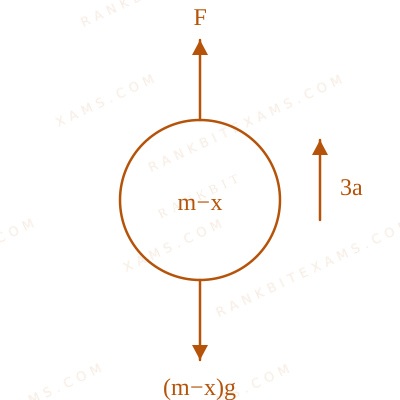
A balloon and its content having mass M is moving up with an acceleration 'a'. The mass that must be released from the content so that the balloon starts moving up with an acceleration '3a' will be : (Take 'g' as acceleration due to gravity) [cite: 174, 175]

Solution & Explanation

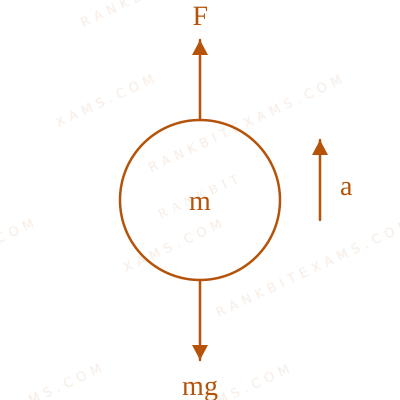
### Related Formula By Newton's second law of motion, the net upward force acting on an accelerating balloon system is given by: F_textbuoyant - m_texttotal g = m_texttotal a ### Core Logic Let F be the constant buoyant force acting upward on the balloon. **Case 1 (Initial upward acceleration)** : F - M g = M a implies F = M(g + a) quad text **Case 2 (After releasing mass x)** : The new total mass becomes (M - x), and its acceleration increases to 3a: F - (M - x)g = (M - x)3a quad text Substitute the value of F from Case 1 into Case 2 [cite: 836, 839]: M(g + a) - (M - x)g = (M - x)3a M g + M a - M g + x g = 3 M a - 3 x a quad text M a + x g = 3 M a - 3 x a x(g + 3a) = 2 M a x = frac2 M a3a + g quad text ### Step 1: Visual Context The free-body force layout for both accelerating phases is shown below:
Newton Second Law Applications free body diagrams for Q20
### Pattern Recognition Since the upward buoyant force is completely determined by the balloon's volume, it remains constant. Expressing this constant force in terms of the initial conditions allows you to quickly solve for mass changes when acceleration states vary. ### Evaluation Rubric / Model Answer null ### Chapter Mix Class 11 Physics: Laws of Motion

Reference Study Guides

More Laws of Motion Previous-Year Questions

Q31 jee_main_2026_21_jan_morning Force and Acceleration
A 4 kg mass moves under the influence of a force vecmathrmF = (4mathrmt^3hatmathrmi - 3mathrmthatmathrmj)text N where t is the time in second. If mass starts from origin at t = 0, the velocity and position after t = 2texts will be:
  • A. vecmathrmv = 3hatmathrmi +frac32hatmathrmj, quad vecmathrmr = frac65hatmathrmi +hatmathrmj
  • B. vecmathrmv = 4hatmathrmi -frac32hatmathrmj, quad vecmathrmr = frac85hatmathrmi -hatmathrmj
  • C. vecmathrmv = 4hatmathrmi +frac52hatmathrmj, quad vecmathrmr = frac85hatmathrmi +2hatmathrmj
  • D. vecmathrmv = 4hatmathrmi -frac32hatmathrmj, quad vecmathrmr = frac65hatmathrmi -hatmathrmj

Solution

### Related Formula veca = fracvecFm vecv = int veca \, dt vecr = int vecv \, dt ### Core Logic Given vecF = 4t^3hati - 3thatj and mass m = 4text kg. Acceleration: veca = fracvecFm = frac4t^3hati - 3thatj4 = t^3hati - frac34thatj ### Step 1: Calculating Velocity Velocity is the integral of acceleration with v(0) = 0: vecv = int left( t^3hati - frac34thatj right) dt = fract^44hati - frac38t^2hatj At t = 2text s: vecv(2) = frac(2)^44hati - frac38(2)^2hatj = 4hati - frac32hatj ### Step 2: Calculating Position Position is the integral of velocity with vecr(0) = vec0: vecr = int vecv \, dt = int left( fract^44hati - frac38t^2hatj right) dt vecr = fract^520hati - frac324t^3hatj = fract^520hati - fract^38hatj At t = 2text s: vecr(2) = frac(2)^520hati - frac(2)^38hatj = frac3220hati - frac88hatj = frac85hati - hatj ### Pattern Recognition Recognize F to a to v to r means consecutive integrations. Because the initial state is from rest at origin, we don't have to worry about constants of integration. ### Evaluation Rubric / Model Answer null ### Chapter Mix Class 11 Physics: Laws of Motion Class 11 Physics: Kinematics
Q16 jee_main_2025_02_april_evening Equilibrium of Forces
A body of mass 1mathrmkg is suspended with the help of two strings making angles as shown in figure. Magnitude of tensions mathbfT_1 and mathbfT_2 , respectively, are (in N):
Suspended mass equilibrium with two angled strings
The diagram shows a suspended mass of 1 kg held by two strings making angles of 60 and 30 degrees with the horizontal.
  • A. 5, 5sqrt3
  • B. 5sqrt3, 5
  • C. 5sqrt3, 5sqrt3
  • D. 5, 5

Solution

### Related Formula For a system in static equilibrium: sum F_x = 0 quad textand quad sum F_y = 0 ### Core Logic Let's resolve the tension forces vecT_1 and vecT_2 into horizontal and vertical components: - T_1 makes 60^circ with the horizontal. - T_2 makes 30^circ with the horizontal. - Downward gravitational force: W = m g = 1 times 10 = 10 \ mathrmN. 1. **Horizontal Equilibrium (sum F_x = 0):** T_1 cos 60^circ = T_2 cos 30^circ T_1 cdot frac12 = T_2 cdot fracsqrt32 implies T_1 = T_2 sqrt3 2. **Vertical Equilibrium (sum F_y = 0):** T_1 sin 60^circ + T_2 sin 30^circ = m g = 10 T_1 cdot fracsqrt32 + T_2 cdot frac12 = 10 ### Step 1: Solve for Tensions Substitute T_1 = T_2 sqrt3 into the vertical equilibrium equation: (T_2 sqrt3) fracsqrt32 + fracT_22 = 10 frac3 T_22 + fracT_22 = 10 implies 2 T_2 = 10 implies T_2 = 5 \ mathrmN Substitute T_2 back to obtain T_1: T_1 = 5 sqrt3 \ mathrmN Thus, the tension magnitudes are T_1 = 5sqrt3 \ mathrmN and T_2 = 5 \ mathrmN. ### Pattern Recognition Sees: Suspending particle static equilibrium with asymmetric strings. Trap: Associating components with incorrect trigonometry axes or swapping T_1 and T_2 in options. Shortcut: Since the incline of T_1 (60^circ) is steeper than that of T_2 (30^circ), T_1 must carry a larger portion of the load, meaning T_1 > T_2. From the choices, only (2) satisfies this hierarchy. ### Evaluation Rubric / Model Answer null ### Chapter Mix Class 11 Physics: Laws of Motion
Q14 jee_main_2025_07_april_morning Friction
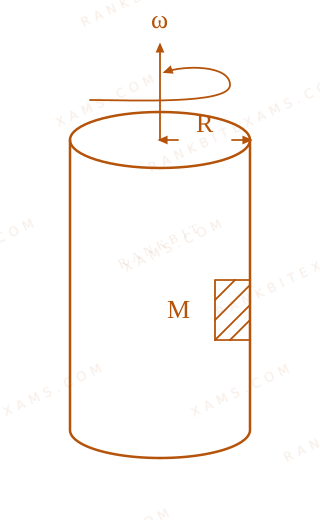
A cubic block of mass m is sliding down on an inclined plane at 60^circ with an acceleration of fracg2 , the value of coefficient of kinetic friction is
  • A. sqrt3 - 1
  • B. fracsqrt32
  • C. fracsqrt23
  • D. 1 - fracsqrt32

Solution

### Related Formula For a block sliding down an inclined plane of inclination theta: mg sintheta - f_k = ma Where normal reaction is N = mg costheta and kinetic friction is: f_k = mu_k N = mu_k mg costheta ### Core Logic Substitute f_k into the equation of motion: mg sintheta - mu_k mg costheta = ma Divide by m: g sintheta - mu_k g costheta = a ### Step 1: Substitute Values Given a = fracg2 and theta = 60^circ: g sin 60^circ - mu_k g cos 60^circ = fracg2 fracsqrt32 - fracmu_k2 = frac12 sqrt3 - mu_k = 1 implies mu_k = sqrt3 - 1 ### Pattern Recognition Sees: Block sliding down with acceleration on an incline. Shortcut: The acceleration on an incline is a = g(sintheta - mu_k costheta). For theta = 60^circ, this is a = gleft(fracsqrt32 - fracmu_k2right). Equating to g/2 gives mu_k = sqrt3 - 1 directly. ### Evaluation Rubric / Model Answer null ### Chapter Mix Class 11 Physics: Laws of Motion
Q15 jee_main_2025_08_april_evening Newton's Second Law
A body of mass 2mathrm~kg moving with velocity of vecv_mathrmin = 3hati +4hatjmathrm~m/s enters into a constant force field of 6mathrm~N directed along positive z-axis. If the body remains in the field for a period of frac53 seconds, then velocity of the body when it emerges from force field is:
  • A. 4hati +3hatj +5hatk
  • B. 3hati +4hatj +5hatk
  • C. 3hati + 4hatj - 5hatk
  • D. 3hati + 4hatj + sqrt5hatk

Solution

### Related Formula vecF = m veca vecv = vecu + vecat where, vecF = constant force vector m = mass of body veca = acceleration vector vecu = initial velocity vector vecv = final velocity vector ### Core Logic Given parameters: - Mass, m = 2mathrm~kg - Initial velocity, vecu = 3hati + 4hatjmathrm~m/s - Force, vecF = 6hatkmathrm~N (directed along positive z-axis) - Time interval, t = frac53mathrm~s Calculate the acceleration vector veca: veca = fracvecFm = frac6hatk2 = 3hatkmathrm~m/s^2 ### Step 1: Compute Final Velocity Using the kinematic equation of motion: vecv = vecu + vecat vecv = (3hati + 4hatj) + (3hatk) left(frac53right) vecv = 3hati + 4hatj + 5hatkmathrm~m/s Thus, the emerging velocity of the body is 3hati + 4hatj + 5hatkmathrm~m/s. ### Pattern Recognition Sees: Orthogonal initial velocity and force field direction. Shortcut: Since the force acts entirely along the z-axis, the x and y components of the velocity remain unchanged (3hati + 4hatj). Simply compute the z-component change: v_z = a_z t = left(frac62right) left(frac53right) = 5. Result: 3hati + 4hatj + 5hatk. ✓ ### Evaluation Rubric / Model Answer null ### Chapter Mix Class 11 Physics: Laws of Motion Class 11 Physics: Kinematics
Q12 jee_main_2025_29_jan_evening Variable Mass System
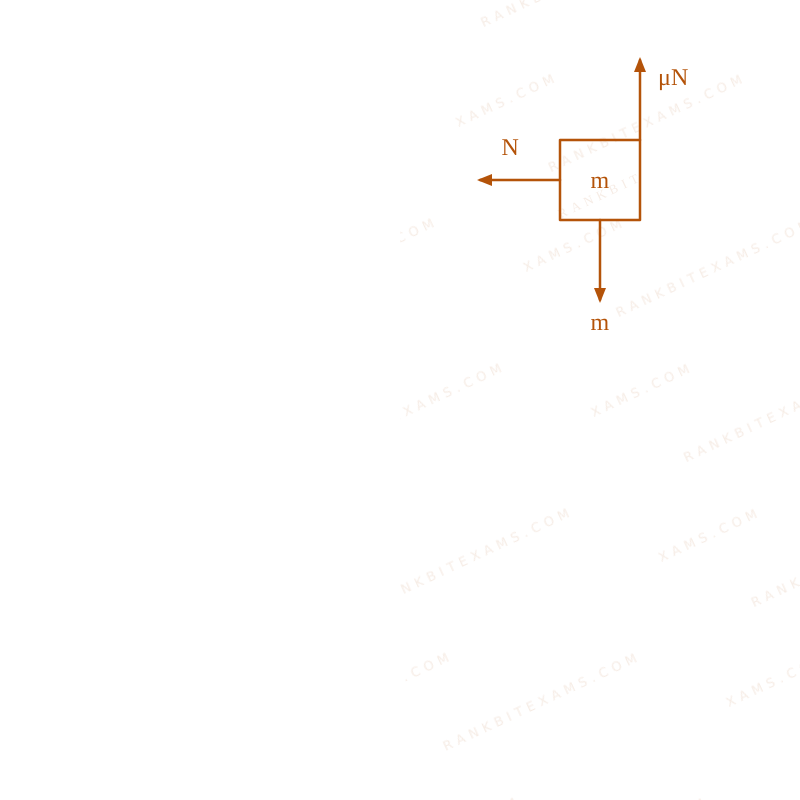
A sand dropper drops sand of mass m(t) on a conveyer belt at a rate proportional to the square root of speed (v) of the belt, i.e. fracdmdt propto sqrtv . If P is the power delivered to run the belt at constant speed then which of the following relationship is true?
  • A. mathrmP^2propto mathrmv^3
  • B. mathrmP propto sqrtmathrmv
  • C. mathrmP propto mathrmv
  • D. mathbfP^2propto mathbfv^5

Solution

### Related Formula F_textthrust = left(fracdmdtright)v P = F cdot v ### Core Logic Given the sand dropping rate rule: fracdmdt = C sqrtv quad (textwhere C text is a constant) To maintain a constant velocity v, the continuous force applied by the conveyor system must balance the rate of gain of momentum of the dropped sand: F = left(fracdmdtright) v = (C sqrtv) cdot v = C v^3/2 Power delivered is the product of force and speed: P = F cdot v = (C v^3/2) cdot v = C v^5/2 Squaring both sides of the expression: P^2 propto v^5 ### Pattern Recognition In variable mass problems involving dropping dust/sand at rest onto a moving frame, the thrust force always simplifies to v cdot fracdmdt, which makes power scale as v^2 cdot fracdmdt. ### Evaluation Rubric / Model Answer null ### Chapter Mix Class 11 Physics: Laws of Motion

More Laws of Motion Questions — jee_main_2025_28_jan_evening

Practice all Laws of Motion previous-year questions →

Rankbit System
JEE Physics: Waves (+15.5%) | Electrostatics: Concentric Shells (-29.7%) | Modern Physics: Photoelectric Clones (+34.2%) | Mathematics: Definite Integrals (+18.1%) | Chemistry: Coordination Splitting (-11.4%) | JEE Physics: Waves (+15.5%) | Electrostatics: Concentric Shells (-29.7%) | Modern Physics: Photoelectric Clones (+34.2%) | Mathematics: Definite Integrals (+18.1%) | Chemistry: Coordination Splitting (-11.4%)