JEE Main · Physics ↓ Falling

Laws of Motion appeared 34 times across 3 years — 3.9% of Physics. This question is from Friction on an Inclined Plane.

Year 2026 2025 2024 Total
Questions 9 10 15 34

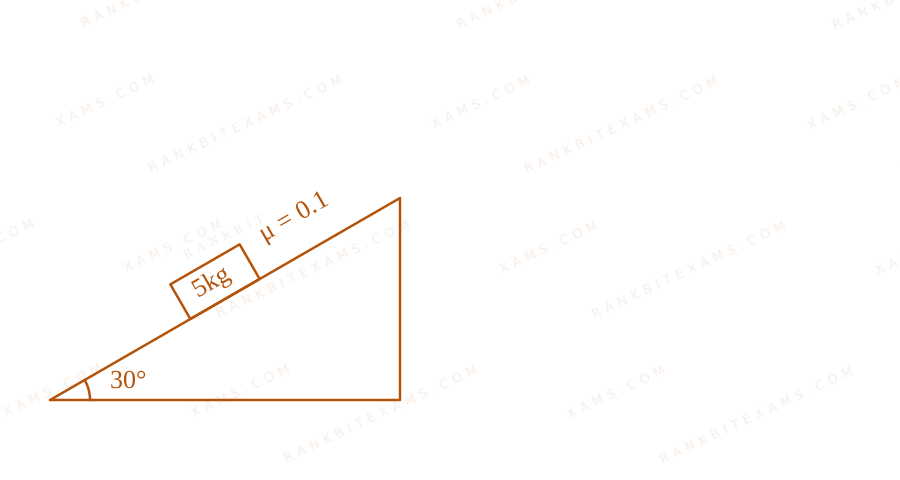
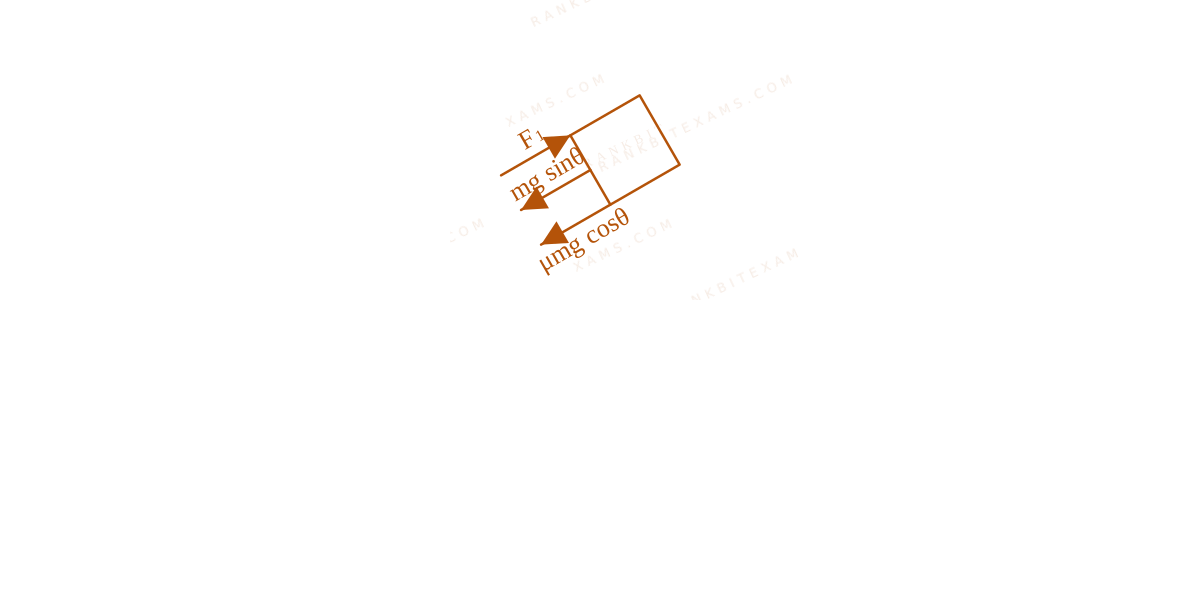
A block of mass 5 kg is placed on a rough inclined surface as shown in the figure.
Friction on an Inclined Plane diagram for Q42 - JEE Main 2024 Evening
The image shows a 5 kg block on a rough plane inclined at 30 degrees, with coefficient of friction mu = 0.1.
If F₁ is the force required to just move the block up the inclined plane and F₂ is the force required to just prevent the block from sliding down, then the value of | F₁| - | F₂| is: [Use g = 10 m/s²]

Solution & Explanation

Related Formula
fk = μ mg θ F₁ = mg θ + fk F₂ = mg θ - fk
Core Logic

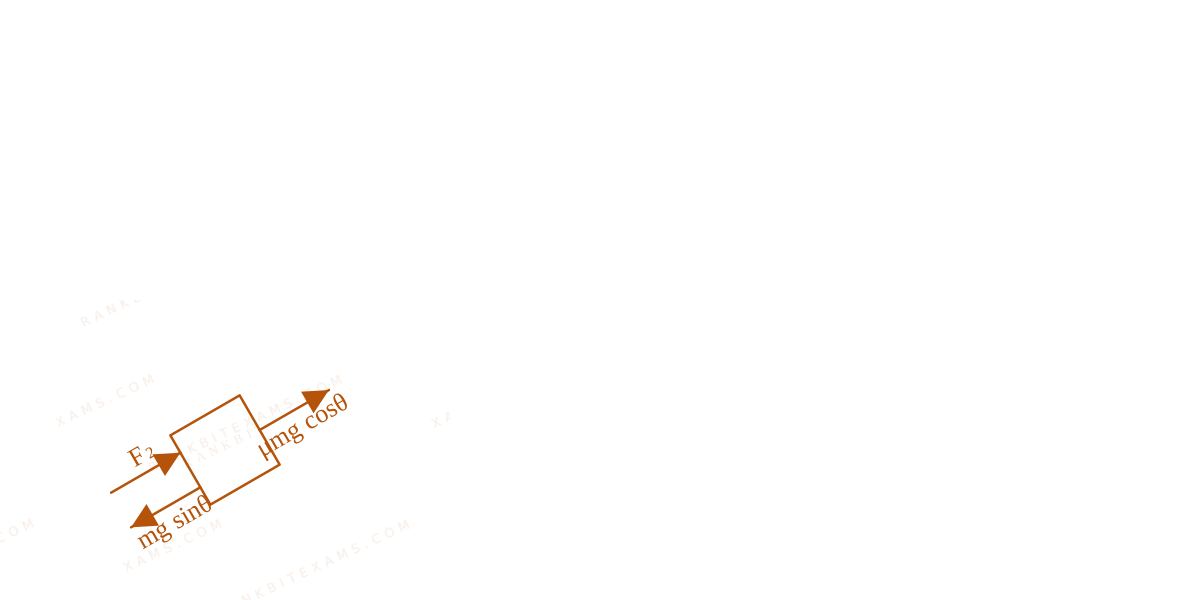
To move the block up, the applied force F₁ must overcome both the downward gravitational component and the downward frictional force. To prevent it from sliding down, the applied force F₂ acts upwards and is aided by friction which acts upwards to oppose impending downward slip.

Friction on an Inclined Plane diagram for Q42 - JEE Main 2024 Evening
The image shows a 5 kg block on a rough plane inclined at 30 degrees, with coefficient of friction mu = 0.1.

Friction on an Inclined Plane diagram for Q42 - JEE Main 2024 Evening
The image shows a 5 kg block on a rough plane inclined at 30 degrees, with coefficient of friction mu = 0.1.

Step 1: Calculate Friction
fk = μ mg θ fk = 0.1 × 5 × 10 × (30°) fk = 5 × √(3)2 = 2.5√(3) N
Step 2: Force Equations

Moving up:

F₁ = mg θ + fk = 50 (30°) + 2.5√(3) = 25 + 2.5√(3)

Preventing slip down:

F₂ = mg θ - fk = 50 (30°) - 2.5√(3) = 25 - 2.5√(3)
Step 3: Difference calculation
|F₁| - |F₂| = (25 + 2.5√(3)) - (25 - 2.5√(3)) |F₁| - |F₂| = 2 × 2.5√(3) = 5√(3) N

Note: The official options had an anomaly where 5√(3) N was missing or evaluated as a bonus. Option 2 was listed as 50√(3) in the primary text. We track the closest logic path indicating Bonus.

Pattern Recognition

The difference between 'push up' and 'hold from sliding' forces on an incline is always precisely 2 fk (2 μ mg θ). Bypass calculating the mg θ terms entirely.

Chapter Mix

Class 11 Physics: Laws of Motion

Reference Study Guides

More Laws of Motion Previous-Year Questions

Q31 jee_main_2026_21_jan_morning Force and Acceleration
A 4 kg mass moves under the influence of a force F = (4t³ i - 3t j) N where t is the time in second. If mass starts from origin at t = 0, the velocity and position after t = 2s will be:
  • A. v = 3 i +(3)/(2) j, r = (6)/(5) i + j
  • B. v = 4 i -(3)/(2) j, r = (8)/(5) i - j
  • C. v = 4 i +(5)/(2) j, r = (8)/(5) i +2 j
  • D. v = 4 i -(3)/(2) j, r = (6)/(5) i - j

Solution

Related Formula
a = Fm v = ∫ a dt r = ∫ v dt
Core Logic

Given F = 4t³ i - 3t j and mass m = 4 kg. Acceleration:

a = Fm = 4t³ i - 3t j4 = t³ i - (3)/(4)t j
Step 1: Calculating Velocity

Velocity is the integral of acceleration with v(0) = 0:

v = ∫ ( t³ i - (3)/(4)t j ) dt = (t⁴)/(4) i - (3)/(8)t² j

At t = 2 s:

v(2) = ((2)⁴)/(4) i - (3)/(8)(2)² j = 4 i - (3)/(2) j
Step 2: Calculating Position

Position is the integral of velocity with r(0) = 0:

r = ∫ v dt = ∫ ( (t⁴)/(4) i - (3)/(8)t² j ) dt r = (t⁵)/(20) i - (3)/(24)t³ j = (t⁵)/(20) i - (t³)/(8) j

At t = 2 s:

r(2) = ((2)⁵)/(20) i - ((2)³)/(8) j = (32)/(20) i - (8)/(8) j = (8)/(5) i - j
Pattern Recognition

Recognize F → a → v → r means consecutive integrations. Because the initial state is from rest at origin, we don't have to worry about constants of integration.

Chapter Mix

Class 11 Physics: Laws of Motion Class 11 Physics: Kinematics
Q43 jee_main_2026_21_jan_evening Circular Motion
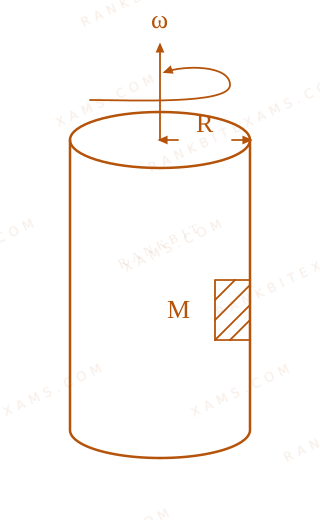
A large drum having radius R is spinning around its axis with angular velocity ω, as shown in figure. The minimum value of ω so that a body of mass M remains stuck to the inner wall of the drum, taking the coefficient of friction between the drum surface and mass M is μ, is :
Spinning drum with mass M for Q43 - JEE Main 2026 Evening
Large drum of radius R spinning about its vertical axis with mass M stuck to the inner wall.
  • A. √((μ g)/(R))
  • B. √((2g)/(μ R))
  • C. √((g)/(2μ R))
  • D. √((g)/(μ R))

Solution

Related Formula

N = Mω² R

fmax = μ N

f = Mg

Core Logic

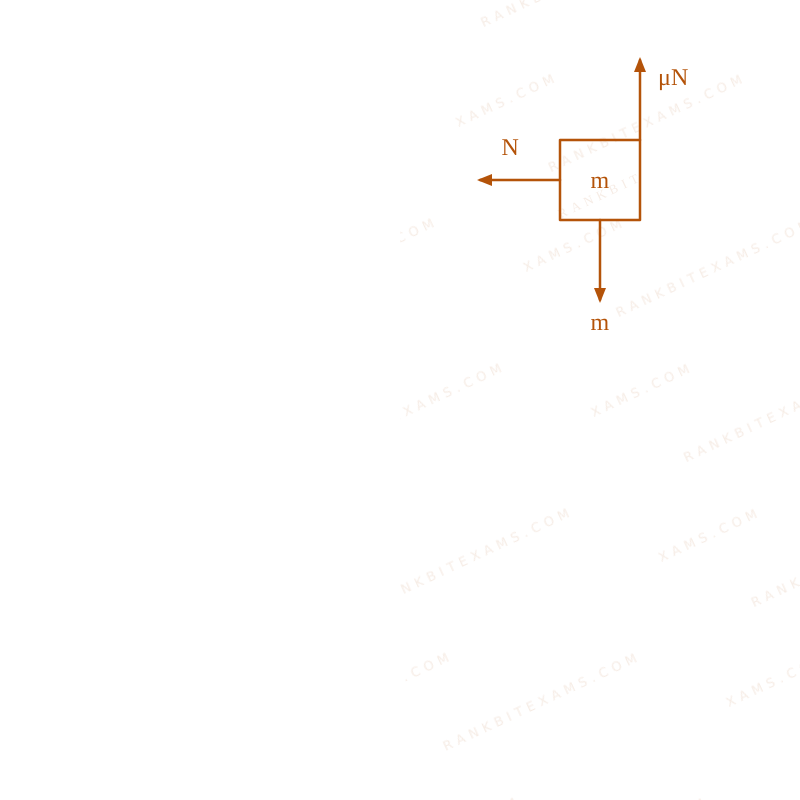
Free body diagram for spinning drum Q43 - JEE Main 2026 Evening
Large drum of radius R spinning about its vertical axis with mass M stuck to the inner wall.

For the mass M to remain stuck to the inner wall and not slide down, the upward frictional force must balance the downward gravitational force. f = Mg The normal force N providing the friction is generated by the centrifugal effect (or provides the centripetal acceleration): N = Mω² R The condition for no sliding is that required friction cannot exceed the maximum static friction: Mg ≤ μ N

Step 1: Final Conclusion

Substitute N into the inequality:

Mg ≤ μ (Mω² R) g ≤ μ ω² R ω² ≥ (g)/(μ R)

For minimum angular velocity:

ωmin = √((g)/(μ R))
Pattern Recognition

In a "rotor" ride setup, gravity is opposed by friction, and the normal force is solely centripetal. Equating μ Fc to mg always yields the minimum spin limit.

Chapter Mix

Class 11 Physics: Laws of Motion

Q28 jee_main_2026_23_january_evening Motion on Inclined Plane
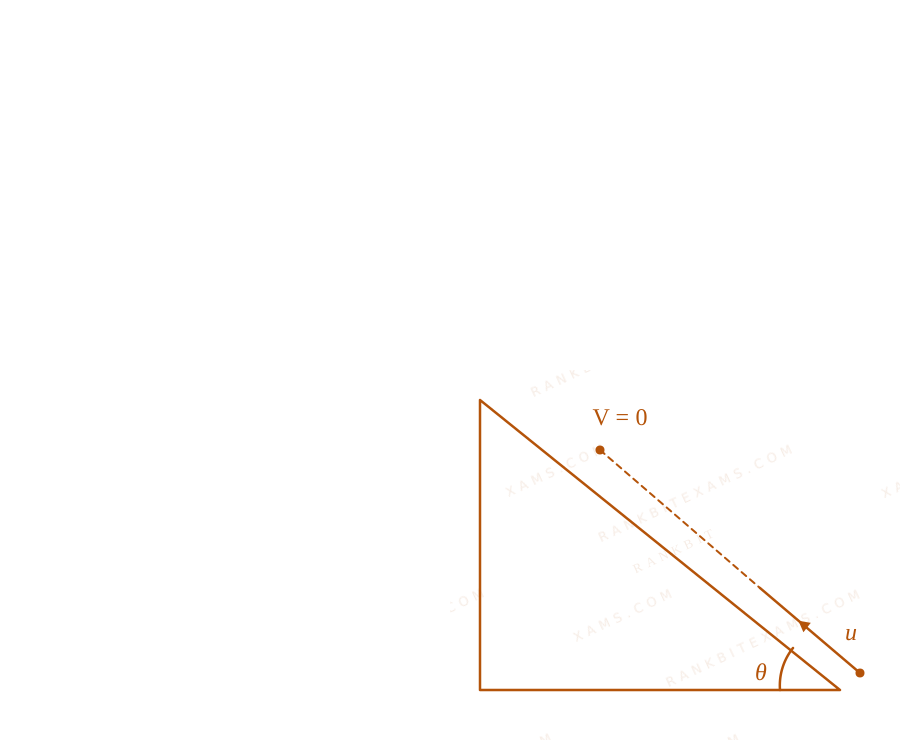
A block is sliding down on an inclined plane of slope θ and at an instant t = 0 this block is given an upward momentum so that it starts moving up on the inclined surface with velocity u . The distance (S) travelled by the block before its velocity become zero, is ____. (g = gravitational acceleration)
  • A. (u²)/(4g θ)
  • B. (2u²)/(g θ)
  • C. u²√(2)g θ
  • D. (u²)/(2g θ)

Solution

Related Formula

v² = u² + 2as

Core Logic

Motion on Inclined Plane diagram for Q28 - JEE Main 2026 Evening

Since the surface is frictionless (implied as no friction coefficient is given), the only force along the incline opposing the upward motion is the component of gravity, mg θ.

Acceleration a = -g θ.

Step 1: Apply Kinematic Equation

Using the third equation of motion: V² = U² + 2as

Set final velocity V = 0:

0 = u² - 2(g θ) S S = (u²)/(2g θ)
Pattern Recognition

For upward motion on a smooth incline, deceleration is purely g θ. The stopping distance is always u² / 2a.

Chapter Mix

Class 11 Physics: Laws of Motion Class 11 Physics: Kinematics
Q36 jee_main_2026_24_january_morning Spring Force
A spring of force constant 15 N/m is cut into two pieces. If the ratio of their length is 1:3, then the force constant of smaller piece is ____ N/m
  • A. 15
  • B. 20
  • C. 60
  • D. 45

Solution

Related Formula
K = constant K ∝ (1)/( )
Core Logic

Spring cut into pieces diagram

The spring of total length is cut into two parts with a length ratio of 1:3. The lengths of the two pieces are: ₁ = (1)/(4) (smaller piece) ₂ = (3)/(4) (larger piece)

Step 1: Calculate Spring Constant of Smaller Piece

Since K = K' ', for the smaller piece:

K = K' (( )/(4))

K' = 4K Given K = 15 N/m:

K' = 4 × 15 = 60 N/m
Pattern Recognition

Spring constant is inversely proportional to spring length. Cutting a spring to 1/n of its length increases its stiffness by a factor of n.

Chapter Mix

Class 11 Physics: Laws of Motion

Q49 jee_main_2026_24_january_morning Friction
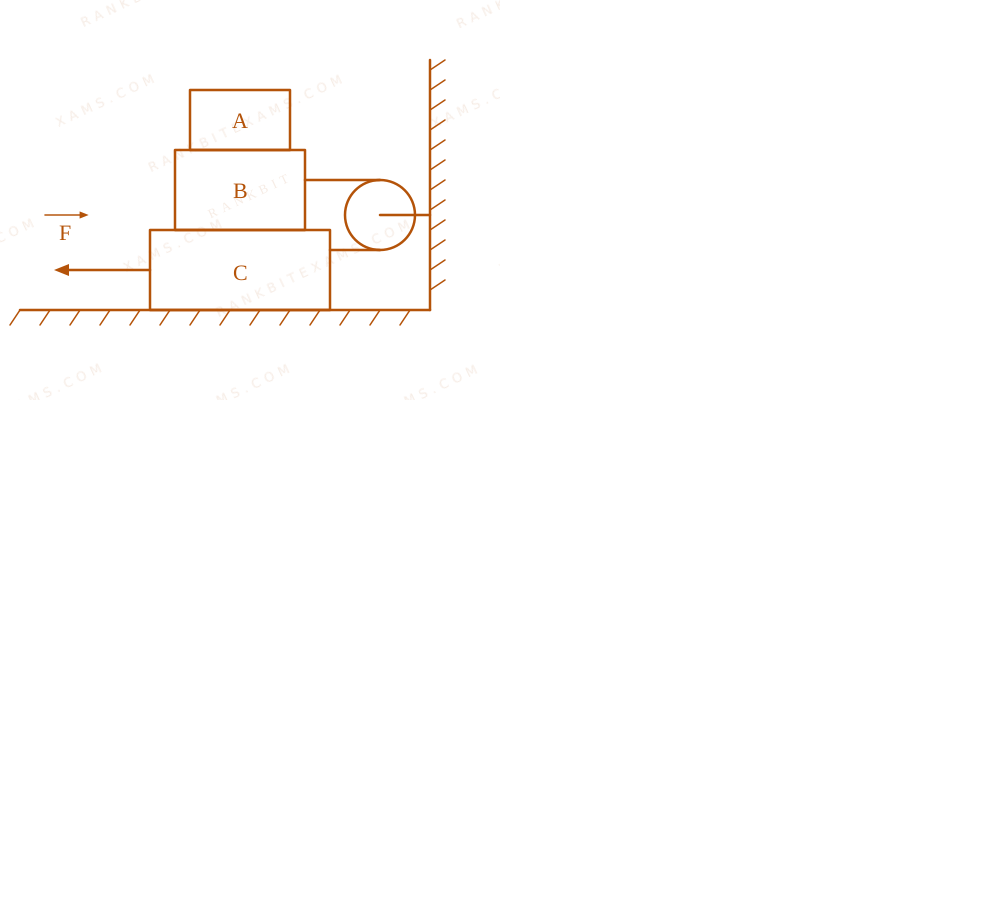
In the given figure the blocks A, B and C weigh 4 kg, 6 kg and 8 kg respectively. The co-efficient of sliding friction between any two surfaces is 0.5. The force F required to slide the block C with constant speed is ____ N. (Used g = 10 m/s²)
Stacked blocks with friction and string
Three stacked blocks A, B, C with an external pulling force F applied to C.
Numerical Answer. Answer: 210 to 210

Solution

Related Formula

fk = μk N

Fₙₑₜ = 0 (for constant speed)
Core Logic

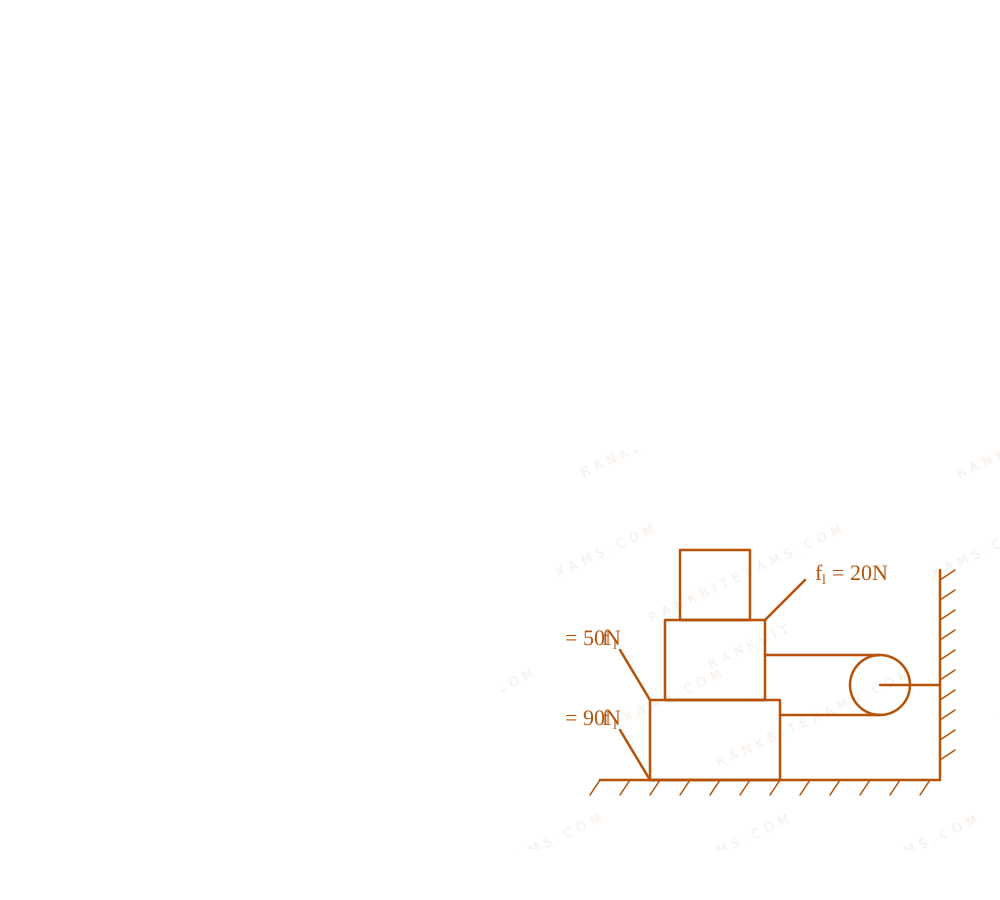
Free body diagram for stacked blocks
Three stacked blocks A, B, C with an external pulling force F applied to C.

Since C moves with constant speed, a=0, meaning net force is zero. For block A (4 kg) over B, sliding friction fA = μ (mA)g = 0.5 × 4 × 10 = 20 N. For block B (6 kg) over C, the normal force includes block A. NB = (mA + mB)g = 100 N. Friction on B from C is fB = 0.5 × 100 = 50 N. For block C (8 kg) over ground, normal force is total weight NC = (mA + mB + mC)g = 180 N. Friction on C from ground is fC = 0.5 × 180 = 90 N.

Step 1: Force Balance Equations

For block B to move relative to A and C (assuming standard string configuration where pulling C left causes B to be dragged right relative to C via pulley): The tension T on B balances friction from A and C:

T = fA + fB = 20 + 50 = 70 N

For block C moving left, the force F must overcome friction from ground, friction from B, and the tension T attached to it (depending on pulley setup. If pulley is on wall, string pulls C right): Assuming standard setup where string connects B and C around wall pulley:

F = fC + fB + T F = 90 + 50 + 70 = 210 N
Pattern Recognition

In multi-block pulley systems, pulling the bottom block accumulates all nested friction forces. The bottom block fights the ground, the block above it, AND the tension of the string anchoring the block above it.

Chapter Mix

Class 11 Physics: Laws of Motion

More Laws of Motion Questions — jee_main_2024_31_jan_evening

Practice all Laws of Motion previous-year questions →

Rankbit System
JEE Physics: Waves (+15.5%) | Electrostatics: Concentric Shells (-29.7%) | Modern Physics: Photoelectric Clones (+34.2%) | Mathematics: Definite Integrals (+18.1%) | Chemistry: Coordination Splitting (-11.4%) | JEE Physics: Waves (+15.5%) | Electrostatics: Concentric Shells (-29.7%) | Modern Physics: Photoelectric Clones (+34.2%) | Mathematics: Definite Integrals (+18.1%) | Chemistry: Coordination Splitting (-11.4%)