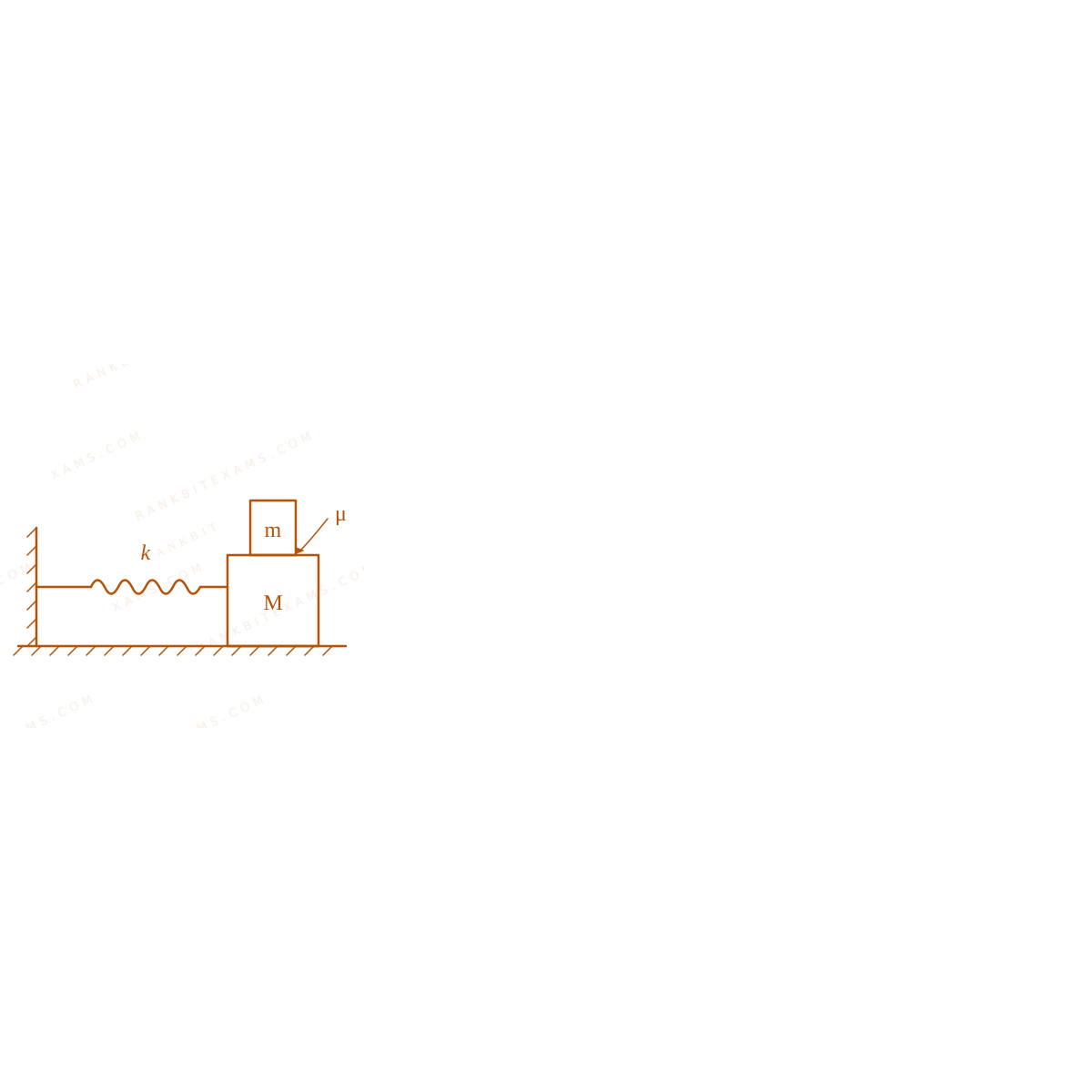
Two blocks of masses m and M, (M > m)$(\mathbf{M} > \mathbf{m})$ , are placed on a frictionless table as shown in figure. A massless spring with spring constant k is attached with the lower block. If the system is slightly displaced and released then
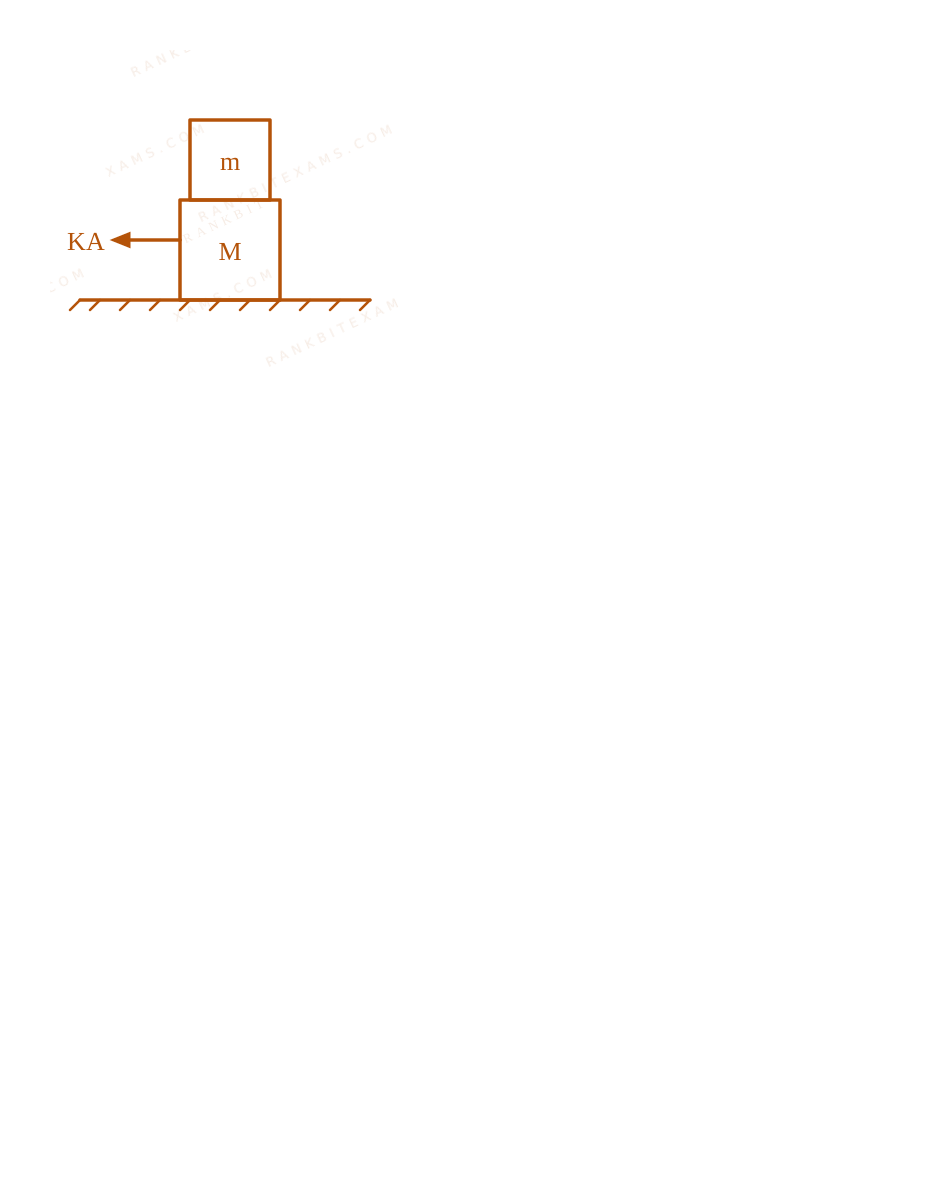
(μ =coefficient of friction between the two blocks)$(\mu =\text{coefficient of friction between the two blocks})$The diagram displays a smaller block of mass m placed on top of a larger block of mass M, which is connected to a horizontal spring on a smooth table.
(A) The time period of small oscillation of the two blocks is T = 2π (m + M)k$\mathrm{T} = 2\pi \sqrt{\frac{(\mathrm{m} + \mathrm{M})}{\mathrm{k}}}$
(B) The acceleration of the blocks is a = (kx)/(M + m)$a = \frac{kx}{M + m}$ (x = displacement of the blocks from the mean position)
(C) The magnitude of the frictional force on the upper block is mk|x|M + m$\frac{\mathrm{m}k|\mathrm{x}|}{\mathrm{M} + \mathrm{m}}$
(D) The maximum amplitude of the upper block, if it does not slip, is μ(M + m)gk$\frac{\mu(\mathbf{M} + \mathbf{m})\mathbf{g}}{\mathbf{k}}$
(E) Maximum frictional force can be μ (M + m)g$\mu (\mathbf{M} + \mathbf{m})\mathbf{g}$.
Choose the correct answer from the options given below:
A.A, B, D Only
B.B, C, D Only
C.C, D, E Only
D.A, B, C Only
Solution & Explanation
Related Formula
For combined system performing simple harmonic motion without relative slipping:
T = 2π mtotalk$$T = 2\pi \sqrt{\frac{m_{\text{total}}}{k}}$$a = -ω² x = -(k)/(M+m) x$$a = -\omega^2 x = -\frac{k}{M+m} x$$
Core Logic
Let's analyze each statement:
Statement (A): Since both blocks perform SHM together, the combined mass is (M + m)$(M + m)$. The spring constant is k$k$. Thus, the time period of small oscillation is:
T = 2π √((M+m)/(k))$$T = 2\pi \sqrt{\frac{M+m}{k}}$$
This is correct. (A is True)
Statement (B): When the system is displaced by x$x$, the restoring spring force on the combined system is F = -kx$F = -kx$. The common acceleration of the combined mass is:
This matches the expression (taking magnitude). (B is True)
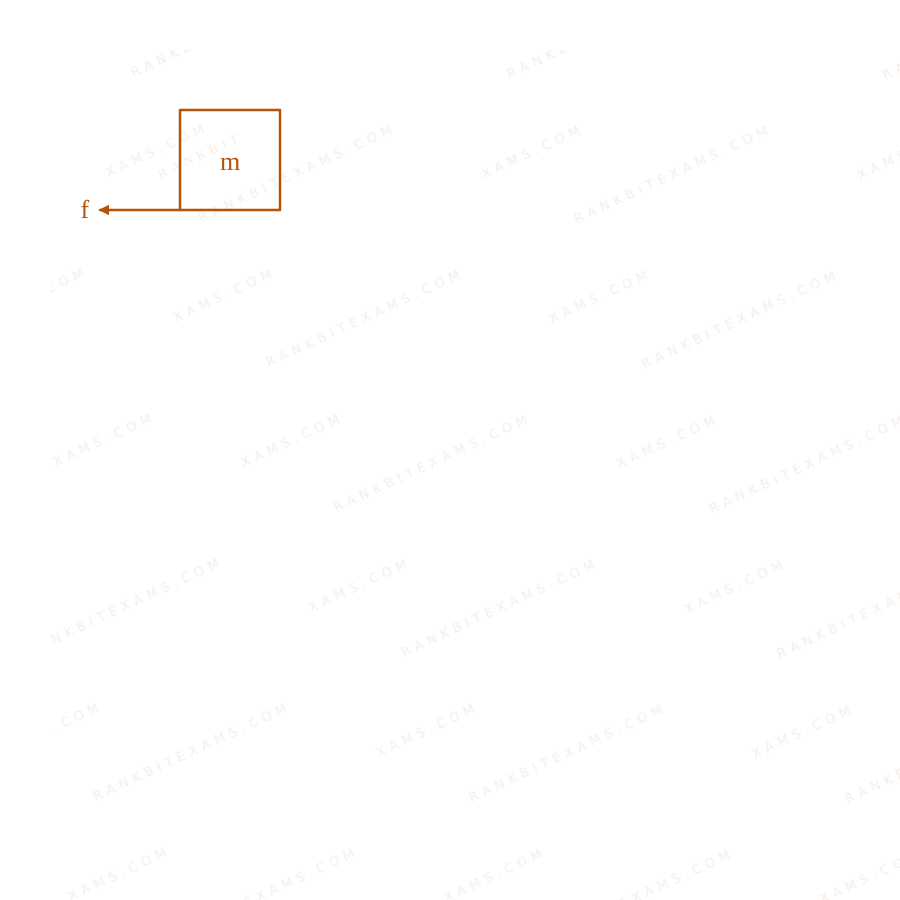
Statement (C): The upper block of mass m$m$ moves solely due to the static frictional force f$f$ acting on it. Thus:
f = m a = m ( (kx)/(M+m) ) = (mkx)/(M+m)$$f = m a = m \left( \frac{kx}{M+m} \right) = \frac{mkx}{M+m}$$
Statement (C) claims the frictional force is (mμ|x|)/(M+m)$\frac{m\mu|x|}{M+m}$, which is incorrect because friction is determined by acceleration, not by coefficient of friction μ$\mu$ during static grip. (C is False)
Statement (D): For no slipping to occur, the maximum frictional force required at peak amplitude A$A$ must be less than or equal to the limiting static friction fL = μ mg$f_L = \mu mg$:
fmax = (mkA)/(M+m) ≤ μ mg$$f_{\text{max}} = \frac{mkA}{M+m} \le \mu mg$$(kA)/(M+m) ≤ μ g A ≤ (μ(M+m)g)/(k)$$\frac{kA}{M+m} \le \mu g \implies A \le \frac{\mu(M+m)g}{k}$$
Thus, the maximum amplitude is (μ(M+m)g)/(k)$\frac{\mu(M+m)g}{k}$. (D is True)
Statement (E): The maximum static frictional force between the blocks is fL = μ mg$f_L = \mu mg$, not μ (M+m)g$\mu (M+m)g$. (E is False)
Step 1: Conclusion
Only statements A, B, and D are correct. Hence, the correct option is (1).
The diagram displays a smaller block of mass m placed on top of a larger block of mass M, which is connected to a horizontal spring on a smooth table.The diagram displays a smaller block of mass m placed on top of a larger block of mass M, which is connected to a horizontal spring on a smooth table.
Pattern Recognition
In stacked blocks with springs, always identify the force driving the non-spring-loaded block. Here, mass m$m$ is driven purely by friction, so f = m · a$f = m \cdot a$. Slipping begins when this required force exceeds flimit = μ m g$f_{\text{limit}} = \mu m g$. This simple boundary matches the derivation of maximum amplitude perfectly!
Chapter Mix
Class 11 Physics: Laws of Motion: Friction
Class 11 Physics: Oscillations: Simple Harmonic Motion
Keywords:#stacked block SHM friction#JEE Main 2025 Morning Q6#maximum amplitude no slipping#Oscillations and friction JEE#spring block system#stacked blocks#frictional oscillation
More Laws of Motion Previous-Year Questions — Page 6
Q39jee_main_2024_29_jan_morningFriction and Work Done
A block of mass 100 ~kg$100 \mathrm{~kg}$ slides over a distance of 10 ~m$10 \mathrm{~m}$ on a horizontal surface. If the co-efficient of friction between the surfaces is 0.4, then the work done against friction (in J) is:
A. 4200
B. 3900
C. 4000
D. 4500
Solution
Related Formula
Kinetic frictional force (f$f$) on a flat surface:
Wagainst = f · s = 400 ~N × 10 ~m = 4000 ~J$$W_{\text{against}} = f \cdot s = 400 \mathrm{~N} \times 10 \mathrm{~m} = 4000 \mathrm{~J}$$
Therefore, the work done is 4000 ~J$4000 \mathrm{~J}$.
Pattern Recognition
Work done by friction is negative (-4000 ~J$-4000 \mathrm{~J}$) because the frictional force opposes displacement. Work done against friction is positive (+4000 ~J$+4000 \mathrm{~J}$) because it represents the external energy that must be spent to sustain slide.
Chapter Mix
Class 11 Physics: Laws of Motion
Qjee_main_2024_30_january_eveningConnected Bodies and Tension
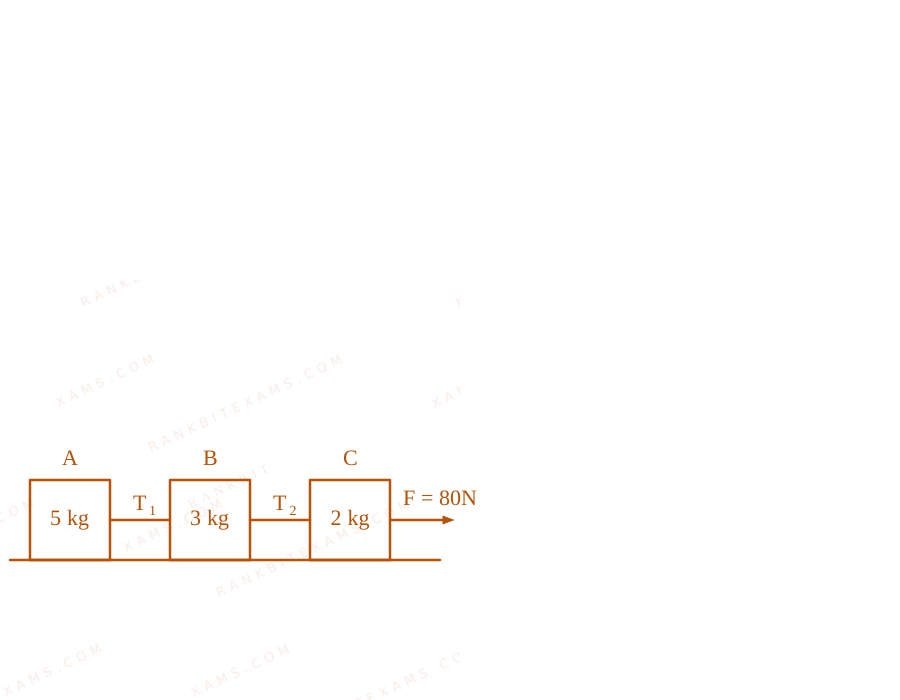
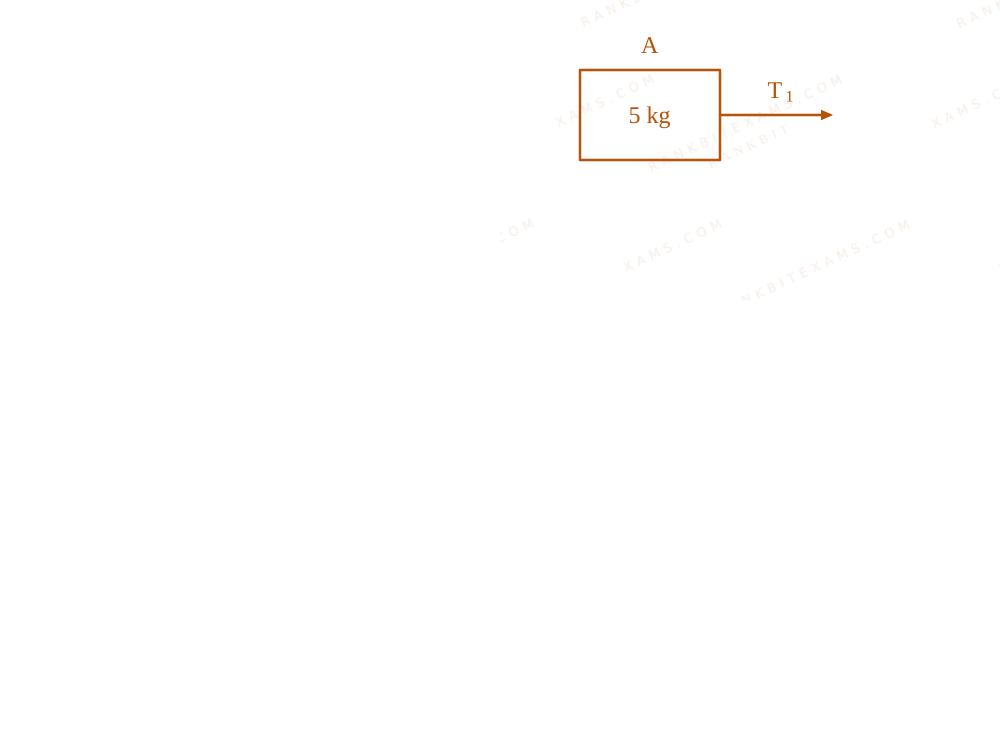
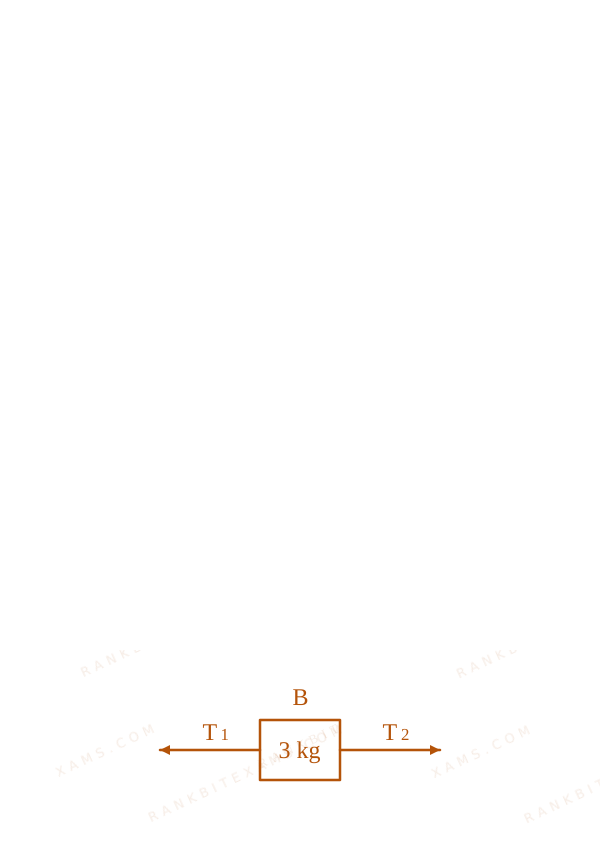
Three blocks A$\mathrm{A}$, B$\mathrm{B}$ and C$\mathrm{C}$ are pulled on a horizontal smooth surface by a force of 80N$80\mathrm{N}$ as shown in figure
Three masses (5 kg, 3 kg, 2 kg) connected by strings with tensions T1 and T2, being pulled by a common force F = 80N.
The tensions T₁$\mathrm{T}_{1}$ and T₂$\mathrm{T}_{2}$ in the string are respectively:
Tension at any point in a train of connected accelerating bodies (without friction) is directly proportional to the total mass being pulled behind that point.
Chapter Mix
Class 11 Physics: Laws of Motion
Q32jee_main_2024_30_january_eveningWork Done by Friction on Incline
A block of mass 1 ~kg$1 \mathrm{~kg}$ is pushed up a surface inclined to horizontal at an angle of 60°$60^{\circ}$ by a force of 10 ~N$10 \mathrm{~N}$ parallel to the inclined surface as shown in figure. When the block is pushed up by 10 ~m$10 \mathrm{~m}$ along inclined surface, the work done against frictional force is: [g = 10 ~m / s²]$\left[\mathrm{g} = 10 \mathrm{~m} / \mathrm{s}^{2}\right]$A block of mass M on an incline at 60 degrees, pulled by 10 N force, with coefficient of static friction 0.1.
A.5√(3) ~J$5\sqrt{3} \mathrm{~J}$
B.5 ~J$5 \mathrm{~J}$
C.5 × 10³ ~J$5 \times 10^{3} \mathrm{~J}$
D.10 ~J$10 \mathrm{~J}$
Solution
Related Formula
Wf = fk · d$$W_f = f_k \cdot d$$
fk = μ N$f_k = \mu N$
N = mg θ$$N = mg \cos\theta$$
Core Logic
The work done against the frictional force is the product of the kinetic friction force and the displacement along the plane.
The normal force N$N$ on the block is given by N = mg θ$N = mg \cos\theta$, where θ = 60°$\theta = 60^{\circ}$.
Whenever asked for "work done against friction", simply compute μ mg θ × d$\mu mg \cos\theta \times d$. The applied force (10 ~N$10 \mathrm{~N}$) is irrelevant to the friction calculation itself since it is parallel to the plane.
Chapter Mix
Class 11 Physics: Laws of Motion
Class 11 Physics: Work, Energy and Power
Q39jee_main_2024_30_january_eveningEquilibrium on a Rough Parabolic Curve
A block of mass m$m$ is placed on a surface having vertical cross section given by y = x² / 4$y = x^2 / 4$. If coefficient of friction is 0.5$0.5$, the maximum height above the ground at which block can be placed without slipping is:
For a block to remain stationary on a rough surface without slipping, the maximum slope of the surface it can rest on is determined by the angle of repose.
θ ≤ μ$$\tan \theta \le \mu$$
The slope of the given parabolic curve at any point (x,y)$(x,y)$ is dydx$\frac{\mathrm{d}y}{\mathrm{d}x}$.
When asked for maximum height on a curve y=f(x)$y=f(x)$ without slipping, set dydx = μ$\frac{\mathrm{d}y}{\mathrm{d}x} = \mu$, solve for x$x$, and plug it back into the original equation to find y$y$.
Chapter Mix
Class 11 Physics: Laws of Motion
Q32jee_main_2024_30_jan_morningConstraint Motion and Pulleys
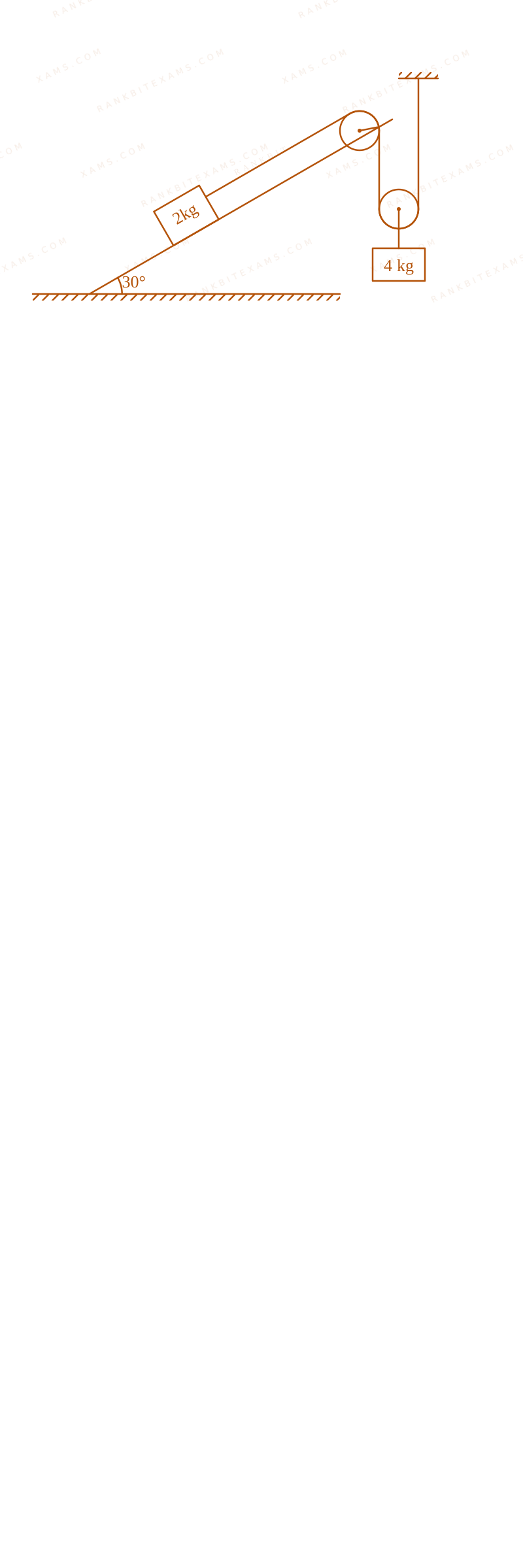
All surfaces shown in figure are assumed to be frictionless and the pulleys and the string are light. The acceleration of the block of mass 2 ~kg$2 \mathrm{~kg}$ is:
Illustration of a 2kg block on a 30 degree incline attached via a pulley system to a 4kg hanging block.
A.g$g$
B.(g)/(3)$\frac{g}{3}$
C.(g)/(2)$\frac{g}{2}$
D.(g)/(4)$\frac{g}{4}$
Solution
Related Formula
Σ F = ma$$\sum F = ma$$a₁ = Constraint relation× a₂$$a_1 = \text{Constraint relation}\times a_2$$
Core Logic
Illustration of a 2kg block on a 30 degree incline attached via a pulley system to a 4kg hanging block.
Let the tension in the string attached to the 2 ~kg$2 \mathrm{~kg}$ block be T$T$. By tracing the string around the movable pulley, the tension supporting the 4 ~kg$4 \mathrm{~kg}$ mass becomes 2T$2T$.
From the principle of virtual work (or string constraints), if the 4 ~kg$4 \mathrm{~kg}$ block moves down with an acceleration a$a$, the string shortens by 2x$2x$ on the incline side, meaning the 2 ~kg$2 \mathrm{~kg}$ block moves up the incline with an acceleration of 2a$2a$.
Step 1: Write Equations of Motion
For the 4 ~kg$4 \mathrm{~kg}$ block (moving downwards):
4g - 2T = 4a$4g - 2T = 4a$
40 - 2T = 4a (i)$$40 - 2T = 4a \quad \dots (i)$$
For the 2 ~kg$2 \mathrm{~kg}$ block (moving up the incline):
Since g = 10 ~m/s²$g = 10 \mathrm{~m/s^2}$, this acceleration is exactly (g)/(3)$\frac{g}{3}$.
Pattern Recognition
Movable pulleys double the force but halve the displacement/acceleration on the supported side. Tension on the movable pulley side is twice the tension on the single string side. Remember to explicitly solve for the requested block's specific acceleration, not just 'a'.
Chapter Mix
Class 11 Physics: Laws of Motion
More Laws of Motion Questions — jee_main_2025_03_april_morning
Practice past-year questions one chapter at a time. Pick an exam → subject → chapter and get every PYQ for that topic — pulled together from all past papers — with the chapter's key formulas alongside.