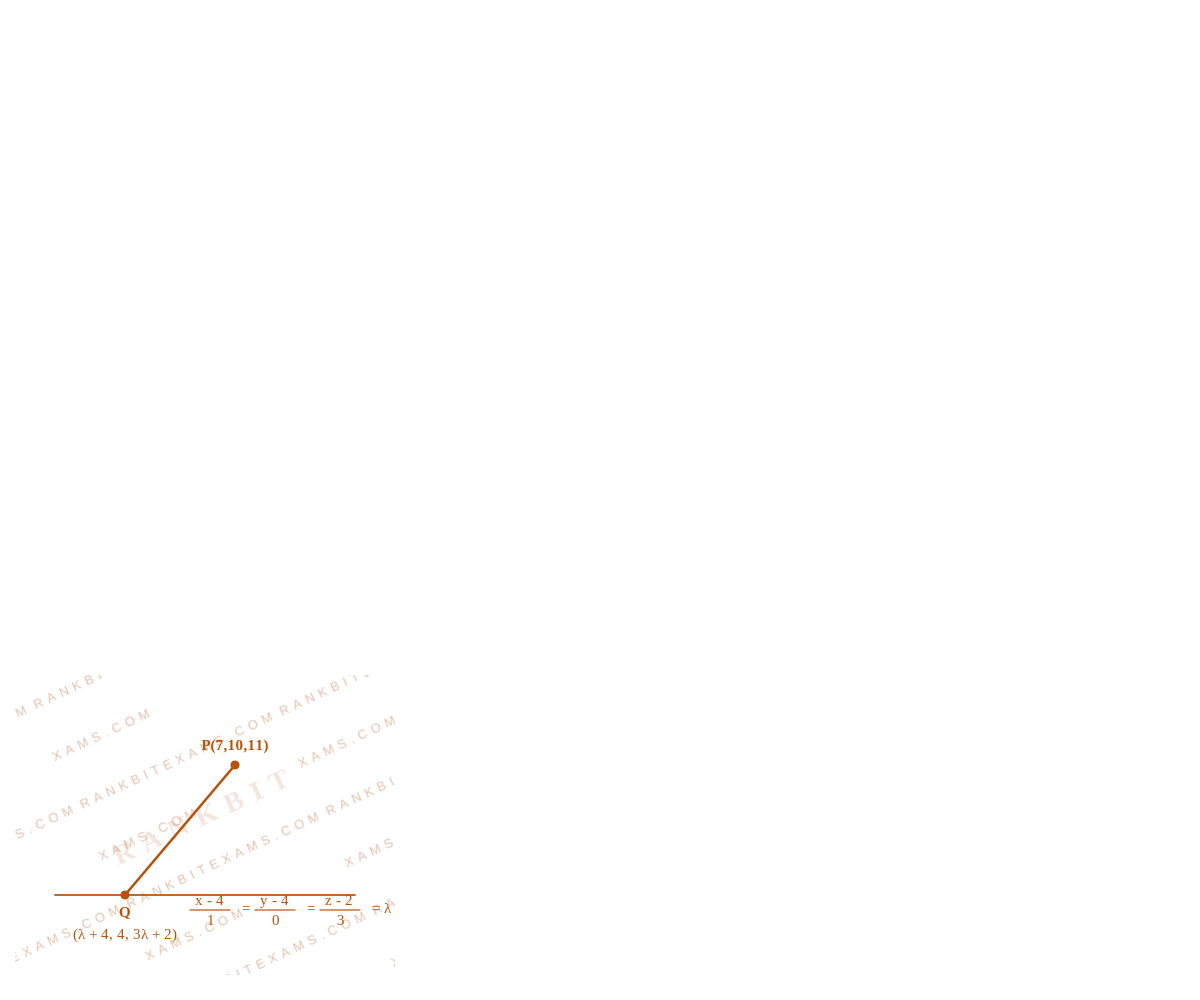
The distance of the point (7, 10, 11)$(7, 10, 11)$ from the line (x-4)/(1) = (y-4)/(0) = (z-2)/(3)$\frac{x-4}{1} = \frac{y-4}{0} = \frac{z-2}{3}$ along the line (x-9)/(2) = (y-13)/(3) = (z-17)/(6)$\frac{x-9}{2} = \frac{y-13}{3} = \frac{z-17}{6}$ is
A.18$18$
B.14$14$
C.12$12$
D.16$16$
Solution & Explanation
Related Formula
Distance 'along a line' means the direction vector of the line segment joining target point P$P$ to intersecting point Q$Q$ must be parallel to the given direction ratios:
PQ = k · d$$\vec{PQ} = k \cdot \vec{d}$$
Core Logic
Let point P = (7, 10, 11)$P = (7, 10, 11)$.
Any general point Q$Q$ on the first line (x-4)/(1) = (y-4)/(0) = (z-2)/(3) = λ$\frac{x-4}{1} = \frac{y-4}{0} = \frac{z-2}{3} = \lambda$ is:
When solving distance parallel to a line in 3D, always write down the parametric coordinates of the general point first. Match the ratio of direction cosines directly to avoid setting up complicated systems of coordinate planes.
Chapter Mix
Class 12 Mathematics: Three Dimensional Geometry
Class 12 Mathematics: Vector Algebra
Keywords:#distance along a line 3D#JEE Main 2025 Evening Q69#Three Dimensional Geometry JEE Main 2025#direction ratios straight line vector
More Three Dimensional Geometry Previous-Year Questions — Page 8
Q56jee_main_2025_04_april_morningShortest Distance Between Two Lines
Let the shortest distance between the lines (x - 3)/(3) = (y - α)/(-1) = (z - 3)/(1)$\frac{x - 3}{3} = \frac{y - \alpha}{-1} = \frac{z - 3}{1}$ and (x + 3)/(-3) = (y + 7)/(2) = (z - β)/(4)$\frac{x + 3}{-3} = \frac{y + 7}{2} = \frac{z - \beta}{4}$ be 3√(30)$3\sqrt{30}$. Then the positive value of 5α + β$5\alpha + \beta$ is
A. 42
B. 46
C. 48
D. 40
Solution
Related Formula
Shortest distance between lines passing through a₁, a₂$\vec{a}_1, \vec{a}_2$ with directions p, q$\vec{p}, \vec{q}$:
d = |( a₂ - a₁) · ( p × q)|| p × q|$$d = \frac{|(\vec{a}_2 - \vec{a}_1) \cdot (\vec{p} \times \vec{q})|}{|\vec{p} \times \vec{q}|}$$
Core Logic
Identify parameters:
A = (3, α, 3)$A = (3, \alpha, 3)$ and B = (-3, -7, β) BA = 6 i + (α + 7) j + (3 - β) k$B = (-3, -7, \beta) \implies \overrightarrow{BA} = 6\hat{i} + (\alpha + 7)\hat{j} + (3 - \beta)\hat{k}$.
Directions: p = 3 i - j + k$\vec{p} = 3\hat{i} - \hat{j} + \hat{k}$ and \ \vec{q} = -3\hat{i} + 2\hat{j} + 4\hat{k}.
Notice that the determinant logic perfectly structures linear equations. Simplifying the dot product using standard scaling helps prevent sign errors.
Chapter Mix
Class 12 Mathematics: Three Dimensional Geometry
Q64jee_main_2025_07_april_eveningLines in 3D Space
If the equation of the line passing through the point (0, -(1)/(2), 0)$\left(0, -\frac{1}{2}, 0\right)$ and perpendicular to the lines r = λ ( i + a j + b k)$\vec {\mathrm {r}} = \lambda (\hat {\mathrm {i}} + \mathrm {a} \hat {\mathrm {j}} + \mathrm {b} \hat {\mathrm {k}})$ and r = ( i - j - 6 k) + μ (- b i + a j + 5 k)$\vec {\mathrm {r}} = \left(\hat {\mathrm {i}} - \hat {\mathrm {j}} - 6 \hat {\mathrm {k}}\right) + \mu \left(- b \hat {\mathrm {i}} + a \hat {\mathrm {j}} + 5 \hat {\mathrm {k}}\right)$ is x - 1-2 = y + 4d = z - c-4$\frac{\mathrm{x} - 1}{-2} = \frac{\mathrm{y} + 4}{\mathrm{d}} = \frac{\mathrm{z} - \mathrm{c}}{-4}$ then a +b + c + d$+\mathrm{b} + \mathrm{c} + \mathrm{d}$ is equal to:
A.10$10$
B.14$14$
C.13$13$
D.12$12$
Solution
Related Formula
The direction vector of a line perpendicular to two given lines with direction vectors v₁$\vec{v}_1$ and \vec{v}_2 is determined by their cross product:
v = v₁ × v₂$$\vec{v} = \vec{v}_1 \times \vec{v}_2$$
Core Logic
The given point (0, -(1)/(2), 0)$\left(0, -\frac{1}{2}, 0\right)$ lies on the required line:
From the first and third components of equation (i):
(5a - ab)/(-2) = (a + ab)/(-4) 2(5a - ab) = a + ab$$\frac{5a - ab}{-2} = \frac{a + ab}{-4} \implies 2(5a - ab) = a + ab$$10a - 2ab = a + ab 9a = 3ab b = 3$$10a - 2ab = a + ab \implies 9a = 3ab \implies b = 3$$
Now use the second component ratio with b = 3$b = 3$ and d = 7$d = 7$:
(-(3² + 5))/(7) = (a + a(3))/(-4) (-14)/(7) = (4a)/(-4) -2 = -a a = 2$$\frac{-(3^2 + 5)}{7} = \frac{a + a(3)}{-4} \implies \frac{-14}{7} = \frac{4a}{-4} \implies -2 = -a \implies a = 2$$
Step 3: Sum the Variables
Summing up a, b, c, d$a, b, c, d$:
a + b + c + d = 2 + 3 + 2 + 7 = 14$$a + b + c + d = 2 + 3 + 2 + 7 = 14$$
Pattern Recognition
Substituting known point values into symmetric equations immediately determines structural values like c$c$ and d$d$ before running cross product systems.
Chapter Mix
Class 12 Mathematics: Three Dimensional Geometry
Q66jee_main_2025_07_april_eveningFoot of Perpendicular and Area
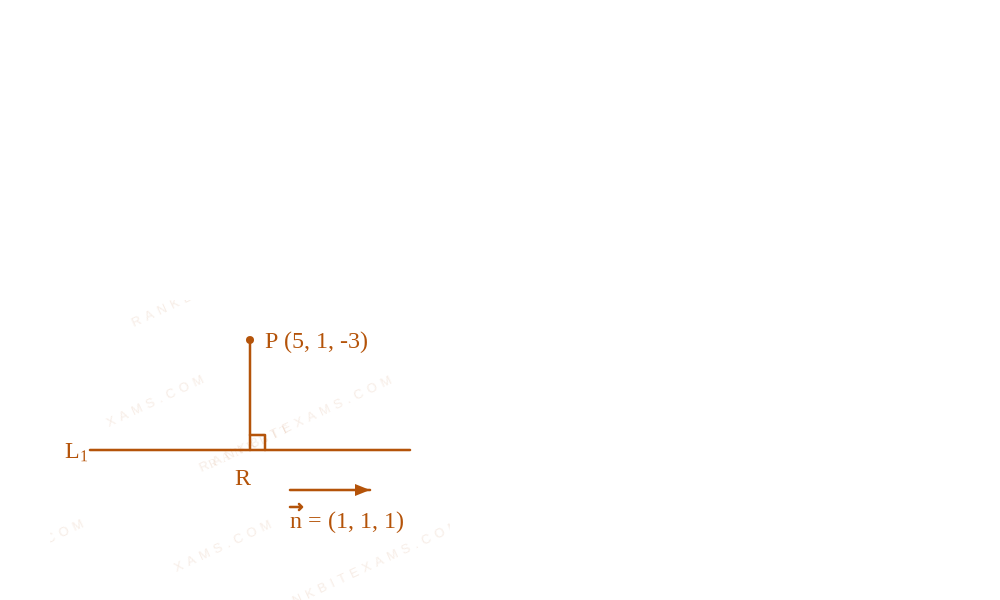
Consider the lines L₁: x - 1 = y - 2 = z$\mathrm{L}_1: \mathrm{x} - 1 = \mathrm{y} - 2 = \mathrm{z}$ and L₂: x - 2 = y = z - 1$\mathrm{L}_2: \mathrm{x} - 2 = \mathrm{y} = \mathrm{z} - 1$. Let the feet of the perpendiculars from the point P(5,1,-3)$\mathrm{P}(5,1,-3)$ on the lines L₁$\mathrm{L}_1$ and L₂$\mathrm{L}_2$ be Q$\mathrm{Q}$ and R$\mathrm{R}$ respectively. If the area of the triangle PQR is A$\mathrm{A}$, then 4A²$4\mathrm{A}^2$ is equal to:
A.139$139$
B.147$147$
C.151$151$
D.143$143$
Solution
Related Formula
The vector area of a triangle given two adjacent position vectors u$\vec{u}$ and v$\vec{v}$ is calculated as:
Area = (1)/(2) | u × v|$$\text{Area} = \frac{1}{2} |\vec{u} \times \vec{v}|$$
Core Logic
For line L₁$L_1$: (x-1)/(1) = (y-2)/(1) = (z-0)/(1)$\frac{x-1}{1} = \frac{y-2}{1} = \frac{z-0}{1}$. Let a general point be Q(λ+1, λ+2, λ)$Q(\lambda+1, \lambda+2, \lambda)$.
Foot of Perpendicular and Area diagram for Q66 - JEE Main 2025 Evening
Step 1: Compute Foot R
For line L₂$L_2$: (x-2)/(1) = (y)/(1) = (z-1)/(1)$\frac{x-2}{1} = \frac{y}{1} = \frac{z-1}{1}$. Let a general point be R(μ+2, μ, μ+1)$R(\mu+2, \mu, \mu+1)$.
Setting up dot products systematically with general parametric forms quickly locks in spatial feet indices without complex geometric drawings.
Chapter Mix
Class 12 Mathematics: Three Dimensional Geometry
Q72jee_main_2025_24_jan_eveningImage of a Point and Area of Triangle
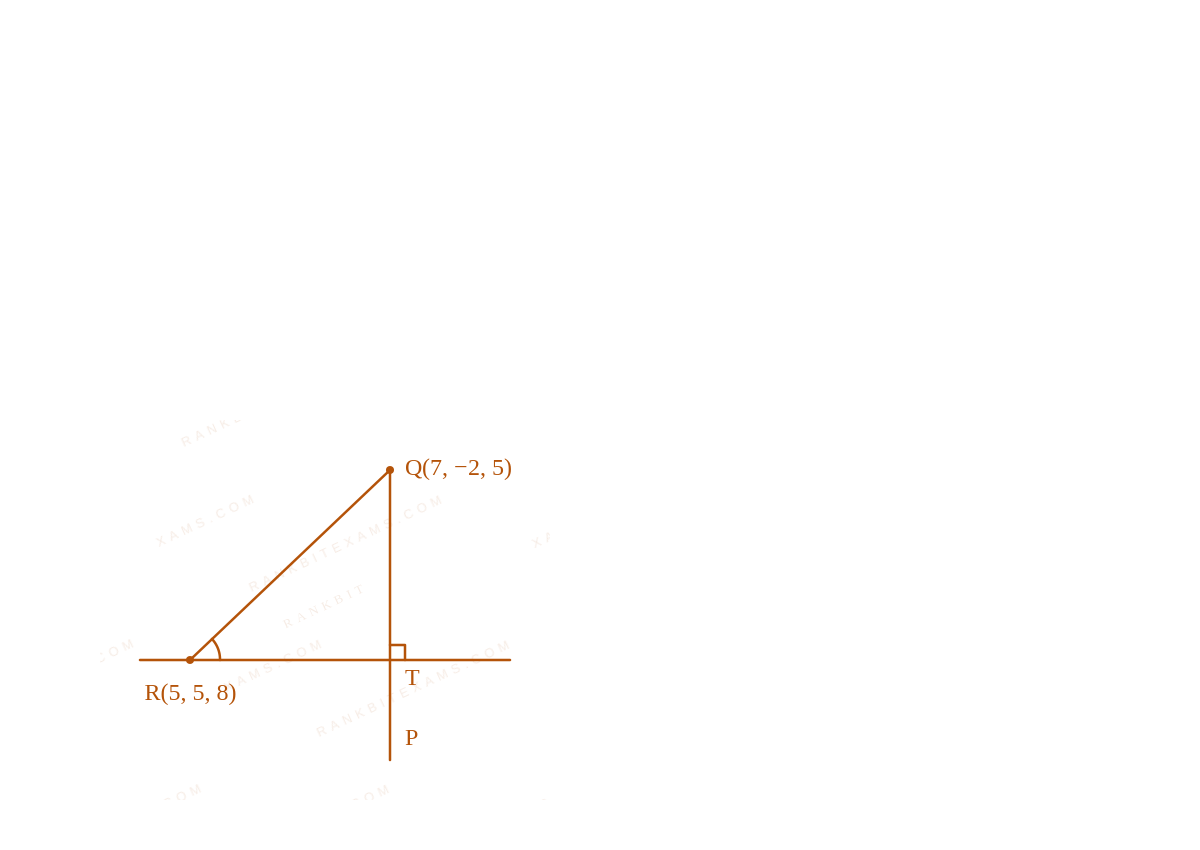
Let P be the image of the point Q(7,-2,5)$Q(7,-2,5)$ in the line L: (x-1)/(2)=(y+1)/(3)=(z)/(4)$\frac{x-1}{2}=\frac{y+1}{3}=\frac{z}{4}$ and R(5,p,q)$R(5,p,q)$ be a point on L. Then the square of the area of PQR$\triangle PQR$ is \_\_\_\_.
Numerical Answer.Answer: 957
Solution
Related Formula
Area of a $\triangle$ with perpendicular height h$h$ and base b$b$:
Area = (1)/(2) × b × h$$\text{Area} = \frac{1}{2} \times b \times h$$
Since P$P$ is the reflection image of Q$Q$ across line L$L$, the line acts as a perpendicular bisector. For any point R$R$ lying on the line, the height from R$R$ to the line is RT$RT$, and the base QP = 2QT$QP = 2QT$.
Core Logic
Determine parameters for point R$R$ lying directly on line L:
Because the image geometry creates an isosceles pairing from any point on the mirror line to the object and image point, the area reduces beautifully to 2 × Area( QTR) = QT × RT$2 \times \text{Area}(\triangle QTR) = QT \times RT$.
Chapter Mix
Class 12 Mathematics: Three Dimensional Geometry

Q58jee_main_2025_24_jan_morningArea of a Triangle in 3D Space
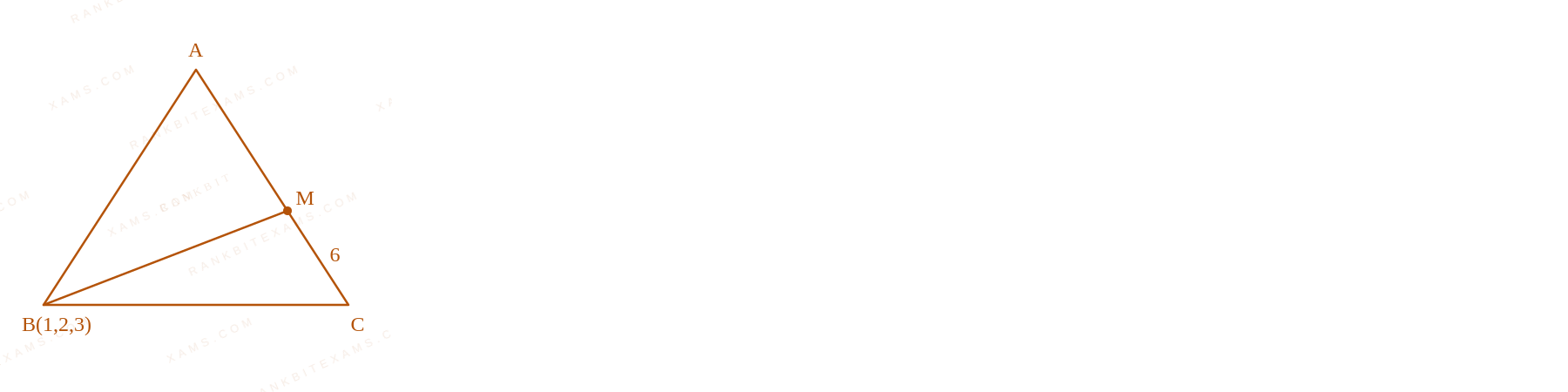
Let in a Δ ABC$\Delta ABC$ , the length of the side AC$AC$ be 6$6$, the vertex B$B$ be (1, 2, 3)$(1, 2, 3)$ and the vertices A, C$A, C$ lie on the line (x - 6)/(3) = (y - 7)/(2) = (z - 7)/(-2)$\frac{x - 6}{3} = \frac{y - 7}{2} = \frac{z - 7}{-2}$ . Then the area (in sq. units) of Δ ABC$\Delta ABC$ is :
A.42$42$
B.21$21$
C.56$56$
D.17$17$
Solution
Related Formula
The area of a triangle given base length b$b$ and altitude perpendicular height h$h$ is evaluated as:
Area = (1)/(2) · b · h$$\text{Area} = \frac{1}{2} \cdot b \cdot h$$
Core Logic
The base side AC$AC$ lies entirely along the line equation. Let M$M$ be the foot of the perpendicular dropped from vertex B(1,2,3)$B(1,2,3)$ to the line segment AC$AC$:
Area of a Triangle in 3D Space diagram for Q58 - JEE Main 2025 Morning
Any coordinate point on the line can be represented parametrically by setting the line fractions equal to λ$\lambda$:
Since BM$BM$ is perpendicular to the base line segment direction vector v = 3 i + 2 j - 2 k$\vec{v} = 3\hat{\mathbf{i}} + 2\hat{\mathbf{j}} - 2\hat{\mathbf{k}}$, their dot product must equal zero:
Instead of determining the absolute coordinates for individual triangle vertices A$A$ and C$C$, treating the problem via altitude minimization relative to the given parametric vector direction saves substantial calculation steps.
Chapter Mix
Class 12 Mathematics: Three Dimensional Geometry
More Three Dimensional Geometry Questions — jee_main_2025_03_april_evening
Practice past-year questions one chapter at a time. Pick an exam → subject → chapter and get every PYQ for that topic — pulled together from all past papers — with the chapter's key formulas alongside.