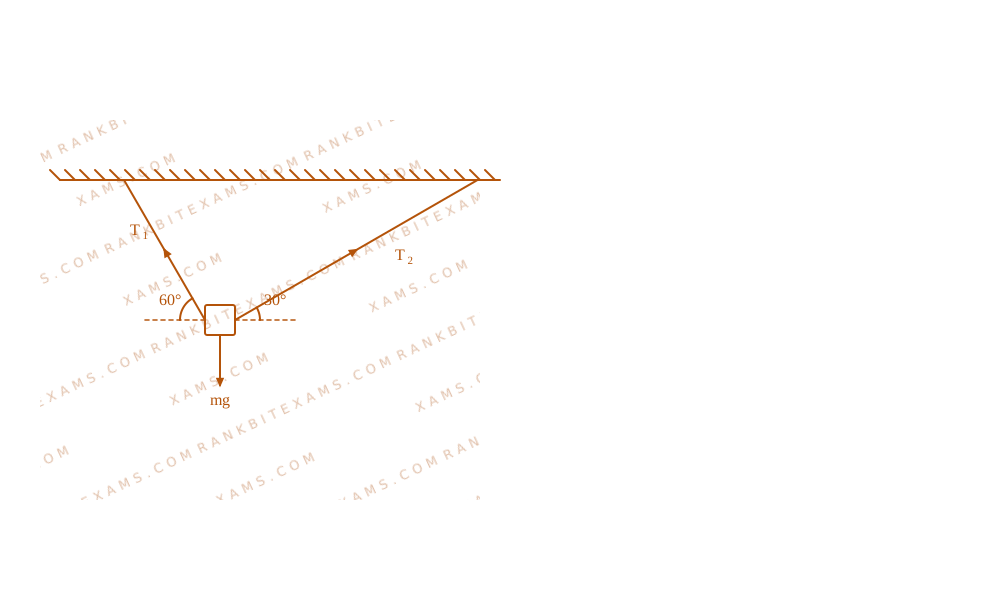
A body of mass 1mathrmkg$1\mathrm{kg}$ is suspended with the help of two strings making angles as shown in figure. Magnitude of tensions mathbfT_1$\mathbf{T}_1$ and mathbfT_2$\mathbf{T}_2$ , respectively, are (in N):
The diagram shows a suspended mass of 1 kg held by two strings making angles of 60 and 30 degrees with the horizontal.
A.5, 5sqrt3$5, 5\sqrt{3}$
B.5sqrt3, 5$5\sqrt{3}, 5$
C.5sqrt3, 5sqrt3$5\sqrt{3}, 5\sqrt{3}$
D.5, 5$5, 5$
Solution & Explanation
### Related Formula
For a system in static equilibrium:
sum F_x = 0 quad textand quad sum F_y = 0$$\sum F_x = 0 \quad \text{and} \quad \sum F_y = 0$$
### Core Logic
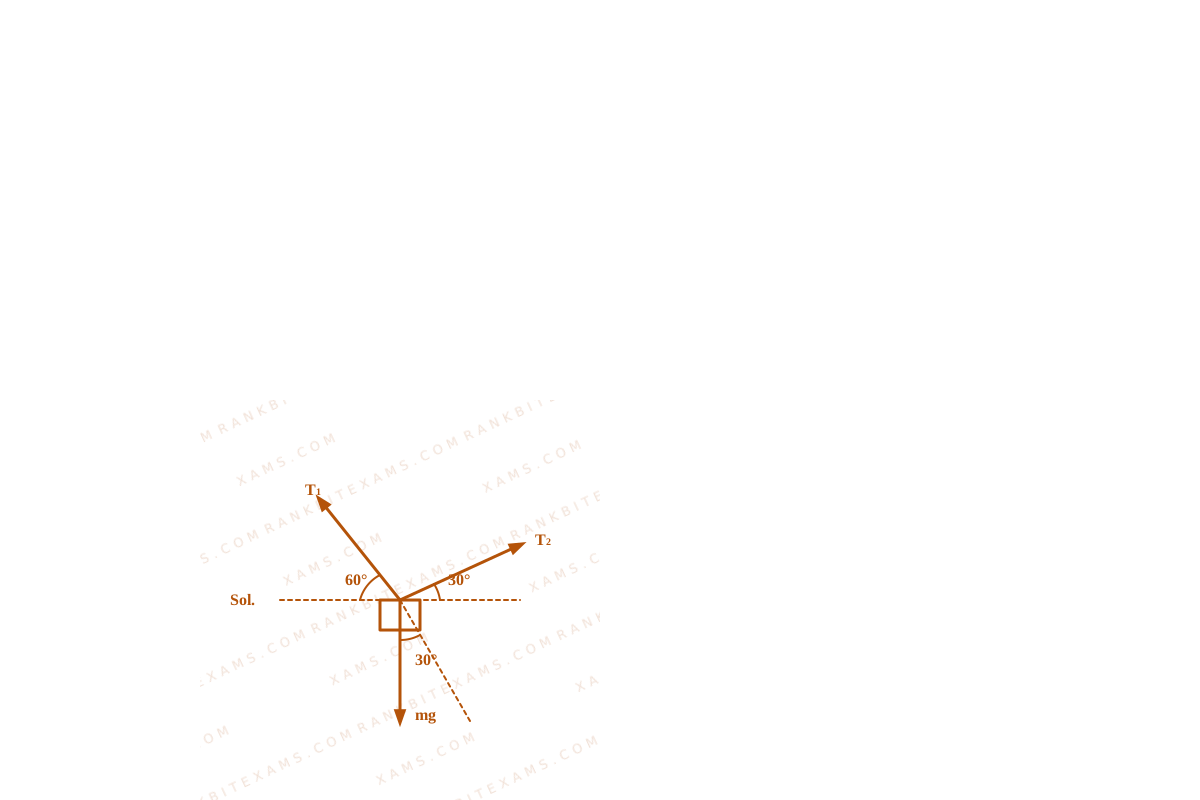
Let's resolve the tension forces vecT_1$\vec{T}_1$ and vecT_2$\vec{T}_2$ into horizontal and vertical components:
- T_1$T_1$ makes 60^circ$60^\circ$ with the horizontal.
- T_2$T_2$ makes 30^circ$30^\circ$ with the horizontal.
- Downward gravitational force: W = m g = 1 times 10 = 10 \ mathrmN$W = m g = 1 \times 10 = 10 \ \mathrm{N}$.
1. **Horizontal Equilibrium (sum F_x = 0$\sum F_x = 0$):**
T_1 cos 60^circ = T_2 cos 30^circ$$T_1 \cos 60^\circ = T_2 \cos 30^\circ$$T_1 cdot frac12 = T_2 cdot fracsqrt32 implies T_1 = T_2 sqrt3$$T_1 \cdot \frac{1}{2} = T_2 \cdot \frac{\sqrt{3}}{2} \implies T_1 = T_2 \sqrt{3}$$
2. **Vertical Equilibrium (sum F_y = 0$\sum F_y = 0$):**
T_1 sin 60^circ + T_2 sin 30^circ = m g = 10$$T_1 \sin 60^\circ + T_2 \sin 30^\circ = m g = 10$$T_1 cdot fracsqrt32 + T_2 cdot frac12 = 10$$T_1 \cdot \frac{\sqrt{3}}{2} + T_2 \cdot \frac{1}{2} = 10$$
### Step 1: Solve for Tensions
Substitute T_1 = T_2 sqrt3$T_1 = T_2 \sqrt{3}$ into the vertical equilibrium equation:
(T_2 sqrt3) fracsqrt32 + fracT_22 = 10$$(T_2 \sqrt{3}) \frac{\sqrt{3}}{2} + \frac{T_2}{2} = 10$$frac3 T_22 + fracT_22 = 10 implies 2 T_2 = 10 implies T_2 = 5 \ mathrmN$$\frac{3 T_2}{2} + \frac{T_2}{2} = 10 \implies 2 T_2 = 10 \implies T_2 = 5 \ \mathrm{N}$$
Substitute T_2$T_2$ back to obtain T_1$T_1$:
T_1 = 5 sqrt3 \ mathrmN$$T_1 = 5 \sqrt{3} \ \mathrm{N}$$
Thus, the tension magnitudes are T_1 = 5sqrt3 \ mathrmN$T_1 = 5\sqrt{3} \ \mathrm{N}$ and T_2 = 5 \ mathrmN$T_2 = 5 \ \mathrm{N}$.
### Pattern Recognition
Sees: Suspending particle static equilibrium with asymmetric strings.
Trap: Associating components with incorrect trigonometry axes or swapping T_1$T_1$ and T_2$T_2$ in options.
Shortcut: Since the incline of T_1$T_1$ (60^circ$60^\circ$) is steeper than that of T_2$T_2$ (30^circ$30^\circ$), T_1$T_1$ must carry a larger portion of the load, meaning T_1 > T_2$T_1 > T_2$. From the choices, only (2) satisfies this hierarchy.
### Evaluation Rubric / Model Answer
null
### Chapter Mix
Class 11 Physics: Laws of Motion
The diagram shows a suspended mass of 1 kg held by two strings making angles of 60 and 30 degrees with the horizontal.
Keywords:#static equilibrium tension forces mass#JEE Main 2025 Evening Q16#Lami theorem suspended mass physics#force components equilibrium Laws of Motion#tension#force components#static equilibrium
More Laws of Motion Previous-Year Questions — Page 3
Q20jee_main_2025_28_jan_eveningNewton Second Law Applications
A balloon and its content having mass M is moving up with an acceleration 'a'. The mass that must be released from the content so that the balloon starts moving up with an acceleration '3a' will be : (Take 'g' as acceleration due to gravity) [cite: 174, 175]
### Related Formula
By Newton's second law of motion, the net upward force acting on an accelerating balloon system is given by:
F_textbuoyant - m_texttotal g = m_texttotal a$$F_{\text{buoyant}} - m_{\text{total}} g = m_{\text{total}} a$$
### Core Logic
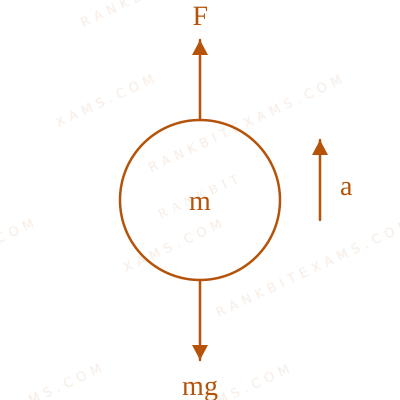
Let F$F$ be the constant buoyant force acting upward on the balloon.
**Case 1 (Initial upward acceleration)** :
F - M g = M a implies F = M(g + a) quad text$$F - M g = M a \implies F = M(g + a) \quad \text{}$$
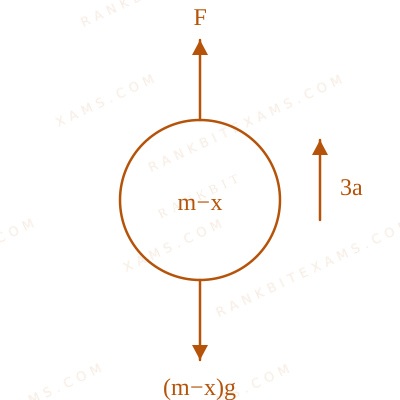
**Case 2 (After releasing mass x$x$)** :
The new total mass becomes (M - x)$(M - x)$, and its acceleration increases to 3a$3a$:
F - (M - x)g = (M - x)3a quad text$$F - (M - x)g = (M - x)3a \quad \text{}$$
Substitute the value of F$F$ from Case 1 into Case 2 [cite: 836, 839]:
M(g + a) - (M - x)g = (M - x)3a$$M(g + a) - (M - x)g = (M - x)3a$$M g + M a - M g + x g = 3 M a - 3 x a quad text$$M g + M a - M g + x g = 3 M a - 3 x a \quad \text{}$$M a + x g = 3 M a - 3 x a$$M a + x g = 3 M a - 3 x a$$x(g + 3a) = 2 M a$$x(g + 3a) = 2 M a$$x = frac2 M a3a + g quad text$$x = \frac{2 M a}{3a + g} \quad \text{}$$
### Step 1: Visual Context
The free-body force layout for both accelerating phases is shown below:
Newton Second Law Applications free body diagrams for Q20Newton Second Law Applications free body diagrams for Q20
### Pattern Recognition
Since the upward buoyant force is completely determined by the balloon's volume, it remains constant. Expressing this constant force in terms of the initial conditions allows you to quickly solve for mass changes when acceleration states vary.
### Evaluation Rubric / Model Answer
null
### Chapter Mix
Class 11 Physics: Laws of Motion
A ball of mass 0.5mathrm~kg$0.5\mathrm{~kg}$ is attached to a string of length 50mathrm~cm$50\mathrm{~cm}$. The ball is rotated on a horizontal circular path about its vertical axis. The maximum tension that the string can bear is 400mathrm~N$400\mathrm{~N}$. The maximum possible value of angular velocity of the ball in mathrmrad/s$\mathrm{rad/s}$ is:
A. 1600
B. 40
C. 1000
D. 20
Solution
### Related Formula
Centripetal force configuration for simplified horizontal rotation layout:
T = momega^2 l$T = m\omega^2 l$
### Core Logic
Given values:
m = 0.5mathrm~kg$m = 0.5\mathrm{~kg}$, l = 50mathrm~cm = 0.5mathrm~m$l = 50\mathrm{~cm} = 0.5\mathrm{~m}$, T_textmax = 400mathrm~N$T_{\text{max}} = 400\mathrm{~N}$.
Equating max tension to centripetal requirement:
400 = 0.5 times omega^2 times 0.5$$400 = 0.5 \times \omega^2 \times 0.5$$
### Step 1: Compute Angular Velocity
400 = 0.25 omega^2$$400 = 0.25 \omega^2$$omega^2 = frac4000.25 = 1600$$\omega^2 = \frac{400}{0.25} = 1600$$omega = sqrt1600 = 40mathrm~rad/s$$\omega = \sqrt{1600} = 40\mathrm{~rad/s}$$
### Pattern Recognition
Ensure units are metric (50mathrm~cm to 0.5mathrm~m$50\mathrm{~cm} \to 0.5\mathrm{~m}$). Direct mapping to horizontal string projection metrics.
### Evaluation Rubric / Model Answer
null
### Chapter Mix
Class 11 Physics: Laws of Motion
Q48jee_main_2024_01_february_morningFriction
Consider a block and trolley system as shown in figure. If the coefficient of kinetic friction between the trolley and the surface is 0.04, the acceleration of the system in mathrmms^-2$\mathrm{ms}^{-2}$ is (Consider that the string is massless and unstretchable and the pulley is also massless and frictionless):
A block and trolley mass arrangement demonstrating a horizontal kinetic interface connected over a corner pulley driven by an explicit 60N forcing function loop.
A. 3
B. 4
C. 2
D. 1.2
Solution
### Related Formula
Kinetic friction force:
f_k = mu_k N = mu_k m_1 g$$f_k = \mu_k N = \mu_k m_1 g$$
System acceleration:
a = fracF_textpull - f_km_texttotal$$a = \frac{F_{\text{pull}} - f_k}{m_{\text{total}}}$$
### Core Logic
Given values:
Trolley mass m_1 = 20mathrm~kg$m_1 = 20\mathrm{~kg}$, total system mass component in frame m_texttotal = 26mathrm~kg$m_{\text{total}} = 26\mathrm{~kg}$ (from solution fraction frac60-826$\frac{60-8}{26}$).
Applied pulling force F = 60mathrm~N$F = 60\mathrm{~N}$.
mu_k = 0.04$\mu_k = 0.04$.
Calculate the kinetic friction resisting the trolley:
f_k = 0.04 times 20 times 10 = 8mathrm~N$$f_k = 0.04 \times 20 \times 10 = 8\mathrm{~N}$$
### Step 1: Calculate Acceleration
Using the dynamic equation for connected translation systems:
a = frac60 - 826 = frac5226 = 2mathrm~ms^-2$$a = \frac{60 - 8}{26} = \frac{52}{26} = 2\mathrm{~ms}^{-2}$$
### Pattern Recognition
Treat connected inline systems as a single collective mass block, balancing external driving forces against collective internal friction resistance.
### Evaluation Rubric / Model Answer
null
### Chapter Mix
Class 11 Physics: Laws of Motion
Q36jee_main_2024_29_january_eveningCircular Motion and Tension
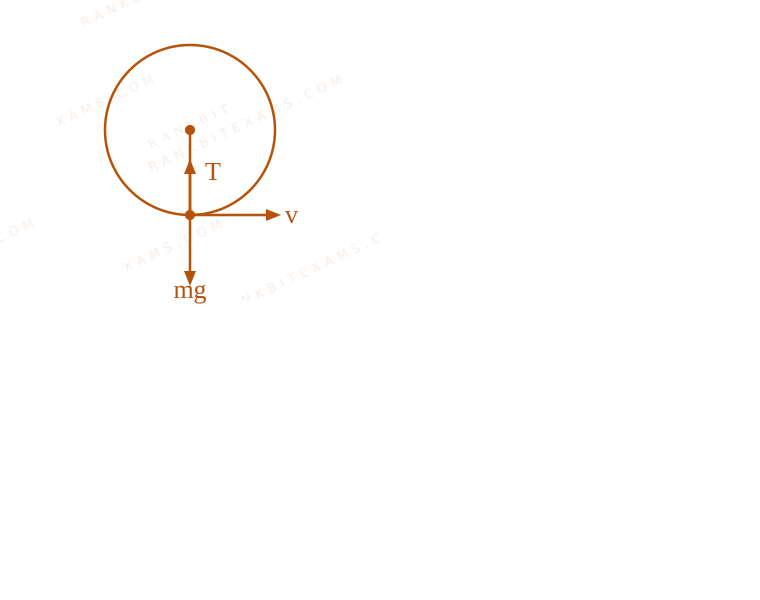
A stone of mass 900text g$900\text{ g}$ is tied to a string and moved in a vertical circle of radius 1text m$1\text{ m}$ making 10text rpm$10\text{ rpm}$. The tension in the string, when the stone is at the lowest point is (if pi^2 = 9.8$\pi^2 = 9.8$ and g = 9.8text m/s^2$g = 9.8\text{ m/s}^2$):
A.97text N$97\text{ N}$
B.9.8text N$9.8\text{ N}$
C.8.82text N$8.82\text{ N}$
D.17.8text N$17.8\text{ N}$
Solution
### Related Formula
At the lowest point of a vertical circle, the equation of motion for a mass m$m$ is:
T - mg = m r omega^2$$T - mg = m r \omega^2$$
Rearranging to solve for tension T$T$:
T = mg + m r omega^2$$T = mg + m r \omega^2$$
### Core Logic
Given data:
* Mass, m = 900text g = 0.9text kg$m = 900\text{ g} = 0.9\text{ kg}$
* Radius, r = 1text m$r = 1\text{ m}$
* Frequency, N = 10text rpm = frac1060text rps = frac16text rps$N = 10\text{ rpm} = \frac{10}{60}\text{ rps} = \frac{1}{6}\text{ rps}$
* Angular velocity, omega = 2pi N = 2pi left(frac16right) = fracpi3text rad/s$\omega = 2\pi N = 2\pi \left(\frac{1}{6}\right) = \frac{\pi}{3}\text{ rad/s}$
### Step 1: Calculate Force Values
Now we substitute our parameters into the tension equation:
T = (0.9)(9.8) + (0.9)(1)left(fracpi3right)^2$$T = (0.9)(9.8) + (0.9)(1)\left(\frac{\pi}{3}\right)^2$$T = 8.82 + 0.9 times fracpi^29$$T = 8.82 + 0.9 \times \frac{\pi^2}{9}$$
Since pi^2 = 9.8$\pi^2 = 9.8$:
T = 8.82 + 0.1 times 9.8$$T = 8.82 + 0.1 \times 9.8$$T = 8.82 + 0.98 = 9.80text N$$T = 8.82 + 0.98 = 9.80\text{ N}$$Free-body diagram of stone at lowest point in vertical circle for Q36
### Pattern Recognition
Always convert Mass to textkg$\text{kg}$ and rotational speed to textrad/s$\text{rad/s}$ first. Using the prompt constraint pi^2 = 9.8$\pi^2 = 9.8$ yields a perfect decimal addition match.
### Evaluation Rubric / Model Answer
null
### Chapter Mix
Class 11 Physics: Laws of Motion
A particle is moving in a circle of radius 50text cm$50\text{ cm}$ in such a way that at any instant the normal and tangential components of its acceleration are equal. If its speed at t = 0$t = 0$ is 4text m/s$4\text{ m/s}$, the time taken to complete the first revolution will be frac1alphaleft[ 1 - e^-2pi right]text s$\frac{1}{\alpha}\left[ 1 - e^{-2\pi} \right]\text{ s}$, where alpha =$\alpha =$ ________.
Numerical Answer.Answer: 8 to 8
Solution
### Related Formula
For a particle in circular motion:
* Normal (centripetal) acceleration: a_c = fracv^2r$a_c = \frac{v^2}{r}$
* Tangential acceleration: a_t = fracdvdt$a_t = \frac{dv}{dt}$
### Core Logic
Given a_c = a_t$a_c = a_t$:
fracv^2r = fracdvdt$$\frac{v^2}{r} = \frac{dv}{dt}$$int_v_0^v fracdvv^2 = int_0^t fracdtr$$\int_{v_0}^{v} \frac{dv}{v^2} = \int_{0}^{t} \frac{dt}{r}$$left[ -frac1v right]_v_0^v = fractr$$\left[ -\frac{1}{v} \right]_{v_0}^{v} = \frac{t}{r}$$-frac1v + frac1v_0 = fractr implies frac1v = frac1v_0 - fractr$$-\frac{1}{v} + \frac{1}{v_0} = \frac{t}{r} \implies \frac{1}{v} = \frac{1}{v_0} - \frac{t}{r}$$v = fracv_01 - fracv_0 tr$$v = \frac{v_0}{1 - \frac{v_0 t}{r}}$$
### Step 1: Relate Velocity to Position and Integrate
Substitute the parameters v_0 = 4text m/s$v_0 = 4\text{ m/s}$ and r = 50text cm = 0.5text m$r = 50\text{ cm} = 0.5\text{ m}$:
v = frac41 - 8t = fracdsdt$$v = \frac{4}{1 - 8t} = \frac{ds}{dt}$$
Integrating this to find the position s(t)$s(t)$:
int_0^s ds = int_0^t frac41 - 8t dt$$\int_{0}^{s} ds = \int_{0}^{t} \frac{4}{1 - 8t} dt$$s = 4 left[ fracln(1 - 8t)-8 right]_0^t = -frac12 ln(1 - 8t)$$s = 4 \left[ \frac{\ln(1 - 8t)}{-8} \right]_0^t = -\frac{1}{2} \ln(1 - 8t)$$
### Step 2: Solve for Time of First Revolution
To complete the first revolution, the distance covered is:
s = 2pi r = 2pi (0.5) = pitext m$$s = 2\pi r = 2\pi (0.5) = \pi\text{ m}$$
Equating the distance:
pi = -frac12 ln(1 - 8t)$$\pi = -\frac{1}{2} \ln(1 - 8t)$$-2pi = ln(1 - 8t)$$-2\pi = \ln(1 - 8t)$$1 - 8t = e^-2pi$$1 - 8t = e^{-2\pi}$$8t = 1 - e^-2pi implies t = frac18 left[ 1 - e^-2pi right]text s$$8t = 1 - e^{-2\pi} \implies t = \frac{1}{8} \left[ 1 - e^{-2\pi} \right]\text{ s}$$
Comparing this to frac1alphaleft[ 1 - e^-2pi right]text s$\frac{1}{\alpha}\left[ 1 - e^{-2\pi} \right]\text{ s}$, we get:
alpha = 8$\alpha = 8$
### Pattern Recognition
The condition a_t = a_c implies v fracdvds = fracv^2r implies fracdvv = fracdsr$a_t = a_c \implies v \frac{dv}{ds} = \frac{v^2}{r} \implies \frac{dv}{v} = \frac{ds}{r}$. Integrating directly gives v = v_0 e^s/r$v = v_0 e^{s/r}$. Substituting this back into v = ds/dt$v = ds/dt$ makes the final time integral much more intuitive.
### Evaluation Rubric / Model Answer
null
### Chapter Mix
Class 11 Physics: Laws of Motion
More Laws of Motion Questions — jee_main_2025_02_april_evening
We Map Every Repeating Question in Competitive Exams.
Say goodbye to generic mock test fatigue. RankBit uses smart analysis to group past exam questions into their foundational Repeating Question Types. Find chapter weightage, track repeating questions, and score higher with targeted practice.
Select Your Target Exam
Choose an exam track below to find formulas per chapter and patterns.
Syncing Exam Intelligence
Mapping formulas and patterns across all tracks…
PATH A — FULL LENGTH PRACTICE
Full Mock Test Hub
Simulate real NTA exam conditions with fully tracked mocks. Time yourself against past papers.
Practice past-year questions one chapter at a time. Pick an exam → subject → chapter and get every PYQ for that topic — pulled together from all past papers — with the chapter's key formulas alongside.