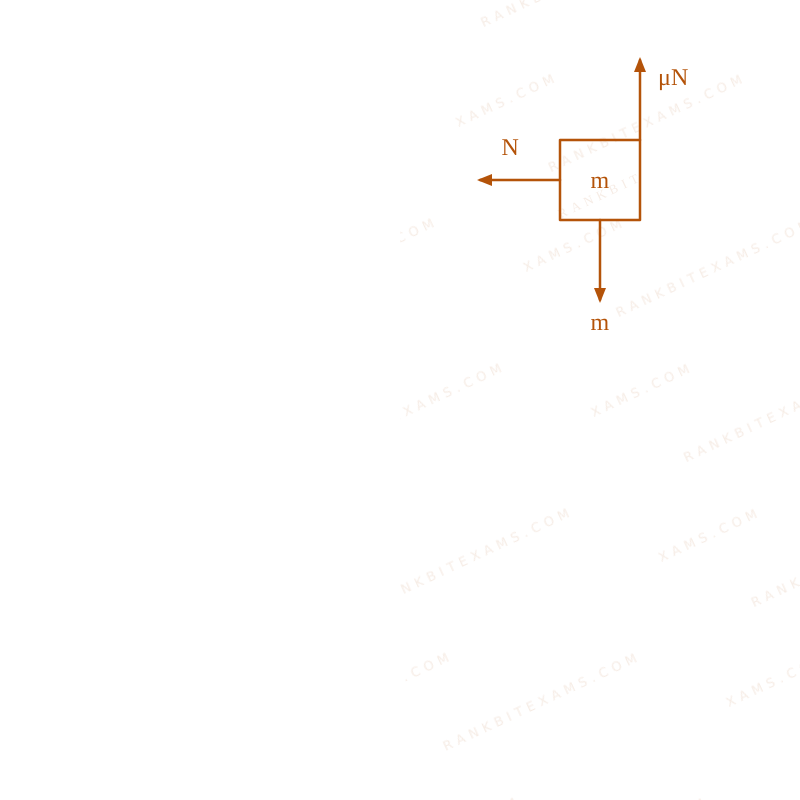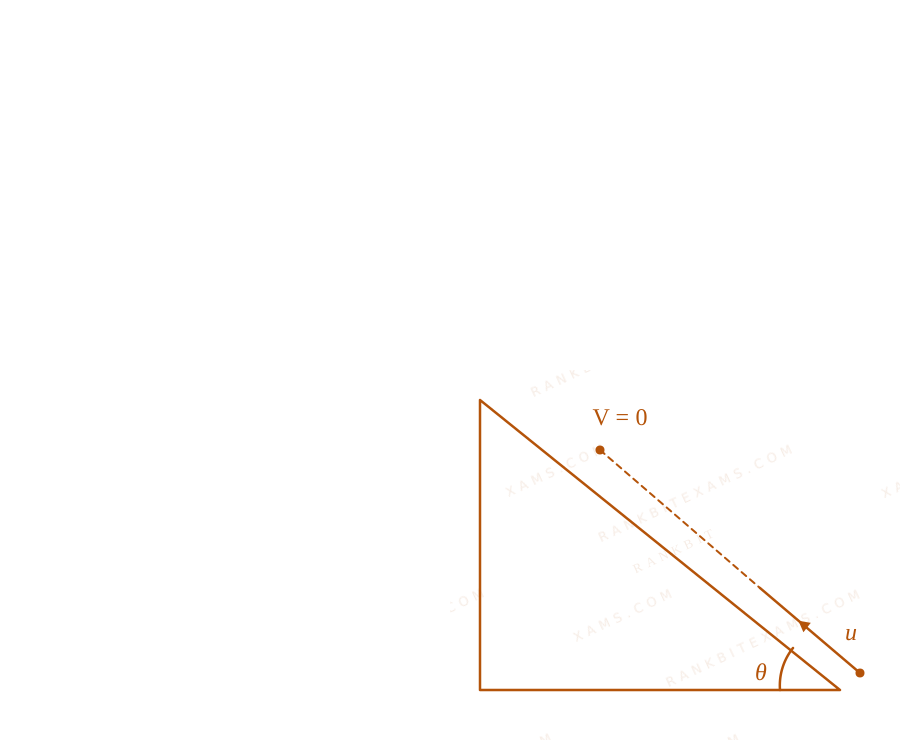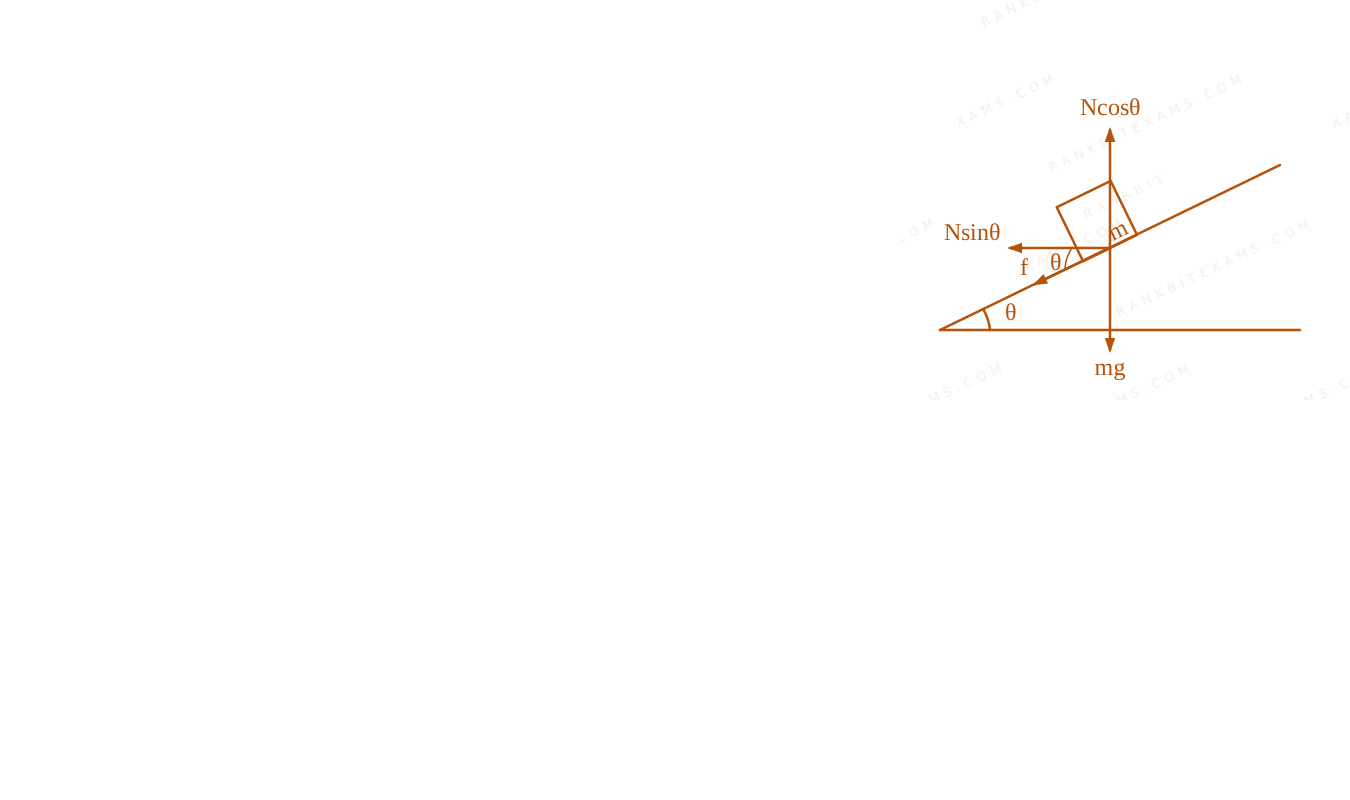
A car of mass 'm' moves on a banked road having radius 'r' and banking angle theta$\theta$ To avoid slipping from banked road, the maximum permissible speed of the car is v_0.$v_{0}.$ The coefficient of friction mu$\mu$ between the wheels of the car and the banked road is :-
Keywords:#maximum permissible speed of the car#JEE Main 2025 Morning Q10#Laws of Motion JEE Main 2025#Circular Motion and Banking of Roads JEE Main 2025
More Laws of Motion Previous-Year Questions
Q162025Equilibrium of Forces
A body of mass 1mathrmkg$1\mathrm{kg}$ is suspended with the help of two strings making angles as shown in figure. Magnitude of tensions mathbfT_1$\mathbf{T}_1$ and mathbfT_2$\mathbf{T}_2$ , respectively, are (in N):
The diagram shows a suspended mass of 1 kg held by two strings making angles of 60 and 30 degrees with the horizontal.
A.5, 5sqrt3$5, 5\sqrt{3}$
B.5sqrt3, 5$5\sqrt{3}, 5$
C.5sqrt3, 5sqrt3$5\sqrt{3}, 5\sqrt{3}$
D.5, 5$5, 5$
Solution
### Related Formula
For a system in static equilibrium:
sum F_x = 0 quad textand quad sum F_y = 0$\sum F_x = 0 \quad \text{and} \quad \sum F_y = 0$
### Core Logic
Let's resolve the tension forces vecT_1$\vec{T}_1$ and vecT_2$\vec{T}_2$ into horizontal and vertical components:
- T_1$T_1$ makes 60^circ$60^\circ$ with the horizontal.
- T_2$T_2$ makes 30^circ$30^\circ$ with the horizontal.
- Downward gravitational force: W = m g = 1 times 10 = 10 \ mathrmN$W = m g = 1 \times 10 = 10 \ \mathrm{N}$.
1. **Horizontal Equilibrium (sum F_x = 0$\sum F_x = 0$):**
T_1 cos 60^circ = T_2 cos 30^circ$T_1 \cos 60^\circ = T_2 \cos 30^\circ$T_1 cdot frac12 = T_2 cdot fracsqrt32 implies T_1 = T_2 sqrt3$T_1 \cdot \frac{1}{2} = T_2 \cdot \frac{\sqrt{3}}{2} \implies T_1 = T_2 \sqrt{3}$
2. **Vertical Equilibrium (sum F_y = 0$\sum F_y = 0$):**
T_1 sin 60^circ + T_2 sin 30^circ = m g = 10$T_1 \sin 60^\circ + T_2 \sin 30^\circ = m g = 10$T_1 cdot fracsqrt32 + T_2 cdot frac12 = 10$T_1 \cdot \frac{\sqrt{3}}{2} + T_2 \cdot \frac{1}{2} = 10$
### Step 1: Solve for Tensions
Substitute T_1 = T_2 sqrt3$T_1 = T_2 \sqrt{3}$ into the vertical equilibrium equation:
(T_2 sqrt3) fracsqrt32 + fracT_22 = 10$(T_2 \sqrt{3}) \frac{\sqrt{3}}{2} + \frac{T_2}{2} = 10$frac3 T_22 + fracT_22 = 10 implies 2 T_2 = 10 implies T_2 = 5 \ mathrmN$\frac{3 T_2}{2} + \frac{T_2}{2} = 10 \implies 2 T_2 = 10 \implies T_2 = 5 \ \mathrm{N}$
Substitute T_2$T_2$ back to obtain T_1$T_1$:
T_1 = 5 sqrt3 \ mathrmN$T_1 = 5 \sqrt{3} \ \mathrm{N}$
Thus, the tension magnitudes are T_1 = 5sqrt3 \ mathrmN$T_1 = 5\sqrt{3} \ \mathrm{N}$ and T_2 = 5 \ mathrmN$T_2 = 5 \ \mathrm{N}$.
### Pattern Recognition
Sees: Suspending particle static equilibrium with asymmetric strings.
Trap: Associating components with incorrect trigonometry axes or swapping T_1$T_1$ and T_2$T_2$ in options.
Shortcut: Since the incline of T_1$T_1$ (60^circ$60^\circ$) is steeper than that of T_2$T_2$ (30^circ$30^\circ$), T_1$T_1$ must carry a larger portion of the load, meaning T_1 > T_2$T_1 > T_2$. From the choices, only (2) satisfies this hierarchy.
### Evaluation Rubric / Model Answer
null
### Chapter Mix
Class 11 Physics: Laws of Motion
Q142025Friction
A cubic block of mass m is sliding down on an inclined plane at 60^circ$60^{\circ}$ with an acceleration of fracg2$\frac{g}{2}$ , the value of coefficient of kinetic friction is
A.sqrt3 - 1$\sqrt{3} - 1$
B.fracsqrt32$\frac{\sqrt{3}}{2}$
C.fracsqrt23$\frac{\sqrt{2}}{3}$
D.1 - fracsqrt32$1 - \frac{\sqrt{3}}{2}$
Solution
### Related Formula
For a block sliding down an inclined plane of inclination theta$\theta$:
mg sintheta - f_k = ma$mg \sin\theta - f_k = ma$
Where normal reaction is N = mg costheta$N = mg \cos\theta$ and kinetic friction is:
f_k = mu_k N = mu_k mg costheta$f_k = \mu_k N = \mu_k mg \cos\theta$
### Core Logic
Substitute f_k$f_k$ into the equation of motion:
mg sintheta - mu_k mg costheta = ma$mg \sin\theta - \mu_k mg \cos\theta = ma$
Divide by m$m$:
g sintheta - mu_k g costheta = a$g \sin\theta - \mu_k g \cos\theta = a$
### Step 1: Substitute Values
Given a = fracg2$a = \frac{g}{2}$ and theta = 60^circ$\theta = 60^\circ$:
g sin 60^circ - mu_k g cos 60^circ = fracg2$g \sin 60^\circ - \mu_k g \cos 60^\circ = \frac{g}{2}$fracsqrt32 - fracmu_k2 = frac12$\frac{\sqrt{3}}{2} - \frac{\mu_k}{2} = \frac{1}{2}$sqrt3 - mu_k = 1 implies mu_k = sqrt3 - 1$\sqrt{3} - \mu_k = 1 \implies \mu_k = \sqrt{3} - 1$
### Pattern Recognition
Sees: Block sliding down with acceleration on an incline.
Shortcut: The acceleration on an incline is a = g(sintheta - mu_k costheta)$a = g(\sin\theta - \mu_k \cos\theta)$. For theta = 60^circ$\theta = 60^\circ$, this is a = gleft(fracsqrt32 - fracmu_k2right)$a = g\left(\frac{\sqrt{3}}{2} - \frac{\mu_k}{2}\right)$. Equating to g/2$g/2$ gives mu_k = sqrt3 - 1$\mu_k = sqrt{3} - 1$ directly.
### Evaluation Rubric / Model Answer
null
### Chapter Mix
Class 11 Physics: Laws of Motion
Q152025Newton's Second Law
A body of mass 2mathrm~kg$2\mathrm{~kg}$ moving with velocity of vecv_mathrmin = 3hati +4hatjmathrm~m/s$\vec{v}_{\mathrm{in}} = 3\hat{i} +4\hat{j}\mathrm{~m/s}$ enters into a constant force field of 6mathrm~N$6\mathrm{~N}$ directed along positive z-axis. If the body remains in the field for a period of frac53$\frac{5}{3}$ seconds, then velocity of the body when it emerges from force field is:
### Related Formula
vecF = m veca$\vec{F} = m \vec{a}$vecv = vecu + vecat$\vec{v} = \vec{u} + \vec{a}t$
where,
vecF$\vec{F}$ = constant force vector
m$m$ = mass of body
veca$\vec{a}$ = acceleration vector
vecu$\vec{u}$ = initial velocity vector
vecv$\vec{v}$ = final velocity vector
### Core Logic
Given parameters:
- Mass, m = 2mathrm~kg$m = 2\mathrm{~kg}$
- Initial velocity, vecu = 3hati + 4hatjmathrm~m/s$\vec{u} = 3\hat{i} + 4\hat{j}\mathrm{~m/s}$
- Force, vecF = 6hatkmathrm~N$\vec{F} = 6\hat{k}\mathrm{~N}$ (directed along positive z-axis)
- Time interval, t = frac53mathrm~s$t = \frac{5}{3}\mathrm{~s}$
Calculate the acceleration vector veca$\vec{a}$:
veca = fracvecFm = frac6hatk2 = 3hatkmathrm~m/s^2$\vec{a} = \frac{\vec{F}}{m} = \frac{6\hat{k}}{2} = 3\hat{k}\mathrm{~m/s}^{2}$
### Step 1: Compute Final Velocity
Using the kinematic equation of motion:
vecv = vecu + vecat$\vec{v} = \vec{u} + \vec{a}t$vecv = (3hati + 4hatj) + (3hatk) left(frac53right)$\vec{v} = (3\hat{i} + 4\hat{j}) + (3\hat{k}) \left(\frac{5}{3}\right)$vecv = 3hati + 4hatj + 5hatkmathrm~m/s$\vec{v} = 3\hat{i} + 4\hat{j} + 5\hat{k}\mathrm{~m/s}$
Thus, the emerging velocity of the body is 3hati + 4hatj + 5hatkmathrm~m/s$3\hat{i} + 4\hat{j} + 5\hat{k}\mathrm{~m/s}$.
### Pattern Recognition
Sees: Orthogonal initial velocity and force field direction.
Shortcut: Since the force acts entirely along the z-axis, the x and y components of the velocity remain unchanged (3hati + 4hatj$3\hat{i} + 4\hat{j}$). Simply compute the z-component change: v_z = a_z t = left(frac62right) left(frac53right) = 5$v_z = a_z t = \left(\frac{6}{2}\right) \left(\frac{5}{3}\right) = 5$. Result: 3hati + 4hatj + 5hatk$3\hat{i} + 4\hat{j} + 5\hat{k}$. ✓
### Evaluation Rubric / Model Answer
null
### Chapter Mix
Class 11 Physics: Laws of Motion
Class 11 Physics: Kinematics
Q122025Variable Mass System
A sand dropper drops sand of massm(t)$m(t)$ on a conveyer belt at a rate proportional to the square root of speed (v$v$) of the belt, i.e. fracdmdt propto sqrtv$\frac{dm}{dt} \propto \sqrt{v}$ . If P$P$ is the power delivered to run the belt at constant speed then which of the following relationship is true?
### Related Formula
F_textthrust = left(fracdmdtright)v$F_{\text{thrust}} = \left(\frac{dm}{dt}\right)v$P = F cdot v$P = F \cdot v$
### Core Logic
Given the sand dropping rate rule:
fracdmdt = C sqrtv quad (textwhere C text is a constant)$\frac{dm}{dt} = C \sqrt{v} \quad (\text{where } C \text{ is a constant})$
To maintain a constant velocity v$v$, the continuous force applied by the conveyor system must balance the rate of gain of momentum of the dropped sand:
F = left(fracdmdtright) v = (C sqrtv) cdot v = C v^3/2$F = \left(\frac{dm}{dt}\right) v = (C \sqrt{v}) \cdot v = C v^{3/2}$
Power delivered is the product of force and speed:
P = F cdot v = (C v^3/2) cdot v = C v^5/2$P = F \cdot v = (C v^{3/2}) \cdot v = C v^{5/2}$
Squaring both sides of the expression:
P^2 propto v^5$P^2 \propto v^5$
### Pattern Recognition
In variable mass problems involving dropping dust/sand at rest onto a moving frame, the thrust force always simplifies to v cdot fracdmdt$v \cdot \frac{dm}{dt}$, which makes power scale as v^2 cdot fracdmdt$v^2 \cdot \frac{dm}{dt}$.
### Evaluation Rubric / Model Answer
null
### Chapter Mix
Class 11 Physics: Laws of Motion
Q62025Spring-Block Dynamics with Friction
Two blocks of masses m and M, (mathbfM > mathbfm)$(\mathbf{M} > \mathbf{m})$ , are placed on a frictionless table as shown in figure. A massless spring with spring constant k is attached with the lower block. If the system is slightly displaced and released then
(mu =textcoefficient of friction between the two blocks)$(\mu =\text{coefficient of friction between the two blocks})$The diagram displays a smaller block of mass m placed on top of a larger block of mass M, which is connected to a horizontal spring on a smooth table.
(A) The time period of small oscillation of the two blocks is mathrmT = 2pi sqrtfrac(mathrmm + mathrmM)mathrmk$\mathrm{T} = 2\pi \sqrt{\frac{(\mathrm{m} + \mathrm{M})}{\mathrm{k}}}$
(B) The acceleration of the blocks is a = frackxM + m$a = \frac{kx}{M + m}$ (x = displacement of the blocks from the mean position)
(C) The magnitude of the frictional force on the upper block is fracmathrmmk|mathrmx|mathrmM + mathrmm$\frac{\mathrm{m}k|\mathrm{x}|}{\mathrm{M} + \mathrm{m}}$
(D) The maximum amplitude of the upper block, if it does not slip, is fracmu(mathbfM + mathbfm)mathbfgmathbfk$\frac{\mu(\mathbf{M} + \mathbf{m})\mathbf{g}}{\mathbf{k}}$
(E) Maximum frictional force can be mu (mathbfM + mathbfm)mathbfg$\mu (\mathbf{M} + \mathbf{m})\mathbf{g}$.
Choose the correct answer from the options given below:
A. A, B, D Only
B. B, C, D Only
C. C, D, E Only
D. A, B, C Only
Solution
### Related Formula
For combined system performing simple harmonic motion without relative slipping:
T = 2pi sqrtfracm_texttotalk$T = 2\pi \sqrt{\frac{m_{\text{total}}}{k}}$a = -omega^2 x = -frackM+m x$a = -\omega^2 x = -\frac{k}{M+m} x$
### Core Logic
Let's analyze each statement:
- **Statement (A)**: Since both blocks perform SHM together, the combined mass is (M + m)$(M + m)$. The spring constant is k$k$. Thus, the time period of small oscillation is:
T = 2pi sqrtfracM+mk$T = 2\pi \sqrt{\frac{M+m}{k}}$
This is correct. (A is True)
- **Statement (B)**: When the system is displaced by x$x$, the restoring spring force on the combined system is F = -kx$F = -kx$. The common acceleration of the combined mass is:
a = -frackxM+m implies |a| = frack|x|M+m$a = -\frac{kx}{M+m} \implies |a| = \frac{k|x|}{M+m}$
This matches the expression (taking magnitude). (B is True)
- **Statement (C)**: The upper block of mass m$m$ moves solely due to the static frictional force f$f$ acting on it. Thus:
f = m a = m left( frackxM+m right) = fracmkxM+m$f = m a = m \left( \frac{kx}{M+m} \right) = \frac{mkx}{M+m}$
Statement (C) claims the frictional force is fracmmu|x|M+m$\frac{m\mu|x|}{M+m}$, which is incorrect because friction is determined by acceleration, not by coefficient of friction mu$\mu$ during static grip. (C is False)
- **Statement (D)**: For no slipping to occur, the maximum frictional force required at peak amplitude A$A$ must be less than or equal to the limiting static friction f_L = mu mg$f_L = \mu mg$:
f_textmax = fracmkAM+m le mu mg$f_{\text{max}} = \frac{mkA}{M+m} \le \mu mg$frackAM+m le mu g implies A le fracmu(M+m)gk$\frac{kA}{M+m} \le \mu g \implies A \le \frac{\mu(M+m)g}{k}$
Thus, the maximum amplitude is fracmu(M+m)gk$\frac{\mu(M+m)g}{k}$. (D is True)
- **Statement (E)**: The maximum static frictional force between the blocks is f_L = mu mg$f_L = \mu mg$, not mu (M+m)g$\mu (M+m)g$. (E is False)
### Step 1: Conclusion
Only statements A, B, and D are correct. Hence, the correct option is (1).
The diagram displays a smaller block of mass m placed on top of a larger block of mass M, which is connected to a horizontal spring on a smooth table.The diagram displays a smaller block of mass m placed on top of a larger block of mass M, which is connected to a horizontal spring on a smooth table.
### Pattern Recognition
In stacked blocks with springs, always identify the force driving the non-spring-loaded block. Here, mass m$m$ is driven purely by friction, so f = m cdot a$f = m \cdot a$. Slipping begins when this required force exceeds f_textlimit = mu m g$f_{\text{limit}} = \mu m g$. This simple boundary matches the derivation of maximum amplitude perfectly!
### Evaluation Rubric / Model Answer
null
### Chapter Mix
Class 11 Physics: Laws of Motion: Friction
Class 11 Physics: Oscillations: Simple Harmonic Motion
More Laws of Motion Questions — jee_main_2025_24_jan_morning
We Map Every Repeating Question in Competitive Exams.
Say goodbye to generic mock test fatigue. RankBit uses smart analysis to group past exam questions into their foundational Repeating Question Types. Find chapter weightage, track repeating questions, and score higher with targeted practice.
Select Your Target Exam
Choose an exam track below to find formulas per chapter and patterns.
Syncing Exam Intelligence
Mapping formulas and patterns across all tracks…
PATH A — FULL LENGTH PRACTICE
Full Mock Test Hub
Simulate real NTA exam conditions with fully tracked mocks. Time yourself against past papers.
Under Development
PATH B — TARGETED PRACTICE
Topic-wise Practice Hub
Practice past-year questions one chapter at a time. Pick an exam → subject → chapter and get every PYQ for that topic — pulled together from all past papers — with the chapter's key formulas alongside.