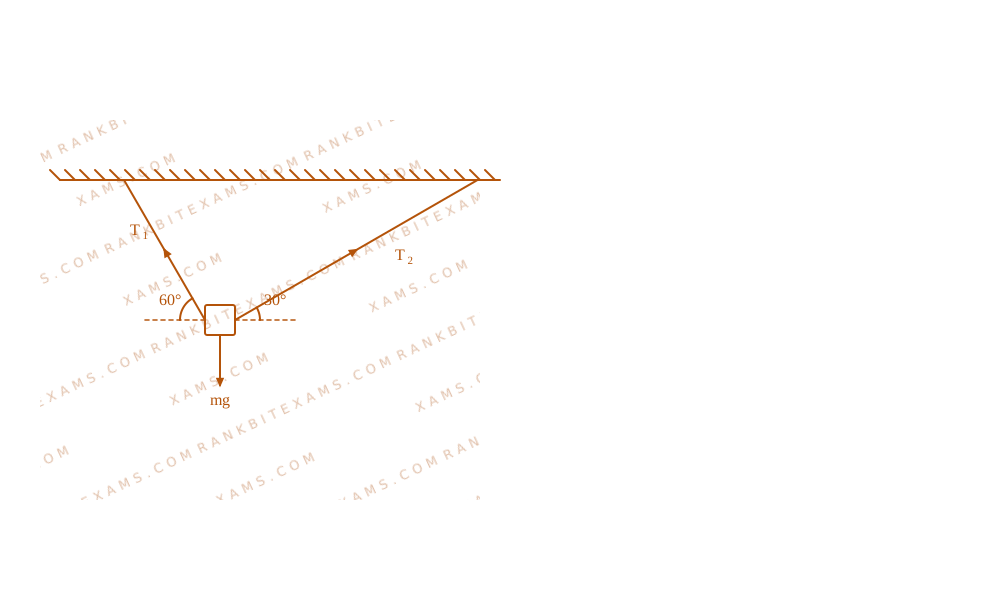
A body of mass 1mathrmkg$1\mathrm{kg}$ is suspended with the help of two strings making angles as shown in figure. Magnitude of tensions mathbfT_1$\mathbf{T}_1$ and mathbfT_2$\mathbf{T}_2$ , respectively, are (in N):
The diagram shows a suspended mass of 1 kg held by two strings making angles of 60 and 30 degrees with the horizontal.
A.5, 5sqrt3$5, 5\sqrt{3}$
B.5sqrt3, 5$5\sqrt{3}, 5$
C.5sqrt3, 5sqrt3$5\sqrt{3}, 5\sqrt{3}$
D.5, 5$5, 5$
Solution & Explanation
### Related Formula
For a system in static equilibrium:
sum F_x = 0 quad textand quad sum F_y = 0$$\sum F_x = 0 \quad \text{and} \quad \sum F_y = 0$$
### Core Logic
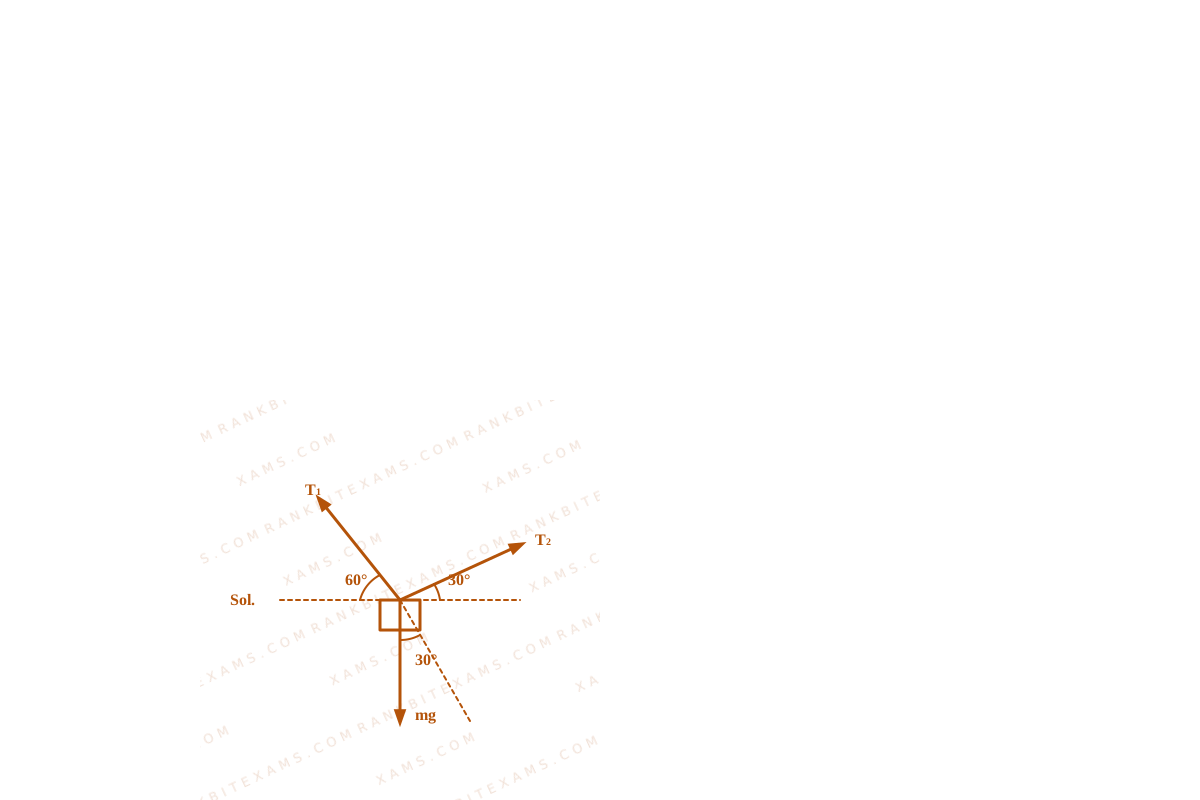
Let's resolve the tension forces vecT_1$\vec{T}_1$ and vecT_2$\vec{T}_2$ into horizontal and vertical components:
- T_1$T_1$ makes 60^circ$60^\circ$ with the horizontal.
- T_2$T_2$ makes 30^circ$30^\circ$ with the horizontal.
- Downward gravitational force: W = m g = 1 times 10 = 10 \ mathrmN$W = m g = 1 \times 10 = 10 \ \mathrm{N}$.
1. **Horizontal Equilibrium (sum F_x = 0$\sum F_x = 0$):**
T_1 cos 60^circ = T_2 cos 30^circ$$T_1 \cos 60^\circ = T_2 \cos 30^\circ$$T_1 cdot frac12 = T_2 cdot fracsqrt32 implies T_1 = T_2 sqrt3$$T_1 \cdot \frac{1}{2} = T_2 \cdot \frac{\sqrt{3}}{2} \implies T_1 = T_2 \sqrt{3}$$
2. **Vertical Equilibrium (sum F_y = 0$\sum F_y = 0$):**
T_1 sin 60^circ + T_2 sin 30^circ = m g = 10$$T_1 \sin 60^\circ + T_2 \sin 30^\circ = m g = 10$$T_1 cdot fracsqrt32 + T_2 cdot frac12 = 10$$T_1 \cdot \frac{\sqrt{3}}{2} + T_2 \cdot \frac{1}{2} = 10$$
### Step 1: Solve for Tensions
Substitute T_1 = T_2 sqrt3$T_1 = T_2 \sqrt{3}$ into the vertical equilibrium equation:
(T_2 sqrt3) fracsqrt32 + fracT_22 = 10$$(T_2 \sqrt{3}) \frac{\sqrt{3}}{2} + \frac{T_2}{2} = 10$$frac3 T_22 + fracT_22 = 10 implies 2 T_2 = 10 implies T_2 = 5 \ mathrmN$$\frac{3 T_2}{2} + \frac{T_2}{2} = 10 \implies 2 T_2 = 10 \implies T_2 = 5 \ \mathrm{N}$$
Substitute T_2$T_2$ back to obtain T_1$T_1$:
T_1 = 5 sqrt3 \ mathrmN$$T_1 = 5 \sqrt{3} \ \mathrm{N}$$
Thus, the tension magnitudes are T_1 = 5sqrt3 \ mathrmN$T_1 = 5\sqrt{3} \ \mathrm{N}$ and T_2 = 5 \ mathrmN$T_2 = 5 \ \mathrm{N}$.
### Pattern Recognition
Sees: Suspending particle static equilibrium with asymmetric strings.
Trap: Associating components with incorrect trigonometry axes or swapping T_1$T_1$ and T_2$T_2$ in options.
Shortcut: Since the incline of T_1$T_1$ (60^circ$60^\circ$) is steeper than that of T_2$T_2$ (30^circ$30^\circ$), T_1$T_1$ must carry a larger portion of the load, meaning T_1 > T_2$T_1 > T_2$. From the choices, only (2) satisfies this hierarchy.
### Evaluation Rubric / Model Answer
null
### Chapter Mix
Class 11 Physics: Laws of Motion
The diagram shows a suspended mass of 1 kg held by two strings making angles of 60 and 30 degrees with the horizontal.
Keywords:#static equilibrium tension forces mass#JEE Main 2025 Evening Q16#Lami theorem suspended mass physics#force components equilibrium Laws of Motion#tension#force components#static equilibrium
More Laws of Motion Previous-Year Questions — Page 2
Q6jee_main_2025_03_april_morningSpring-Block Dynamics with Friction
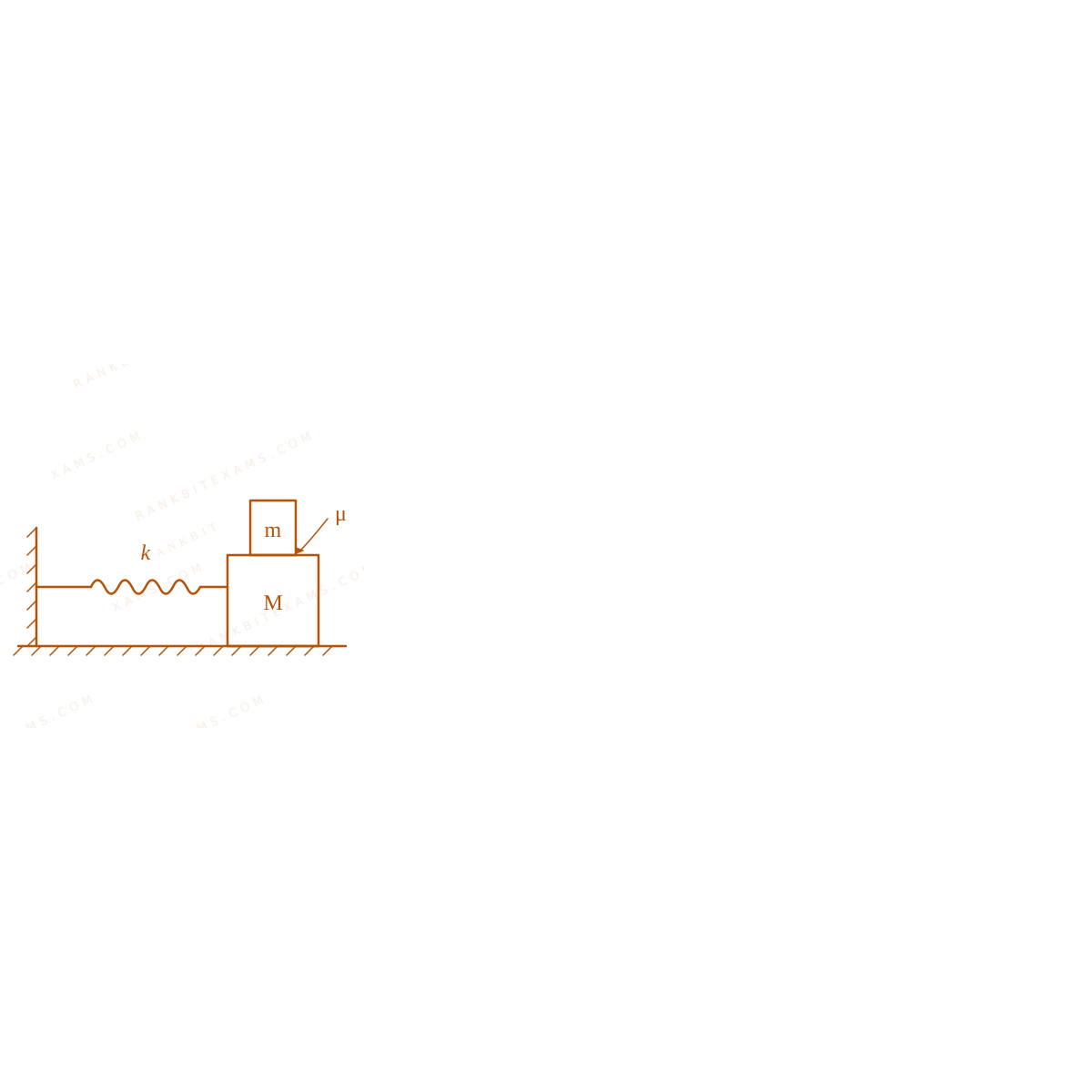
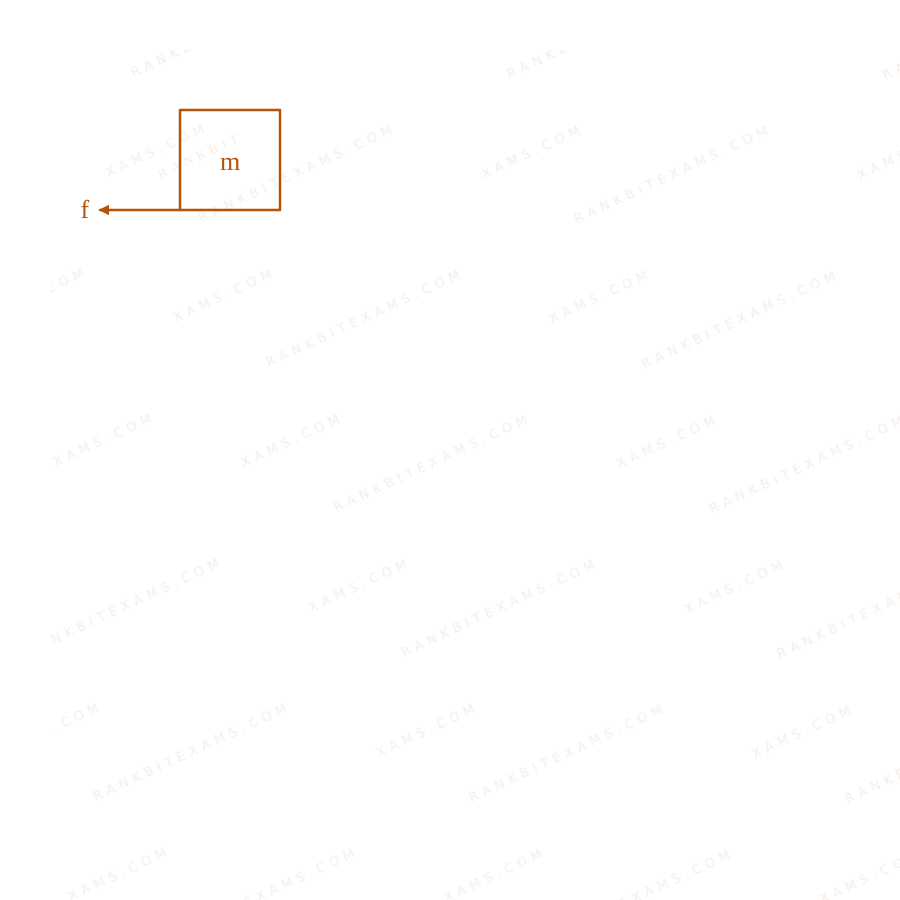
Two blocks of masses m and M, (mathbfM > mathbfm)$(\mathbf{M} > \mathbf{m})$ , are placed on a frictionless table as shown in figure. A massless spring with spring constant k is attached with the lower block. If the system is slightly displaced and released then
(mu =textcoefficient of friction between the two blocks)$(\mu =\text{coefficient of friction between the two blocks})$The diagram displays a smaller block of mass m placed on top of a larger block of mass M, which is connected to a horizontal spring on a smooth table.
(A) The time period of small oscillation of the two blocks is mathrmT = 2pi sqrtfrac(mathrmm + mathrmM)mathrmk$\mathrm{T} = 2\pi \sqrt{\frac{(\mathrm{m} + \mathrm{M})}{\mathrm{k}}}$
(B) The acceleration of the blocks is a = frackxM + m$a = \frac{kx}{M + m}$ (x = displacement of the blocks from the mean position)
(C) The magnitude of the frictional force on the upper block is fracmathrmmk|mathrmx|mathrmM + mathrmm$\frac{\mathrm{m}k|\mathrm{x}|}{\mathrm{M} + \mathrm{m}}$
(D) The maximum amplitude of the upper block, if it does not slip, is fracmu(mathbfM + mathbfm)mathbfgmathbfk$\frac{\mu(\mathbf{M} + \mathbf{m})\mathbf{g}}{\mathbf{k}}$
(E) Maximum frictional force can be mu (mathbfM + mathbfm)mathbfg$\mu (\mathbf{M} + \mathbf{m})\mathbf{g}$.
Choose the correct answer from the options given below:
A. A, B, D Only
B. B, C, D Only
C. C, D, E Only
D. A, B, C Only
Solution
### Related Formula
For combined system performing simple harmonic motion without relative slipping:
T = 2pi sqrtfracm_texttotalk$$T = 2\pi \sqrt{\frac{m_{\text{total}}}{k}}$$a = -omega^2 x = -frackM+m x$$a = -\omega^2 x = -\frac{k}{M+m} x$$
### Core Logic
Let's analyze each statement:
- **Statement (A)**: Since both blocks perform SHM together, the combined mass is (M + m)$(M + m)$. The spring constant is k$k$. Thus, the time period of small oscillation is:
T = 2pi sqrtfracM+mk$$T = 2\pi \sqrt{\frac{M+m}{k}}$$
This is correct. (A is True)
- **Statement (B)**: When the system is displaced by x$x$, the restoring spring force on the combined system is F = -kx$F = -kx$. The common acceleration of the combined mass is:
a = -frackxM+m implies |a| = frack|x|M+m$$a = -\frac{kx}{M+m} \implies |a| = \frac{k|x|}{M+m}$$
This matches the expression (taking magnitude). (B is True)
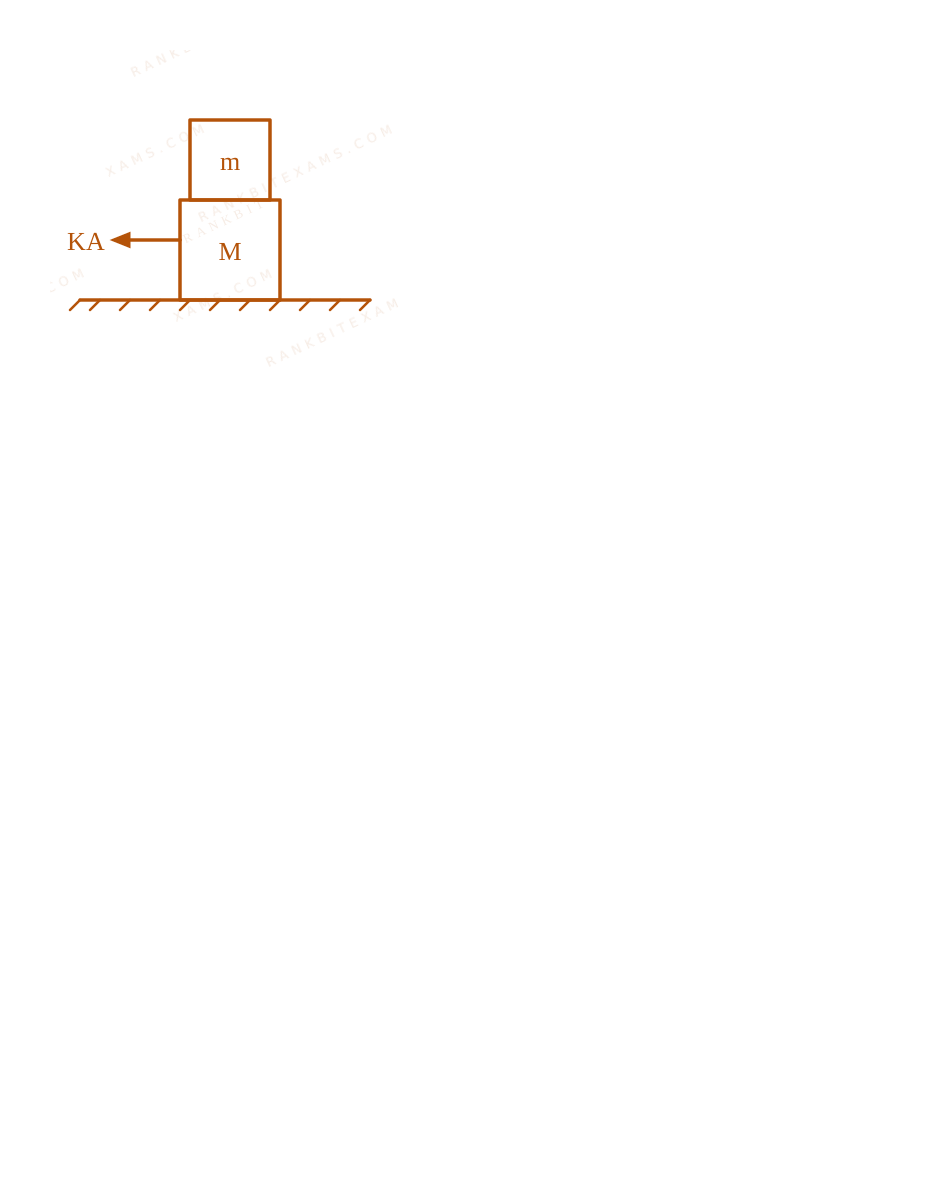
- **Statement (C)**: The upper block of mass m$m$ moves solely due to the static frictional force f$f$ acting on it. Thus:
f = m a = m left( frackxM+m right) = fracmkxM+m$$f = m a = m \left( \frac{kx}{M+m} \right) = \frac{mkx}{M+m}$$
Statement (C) claims the frictional force is fracmmu|x|M+m$\frac{m\mu|x|}{M+m}$, which is incorrect because friction is determined by acceleration, not by coefficient of friction mu$\mu$ during static grip. (C is False)
- **Statement (D)**: For no slipping to occur, the maximum frictional force required at peak amplitude A$A$ must be less than or equal to the limiting static friction f_L = mu mg$f_L = \mu mg$:
f_textmax = fracmkAM+m le mu mg$$f_{\text{max}} = \frac{mkA}{M+m} \le \mu mg$$frackAM+m le mu g implies A le fracmu(M+m)gk$$\frac{kA}{M+m} \le \mu g \implies A \le \frac{\mu(M+m)g}{k}$$
Thus, the maximum amplitude is fracmu(M+m)gk$\frac{\mu(M+m)g}{k}$. (D is True)
- **Statement (E)**: The maximum static frictional force between the blocks is f_L = mu mg$f_L = \mu mg$, not mu (M+m)g$\mu (M+m)g$. (E is False)
### Step 1: Conclusion
Only statements A, B, and D are correct. Hence, the correct option is (1).
The diagram displays a smaller block of mass m placed on top of a larger block of mass M, which is connected to a horizontal spring on a smooth table.The diagram displays a smaller block of mass m placed on top of a larger block of mass M, which is connected to a horizontal spring on a smooth table.
### Pattern Recognition
In stacked blocks with springs, always identify the force driving the non-spring-loaded block. Here, mass m$m$ is driven purely by friction, so f = m cdot a$f = m \cdot a$. Slipping begins when this required force exceeds f_textlimit = mu m g$f_{\text{limit}} = \mu m g$. This simple boundary matches the derivation of maximum amplitude perfectly!
### Evaluation Rubric / Model Answer
null
### Chapter Mix
Class 11 Physics: Laws of Motion: Friction
Class 11 Physics: Oscillations: Simple Harmonic Motion
Q14jee_main_2025_04_april_eveningFriction
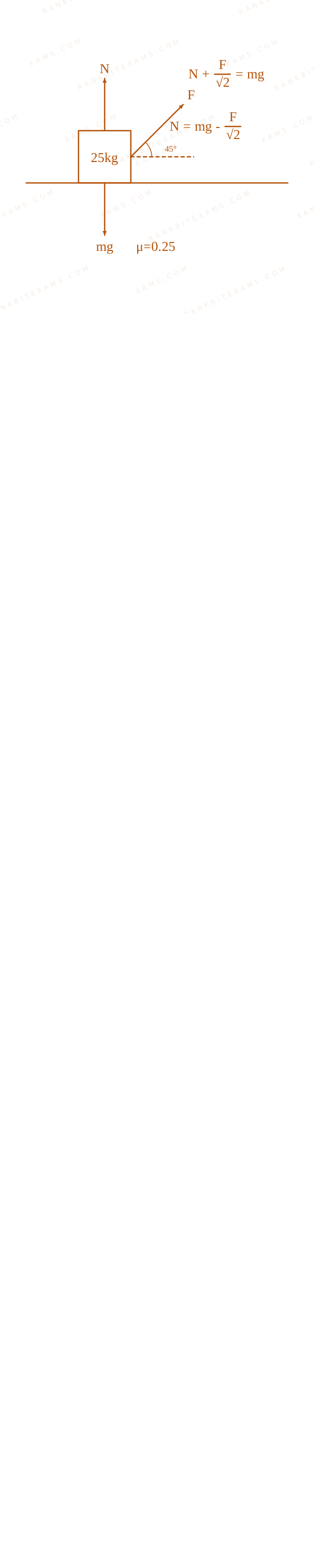
A block of mass 25 kg is pulled along a horizontal surface by a force at an angle 45^circ$45^{circ}$ with the horizontal. The friction coefficient between the block and the surface is 0.25. The work done for a displacement of 5 m of the block with uniform velocity is:
A. 970 J
B. 735 J
C. 245 J
D. 490 J
Solution
### Related Formula
N + Fsintheta = mg implies N = mg - Fsintheta$$N + F\sin\theta = mg \implies N = mg - F\sin\theta$$Fcostheta = f_k = mu_k N$$F\cos\theta = f_k = \mu_k N$$W = F cdot S cdot costheta$$W = F \cdot S \cdot \cos\theta$$
### Core Logic
Since the block moves with uniform velocity, horizontal acceleration is zero.
Fcos(45^circ) = mu [mg - Fsin(45^circ)]$$F\cos(45^\circ) = \mu [mg - F\sin(45^\circ)]$$fracFsqrt2 = 0.25 left[25 times 9.8 - fracFsqrt2right]$$\frac{F}{\sqrt{2}} = 0.25 \left[25 \times 9.8 - \frac{F}{\sqrt{2}}\right]$$fracFsqrt2 = 61.25 - 0.25 fracFsqrt2 implies 1.25 fracFsqrt2 = 61.25$$\frac{F}{\sqrt{2}} = 61.25 - 0.25 \frac{F}{\sqrt{2}} \implies 1.25 \frac{F}{\sqrt{2}} = 61.25$$
### Step 1: Compute Force and Work Done
fracFsqrt2 = frac61.251.25 = 49 implies F = 49sqrt2text N$$\frac{F}{\sqrt{2}} = \frac{61.25}{1.25} = 49 \implies F = 49\sqrt{2}\text{ N}$$
The work done by the external force over displacement S=5text m$S=5\text{ m}$ is:
W = F S cos(45^circ) = (49sqrt2) times 5 times frac1sqrt2 = 245text J$$W = F S \cos(45^\circ) = (49\sqrt{2}) \times 5 \times \frac{1}{\sqrt{2}} = 245\text{ J}$$Free body diagram of the block showing external force components and friction
### Pattern Recognition
When uniform velocity is sustained, work done by the external pulling component perfectly matches the work consumed against internal friction dissipation (W = f_k cdot S$W = f_k \cdot S$).
### Evaluation Rubric / Model Answer
null
### Chapter Mix
Class 11 Physics: Laws of Motion
Q12jee_main_2025_04_april_morningEquilibrium of Forces
A body of mass m$m$ is suspended by two strings making angles theta1$\theta{1}$ and theta_2$\theta_{2}$ with the horizontal ceiling with tensions T_1$T_{1}$ and T_2$T_{2}$ simultaneously. T_1$T_{1}$ and T_2$T_{2}$ are related by T_1=sqrt3T_2$T_{1}=\sqrt{3}T_{2}$ the angles \theta_{1} and \theta_{2} are
A.theta_1=30^circ, theta_2=60^circtext with T_2=frac3mg4$\theta_{1}=30^{\circ}, \theta_{2}=60^{\circ}\text{ with } T_{2}=\frac{3mg}{4}$
B.theta_1=60^circ, theta_2=30^circtext with T_2=fracmg2$\theta_{1}=60^{\circ}, \theta_{2}=30^{\circ}\text{ with } T_{2}=\frac{mg}{2}$
C.theta_1=45^circ, theta_2=45^circtext with T_2=frac3mg4$\theta_{1}=45^{\circ}, \theta_{2}=45^{\circ}\text{ with } T_{2}=\frac{3mg}{4}$
D.theta_1=30^circ, theta_2=60^circtext with T_2=frac4mg5$\theta_{1}=30^{\circ}, \theta_{2}=60^{\circ}\text{ with } T_{2}=\frac{4mg}{5}$
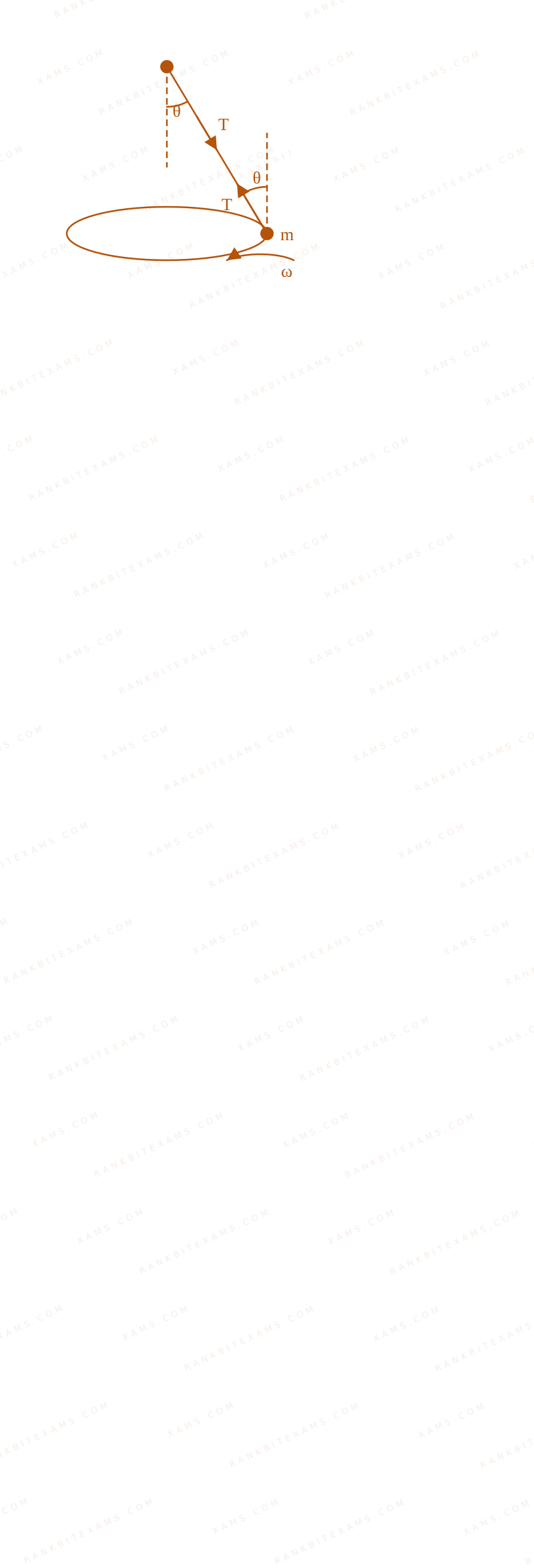
A string of length L is fixed at one end and carries a mass of M at the other end. The mass makes left(frac3pi
ight)$\left(\frac{3}{\pi}
ight)$ rotations per second about the vertical axis passing through end of the string as shown. The tension in the string is ____ ML.
Numerical Answer.Answer: 36 to 36
Solution
### Related Formula
For a conical pendulum:
T cos theta = Mg$$T \cos \theta = Mg$$T sin theta = Momega^2 R$$T \sin \theta = M\omega^2 R$$
where R = L sin theta$R = L \sin \theta$.
### Core Logic
Substituting R = L sin theta$R = L \sin \theta$ into the centripetal equation: Conical pendulum string force vectors diagram Q22T sin theta = M omega^2 (L sin theta)$$T \sin \theta = M \omega^2 (L \sin \theta)$$T = M omega^2 L$$T = M \omega^2 L$$
Given rotational frequency: f = frac3pi\ mathrmrev/s$f = \frac{3}{\pi}\ \mathrm{rev/s}$
Angular velocity:
omega = 2pi f = 2pi left(frac3pi
ight) = 6\ mathrmrad/s$$\omega = 2\pi f = 2\pi \left(\frac{3}{\pi}
ight) = 6\ \mathrm{rad/s}$$
Substituting omega$\omega$ back into the simplified tension equation:
T = M (6)^2 L = 36\ ML$$T = M (6)^2 L = 36\ ML$$
### Pattern Recognition
In a conical pendulum, the horizontal projection of tension provides the exact centripetal force. The sintheta$\sin\theta$ terms cancel out, making string tension independent of the semi-vertical angle.
### Evaluation Rubric / Model Answer
null
### Chapter Mix
Class 11 Physics: Laws of Motion
Q10jee_main_2025_24_jan_morningCircular Motion and Banking of Roads
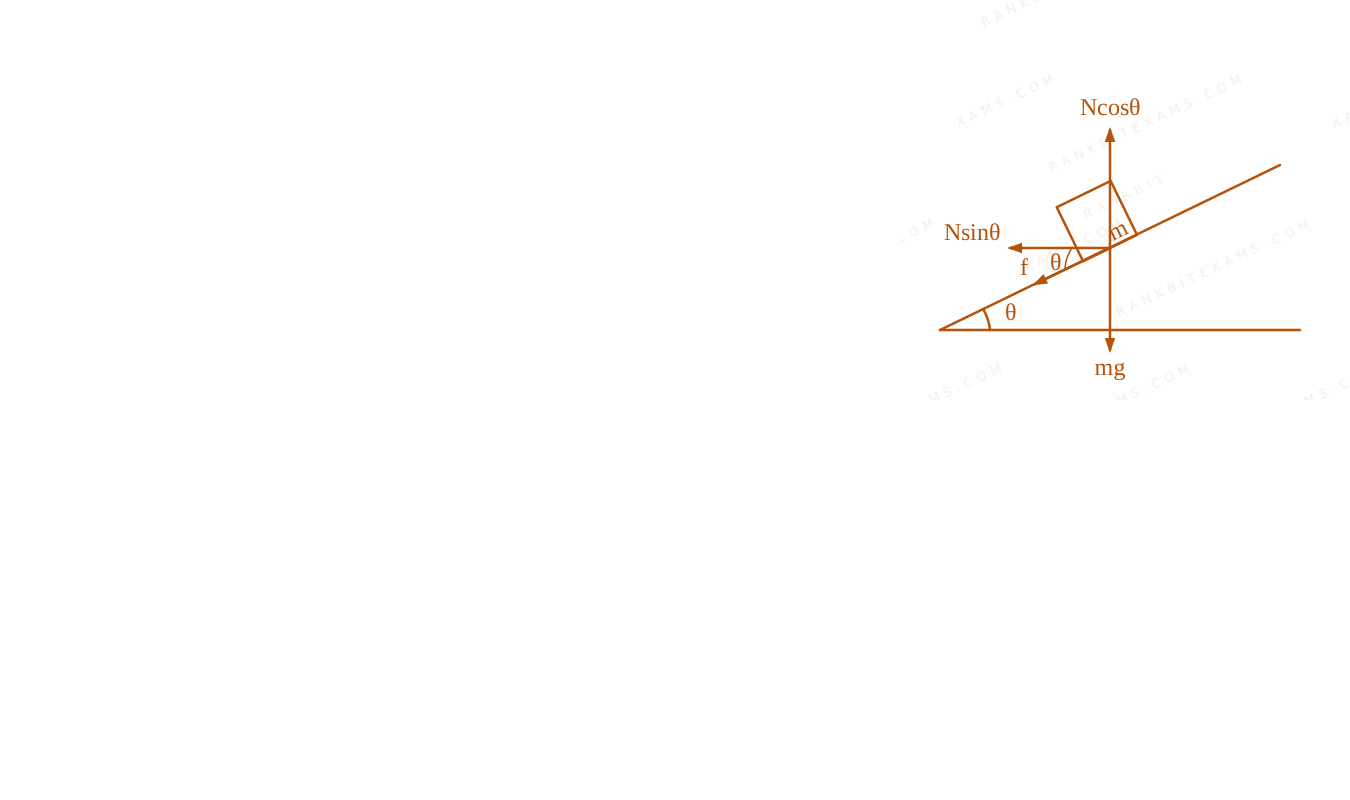
A car of mass 'm' moves on a banked road having radius 'r' and banking angle theta$\theta$ To avoid slipping from banked road, the maximum permissible speed of the car is v_0.$v_{0}.$ The coefficient of friction mu$\mu$ between the wheels of the car and the banked road is :-
We Map Every Repeating Question in Competitive Exams.
Say goodbye to generic mock test fatigue. RankBit uses smart analysis to group past exam questions into their foundational Repeating Question Types. Find chapter weightage, track repeating questions, and score higher with targeted practice.
Select Your Target Exam
Choose an exam track below to find formulas per chapter and patterns.
Syncing Exam Intelligence
Mapping formulas and patterns across all tracks…
PATH A — FULL LENGTH PRACTICE
Full Mock Test Hub
Simulate real NTA exam conditions with fully tracked mocks. Time yourself against past papers.
Practice past-year questions one chapter at a time. Pick an exam → subject → chapter and get every PYQ for that topic — pulled together from all past papers — with the chapter's key formulas alongside.