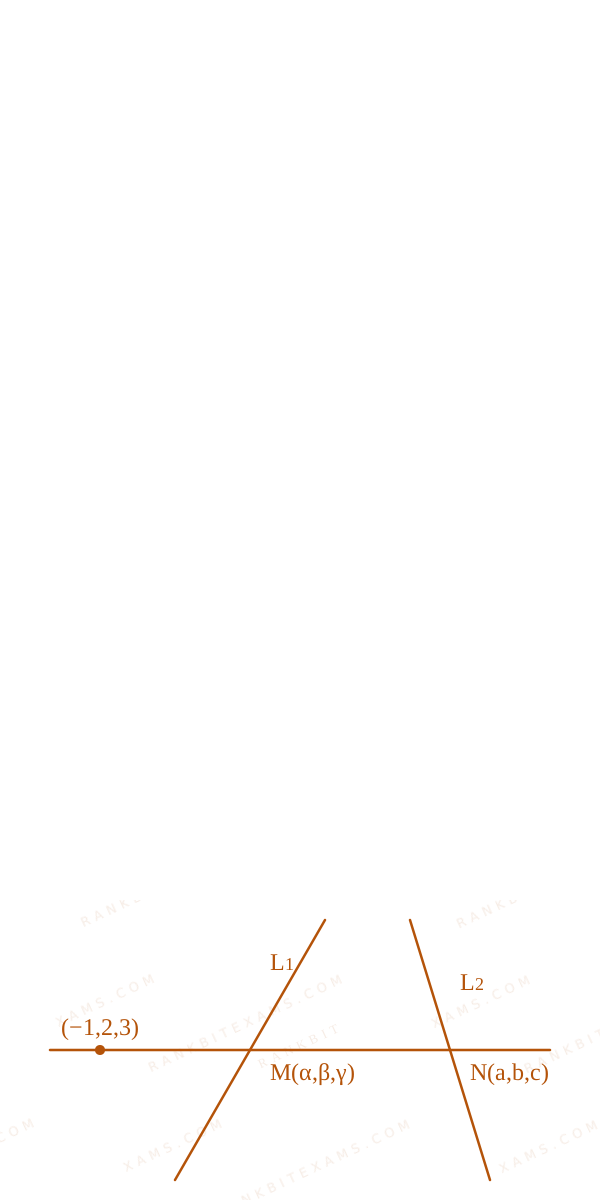
A line crossing two given lines acts as a transversal holding 3 collinear points. Setting PM = k · PN$\vec{PM} = k \cdot \vec{PN}$ rapidly locks the parametric constants λ$\lambda$ and μ$\mu$.
Keywords:#Intersecting lines in 3D#JEE Main 2024 Evening Q22#Three Dimensional Geometry JEE Main 2024#Lines in Space JEE Main 2024
More Three Dimensional Geometry Previous-Year Questions — Page 9
Q68jee_main_2025_24_jan_morningIntersection of Lines in 3D Space
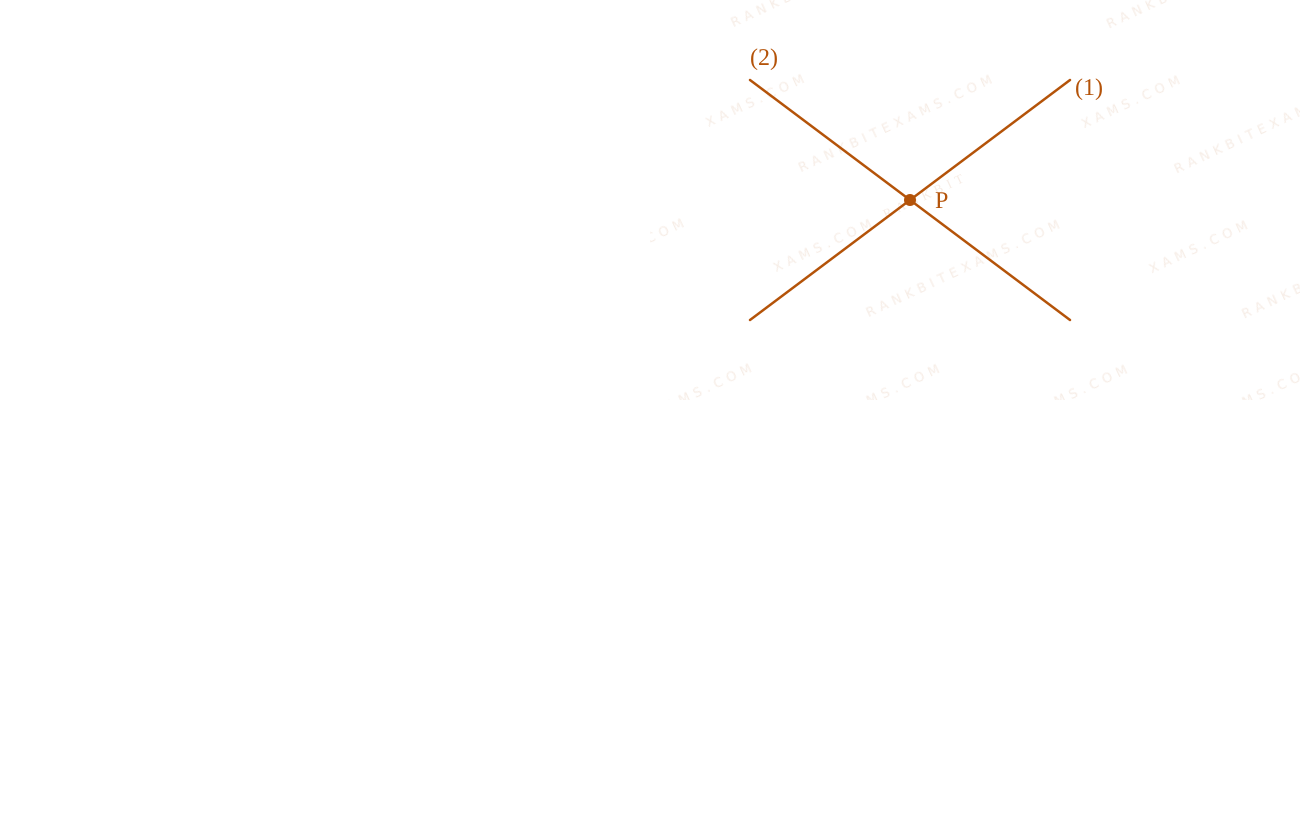
Let the line passing through the points (-1, 2, 1)$(-1, 2, 1)$ and \parallel to the line (x - 1)/(2) = (y + 1)/(3) = (z)/(4)$\frac{x - 1}{2} = \frac{y + 1}{3} = \frac{z}{4}$ intersect the line (x + 2)/(3) = (y - 3)/(2) = (z - 4)/(1)$\frac{x + 2}{3} = \frac{y - 3}{2} = \frac{z - 4}{1}$ at the point P$P$. Then the distance of P$P$ from the point Q(4, -5, 1)$Q(4, -5, 1)$ is :
A.5$5$
B.10$10$
C.5√(6)$5\sqrt{6}$
D.5√(5)$5\sqrt{5}$
Solution
Related Formula
The line passing through a$\vec{a}$ and \parallel to direction vector v = l i + m j + n k$\vec{v} = l\hat{\mathbf{i}} + m\hat{\mathbf{j}} + n\hat{\mathbf{k}}$ is written in symmetric form as:
When finding the intersection point of two 3D lines, always use the third coordinate equation to verify the parameter values obtained from the first two equations to ensure consistency.
Chapter Mix
Class 12 Mathematics: Three Dimensional Geometry
Qjee_main_2025_28_jan_eveningDistance from a Point to a Line
The square of the distance of the point ((15)/(7),(32)/(7),7)$(\frac{15}{7},\frac{32}{7},7)$ from the line (x+1)/(3)=(y+3)/(5)=(z+5)/(7)$\frac{x+1}{3}=\frac{y+3}{5}=\frac{z+5}{7}$ in the direction of the vector i+4 j+7 k$\hat{i}+4\hat{j}+7\hat{k}$ is:
A.54$54$
B.41$41$
C.66$66$
D.44$44$
Solution
Related Formula
Equation of a line passing through P(x₀, y₀, z₀)$P(x_0, y_0, z_0)$ along direction vector v = a i+b j+c k$\vec{v} = a\hat{i}+b\hat{j}+c\hat{k}$:
Let the given point be P((15)/(7), (32)/(7), 7)$P\left(\frac{15}{7}, \frac{32}{7}, 7\right)$.
We need to find the distance measured along the line passing through P$P$ parallel to the vector v = i+4 j+7 k$\vec{v} = \hat{i}+4\hat{j}+7\hat{k}$.
Instead of finding coordinates of Q$Q$, we could also use the vector form directly: PQ = λ( i + 4 j + 7 k)$\vec{PQ} = \lambda(\hat{i} + 4\hat{j} + 7\hat{k})$. Distance squared is PQ² = λ²(1² + 4² + 7²) = (-1)²(1 + 16 + 49) = 66$PQ^2 = \lambda^2(1^2 + 4^2 + 7^2) = (-1)^2(1 + 16 + 49) = 66$. This saves a lot of fractional coordinate subtraction arithmetic!
Chapter Mix
Class 12 Mathematics: Three Dimensional Geometry
Q64jee_main_2025_29_jan_morningIntersection of Lines
Let a = i + 2 j + k$\vec{a} = \hat{i} + 2\hat{j} + \hat{k}$ and b = 2 i + 7 j + 3 k$\vec{b} = 2\hat{i} + 7\hat{j} + 3\hat{k}$ . Let L₁: r = (- i +2 j + k) + λ a,λ in R$\mathrm{L}_1:\vec{\mathrm{r}} = \left(-\hat{\mathrm{i}} +2\hat{\mathrm{j}} +\hat{\mathrm{k}}\right) + \lambda \vec{\mathrm{a}},\lambda \in \mathbb{R}$ and L₂: r = ( j + k) + μ b,μ in R$\mathrm{L}_2:\vec{\mathrm{r}} = \left(\hat{\mathrm{j}} +\hat{\mathrm{k}}\right) + \mu \vec{\mathrm{b}},\mu \in \mathbb{R}$ be two lines. If the line L₃$\mathrm{L}_3$ passes through the point of intersection of L₁$\mathrm{L}_1$ and L₂$\mathrm{L}_2$ , and is \parallel to a + b$\vec{\mathrm{a}} +\vec{\b}$, then L₃$\mathrm{L}_3$ passes through the point:
A. (8, 26, 12)
B. (2, 8, 5)
C. (-1, -1, 1)
D. (5, 17, 4)
Solution
Related Formula
Equation of line passing through r₀ ∥ to v: r = r₀ + α v$$\text{Equation of line passing through } \vec{r}_0 \text{ \parallel to } \vec{v}: \vec{r} = \vec{r}_0 + \alpha \vec{v}$$
Core Logic
Express general points on L₁$L_1$ and L₂$L_2$ vector components:
Let L₁: (x - 1)/(1) = (y - 2)/(-1) = (z - 1)/(2)$L_1: \frac{x - 1}{1} = \frac{y - 2}{-1} = \frac{z - 1}{2}$ and L₂: x + 1-1 = y - 22 = z1$\mathrm{L}_2:\frac{\mathrm{x} + 1}{-1} = \frac{\mathrm{y} - 2}{2} = \frac{\mathrm{z}}{1}$ be two lines. Let L₃$\mathrm{L}_3$ be a line passing through the point (α, β, γ)$(\alpha, \beta, \gamma)$ and be perpendicular to both L₁$\mathrm{L}_1$ and L₂$\mathrm{L}_2$ . If L₃$\mathrm{L}_3$ intersects L₁$\mathrm{L}_1$ , then |5α - 11β - 8γ|$|5\alpha - 11\beta - 8\gamma|$ equals:
A. 18
B. 16
C. 25
D. 20
Solution
Related Formula
Direction ratios of a line perpendicular to both vectors: v = d₁ × d₂$$\text{Direction ratios of a line perpendicular to both vectors: } \vec{v} = \vec{d}_1 \times \vec{d}_2$$
Core Logic
Compute direction ratios for L₃$L_3$ using cross product of direction vectors of L₁$L_1$ and L₂$L_2$:
Taking absolute value yields |-25| = 25$|-25| = 25$.
Pattern Recognition
The cancellation of internal variables (λ$\lambda$ and k$k$) shows that the absolute expression describes a invariant geometric plane coordinate constraint, allowing simple baseline parameter values (like k=0, λ=0$k=0, \lambda=0$) to evaluate the question instantly.
Chapter Mix
Class 12 Mathematics: Three Dimensional Geometry
Q20jee_main_2024_01_february_morningShortest Distance Between Skew Lines
If the shortest distance between the lines (x-λ)/(-2)=(y-2)/(1)=(z-1)/(1)$\frac{x-\lambda}{-2}=\frac{y-2}{1}=\frac{z-1}{1}$ and x-√(3)1=(y-1)/(-2)=(z-2)/(1)$\frac{x-\sqrt{3}}{1}=\frac{y-1}{-2}=\frac{z-2}{1}$ is 1$1$, then the sum of all possible values of λ$\lambda$ is:
A.0$0$
B.2√(3)$2\sqrt{3}$
C.3√(3)$3\sqrt{3}$
D.-2√(3)$-2\sqrt{3}$
Solution
Related Formula
The shortest distance between two skew lines r = a₁ + s b₁$\vec{r} = \vec{a}_1 + s\vec{b}_1$ and r = a₂ + t b₂$\vec{r} = \vec{a}_2 + t\vec{b}_2$ is given by:
Sees: Shortest distance setup between vector paths containing free variables.
Shortcut: In equations like |c - λ| = d$|c - \lambda| = d$, the sum of the roots is simply equal to 2c$2c$, because the roots are symmetrically balanced around the center point c$c$. Thus, Sum = 2 × √(3) = 2√(3)$\text{Sum} = 2 \times \sqrt{3} = 2\sqrt{3}$ holds instantly without calculating individual values.
Chapter Mix
Class 12 Mathematics: Three Dimensional Geometry
Class 12 Mathematics: Vector Algebra
More Three Dimensional Geometry Questions — jee_main_2024_30_january_evening
Practice past-year questions one chapter at a time. Pick an exam → subject → chapter and get every PYQ for that topic — pulled together from all past papers — with the chapter's key formulas alongside.