JEE Main · Mathematics ↓ Falling

Three Dimensional Geometry appeared 62 times across 3 years — 7.2% of Mathematics. This question is from Line in 3D.

Year 2026 2025 2024 Total
Questions 15 29 18 62

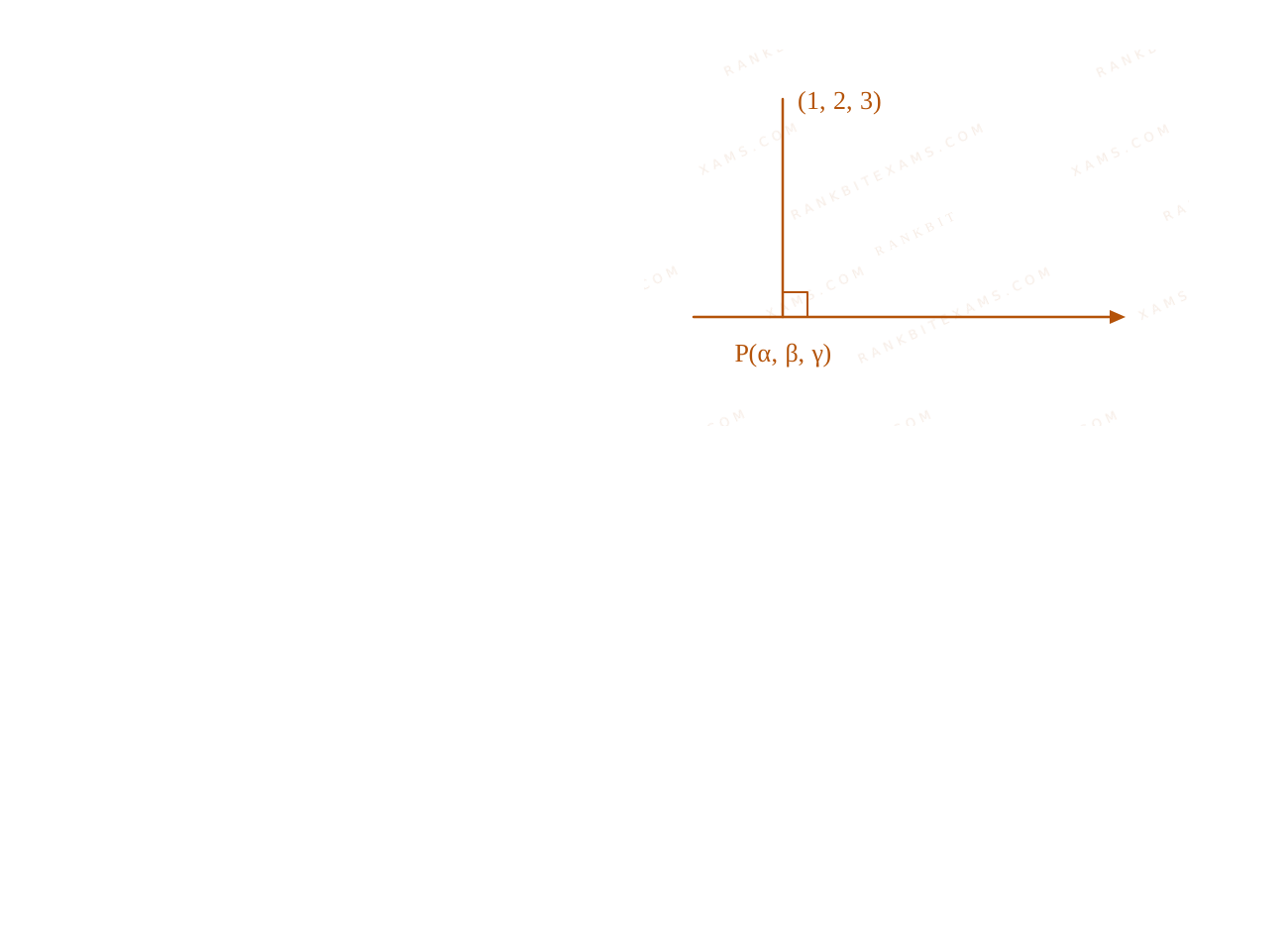
Let (α, β, γ) be the foot of perpendicular from the point (1, 2, 3) on the line (x + 3)/(5) = (y - 1)/(2) = (z + 4)/(3). then 19(α + β + γ) is equal to:

Solution & Explanation

Related Formula
a₁ a₂ + b₁ b₂ + c₁ c₂ = 0 (Condition for perpendicular vectors)
Core Logic

Line in 3D diagram for Q10 - JEE Main 2024 Morning

Let the given point be A(1, 2, 3). Let the foot of the perpendicular on the line be P(α, β, γ). The equation of the line is (x + 3)/(5) = (y - 1)/(2) = (z + 4)/(3) = k. So, any point on the line can be written as (5k - 3, 2k + 1, 3k - 4). Let this point be P. Thus, P(α, β, γ) ≡ (5k - 3, 2k + 1, 3k - 4).

Step 1: Finding Direction Ratios

Direction ratios (DR's) of the line segment AP are:

((5k - 3) - 1, (2k + 1) - 2, (3k - 4) - 3) ≡ (5k - 4, 2k - 1, 3k - 7)

Direction ratios of the given line are (5, 2, 3).

Step 2: Using Perpendicularity Condition

Since AP is perpendicular to the given line, the dot product of their direction ratios is zero:

5(5k - 4) + 2(2k - 1) + 3(3k - 7) = 0 (25k - 20) + (4k - 2) + (9k - 21) = 0

38k - 43 = 0

k = (43)/(38)
Step 3: Calculating target expression

We need to find 19(α + β + γ).

α + β + γ = (5k - 3) + (2k + 1) + (3k - 4) α + β + γ = 10k - 6

Substituting k = (43)/(38):

19(α + β + γ) = 19 (10((43)/(38)) - 6) = 19 ( (430)/(38) - 6 ) = (430)/(2) - 114 = 215 - 114 = 101
Pattern Recognition

To find coordinates of a foot of perpendicular, define a general point on the line using parameter k, create the direction vector, and dot it with the line's direction vector set to zero.

Chapter Mix

Class 12 Maths: Three Dimensional Geometry

Reference Study Guides

More Three Dimensional Geometry Previous-Year Questions — Page 2

Q10 jee_main_2026_22_january_evening Distance Between Points on Line
Let L be the line (x+1)/(2) = (y+1)/(3) = (z+3)/(6) and let S be the set of all points (a,b,c) on L, whose distance from the line (x+1)/(2) = (y+1)/(3) = (z-9)/(0) along the line L is 7. Then Σ(a,b,c) in S (a+b+c) is equal to:
  • A. 34
  • B. 28
  • C. 40
  • D. 6

Solution

Related Formula

Distance along a line from intersection point M using parametric coordinates.

Core Logic

Find intersection point M of L₁ and L₂:

2λ - 1 = 2μ - 1, 3λ - 1 = 3μ - 1, 6λ - 3 = 9 λ = 2, μ = 2

Point of intersection M = (3, 5, 9).

Any parametric point P on L₁ is (2K-1, 3K-1, 6K-3).

Step 1: Solve for Points P and Q

Distance PM = 7:

√((2K-4)² + (3K-6)² + (6K-12)²) = 7 7|K-2| = 7 K = 1 or 3
  • For K=1: P = (1, 2, 3), sum = 6
  • For K=3: Q = (5, 8, 15), sum = 28
Step 2: Total Sum

Total sum = 6 + 28 = 34.

Pattern Recognition

Intersection point gives central reference; unit direction vector gives required offset points along the line.

Chapter Mix

Class 12 Maths: Three Dimensional Geometry

Q15 jee_main_2026_23_january_morning Lines in 3D
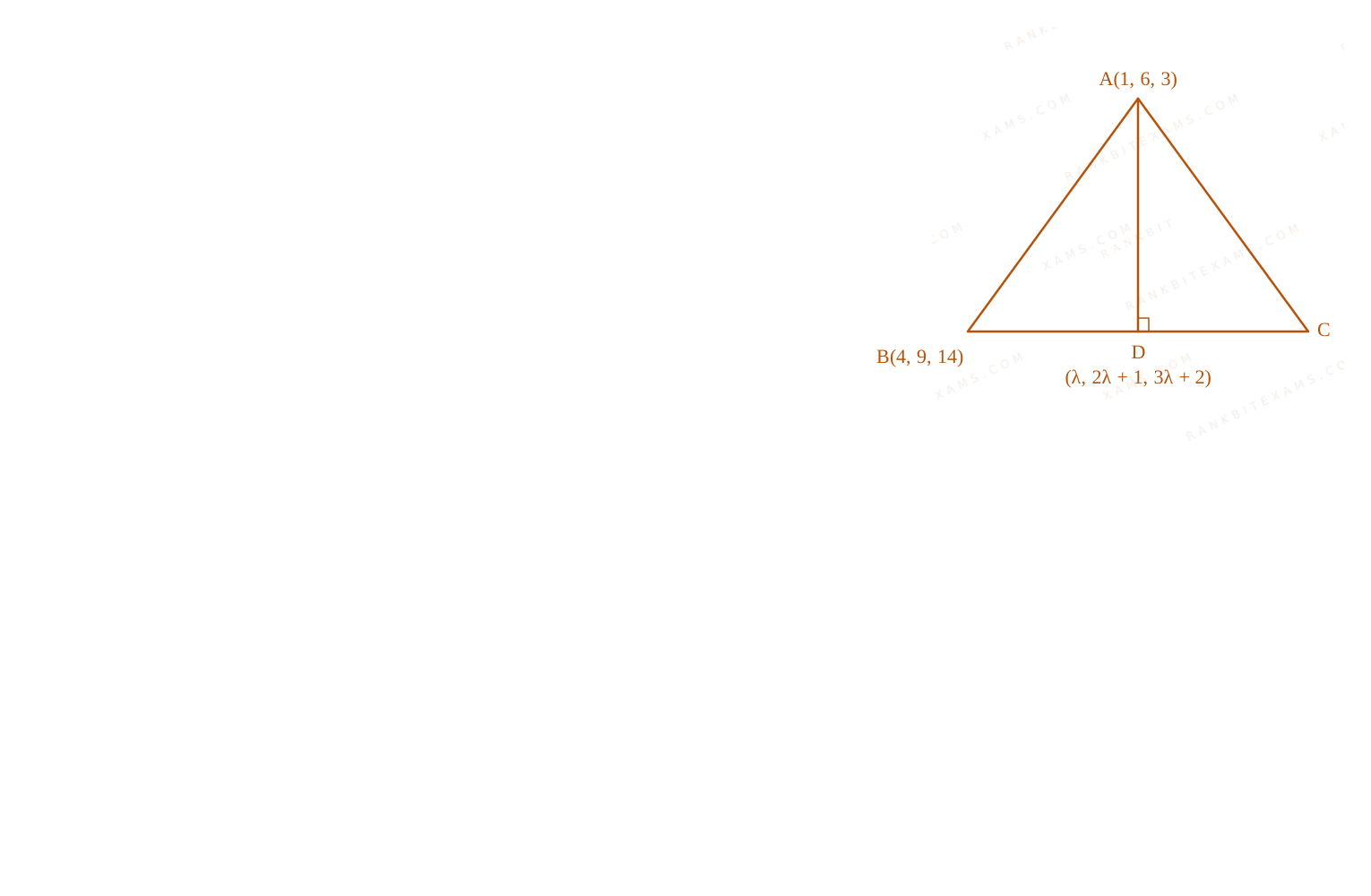
The vertices B and C of a triangle ABC lie on the line (x)/(1) = (1 - y)/(-2) = (z - 2)/(3). The coordinates of A and B are (1, 6, 3) and (4, 9, α) respectively and C is at a distance of 10 units from B. The area (in sq. units) of Δ ABC is:
  • A. 5√(13)
  • B. 15√(13)
  • C. 20√(13)
  • D. 10√(13)

Solution

Related Formula
Area of Δ = (1)/(2) × base × height = (1)/(2) × BC × AD
Core Logic

The line is standardly written as (x)/(1) = (y - 1)/(2) = (z - 2)/(3) = λ. Point B (4, 9, α) lies on this line, so we can solve for α by substituting it in:

(4)/(1) = (9 - 1)/(2) = (α - 2)/(3) ⇒ 4 = 4 = (α - 2)/(3) ⇒ α = 14

Thus, B is (4, 9, 14).

Lines in 3D diagram for Q15 - JEE Main 2026 Morning

Step 1: Find the Perpendicular Foot (D)

Let D be the foot of the perpendicular from A(1, 6, 3) to the line BC. The coordinates of a general point on the line are D = (λ, 2λ + 1, 3λ + 2). The direction vector of AD is AD = (λ - 1) i + (2λ - 5) j + (3λ - 1) k. Since AD is perpendicular to the line whose direction ratios are 1, 2, 3:

1(λ - 1) + 2(2λ - 5) + 3(3λ - 1) = 0 λ - 1 + 4λ - 10 + 9λ - 3 = 0 14λ - 14 = 0 ⇒ λ = 1
Step 2: Calculate Height (AD)

Substitute λ = 1 into D: D = (1, 3, 5). The perpendicular distance AD is:

AD = √((1-1)² + (6-3)² + (3-5)²) = √(0² + 3² + (-2)²) = √(9 + 4) = √(13)
Step 3: Calculate Area of Triangle

We are given that the base BC is 10 units.

Area = (1)/(2) × BC × AD = (1)/(2) × 10 × √(13) = 5√(13)
Pattern Recognition

When a triangle area is requested given a line equation containing the base, dropping a generic lambda-perpendicular establishes height (AD), decoupling the problem from finding the exact coordinate of C.

Chapter Mix

Class 12 Maths: Three Dimensional Geometry

Q20 jee_main_2026_23_january_morning Direction Cosines
Let the direction cosines of two lines satisfy the equations: 4 + m - n = 0 and 2mn + 10n + 3 m = 0. Then the cosine of the acute angle between these lines is:
  • A. 10√(38)
  • B. 203√(38)
  • C. 107√(38)
  • D. 103√(38)

Solution

Related Formula
θ = |a₁a₂ + b₁b₂ + c₁c₂|√(a₁²+b₁²+c₁²)√(a₂²+b₂²+c₂²)
Core Logic

From the first linear equation, isolate n: n = 4 + m Substitute this into the second quadratic relation:

2m(4 + m) + 10 (4 + m) + 3 m = 0 8 m + 2m² + 40 ² + 10 m + 3 m = 0 40 ² + 21 m + 2m² = 0

Factorizing the quadratic equation:

(8 + m)(5 + 2m) = 0

This gives two cases, generating the direction ratios of the two lines.

Step 1: Determine Direction Ratios

Case 1: m = -8 Then n = 4 - 8 = -4. Direction Ratios (D.R.s) for line L₁: ( , -8 , -4 ) ≡ (1, -8, -4).

Case 2: m = -(5)/(2) Then n = 4 - (5)/(2) = (3)/(2). Direction Ratios (D.R.s) for line L₂: ( , -(5)/(2) , (3)/(2) ) ≡ (1, -(5)/(2), (3)/(2)) ≡ (2, -5, 3).

Step 2: Calculate Angle Between Lines

Use the angle formula with D.R.s d₁ = (1, -8, -4) and d₂ = (2, -5, 3):

θ = |(1)(2) + (-8)(-5) + (-4)(3)|√(1² + (-8)² + (-4)²) √(2² + (-5)² + 3²) θ = |2 + 40 - 12|√(1 + 64 + 16) √(4 + 25 + 9) θ = 30√(81) √(38) = 309√(38) = 103√(38)
Pattern Recognition

When direction cosines are entangled in one linear and one quadratic equation, isolate the single-degree variable from the linear plane equation and plug it into the cone equation to split it into two generating lines.

Chapter Mix

Class 12 Maths: Three Dimensional Geometry

Q22 jee_main_2026_23_january_evening Line in 3D
If the image of the point P(a, 2, a) in the line (x)/(2) = (y + a)/(1) = (z)/(1) is Q and the image of Q in the line (x - 2b)/(2) = (y - a)/(1) = (z + 2b)/(-5) is P, then a + b is equal to
Numerical Answer. Answer: 3 to 3

Solution

Related Formula

For a point and its image across a line, the midpoint of the segment connecting them lies exactly on the line. The segment itself is perpendicular to the line.

Core Logic

Line in 3D diagram for Q22 - JEE Main 2026 Evening
Let the first line be L₁: (x)/(2) = (y + a)/(1) = (z)/(1) = λ. A general point on L₁ is (2λ, λ - a, λ). This is the midpoint M₁ of P(a, 2, a) and Q(x₁, y₁, z₁).

Thus, Q is given by:

x₁ = 4λ - a y₁ = 2λ - 2a - 2 z₁ = 2λ - a

Now, the image of Q across L₂: (x - 2b)/(2) = (y - a)/(1) = (z + 2b)/(-5) = μ is P(a, 2, a). The midpoint M₂ of PQ lies on L₂. But M₂ is the exact same set of coordinates in space as M₁ since they are both the midpoint of the segment PQ!

Step 1: Equating Midpoints

General point on L₂ is (2μ + 2b, μ + a, -5μ - 2b). Since the midpoint must be the same: (a + (4λ - a))/(2) = 2μ + 2b 2λ = 2μ + 2b λ - μ = b (2 + (2λ - 2a - 2))/(2) = μ + a λ - a = μ + a λ - μ = 2a (a + (2λ - a))/(2) = -5μ - 2b λ = -5μ - 2b λ + 5μ = -2b

Step 2: Solving System

From the first two equations, b = 2a. Substitute b = 2a into the third: λ + 5μ = -4a. Also λ - μ = 2a. Subtracting gives 6μ = -6a μ = -a. Thus λ = a.

Line in 3D diagram for Q22 - JEE Main 2026 Evening
The direction vector of segment PQ is proportional to the vector from P to M₁. PM₁ = (2λ - a) i + (λ - a - 2) j + (λ - a) k. Since λ = a: PM₁ = a i - 2 j + 0 k.

This vector must be perpendicular to L₁ (direction vector 2 i + j + k): (a)(2) + (-2)(1) + (0)(1) = 0 2a - 2 = 0 a = 1.

Step 3: Final Values

Since a = 1, and b = 2a, we have b = 2. Therefore, a + b = 1 + 2 = 3.

Pattern Recognition

If P is the image of Q on L₁, and Q is the image of P on L₂, then L₁ and L₂ must intersect segment PQ at the exact same midpoint. Using the midpoint consistency across both lines creates a rapid linear system.

Chapter Mix

Class 12 Maths: Three Dimensional Geometry

Q3 jee_main_2026_24_january_morning Intersection of Lines and Distances
Let the lines L₁: r = i + 2 j + 3 k + λ(2 i + 3 j + 4 k), λ in R and L₂: r = (4 i + j) + μ(5 i + 2 j + k), μ in R, intersect at the point R. Let P and Q be the points lying on lines L₁ and L₂, respectively, such that | PR| = √(29) and | PQ| = √((47)/(3)). If the point P lies in the first octant, then 27(QR)² is equal to
  • A. 340
  • B. 360
  • C. 320
  • D. 348

Solution

Related Formula
Distance formula: d² = (x₂ - x₁)² + (y₂ - y₁)² + (z₂ - z₁)²
Core Logic

Find the point of intersection R by equating general points on L₁ and L₂: General point on L₁: (2λ + 1, 3λ + 2, 4λ + 3) General point on L₂: (5μ + 4, 2μ + 1, μ)

Equating coordinates:

2λ + 1 = 5μ + 4 3λ + 2 = 2μ + 1 4λ + 3 = μ

Solving yields λ = -1 and μ = -1. Point of intersection R is (-1, -1, -1).

Step 1: Finding Point P

Let point P be (2λ + 1, 3λ + 2, 4λ + 3). PR² = 29

(2λ + 1 + 1)² + (3λ + 2 + 1)² + (4λ + 3 + 1)² = 29 (2λ + 2)² + (3λ + 3)² + (4λ + 4)² = 29 4(λ + 1)² + 9(λ + 1)² + 16(λ + 1)² = 29 29(λ + 1)² = 29 ⇒ (λ + 1)² = 1 λ + 1 = ± 1 ⇒ λ = 0 or λ = -2

If λ = -2, P(-3, -4, -5) (not in first octant, rejected). If λ = 0, P(1, 2, 3) (in first octant, accepted).

Step 2: Finding Point Q

Let Q be (5μ + 4, 2μ + 1, μ).

PQ² = (47)/(3) (5μ + 4 - 1)² + (2μ + 1 - 2)² + (μ - 3)² = (47)/(3) (5μ + 3)² + (2μ - 1)² + (μ - 3)² = (47)/(3) 25μ² + 30μ + 9 + 4μ² - 4μ + 1 + μ² - 6μ + 9 = (47)/(3) 30μ² + 20μ + 19 = (47)/(3) 90μ² + 60μ + 57 = 47 ⇒ 90μ² + 60μ + 10 = 0 9μ² + 6μ + 1 = 0 ⇒ (3μ + 1)² = 0 μ = -(1)/(3)
Step 3: Calculating QR^2

Point Q = ( 5(-(1)/(3))+4, 2(-(1)/(3))+1, -(1)/(3) ) = ( (7)/(3), (1)/(3), -(1)/(3) ). R(-1, -1, -1).

(QR)² = ( (7)/(3) + 1 )² + ( (1)/(3) + 1 )² + ( -(1)/(3) + 1 )² = ( (10)/(3) )² + ( (4)/(3) )² + ( (2)/(3) )² = (100 + 16 + 4)/(9) = (120)/(9) 27 × (QR)² = 27 × (120)/(9) = 3 × 120 = 360
Pattern Recognition

When given fixed line parameters and distances, expressing all points in terms of their single parameter (λ or μ) converts 3D distance problems into simple single-variable quadratic equations.

Chapter Mix

Class 12 Maths: Three Dimensional Geometry
More Three Dimensional Geometry Questions — jee_main_2024_30_jan_morning

Practice all Three Dimensional Geometry previous-year questions →

Rankbit System
JEE Physics: Waves (+15.5%) | Electrostatics: Concentric Shells (-29.7%) | Modern Physics: Photoelectric Clones (+34.2%) | Mathematics: Definite Integrals (+18.1%) | Chemistry: Coordination Splitting (-11.4%) | JEE Physics: Waves (+15.5%) | Electrostatics: Concentric Shells (-29.7%) | Modern Physics: Photoelectric Clones (+34.2%) | Mathematics: Definite Integrals (+18.1%) | Chemistry: Coordination Splitting (-11.4%)