JEE Main · Mathematics ↓ Falling

Three Dimensional Geometry appeared 62 times across 3 years — 7.2% of Mathematics. This question is from Line in 3D.

Year 2026 2025 2024 Total
Questions 15 29 18 62

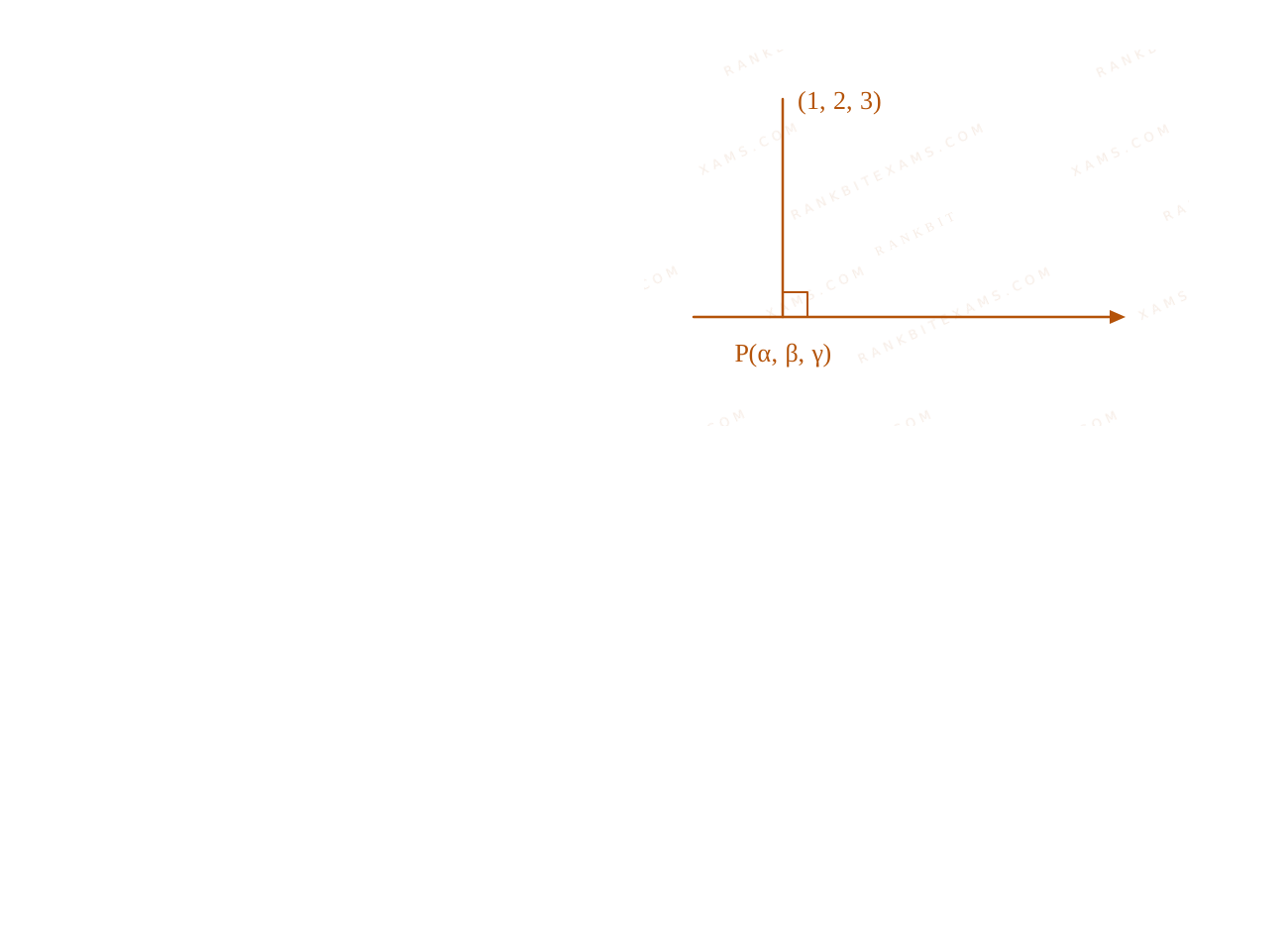
Let (α, β, γ) be the foot of perpendicular from the point (1, 2, 3) on the line (x + 3)/(5) = (y - 1)/(2) = (z + 4)/(3). then 19(α + β + γ) is equal to:

Solution & Explanation

Related Formula
a₁ a₂ + b₁ b₂ + c₁ c₂ = 0 (Condition for perpendicular vectors)
Core Logic

Line in 3D diagram for Q10 - JEE Main 2024 Morning

Let the given point be A(1, 2, 3). Let the foot of the perpendicular on the line be P(α, β, γ). The equation of the line is (x + 3)/(5) = (y - 1)/(2) = (z + 4)/(3) = k. So, any point on the line can be written as (5k - 3, 2k + 1, 3k - 4). Let this point be P. Thus, P(α, β, γ) ≡ (5k - 3, 2k + 1, 3k - 4).

Step 1: Finding Direction Ratios

Direction ratios (DR's) of the line segment AP are:

((5k - 3) - 1, (2k + 1) - 2, (3k - 4) - 3) ≡ (5k - 4, 2k - 1, 3k - 7)

Direction ratios of the given line are (5, 2, 3).

Step 2: Using Perpendicularity Condition

Since AP is perpendicular to the given line, the dot product of their direction ratios is zero:

5(5k - 4) + 2(2k - 1) + 3(3k - 7) = 0 (25k - 20) + (4k - 2) + (9k - 21) = 0

38k - 43 = 0

k = (43)/(38)
Step 3: Calculating target expression

We need to find 19(α + β + γ).

α + β + γ = (5k - 3) + (2k + 1) + (3k - 4) α + β + γ = 10k - 6

Substituting k = (43)/(38):

19(α + β + γ) = 19 (10((43)/(38)) - 6) = 19 ( (430)/(38) - 6 ) = (430)/(2) - 114 = 215 - 114 = 101
Pattern Recognition

To find coordinates of a foot of perpendicular, define a general point on the line using parameter k, create the direction vector, and dot it with the line's direction vector set to zero.

Chapter Mix

Class 12 Maths: Three Dimensional Geometry

Reference Study Guides

More Three Dimensional Geometry Previous-Year Questions — Page 10

Q29 jee_main_2024_01_february_morning Shortest Distance Between Skew Lines
Let the line of the shortest distance between the lines L₁: r=( i+2 j+3 k)+λ( i- j+ k) and L₂: r=(4 i+5 j+6 k)+μ( i+ j- k) intersect L₁ and L₂ at P and Q respectively. If $(α, β, γ)is the midpoint of the line segment PQ, then2(\alpha+\beta+\gamma)$ is equal to
Numerical Answer. Answer: 21 to 21

Solution

Related Formula

The vector connecting the shortest distance points P and Q on two skew lines must be simultaneously perpendicular to the direction vectors b₁ and b₂ of both lines:

PQ ∥ ( b₁ × b₂)
Core Logic

Let's define general points on both lines:

  • Point P on L₁: (1+λ, 2-λ, 3+λ)
  • Point Q on L₂: (4+μ, 5+μ, 6-μ)
  • The direction ratios of vector PQ are:

PQ = (3+μ-λ) i + (3+μ+λ) j + (3-μ-λ) k
Step 1: Compute Perpendicular Direction Vector

Calculate the cross product of the directions of lines L₁ and L₂:

b₁ × b₂ = vmatrix i & j & k 1 & -1 & 1 1 & 1 & -1 vmatrix = 0 i + 2 j + 2 k

Since PQ is parallel to (0, 2, 2), we compare the coordinate ratios:

3+μ-λ = 0 λ - μ = 3 (1) (3+μ+λ)/(2) = (3-μ-λ)/(2) 2μ + 2λ = 0 λ + μ = 0 (2)

Shortest distance foot coordinates calculation for Q29 - JEE Main 2024 01 February Morning
The graphic maps out the geometry of lines L1 and L2 intersected by their common perpendicular segment at points A and B.

Step 2: Solve for Parameters and Midpoint

Solving linear equations (1) and (2) simultaneously:

λ = (3)/(2), μ = -(3)/(2)

Substitute these values back to find the specific coordinates of points P and Q:

  • P = ((5)/(2), (1)/(2), (9)/(2))
  • Q = ((5)/(2), (7)/(2), (15)/(2))
  • The midpoint coordinates $(α, β, γ)are:

(α, β, γ) = ( (5/2 + 5/2)/(2), (1/2 + 7/2)/(2), (9/2 + 15/2)/(2) ) = ((5)/(2), 2, 6)
Step 3: Final Computation

Calculate the required terms:

2(α+β+γ) = 2((5)/(2) + 2 + 6) = 5 + 4 + 12 = 21
Pattern Recognition

Sees: Explicit endpoints of the shortest distance line vector segment. Shortcut: Since the cross product component along

Pattern Recognition

Sees: Explicit endpoints of the shortest distance line vector segment. Shortcut: Since the cross product component along $\hat{i}$ is 0, the x-coordinates of both line points are identical, providing a massive shortcut to check algebraic equations immediately.

Chapter Mix

Class 12 Mathematics: Three Dimensional Geometry
Q3 jee_main_2024_29_january_evening Angle Between Two Lines
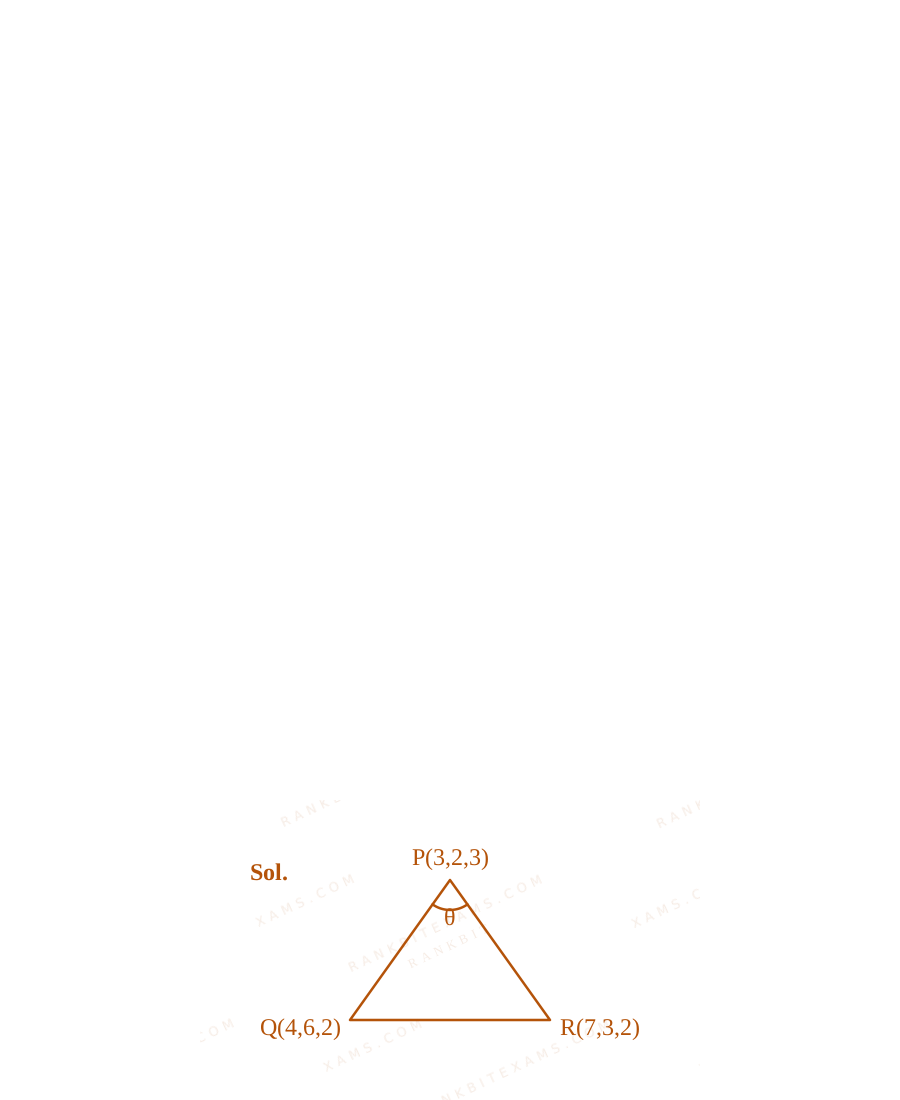
Let P(3,2,3), Q(4,6,2) and R(7,3,2) be the vertices of Δ PQR. Then, the angle ∠ QPR is
  • A. (π)/(6)
  • B. ⁻¹((7)/(18))
  • C. ⁻¹((1)/(18))
  • D. (π)/(3)

Solution

Related Formula
θ = a · b| a|| b|
Core Logic

Let us compute the direction ratios of the vectors PQ and PR originating from vertex P:

Direction ratios of PQ = (4 - 3, 6 - 2, 2 - 3) = (1, 4, -1) Direction ratios of PR = (7 - 3, 3 - 2, 2 - 3) = (4, 1, -1)

Step 1: Evaluating the Angle

Using the dot product formula for the angle θ = ∠ QPR:

θ = 1(4) + 4(1) + (-1)(-1)√(1² + 4² + (-1)²) · √(4² + 1² + (-1)²) θ = 4 + 4 + 1√(18) · √(18) = (9)/(18) = (1)/(2)

Angle Between Two Lines diagram for Q3 - JEE Main 2024 Evening

Since θ = (1)/(2), we have:

θ = (π)/(3)
Pattern Recognition

When asked for an angle like ∠ QPR, always ensure both vectors diverge from the common vertex P (i.e., use PQ and PR) to avoid sign errors.

Chapter Mix

Class 12 Mathematics: Three Dimensional Geometry

Q26 jee_main_2024_29_january_evening Shortest Distance Between Two Lines
Let O be the origin, and M and N be the points on the lines (x - 5)/(4) = (y - 4)/(1) = (z - 5)/(3) and (x + 8)/(12) = (y + 2)/(5) = (z + 11)/(9) respectively such that MN is the shortest distance between the given lines. Then OM· ON is equal to
Numerical Answer. Answer: 9 to 9

Solution

Related Formula

The line segment of shortest distance MN is perpendicular to both directing vectors b₁ and b₂.

Core Logic

Let general point coordinates be expressions of parameters λ and μ:

M = (4λ + 5, λ + 4, 3λ + 5) N = (12μ - 8, 5μ - 2, 9μ - 11)

Vector direction ratios of MN:

MN = (4λ - 12μ + 13, λ - 5μ + 6, 3λ - 9μ + 16)

The cross product vector perpendicular to both lines is b₁ × b₂ = (-6, 0, 8).

Step 1: Finding Parameters via Perpendicular Conditions

Equating directional proportional factors:

(4λ - 12μ + 13)/(-6) = (λ - 5μ + 6)/(0) = (3λ - 9μ + 16)/(8)

From the zero denominator constraint:

λ - 5μ + 6 = 0 (iii)

From the first and third components:

8(4λ - 12μ + 13) = -6(3λ - 9μ + 16) 32λ - 96μ + 104 = -18λ + 54μ - 96 50λ - 150μ + 200 = 0 λ - 3μ + 4 = 0 (iv)

Solving equations (iii) and (iv) yields λ = -1 and μ = 1.

Step 2: Vector Coordinate Evaluation

Substituting parameter roots into point layout vectors:

M = (4(-1)+5, -1+4, 3(-1)+5) = (1, 3, 2) N = (12(1)-8, 5(1)-2, 9(1)-11) = (4, 3, -2)

Evaluating target scalar products:

OM · ON = 1(4) + 3(3) + 2(-2) = 4 + 9 - 4 = 9
Pattern Recognition

Shortest distance points constrain line segments to align with the direct cross product vector. Setting proportional components yields quick parameters.

Chapter Mix

Class 12 Mathematics: Three Dimensional Geometry

Q3 jee_main_2024_27_jan_morning Distance of a Point from a Line
The distance of the point (7, -2, 11) from the line (x-6)/(1)=(y-4)/(0)=(z-8)/(3) along the line (x-5)/(2)=(y-1)/(-3)=(z-5)/(6), is:
  • A. 12
  • B. 14
  • C. 18
  • D. 21

Solution

Related Formula
(x-x₁)/(a) = (y-y₁)/(b) = (z-z₁)/(c) = λ
Core Logic

Let point A = (7, -2, 11). We want the distance from A to the line L₁: (x-6)/(1)=(y-4)/(0)=(z-8)/(3) measured along a line parallel to L₂: (x-5)/(2)=(y-1)/(-3)=(z-5)/(6).

The line passing through A parallel to L₂ will have the equation:

(x-7)/(2) = (y+2)/(-3) = (z-11)/(6) = λ

Any general point B on this new line can be represented as:

B ≡ (2λ + 7, -3λ - 2, 6λ + 11)
Step 1: Finding Intersection Point B

Since B lies on the given line L₁, its coordinates must satisfy the equation of L₁:

((2λ + 7) - 6)/(1) = ((-3λ - 2) - 4)/(0) = ((6λ + 11) - 8)/(3)

Focus on the middle term (since denominator is 0, numerator must equal 0 for intersection):

-3λ - 6 = 0 ⇒ λ = -2
Step 2: Coordinates of B and Distance Calculation

Substitute λ = -2 back into the coordinates of point B:

B = (2(-2)+7, -3(-2)-2, 6(-2)+11) = (3, 4, -1)

Now, calculate the distance AB using the 3D distance formula:

AB = √((7-3)² + (-2-4)² + (11 - (-1))²) AB = √(4² + (-6)² + (12)²) AB = √(16 + 36 + 144) AB = √(196) = 14
Pattern Recognition

Distance of a point from a line along another direction means finding the intersection of the given line and a new line passing through the point parallel to the direction vector. The zero in the direction ratio is a massive shortcut—just equate the corresponding numerator to zero.

Chapter Mix

Class 12 Maths: Three Dimensional Geometry

Q8 jee_main_2024_27_jan_morning Shortest Distance Between Two Lines
If the shortest distance between the lines (x-4)/(1)=(y+1)/(2)=(z)/(-3) and (x-λ)/(2)=(y+1)/(4)=(z-2)/(-5) is 6√(5), then the sum of all possible values of λ is:
  • A. 5
  • B. 8
  • C. 7
  • D. 10

Solution

Related Formula
d = |( a₂ - a₁) · ( b₁ × b₂)|| b₁ × b₂|
Core Logic

Identify the positional vectors and direction ratios for both lines: Line 1: a₁ = (4, -1, 0), direction b₁ = (1, 2, -3) Line 2: a₂ = (λ, -1, 2), direction b₂ = (2, 4, -5)

Vector connecting lines: ( a₂ - a₁) = (λ - 4, 0, 2)

Step 1: Cross Product and Magnitude

Find the normal vector n = b₁ × b₂:

b₁ × b₂ = vmatrix i & j & k 1 & 2 & -3 2 & 4 & -5 vmatrix = i(-10 - (-12)) - j(-5 - (-6)) + k(4 - 4) = 2 i - 1 j + 0 k = (2, -1, 0)

Magnitude of the normal vector:

| b₁ × b₂| = √(2² + (-1)² + 0²) = √(5)
Step 2: Application of Shortest Distance Formula

Dot product of normal vector and positional difference vector:

( a₂ - a₁) · ( b₁ × b₂) = (λ - 4)(2) + (0)(-1) + (2)(0) = 2(λ - 4)

Using the shortest distance formula given as 6√(5):

|2(λ - 4)|√(5) = 6√(5) |2(λ - 4)| = 6 |λ - 4| = 3
Step 3: Finding Unknown values

Solve the absolute value relation:

λ - 4 = 3 ⇒ λ = 7 λ - 4 = -3 ⇒ λ = 1

Sum of possible values = 7 + 1 = 8.

Pattern Recognition

Standard Shortest Distance methodology between skew lines. Cross product of direction vectors forms the perpendicular frame normal, and dot-producting the difference of positional anchor points yields the direct orthogonal projection.

Chapter Mix

Class 12 Maths: Three Dimensional Geometry Class 12 Maths: Vector Algebra

More Three Dimensional Geometry Questions — jee_main_2024_30_jan_morning

Practice all Three Dimensional Geometry previous-year questions →

Rankbit System
JEE Physics: Waves (+15.5%) | Electrostatics: Concentric Shells (-29.7%) | Modern Physics: Photoelectric Clones (+34.2%) | Mathematics: Definite Integrals (+18.1%) | Chemistry: Coordination Splitting (-11.4%) | JEE Physics: Waves (+15.5%) | Electrostatics: Concentric Shells (-29.7%) | Modern Physics: Photoelectric Clones (+34.2%) | Mathematics: Definite Integrals (+18.1%) | Chemistry: Coordination Splitting (-11.4%)